


TL;DR
- Foundational Skill: Persuasion is the art of subtly guiding thoughts and actions, acting as an essential, learnable tool for building trust and achieving professional and personal success.
- The Three Pillars of Effect: Successful persuasion is strategically founded on establishing credibility, empathetically tailoring the message to deeply understand the audience, and communicating with clarity and active engagement.
- Maximising Influence: Impactful speeches are engineered through powerful narrative structure, the strategic use of rhetorical devices, and modern visual aids to inspire profound change across corporate, civic, and personal spheres.
- Lessons from Legacy: Landmark speeches and curated topics offer a practical guide for applying the principles of persuasion to current global issues and debates across academia, politics, and the economy.
Imagine standing before an audience, your heart pounding like a drum, and a critical decision hanging in the balance. Your ability to make a persuasive speech and to communicate effectively has never been more critical. From the hallowed halls of historic speeches to the humble corridors of everyday conversations, persuasive communication is the unspoken power behind change, influence, and success.
In this blog post, we’re embarking on a journey to uncover the art of persuasive speech. Are you ready to discover the secrets that have inspired leaders, swayed opinions, and changed lives throughout history? Let’s begin by demystifying persuasive speech and unlocking its transformative potential, one word at a time.
How Does Persuasion Work?
Persuasion is the subtle art of influencing the audience to thoughts, decisions, and actions through effective communication. It’s the skill that allows you to win hearts, change minds, and motivate others to your cause.
Whether you’re delivering a persuasive speech in front of a packed auditorium or crafting a persuasive email to your boss, this ability to persuade is a potent tool that can help you navigate life’s challenges with finesse.
Persuasive speech matters because it’s not just about convincing others; it’s about building trust and credibility. When you communicate persuasively, you demonstrate your expertise, sincerity, and empathy. This, in turn, fosters trust and credibility with your audience. People are more likely to listen to, respect, and follow those they trust.
While persuasive speeches often come to mind when we think of persuasion, this skill extends far beyond formal presentations. It’s embedded in conversations, negotiations, marketing messages, and social media posts.
Mastering your persuasive speech means becoming a more effective communicator in all aspects of life, from convincing a friend to join a new adventure to negotiating a critical business deal.
Persuasive communication isn’t something you either have or don’t have; it’s a skill that can be learned, honed, and improved throughout your life. Whether you’re a seasoned professional or just starting your career, the audience to whom you’re communicating is always key. There’s always room for growth. Becoming a persuasive communicator is an ongoing process that involves continually honing your skills to engage the audience to convey your message effectively.
In the upcoming sections, we’ll dive into the essential elements of a persuasive speech topic to enhance your skills as a speaker and writer in any situation. Let’s get started in uncovering these secrets.

What Are The Elements Of A Persuasive Speech?
These elements serve as the foundation upon which your persuasive speech skills are built, whether you’re speaking or writing. Let’s uncover the secrets that will empower you to craft your speech and sway hearts and minds effectively.

1. Building Credibility
Credibility is the cornerstone of a persuasive speech, representing the trust your audience invests in you as a communicator. Without it, your words may lack impact. To build credibility, authenticity is key; by sharing your genuine thoughts, emotions, and intentions, you establish trust rapidly.
Additionally, positioning yourself as an authority on the subject through your speech, knowledge, experience, and qualifications enhances your persuasiveness. Moreover, recognising and managing emotions, a trait linked to emotional intelligence, is vital for effective persuasive communication.
2. Understanding Your Audience
Understanding your audience is a fundamental component of a persuasive speech, emphasising the importance of tailoring your message to address their specific needs, desires, and pain points. Demonstrating your consideration of their perspective and showing empathy by understanding their emotions and feelings paves the way for a deeper connection with your audience.
Furthermore, adaptability in your communication style is key; recognising that different individuals may respond better to various approaches, some driven by logic and data, while emotional stories sway others, ensures a more successful and resonant persuasive speech.
3. Communicating Effectively
Effective communication is the linchpin of a persuasive speech topic, demanding a harmonious blend of clarity, engagement, and active listening to create a deeply resonating message. Clarity is of utmost importance; your message must be free from diluting ambiguity. Use straightforward language and logical arguments to eliminate doubts in your audience.
Beyond words, effective communication thrives on constant audience engagement for your audience, using anecdotes, examples, and rhetorical questions to sustain their interest and heighten receptivity. Active listening is equally vital, enabling real-time message adjustments by keenly observing your audience responses and non-verbal cues, ensuring your words continually align with their needs and concerns. Your persuasive speech hinges on this interplay, fostering a connection that resonates and influences the audience.
In the following sections, we’ll apply these elements to your persuasive speech, offering practical tips to enhance your persuasive communication skills in different contexts. Let’s continue our journey to unveil the secrets of persuasion.
To strengthen your persuasive speaking with structured practice and feedback, explore how Kapable guides your learning journey for real-world impact.
How Can You Develop A Persuasive Speech?
In this subsection, we journey into persuasive speaking, uncovering the techniques and strategies that empower you to speak with confidence, clarity, and persuasiveness. Let’s embark on the path to mastering the art of spoken persuasion.
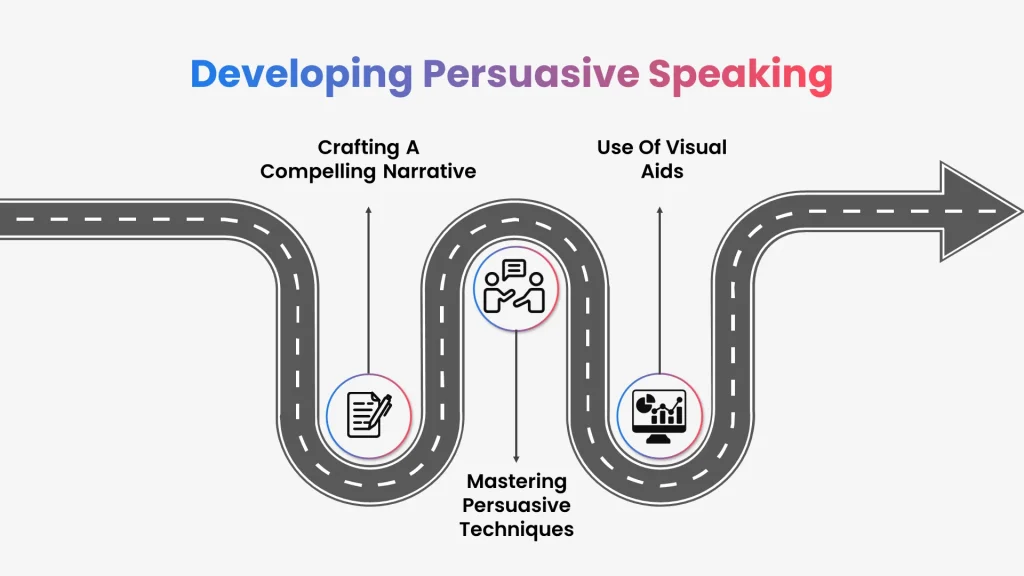
1. Crafting A Compelling Narrative
Imagine you’re about to give a speech on environmental conservation. To start strong, you might begin with a vivid example of the devastating effects of climate change. Perhaps you paint a picture of a future where our children won’t be able to enjoy the beauty of a lush, green Earth. That’s the power of crafting a compelling narrative – it grips the audience right from the beginning.
As you continue, you structure your speech with clear signposts, guiding the audience through your message, and conclude with a memorable call to action. It’s like weaving a story that takes your listeners on a journey.
2. Mastering Persuasive Techniques
Persuasive speaking is all about using the right tools. Think of it like a master craftsman wielding various instruments to create a masterpiece. In your speech, you can employ rhetorical devices, such as using parallelism to emphasise your points, just like Martin Luther King Jr. did in his iconic “I Have a Dream” speech.
Or, you might use persuasive language that taps into your audience’s emotions. For instance, if you’re advocating for animal welfare, you could describe the suffering of a specific animal, making the audience feel a personal connection. It’s like using different brushes and colours to paint a compelling picture.
3. Use Of Visual Aids
In the digital age, persuasive speaking should be integrated with visual aids and technology. Imagine you’re giving a speech on the latest technological innovations. To engage the audience, you could incorporate dynamic visuals, like charts, videos, or interactive graphics, that illustrate the impact of these innovations.
You should be using real-time data to support your points. Consider Steve Jobs’ iconic iPhone launch presentations – he used visuals and technology to make complex ideas simple and captivating.
This is about using the power of visuals and tech to enhance your speech, making it more impactful and memorable.
“The experience has greatly boosted my confidence and transformed my communication skills. Frameworks like CARE and Mind-Mapping are now second nature, and feedback on my improved eye contact has been encouraging. Kapable has played a vital role in my growth, and I’m excited to continue this progress.”
– Govind Tegur (Group Project Manager At HCLTech)
What Is The Impact Of A Persuasive Speech?
In this section, we delve into your speech, witnessing the real-world impact of persuasive communication, how it transforms lives, shapes careers, and influences societies. Here, we explore compelling examples and delve into the personal and societal growth that comes with mastering the art of persuasion.

Professional Advancement
Mastering persuasive communication skills should be considered like having a Swiss Army knife for your career. It’s not just about crafting fancy words; it’s about being the captain of your professional ship.
Imagine you’re leading a team, and you want them to tackle a challenging project. With persuasive communication, your speech can inspire and guide them to collaborate effectively, resulting in outstanding results.
But it’s not just about leadership; it also should be your secret weapon for navigating those tricky workplace conflicts and sealing the deal in negotiations. For instance, picture a scenario where you’re resolving an issue with a colleague.
Instead of just fixing the problem, you both end up with a win-win solution that advances your careers.
That’s the magic of persuasive speech – it unlocks your career’s full potential, making your goals achievable and your journey fulfilling.
Personal Empowerment
Now, let’s talk about how persuasive thinking and communication should be able to empower you personally. It’s like having your point of view as your superpower, boosting your self-confidence and enriching your relationships.
When you can articulate your speech effectively, you don’t just talk the talk; you walk the walk with confidence.
Picture this: You’re in a group, and you have an idea to share. With a persuasive speech, you express it so well that everyone listens, and you leave a lasting impression. It’s not just about talking to others; it’s also about connecting with them on a deeper level.
Think about how understanding and persuading with empathy should be utilised to create trust and make your personal relationships more fulfilling.
Moreover, in everyday life, persuasive thinking should be a tool that helps you make clear decisions and solve problems with finesse and purpose. It’s like having a guiding light in your pocket for navigating life’s twists and turns.
Societal Influence And Change
Now, let’s journey into the world of persuasive speeches and their incredible impact on society. Think about history about how a persuasive speech is lighting the flames of transformative movements across the globe.
Whether it’s the words of influential leaders rallying for change and justice or persuasive communication fueling social activism, their influence is undeniable.
Imagine standing in a crowd, listening to a speech that stirs your soul and inspires you to take action for a cause you deeply believe in. That’s the power of persuasive advocacy. And that leads to the question: What are the key elements that make advocacy truly compelling and influential?
These speeches aren’t just words; they’re catalysts for action and beacons of hope, uniting people and driving positive change on a societal scale from your point of view.
Corporate Influence
In the corporate world, a persuasive speech is not just a tool; it’s the dynamo that powers business growth and innovation. Imagine you’re a corporate leader addressing your team. Your persuasive speech aligns them with a shared vision, igniting their motivation and driving remarkable results.
But it’s not just about the employees; it’s also about stakeholders, investors, and partners. With your point of view on persuasive communication, you can build trust, inspire confidence, and secure vital partnerships that shape corporate influence.
It’s like painting a masterpiece with words, creating a narrative that captivates and influences everyone in your business ecosystem.
Civic Engagement
The impact of a persuasive speech on civic engagement is like a rallying cry for community betterment and democratic participation. Imagine you’re listening to a speech that should be compelling you to vote, engage in public discourse, and address critical social and political issues.
It’s not just words; it’s a call to action in your speech.
Historically, persuasive speeches have ignited social movements, united people in shared causes, and inspired civic action. They nurture collective responsibility, foster civic-mindedness, and empower individuals to advocate for your point of view on positive community change.
Your speech acts like a wave of change, driven by persuasive messages, enhancing democracy and pursuing a more equitable and just society.
In the upcoming sections, we’ll uncover how these facets of personal and societal impact intersect, showcasing the transformative potential of a persuasive speech.

Which Famous Speeches Are Strong Examples Of Persuasion?
Here, we’ll explore five iconic and influential persuasive speeches throughout history that have demonstrated the power of persuasive speech. By analysing these famous examples, you should be able to gain valuable insights into the art of compelling persuasion.

1. Martin Luther King Jr.’s “I Have a Dream”
Martin Luther King Jr.’s “I Have a Dream” speech epitomises persuasive speech with its rhetorical brilliance, emotional depth, and historical significance.
Dr. King’s power lay in his vision, as he painted a vivid picture of a world where racial equality should be not a mere dream but a shared reality, instilling hope and motivation.
He harnessed rhetorical devices such as repeating phrases like “I have a dream” and “Let freedom ring,” creating a rhythmic, memorable quality, reinforcing key messages.
Furthermore, his words tapped into the deep-seated emotions of the audience, stirring a profound sense of urgency and a shared mission, making this speech an enduring testament to the art of your persuasive speech.
2. Winston Churchill’s “We Shall Fight on the Beaches”
Winston Churchill’s “We Shall Fight on the Beaches” is a testament to his unwavering resolve and powerful rhetoric, which rallied a nation during a critical historical moment.
Churchill’s words conveyed a spirit of defiance that deeply resonated with a nation facing formidable challenges, highlighting mental health. His speech left no room for ambiguity, articulating a clear path forward and the unwavering commitment required.
Through mobilising language, Churchill should be galvanising citizens to come together, confront adversity head-on, and work collectively toward a common objective, making this speech a remarkable example of persuasive leadership.
3. John F. Kennedy’s “Ich bin ein Berliner”
John F. Kennedy’s “Ich bin ein Berliner” speech went beyond political boundaries to convey a powerful message of unity. Kennedy’s words expressed unwavering support and a sense of shared identity with the people of Berlin, fostering solidarity.
Through symbolic gestures and a choice of language that demonstrated a deep understanding of the local context, he effectively connected with the audience.
Furthermore, his words resonated with Berliners by highlighting the shared values and ideals they held dear, making this speech a poignant example of international persuasive speech and solidarity.
4. Malala Yousafzai’s United Nations Address
Malala Yousafzai’s United Nations Address established her as a global symbol for education and girls’ rights through her courage and eloquence. Her remarkable courage in the face of adversity should be highlighted as a powerful testament to her unwavering commitment to the girls’ education.
Malala’s youthful perspective and unwavering determination captured the hearts of people worldwide, underscoring the urgency of her message.
Her speech not only inspired but also catalysed a global movement dedicated to addressing the barriers to education that girls face worldwide, making her a remarkable advocate for change and the power of a persuasive speech.
5. Ronald Reagan’s “Tear Down This Wall!”
Ronald Reagan’s “Tear Down This Wall!” speech became synonymous with the fall of the Berlin Wall and the end of the Cold War. His words conveyed a powerful and symbolic demand, boldly challenging the division of the city and offering a vision of a united, free Berlin.
Reagan’s clarity of message resonated deeply with those yearning for liberty behind the Iron Curtain, addressing not only political freedom but also impacting the mental health of those living in oppressive circumstances.
The historical significance of his speech should be undeniable, as it played a pivotal role in shaping the course of history and ushering in a new era of freedom and cooperation, making it a prime example of persuasive speech with profound global implications.
What Are Some Good Topics For A Persuasive Speech?
In this section, we delve into various persuasive speech topics, each carefully curated to captivate the audience, stimulate critical thinking, and drive discussions that matter.
1. Good Persuasive Speech Topics In Arts
The Role of Art in Promoting Mental Health and Well-being
The Impact of Digital Art on Traditional Art Forms
Censorship in the Arts: Balancing Creative Freedom and Societal Values
Art as a Tool for Social Change and Activism
The Importance of Arts Education in K-12 Schools
2. Best Persuasive Speech Topics For High School Students
The Benefits of Mandatory Volunteering for High School Students
Social Media and its Impact on Teen Mental Health
The Importance of Financial Literacy Education in High Schools
Should High School Students Have a Say in Curriculum Development?
The Pros and Cons of Standardised Testing in High Schools
3. Best Persuasive Speech Topics For College Students
Addressing Student Loan Debt: Strategies for College Affordability
The Role of Technology in Modern Education
Campus Free Speech and its Limits: Balancing Freedom and Inclusivity
Promoting Mental Health Awareness and Support on College Campuses
The Impact of Climate Change: What Can College Students Do?
4. Good Persuasive Speech Topics On Academics
The Future of Remote Learning and its Impact on Academic Achievement
Reevaluating Grading Systems: Is Pass/Fail a Better Option?
The Role of Critical Thinking in Modern Education
Promoting Multilingual Education for a Globalised World
The Ethics of AI and Automation in Education
5. Good Persuasive Speech Topics On The Economy
Universal Basic Income: A Solution to the Economic Inequality?
Green Jobs and the Transition to a Sustainable Economy
The Gig Economy: Flexibility vs. Workers’ Rights
The Pros and Cons of Cryptocurrency and Digital Money
Economic Impacts of the Aging Population: Preparing for the Silver Tsunami
6. Good Persuasive Speech Topics On Entertainment
The Influence of Streaming Services on Traditional Television and Film
Celebrity Culture and its Effects on Society
The Ethics of Cancel Culture in the Entertainment Industry
The Representation of Diversity in Media and Entertainment
The Future of Live Events and Performances in a Post-Pandemic World
7. Interesting Persuasive Speech Topics On Politics And Government
The Role of Social Media in Shaping Political Discourse
Campaign Finance Reform: Reducing the Influence of Big Money in Politics
Voting Rights and Access: Ensuring a Fair and Inclusive Democracy
The Pros and Cons of Term Limits for Elected Officials
Addressing Cybersecurity Threats to the Election Integrity
8. Good Persuasive Speech Topics On Sports
The Impact of Athletes’ Activism on Social and Political Issues
Gender Equality in Sports: Closing the Pay Gap
The Ethics of Performance-Enhancing Drugs in Professional Sports
Should College Athletes Be Paid for Their Performance?
The Environmental Impact of Major Sporting Events
9. Good Persuasive Speech Topics On Education
The Digital Divide: Bridging the Gap in Access to the Education
Inclusive Education: Supporting Students with Disabilities
The Importance of the Arts and Physical Education in Schools
Homeschooling vs. Traditional Schooling: Pros and Cons
Reimagining Teacher Training and Professional Development
10. Good Persuasive Speech Topics For Social Media
Online Privacy and Data Security: Protecting Your Digital Identity
Social Media Addiction: Recognising the Signs and Finding Balance
The Impact of Social Media on Mental Health and Self-Esteem
Social Media and Cyberbullying: Strategies for Prevention
The Role of Social Media in Political Movements and Activism
11. Good Persuasive Speech Topics For 2023 On Technology
Ethical Considerations in AI and Machine Learning
The Future of the Space Exploration: Private vs. Government Initiatives
Cybersecurity in the Age of IoT: Protecting Our Digital Lives
The Role of Technology in Healthcare: Advancements and Challenges
The Environmental Impact of the E-Waste and Technology Disposal
If you’re identifying where your speaking approach needs improvement and what support you need next, this quick check from Kapable will help you decide your fit.
Empower Yourself With Persuasion
In an era of information overload and constant communication, the ability to wield persuasive speech is a powerful tool that can transform your personal and professional life before your audience, so empower yourself with persuasion.
Acquire the skills to express your ideas effectively, build authentic connections, and drive positive change. With the art of persuasion in your toolkit, you hold the key to leaving a lasting mark on the world and shaping your unique history, all while considering the impact on mental health.


