


TL;DR
- Progress Through Policy: The rise of women in business, from managing family farms to leading the modern entrepreneurial workforce, was significantly accelerated by landmark legislation granting them independent financial rights.
- Structural Funding Bias: Women founders consistently face systemic disadvantages, including exclusion from key venture capital networks and being asked cautionary, risk-focused questions during pitches that limit their growth potential.
- Defining Future Markets: Despite obstacles, women are pioneering the next wave of business by driving innovation in sectors like AI and Web3, and actively reshaping the investment landscape by launching their own VC firms and billion-dollar global brands.
- Building an Inclusive System: Creating a stronger ecosystem requires intentional initiatives such as dedicated early-stage funds, structured investor introductions, promotion-focused pitch coaching, and corporate partnerships to level the playing field for women leaders.
How long will the world continue to rely on women’s labour while denying them leadership? Women today are building companies that generate $1.8 trillion a year, yet they get talked over or told to “wait their turn.” They are driving economic growth and creating millions of jobs, yet they face barriers that slow their progress at the moments when momentum matters most. Even though women launch businesses and deliver stronger returns, they continue to be underfunded and underrepresented in the senior management positions where major entrepreneurial decisions are made. This blog highlights the rise of women entrepreneurs, the systemic challenges they continue to face, and what it takes to truly uplift their potential.
What Historical Shifts Paved The Way For Women Entrepreneurs?
The rise of women entrepreneurs was driven by several key turning points in history. The four defining eras that opened new pathways for women in business are as follows:
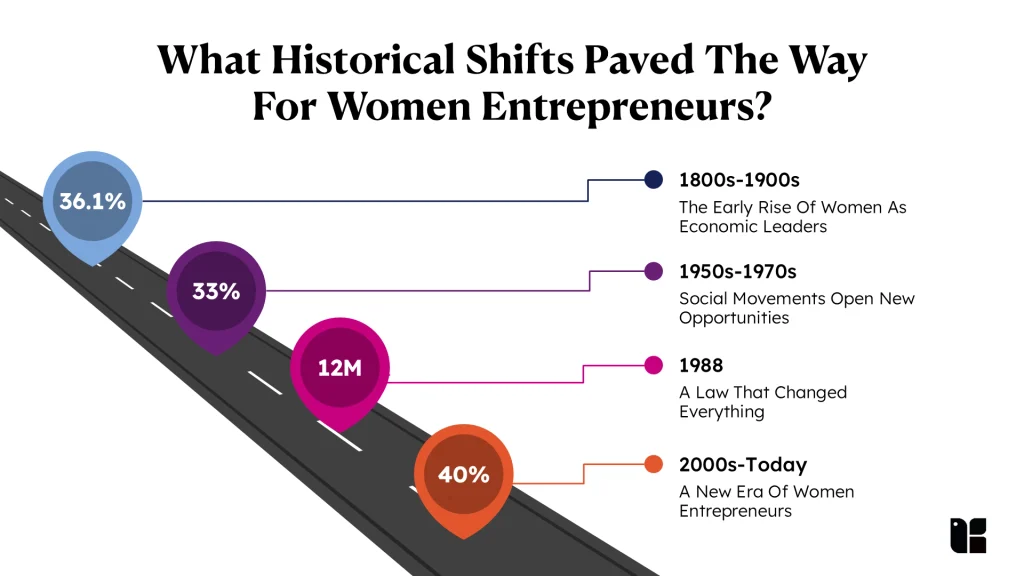
1800s-1900s: The Early Rise Of Women As Economic Leaders
In the 1800s and early 1900s, women all over the world were already keeping local economies running. They managed family farms, small shops, markets, and community businesses, even though their work was rarely seen as “leadership.” During major global conflicts, when many men went to war, women quickly stepped into factory jobs, office work, and business roles. By 1945, women made up 36.1% of the U.S. workforce, and similar rises were seen in many other places. This change showed that when barriers are removed, women advance quickly into complex roles, proving they can lead just as effectively as their male counterparts. It challenged old beliefs and helped people see that women had a real and rightful place in business and leadership.
1950s-1970s: Social Movements Open New Opportunities
After major global conflicts, societies encouraged women to return to traditional roles. However, across the world, women wanted to continue working and pursue the careers they had begun. Growing feminist movements and calls for equal treatment challenged old expectations about women’s place in society, opening new opportunities for career development. As access to higher education improved, women began entering a wider range of industries, slowly building the expertise required for senior management roles. During this period, many countries experienced steady increases in the number of women in the workforce. For example, in India, women’s labour-force participation rose from about 24% in 1955 to 33% by 1972, showing how social change and new opportunities were finally opening the door for women to find greater representation in paid roles.
1988: A Law That Changed Everything
A major turning point came with the Women’s Business Ownership Act of 1988. For the first time, women could apply for business loans independently; no husband, father, or male relative was required to sign off. It might sound simple today, but back then, this was a huge shift. It opened financial doors that had been closed to women for generations and helped spark a major rise in women-led companies. In the United States alone, this shift contributed to the growth of more than 12 million women-owned businesses, showing what becomes possible when women leaders gain full financial rights. Changes like this, along with similar reforms in other parts of the world, helped strengthen women’s entrepreneurship globally and laid the groundwork for a new generation of women business leaders.
2000s-Today: A New Era Of Women Entrepreneurs
Technology, online platforms, and flexible work have transformed how people start and grow businesses. These changes have made it easier for women around the world to launch companies on their own terms, build brands from home, and reach customers without needing large amounts of capital. Today, women make up around 40% of the global entrepreneurial workforce, showing how strongly their presence has grown in recent decades. In many regions, women are starting new businesses at record speed, reflecting a clear shift in how entrepreneurship is evolving. This growing wave of women-led ventures is reshaping markets and influencing the future of business in powerful ways.
Understanding the historical turning points explains how barriers began to break. The growing presence of women entrepreneurs shows the result of that long, steady progress.
How Are Women Entrepreneurs Rising Across The Globe?
Women are redefining entrepreneurship at every level, from startup creation to billion-dollar valuations. These six insights demonstrate the powerful rise of women entrepreneurs and their expanding influence:
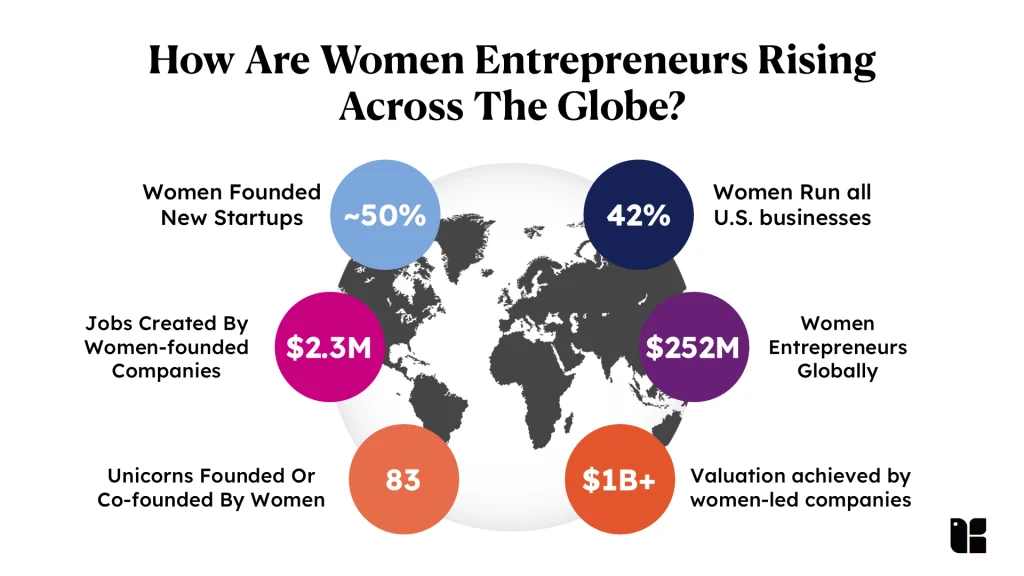
- Statistics on women in business leadership show that women have become pivotal innovators in the global business world. From securing more senior leadership roles in Fortune 500 companies to founding nearly 50% of new startups, women continue to demonstrate their growing influence and indispensable role in the global economy.
- Women now run 42% of all U.S. businesses, showing that entrepreneurship has become one of the strongest and fastest-growing pathways for women to step into leadership and economic influence.
- Women-founded companies have created 2.3 million jobs and generate $1.9 trillion in revenue, proving that when women are given equal opportunities, they build companies that drive the entire economy forward.
- Globally, over 252 million women are entrepreneurs, and an additional 153 million are running established businesses, showing that women now make up one of the fastest-growing entrepreneurial groups worldwide.
- In 2021, 83 of the world’s 595 unicorns were founded or co-founded by women, more than four times the number in 2020. This sharp jump highlights how women founders are breaking into high-growth, venture-backed sectors at an accelerating pace.
- A growing wave of women-founded unicorns is emerging, with more than 130 women-led companies now surpassing the $1 billion valuation mark. This surge reflects how women founders are earning a stronger foothold in global innovation and venture-scale entrepreneurship.
While the trend toward greater representation shows progress, just having more women in the game doesn’t erase the old obstacles they still face. Many women still face persistent barriers on their entrepreneurial journey.
“This 3-month journey has been enlightening, as I transitioned from an ambitious manager to an inspiring leader. Applying Kapable’s techniques, I confidently delivered a 30-minute speech at our Annual Planning Session, receiving positive feedback from my team. Kapable has been instrumental in helping me reach my full potential.”
– Sailesh Gadalay (Sr Account Director – Enterprise Sales At Linkedin)
What Barriers Do Women Entrepreneurs Still Face?
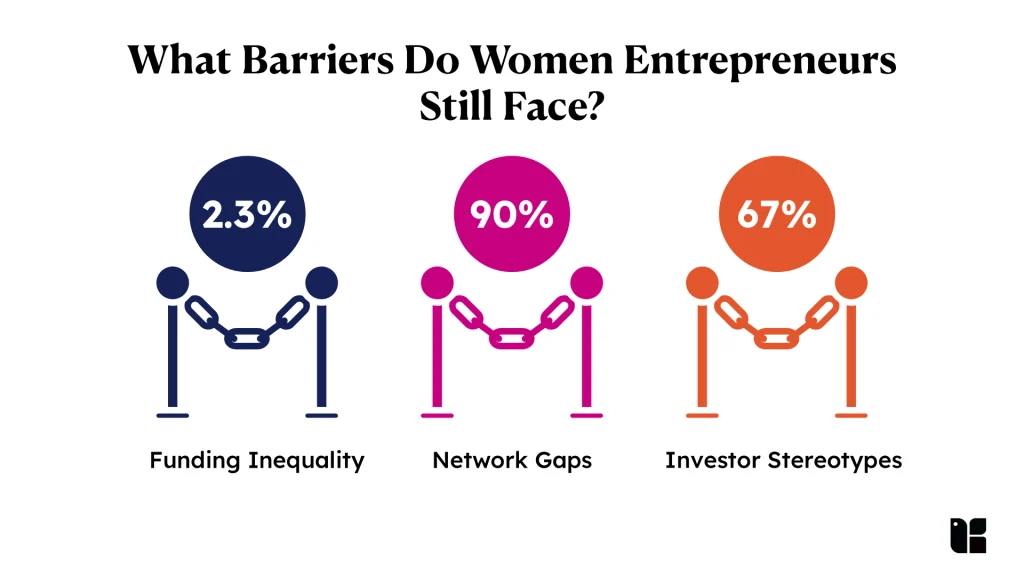
Despite remarkable progress, we are still far from true gender parity. Women entrepreneurs continue to face obstacles that limit their full potential. The three core barriers that most women founders encounter are as follows:
1. Funding Inequality
Women-led startups receive only 2.3% of global venture capital funding, reflecting deep, persistent bias in how investors evaluate women seeking leadership positions. Studies show that investors often perceive women as ‘less scalable,’ failing to recognise that gender diversity within a founding team actually mitigates ‘groupthink’ and leads to more resilient business models. This bias creates a missed opportunity for investors seeking sustainable growth.
2. Network Gaps
Women face significant network disadvantages because over 90% of VC investors are men, and deal-sourcing in VC still relies heavily on face-to-face connections and trusted referrals. Since these networks have been male-dominated, women founders are less likely to be included in the informal circles where opportunities and early-stage deals are exchanged. This network friction limits insider pathways to capital, making it harder for women to gain early traction even when their business performance is strong.
3. Investor Stereotypes
Research on startup pitch Q&As shows that 67% of questions to male founders are “promotion-focused” (growth, scale, opportunity), while 66% of questions to female founders are “prevention-focused” (risks, losses, stability). This difference leads to women pitching defensively while men pitch aspirationally, resulting in dramatically different funding outcomes and fewer women receiving investment. These stereotypes create a structural disadvantage that persists even when women demonstrate superior ideas and performance, ultimately widening the gap in both fundraising and leadership visibility.
The obstacles women entrepreneurs face are real, yet so is their impact. Despite these challenges, women are redefining entrepreneurial ecosystems in bold and transformative ways.
These statistics highlight the barriers women entrepreneurs continue to face. Explore Kapable’s learning process to see how leadership skills are strengthened through coaching and real-world practice.
How Are Women Transforming The Future Of Entrepreneurship?
The future of entrepreneurship is being driven by women who are using innovation and global reach to build scalable ventures. These four shifts highlight the paths women founders are shaping next:
1. Powering The AI Shift
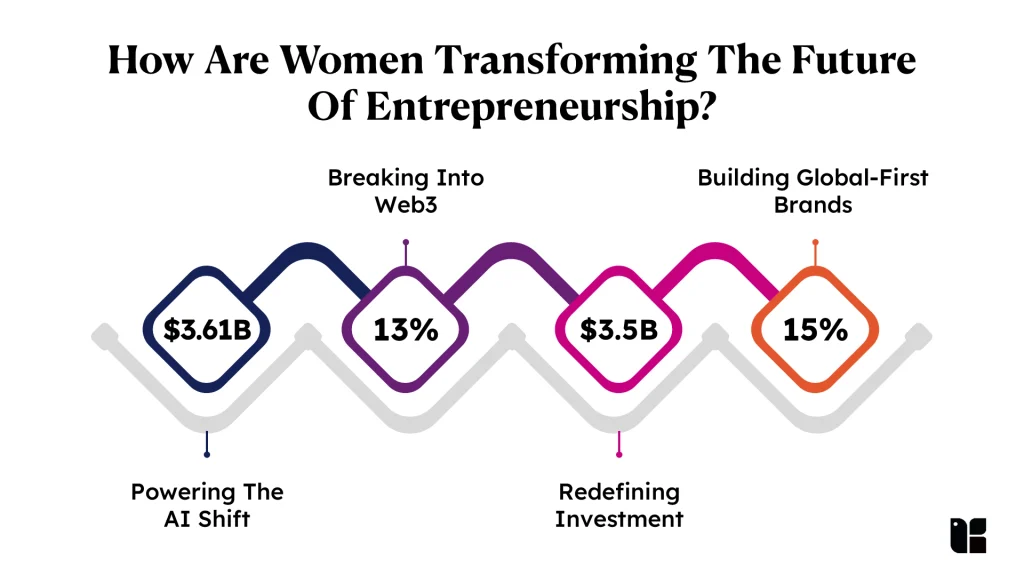
Women founders are increasingly leveraging AI as a powerful tool to create the next generation of businesses, while also supporting other women in positioning themselves for C-suite roles in technology and innovation. AI helps them create, test, and improve products without needing large teams or expensive resources. Their footprint in the AI startup space continues to expand, with AI startups that include at least one woman founder raising $3.61 billion in a recent year, accounting for 15.4% of all AI venture capital. This growing investment shows a big shift: more women are taking on female leadership roles in AI, and investors are finally seeing the unique value they bring.
2. Breaking Into Web3
Women founders are beginning to play a bigger role in Web3, the world of blockchain, digital identity, and decentralised innovation. These technologies give women more ownership and creative freedom, allowing them to build ventures without traditional gatekeepers. Their presence in Web3 is growing steadily, with research showing that 13% of Web3 founding teams now include at least one woman, up from just 3% in 2018. As Web3 continues to evolve, women founders are bringing much-needed inclusivity and user-centred design into a space that has historically excluded them.
3. Redefining Investment
Women founders are increasingly stepping into investing roles themselves, using their experience to support and fund the next generation of women-led businesses. More women are launching venture funds, joining investment committees, and becoming angel investors, steadily increasing their presence among senior leaders in global finance. Recent industry reports show that women-led VC firms have increased in number over the past few years, and in 2023 alone, these firms raised around $3.5 billion globally, up nearly $500 million from the previous year. As more women move into investing and C-suite positions, they bring a stronger focus on inclusive funding and long-term impact.
4. Building Global-First Brands
Women founders are increasingly building global-first businesses, using digital tools to reach customers across borders from the very beginning. They are developing products and services that can operate anywhere, from e-commerce and digital education to online platforms and services. A report shows that only about 15% of exporting firms worldwide are women-led, highlighting how much room there is for growth. As more women expand into global markets earlier in their journey, this number is expected to rise. By starting with a global mindset, women founders are positioning themselves to scale faster, tap into larger customer bases, and play a prominent role in shaping cross-border entrepreneurship.
Women are rewriting the future of entrepreneurship through creativity and leadership. To sustain this shift, they need an ecosystem designed for access, opportunity, and growth.
How Can A Stronger Ecosystem Be Built For Women Entrepreneurs?
Building a better world for female leaders requires a collaborative effort to promote gender equality. The five strategies below illustrate how a more equitable and supportive ecosystem can be built:
1. Create Pre-Seed Funds
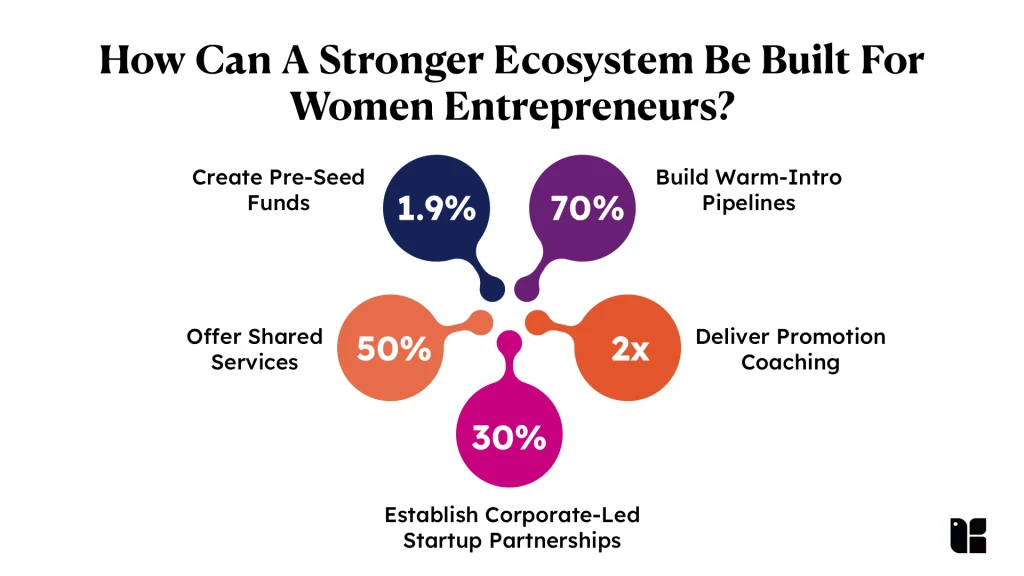
Women-focused pre-seed funds offer small early investments that help women founders build their first product, test their ideas, or get early customers. These funds can be created by angel investors, companies, or foundations and should be simple to apply for, with quick decisions and easy terms like grants or SAFE notes. Early funding is especially important because women are shut out of most traditional investment channels. Recent research shows that female-founded startups receive just 1.9% of global venture capital funding, far below what their performance deserves. Pre-seed funds give women the early boost they need, so they can develop their ideas, gain traction, and become ready for larger investors.
2. Build Warm-Intro Pipelines
Warm-introduction pipelines are structured programs that help women founders get direct introductions to investors, something that usually happens informally through male-dominated networks. These pipelines can be built by angel groups or industry associations by organising monthly intro sessions and commitment-based programs. Research shows that 70% of VC deals come from people an investor already knows, meaning women without access to these circles are often overlooked before they even pitch. By building intentional warm-intro pathways, women founders gain the visibility and investor access they need to raise earlier and grow faster.
3. Deliver Promotion Coaching
Promotion-focused pitch coaching teaches women founders how to confidently shift investor conversations toward long-term potential, even when investors ask risk-heavy or cautious questions. This can be done by running practice pitch sessions, simulating real investor Q&As, and teaching founders how to reframe “What if you fail?” into “Here’s how we plan to scale.” Entrepreneurs receiving promotion-focused questions raise twice as much funding as those facing prevention-focused scrutiny. By equipping women with the tools to shift tone and narrative during pitches, promotion-focused coaching helps level the odds and improves chances of securing investment.
4. Offer Shared Services
Subsidised shared services give women founders affordable access to essential business support, helping them overcome the high upfront costs that early-stage startups often face. These services include legal consultations, accounting support and investor-preparation services such as pitch decks and financial modelling. By partnering with service providers for discounted packages, creating shared-resource hubs in coworking spaces, or offering credits for critical tasks, women founders can reduce operational costs and focus on building traction and growing their businesses. This support is important given that women-owned startups typically raise first funding rounds about 50% smaller than those of male founders, making cost-effective resources crucial for early-stage growth.
5. Establish Corporate-Led Startup Partnerships
Corporate-Led Startup Partnerships help women founders collaborate with established companies through pilot projects, co-development, or procurement opportunities, providing them with market access and credibility. These partnerships can be set up via innovation challenges, networking events, or startup-friendly corporate procurement programs. Data shows startups with corporate partnerships often see a 20–30% increase in valuation, and about 30% launch a new product or service through these collaborations. For women founders, such partnerships not only accelerate growth but also provide validation in the eyes of investors, improve brand visibility, and create long-term business opportunities that strengthen their overall competitive position.
As we consider how to strengthen support systems for women entrepreneurs, it’s equally inspiring to look at those who have already reached remarkable global success.
Which Women Are Making An Impact In Global Entrepreneurship?
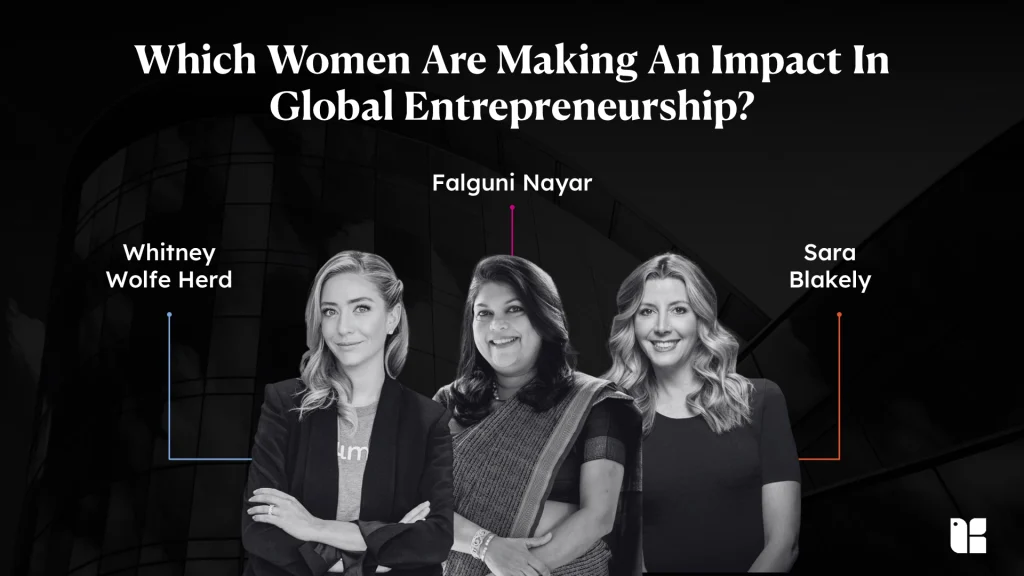
Across industries, many women founders have broken through long-standing barriers to build globally successful companies and assume managerial positions that were historically male-dominated. The three stories below illustrate how women are setting new standards for entrepreneurial leadership:
1. Whitney Wolfe Herd
Whitney Wolfe Herd built Bumble, the women-first dating and social platform that reinvented online relationships. Before launching Bumble, she faced workplace harassment and a loss of credibility in a male-dominated tech industry known for excluding women from leadership and early-stage funding. But despite the setbacks she endured, here’s how she transformed her concept into a globally recognised brand:
- Scaled Bumble to 100+ million users, positioning it as a safety-driven, women-first platform, solving a problem overlooked by most male-led dating apps.
- Built a mission-led brand that secured early investment despite industry bias, becoming the youngest self-made female billionaire at age 31 after Bumble’s IPO.
- Expanded Bumble from dating to include professional and friendship networks, supporting a company valuation of $13 billion at peak.
2. Falguni Nayar
Falguni Nayar stands as one of the most prominent Asian women in the entrepreneurial world as the founder of Nykaa, India’s top beauty and lifestyle platform. By launching her company at age 50, she shattered the stereotype that women at that stage of life couldn’t build or lead high-growth tech empires. Despite cultural bias, gendered assumptions, and scepticism around her late-career shift, here’s how she transformed her idea into one of India’s most respected retail brands:
- Grew Nykaa into a platform with 15+ million monthly active visitors and 3,000+ beauty and wellness brands, filling a trust and accessibility gap in India’s beauty retail sector.
- Led Nykaa to a blockbuster IPO valued at $13 billion, becoming India’s first self-made woman billionaire and redefining the role of women in Indian entrepreneurship.
- Built a profitable omni-channel ecosystem with 100+ physical stores, establishing Nykaa as one of the few sustainable, profitable e-commerce companies in the country.
3. Sara Blakely
Sara Blakely created Spanx with just $5,000 in savings, after identifying a gap in the shapewear market that male-dominated apparel manufacturers dismissed as insignificant. She faced repeated rejection from factories, buyers, and investors who didn’t understand or value women’s clothing needs. But despite being underestimated at every stage, here’s how she transformed her idea into a global consumer brand:
- Scaled Spanx into a billion-dollar business valued at $1.2 billion, becoming the youngest self-made female billionaire by age 41.
- Achieved explosive visibility after Oprah Winfrey featured Spanx as one of her “Favourite Things,” driving a surge in sales within a year.
- Expanded Spanx into 65+ countries, proving that women-led product innovation resonates across global markets and consumer segments.
The global momentum behind women-led ventures reflects both progress and potential. When supported by stronger systems, their impact becomes a catalyst for economic and social change.
Conclusion
Women in leadership are building high-impact companies, transforming markets, and stepping into leadership with remarkable strength, yet they continue to face systems that limit their growth. Despite delivering stronger returns, women founders must work around structures that were never designed to support them. An inclusive environment requires rebuilding these systems through sponsorship programs and other structured initiatives, so women can access senior positions without resistance. As women rise, industries shift, and leadership becomes stronger through broader women’s representation. The test of progress lies in how decisively we remove the obstacles that have long stood in their way, and how committed we are to building a future where women can lead without resistance.
If these findings have encouraged you to invest in your leadership growth, Kapable’s eligibility guide can help you determine whether the program fits your professional ambitions.


