


TL;DR
- Core Components Defined: Articulation training is a two-part process that boosts clear speech and coherent thought organisation, directly improving communication and professional standing.
- Structuring Practice: A successful routine is built on defining specific objectives, such as precision and managing speech pace, using continuous self-evaluation, and tracking progress through milestones.
- Holistic Techniques: Effective methods combine physical exercises, like mirror work and humming for vocal agility, with advanced frameworks like CARE and the Pyramid Principle for structuring complex ideas.
- Sustained Improvement: To ensure long-term progress, practitioners must proactively tackle hurdles like inconsistency and ‘transfer’ to real-life settings, often by seeking regular, objective feedback.
Has there ever been a time when you’re giving a presentation to an important client, but your words come out jumbled and unclear? It’s not just a stressful experience; it can seriously affect how others perceive you. According to a survey, 92% of hiring managers say strong soft skills, including communication, are essential for career advancement.
Articulation practice involves exercises to enhance speech clarity and precision, ensuring effective communication. The purpose of the blog is to offer a comprehensive guide on articulation practice. We’ll explore what articulation is, explore techniques for improving it, provide practical tips for daily practice, and discuss common mistakes to avoid.
What Is Articulation Practice?
Articulation practice helps people speak more clearly by focusing on how they form and pronounce words. It involves doing exercises to improve how distinct each sound is and how smoothly sentences flow. Regular practice makes it easier to get your message across, which is important in many situations, like giving a speech or talking to someone in a professional setting.
To fully understand the importance of articulation, it’s helpful to consider both speech and thought articulation. Speech articulation involves the clear and accurate pronunciation of words, which ensures that your spoken messages are understood as intended. Thought articulation complements this by focusing on how we structure and express our ideas logically before speaking. By developing both areas, you not only improve the clarity of your words but also the coherence of your ideas. This combination enhances your ability to communicate effectively, making your interactions more engaging and impactful.
Besides making speech clearer, practising articulation can also boost confidence and reduce the nervousness that comes with speaking. When people speak clearly, they are often seen as more confident and effective communicators, which can improve their interactions in both their personal lives and careers:

Setting Up Your Articulation Practice Routine
Articulation is the foundation of clear and effective communication. Whether you’re preparing for a public speaking engagement, aiming to improve your professional communication, or simply want to express yourself more clearly, setting up a well-structured articulation practice routine is essential. This guide provides a detailed roadmap to developing and maintaining a practice routine that will enhance your articulation skills.
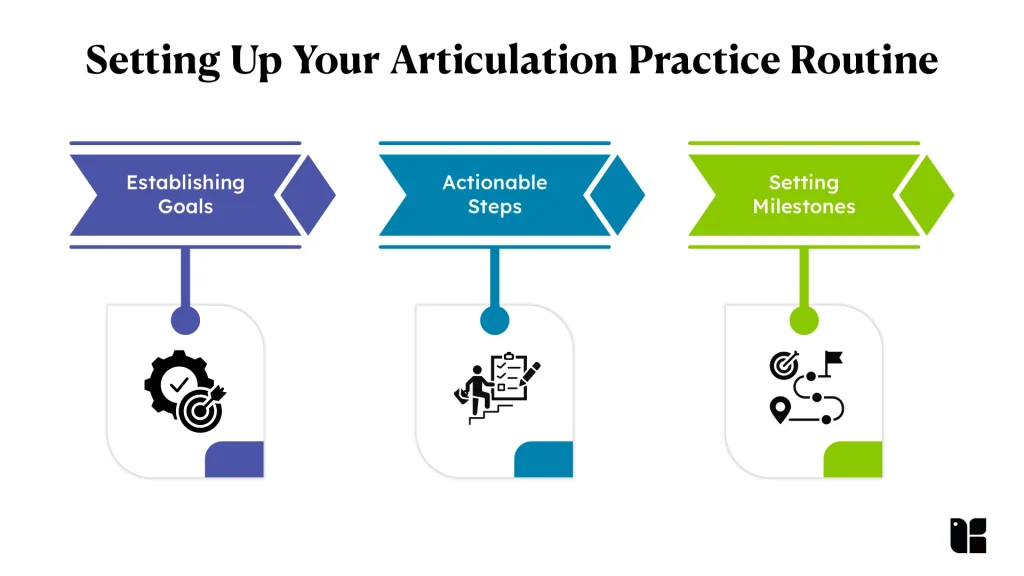
Establishing Goals
Articulation forms the foundation of clear and effective communication. Whether you’re gearing up for a public speaking event, looking to refine your professional interactions, or simply aiming for clearer personal expression, establishing a well-structured practice routine is crucial. Start by setting specific objectives, such as enhancing clarity to ensure each word is pronounced distinctly without mumbling or slurring. This involves paying close attention to the enunciation of each syllable. Focus on precision to perfect challenging sounds like “s,” “r,” and “th,” which can make a significant difference in how well you are understood. Manage pacing to maintain an optimal speech rate, ensuring that your speech is neither rushed nor too slow. Lastly, intelligibility should be worked on to boost overall comprehension by smoothly integrating these elements. Begin with a self-assessment: record yourself speaking in various contexts and listen for areas where your articulation may be lacking.
Actionable Steps
Following your assessment, implement actionable steps to address the identified issues. Record yourself in different speaking situations, including reading aloud, engaging in casual conversations, and delivering formal presentations. Critically review these recordings to detect any articulation problems and identify specific patterns or recurring issues. Seek feedback from colleagues or friends using specific criteria like clarity and precision, and request examples of unclear speech to better understand the context and nuances. Use this feedback to refine your practice routine, focusing on targeted areas such as particular sounds or pacing difficulties. Regularly update your practice plan based on this ongoing evaluation.
Setting Milestones
To enhance your articulation practice, set clear milestones and reward yourself for reaching them. Define clear milestones to track your progress, such as mastering specific sounds or achieving improved fluency in speech. Regularly assess these goals and adjust your practice routine to maintain a steady path toward enhanced articulation. Break down your main goal into smaller, manageable targets, like mastering specific sounds or improving fluency. Track your progress and celebrate achievements with rewards, from small treats to larger incentives. Regularly review and adjust your goals to keep the practice engaging and aligned with your improvement.
By setting clear goals and following these steps, you can systematically improve your articulation and communication. Let’s now explore how to create a practice schedule for this.
Creating A Practice Schedule
Consistency is crucial for improvement. A structured practice schedule will help you stay disciplined and track your progress over time. Let’s discuss tips for setting up a consistent practice routine:

- Set aside time: Designate a specific time each day for articulation practice. Consistency helps build a habit and ensures steady progress. Choose a time that aligns with your daily routine and stick to it as closely as possible. This dedicated time should become a non-negotiable part of your day, reinforcing your commitment to improvement.
- Start small: Begin with shorter practice sessions, around 10-15 minutes, and gradually increase the duration as you become more comfortable with the exercises. Starting small helps you build endurance and prevents early burnout. As you progress, incrementally extend your sessions to keep challenging yourself without overwhelming your schedule.
- Stay flexible: Life can be unpredictable, so allow some flexibility in your schedule. The key is to practise regularly, even if it means adjusting the timing. If you miss a session, quickly reschedule or make up for it on another day. Flexibility ensures that you remain committed to your practice without feeling pressured by strict adherence to a timetable.
- Combine different exercises: Enhance your practice by incorporating a variety of exercises. This keeps the routine engaging and addresses different aspects of articulation. For instance, allocate 5 minutes each to tongue twisters, vowel drills, and sentence articulation, adjusting based on complexity and comfort. Rotating exercises can also prevent monotony and address any specific challenges you encounter.
The goal of articulation practice is not simply to speak more, but to express ideas with clarity when it matters. Kapable reinforces this through communication development built around everyday workplace situations.
Once you have established your articulation practice plan, the next step is to understand major challenges while practising articulation.
What Are The Challenges Of Articulation Practice?
Articulation comes with its own set of challenges. Understanding these obstacles can help you tackle them more effectively and enhance your communication skills. Some of the challenges are as follows:

Consistency
One of the primary difficulties in articulation practice is maintaining a regular schedule. Life’s various commitments, such as work, family, and other responsibilities, can disrupt practice routines, leading to gaps in training. Without consistent effort, the development of new speech patterns is interrupted, which can stall progress and reduce the effectiveness of practice sessions. This challenge emphasises the need to create a structured plan and integrate practice into daily life to ensure continuous improvement.
Motivation
Motivation is crucial for persistence in articulation practice, yet it can be elusive when progress is gradual. The slow pace of improvement may not provide immediate gratification, leading to frustration and decreased enthusiasm. This challenge requires individuals to find personal incentives for continuing their practice, such as setting small, achievable goals and celebrating incremental successes. Keeping motivation high despite slow progress is essential for long-term success.
Accuracy
Precision in articulation is vital for clear communication, but achieving it requires meticulous attention to detail. Without expert guidance, it’s challenging to spot and correct persistent errors in speech. These inaccuracies can persist if not properly addressed, affecting the clarity of communication. The challenge lies in finding effective methods to monitor and correct speech patterns, such as using self-assessment tools or seeking professional feedback, to ensure precise articulation.
Feedback
Immediate and constructive feedback is crucial for refining articulation skills. When practising alone, individuals often lack the necessary input to identify and rectify mistakes promptly. This absence of feedback can hinder the ability to make accurate adjustments, slowing overall progress. To overcome this challenge, incorporating tools like recordings or working with a speech professional can provide valuable insights and support more effective improvements.
Transfer
Successfully applying articulation skills from practice to real-life conversations is a significant challenge. Skills that are well-practised in a controlled environment may not always translate seamlessly to spontaneous speech. This difficulty underscores the need for additional practice in natural settings to ensure that skills are effectively integrated into everyday communication. Adapting practised techniques to various conversational contexts can be complex, but is essential for achieving effective and natural speech.
Recognising these challenges is just the beginning; overcoming them requires practical strategies in your daily articulation practice. Applying focused methods will help improve speech development in both children and adults, which will be explored further in the next sections.
How Can You Maintain Consistency In Practice?
Clear and precise speech is a vital part of a child’s overall communication development. Articulation disorders and phonological disorders are common challenges faced by children during language development. Parents and educators play a crucial role in identifying and supporting children with speech sound disorders. Children with these disorders often struggle to pronounce certain sounds or have speech problems that impact their ability to communicate clearly. They should monitor their child’s progress and note any persistent speech disorders or difficulties.
If a child has a speech disorder with no known cause or if the disorder is not improving with time, further evaluation may be necessary. Addressing these issues early on through targeted speech therapy can significantly enhance a child’s speech and language skills. It can be done in the following ways:

SLP Guidance
A speech-language pathologist (SLP) can provide valuable assistance by creating a tailored therapy plan to meet your child’s specific needs. Articulation practice at home, guided by a professional, is an effective way to supplement the work done in therapy sessions. SLPs can recommend exercises focusing on problematic sounds and offer strategies to help your child be able to articulate sounds correctly. Engaging in regular practice can make a significant difference in improving your child’s speech clarity.
Articulation Games
To help children improve articulation, try fun activities like sound-matching games, where they pair cards with the same sounds, or articulation bingo, where they mark pictures of objects with target sounds. Reading books with repeating sounds and making up stories with specific words can also be useful. Use mirror exercises so they can see their mouth movements while speaking, which will be explained further in the next section in more detail. Early intervention and consistent practice are key to helping your child overcome articulation challenges and develop strong speech and language skills.
Building on effective practices for children, let’s explore how these strategies can benefit daily routines for adults and the elderly, including those managing both speech and thought articulation.
“I needed to enhance my personal brand and overcome my discomfort with public speaking and networking events. Kapable’s personalised sessions gave me the tools and confidence to handle these situations. Recently, I confidently participated in a panel discussion and a networking event, applying the skills I learned. My presentations are now more engaging, and public speaking feels natural, empowering my professional journey.”
– Shreyas Tonse (Founder At Zwayam)
Which Techniques Are Best Suited For Speech Articulation?
Enhance your speech clarity with daily practice techniques that focus on refining articulation through consistent effort. Just like athletes warm up their muscles, your speech muscles need to warm up, too. This helps prepare your mouth, lips, and tongue for more intensive practice. Examples of warm-up exercises are as follows:

Reading aloud
Select a variety of texts, such as excerpts from novels, articles, or poetry. For example, read a passage from 1984 by George Orwell or a recent article from a major news website. Focus on articulating each word clearly, using varied intonation, and maintaining a steady pace. Begin slowly to ensure accuracy and gradually increase your speed. This exercise enhances your fluency, raises awareness of your speech patterns, and boosts confidence. Reading aloud from diverse texts also helps you adapt to different language styles and vocabulary.
Mirror work
Stand in front of a mirror and practice speaking or reciting texts. For instance, try reciting a challenging line like “The big black bug bit the big black bear and made the big black bear bleed blood.” Observe the movement of your mouth, lips, and tongue. This visual feedback helps you identify and correct articulation issues, improving precision and clarity. It also assists in becoming more conscious of your facial expressions and mouth movements during speech.
Shadowing
Listen to recordings of skilled speakers or actors, such as popular TED Talks or voice actors in animated films. For example, mimic the speech patterns of someone like Neil Gaiman in an audiobook. Try to replicate their pronunciation, rhythm, and emotional tone. Shadowing helps you develop a natural speech rhythm and enhances your ability to convey emotions and emphasis effectively, making your own speech more engaging and expressive.
Lip trills
To do lip trills, gently press your lips together and blow air through them to create a vibrating sound, like a gentle “brrrr” or a motorboat. This exercise helps relax and loosen your lips, making them more agile for clear articulation. It also helps to engage your breath support and prepare your vocal cords for more demanding tasks.
Humming
Start by humming softly at a comfortable pitch and then gradually explore different pitches. Humming helps activate your vocal cords and improve vocal resonance, making your voice sound fuller and smoother. It also helps to ease your vocal cords into more complex speech patterns.
Tongue twisters
Tongue twisters are a powerful tool for boosting articulation agility and precision. They challenge your ability to pronounce complex sound patterns quickly and clearly. To start, say the tongue twister slowly, focusing on each individual sound and syllable. As you get more comfortable, gradually speed up while still making sure every sound is clear. This practice helps you improve your control over fast speech, enhances your ability to pronounce words clearly, and makes handling tricky sound combinations easier.
Examples of Tongue Twisters:
- “She sells seashells by the sea shore.” This classic tongue twister focuses on the “s” and “sh” sounds.
- “Peter Piper picked a peck of pickled peppers.” This twister emphasises the “p” sound and helps with quick, clear pronunciation.
To advance your articulation skills, build on daily practices with more complex techniques. Just as basic training prepares you for specialised workouts, these advanced methods will deepen your speech precision and fluency.
What Are Techniques For Thought Articulation?
To improve your articulation skills, it’s essential to incorporate advanced techniques as you progress. Improve your communication with advanced techniques designed to structure and present your thoughts with clarity and impact by practising the following :
CARE Framework
The CARE framework (Context, Answer, Reason, Example) is an effective tool for enhancing articulation, especially in organising and presenting thoughts clearly. Each component of the framework plays a crucial role in improving communication.

- Context: This is where you set up the background for your message. Think of it as telling your audience why the topic is important. By giving them some initial information, you make sure they understand what you’re talking about. For example: “In today’s fast-paced world, effective time management is crucial for professional success.”
- Answer: Here, you state your main point or conclusion clearly. This is the core message you want your audience to remember. For instance: “The key to mastering time management is prioritising tasks based on their urgency and importance.”
- Reason: This part explains why your main point is valid. It provides the logic or rationale behind your message. This helps your audience understand why your point matters. Example: “Prioritising helps ensure that you focus on tasks that drive the most significant results, reducing stress and improving productivity.”
- Example: Lastly, give a concrete example to illustrate your point. This makes your message easier to understand by showing how it works in real life. For example: “For instance, using the Eisenhower Matrix to categorise tasks can help you efficiently manage your daily workload.”
Applying the CARE framework can significantly improve articulation by structuring thoughts logically, enhancing clarity, and improving engagement. By focusing on context, clear answers, rationale, and examples, you ensure that your communication is both precise and impactful.
Pyramid Principle
The Pyramid Principle is a communication technique that can greatly improve articulation by structuring information in a clear and concise manner. It starts with the main point and follows with supporting details, which helps in expressing ideas more effectively. Let’s see how we can implement it:
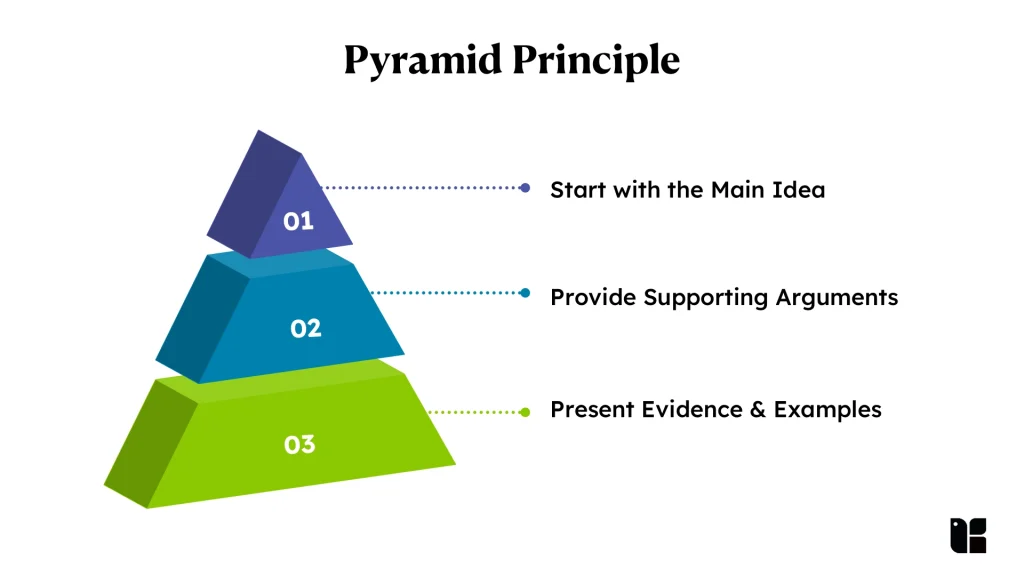
- Top of the Pyramid (Core Message): Start with the main idea you want to communicate. Summarise it in one simple sentence. For example: “Teamwork boosts productivity and fosters innovation.”
- Middle of the Pyramid (Supporting Points): Break down your main idea into several key points that support it. Arrange these points logically. For example: “Teamwork encourages diverse perspectives,” “It improves problem-solving skills,” and “It enhances team morale.”
- Base of the Pyramid (Additional Details): Provide extra details or data to back up your supporting points. This adds context and strengthens your message. For example, you might add: “Teams with diverse members perform 30% better in problem-solving tasks.”
Pyramid Principle involves starting with your main message, organising your supporting points logically, and backing them up with clear examples or data. This approach makes your communication clearer and more effective, helping your audience understand and engage with your message.
With advanced techniques setting the stage for mastery, let’s explore the profound impact of powerful articulation. Understanding how these refined skills can transform communication will reveal the true potential of your speech abilities.
What Is The Power Of Articulation Practice?
Articulation practice is a cornerstone of effective communication, offering distinct benefits that extend well beyond mere clarity. Here’s why dedicating time to perfecting your articulation can transform your interactions:

Ensuring Crystal-Clear Communication
Articulation is the art of speaking clearly and precisely, ensuring that your listeners grasp your message without ambiguity. When you articulate your words carefully, you minimise the risk of miscommunication, making your exchanges more efficient and meaningful. This clarity is essential in both everyday conversations and high-stakes professional presentations.
Building Professional Credibility
In a professional environment, how you speak can significantly impact your perceived competence. Mastery of articulation signals confidence and expertise, helping you establish credibility with colleagues, clients, and audiences. Your ability to express yourself clearly reinforces your image as a skilled and reliable communicator.
Fostering Engaging Dialogue
Practising articulation sharpens your ability to listen and respond effectively. Clear articulation demands careful attention to both what you say and how you say it, which in turn improves your responsiveness in conversations. This attentiveness helps create a more engaging and dynamic dialogue where ideas flow smoothly, and interactions are more rewarding.
Boosting Self-Assurance
Confidence in communication often stems from knowing you can express yourself clearly. Articulation practice builds this confidence by refining your ability to convey thoughts accurately and persuasively. This newfound assurance can reduce speaking anxiety and empower you to engage more fully in various communicative scenarios.
Developing Advanced Communication Skills
Beyond basic clarity, articulation practice enhances your overall communication skills. By focusing on elements like pronunciation, pacing, and modulation, you develop a more nuanced approach to speaking. This holistic skill set supports more effective and expressive communication in diverse contexts, from personal relationships to professional settings.
Enhancing Persuasive Impact
Articulation isn’t just about clarity; it’s also about influence. The way you emphasise and enunciate your points can make your arguments more compelling. Effective articulation enables you to deliver persuasive speeches and presentations, swaying opinions and garnering support through well-structured and impactful communication.
Strengthening Leadership Presence
Effective leaders use articulation to inspire and guide their teams. Clear and deliberate speech enhances your leadership skills and helps you communicate vision and expectations with precision. Mastery of articulation allows leaders to motivate their teams, build trust, and assert their direction confidently, driving organisational success.
Mastering articulation enhances communication skills and impacts both personal and professional interactions. Now, let’s explore how to seamlessly incorporate articulation practice into daily life for maximum benefits.
How Can You Incorporate Artiulation Practice Into Daily Life?
To make practice more natural and integrated, incorporate articulation exercises into your daily routine. It can be done in the following ways:

Practising during daily activities
Find opportunities throughout the day to practise articulation exercises without disrupting your routine. For instance, reading aloud can be an effective way to practise clarity and expression. By reading books, articles, or news aloud, you apply articulation techniques in a natural context. Additionally, talking to yourself or rehearsing speeches while going about your day allows you to practise articulation in a relaxed, informal setting, making it a seamless part of your routine.
Analyse reviews
Recording your practice sessions allows you to assess your progress and identify areas for improvement. Use a recording device to capture yourself speaking or reading, and then listen for areas that need adjustment. Pay attention to clarity, precision, and overall delivery. Regularly reviewing these recordings helps track your progress over time, allowing you to identify patterns and make necessary adjustments to your practice routine.
Getting feedback
Feedback from others provides valuable insights into your articulation and helps you refine your practice. Ask friends or family for honest feedback, as they can offer perspectives on areas that may need improvement. Alternatively, consider joining a speech club or group where you can receive constructive critique. Engaging with others who are also working on their articulation can provide additional support and motivation. You can also record your meetings and presentations for self-feedback.
Incorporating practice into your daily life makes articulation exercises more natural. As you do this, be sure to address any challenges you encounter to enhance your progress further.
Practising articulation is valuable, but continued growth depends on how well that practice connects to real workplace situations. Kapable helps you assess whether its approach supports that need.
How Can To Address The Common Articulation Challenges?
It’s common to encounter challenges during your articulation practice. Understanding and addressing these challenges can help you overcome obstacles and continue making progress. Some of the challenges are as follows:

Overcoming plateaus
If you’re practising articulation and hit a point where you feel stuck, don’t worry, it’s a common part of learning. Here are some tips to help you move forward: Try changing up your exercises or adding new ones to keep your practice fresh. For example, you might work on different drills or focus on aspects of articulation you haven’t tried yet. Setting new goals can also keep you motivated and help you make progress. Fresh challenges can reinvigorate your practice and help you get past the plateau.
Dealing with speech anxiety
If you feel anxious when speaking, it can affect how clearly you articulate. Managing this anxiety is important for effective communication. One way to help is by practising deep breathing before you speak. This can calm your nerves and improve your control over your voice. Another helpful technique is visualisation, imagine yourself speaking confidently and clearly. This mental practice can boost your confidence and reduce anxiety, making it easier to articulate your thoughts.
Feedback-driven adjustments
Adjust your practice based on feedback and your own observations. If you receive comments on specific areas where you need improvement, focus on those areas in your practice. Be open to changing your exercises and techniques to meet your evolving needs. This flexibility will help you keep improving your articulation skills.
Navigating practice fatigue
Articulation practice can sometimes feel taxing, particularly during intense sessions or extended practice periods. To combat this, integrate short, restorative breaks into your routine. These breaks will help maintain your energy and focus. Additionally, balance rigorous practice with lighter, enjoyable activities to keep your enthusiasm high and avoid exhaustion.
Upholding practice regularity
While consistency is essential for progress, it can be challenging to maintain a steady practice schedule due to various life demands. Establish a structured practice plan that aligns with your daily routine, dedicating specific times each week to articulation exercises. If you miss a session, don’t let it derail your progress; simply resume your practice and stay committed to your schedule. Regular practice, even if occasionally interrupted, will foster continuous improvement in your articulation skills.
Addressing common challenges is an important step in improving your articulation. Considering these obstacles, it’s helpful to explore various tools and resources that can enhance your practice and support your progress.
Which Tools & Resources Are Useful For Articulation Practice?
Utilise various tools and resources to support and enhance your articulation practice. Leveraging diverse materials and techniques can accelerate progress and deepen your understanding.
Recommended apps and online tools
Several digital resources can aid in articulation practice by providing guided exercises and feedback.
Examples:
- Speech improvement apps: Apps like “Speech Bulbs” or “Articulation Station” offer a range of exercises tailored to different speech challenges.
- Online tutorials: Platforms like YouTube provide tutorials on articulation techniques and exercises, such as “The Speech Room News” and a couple of others.
Useful books and guides
Books and guides offer additional exercises, tips, and techniques for improving articulation.
- “Speak with Distinction” by Edith Skinner: A classic guide on improving speech clarity and precision.
- “The Complete Guide to Voice and Speech Training” by Robert Blumenfeld: Comprehensive resource for voice and speech development.
Conclusion
Developing a well-organised articulation practice plan can significantly improve your communication abilities. By establishing clear objectives, utilising daily exercises, and weaving practice into your daily activities, you can achieve remarkable gains in both clarity and accuracy. The essential factors for success are persistence and commitment. Embrace the journey, remain motivated, and relish the path toward more effective and articulate communication.


