

TL;DR
- Conflict Management in HRM: It is a vital HR function focused on constructively identifying, addressing, and resolving workplace disputes to enhance organisational health and productivity.
- HR’s Multifaceted Responsibilities: The role of HR professionals involves developing resolution policies, providing necessary training, building positive client relationships, and proactively addressing underlying systemic issues.
- Five Primary Resolution Styles: Effective conflict handling requires strategically employing one of the five styles: Collaborating, Competing, Compromising, Avoiding, or Accommodating, to suit the specific nature of the dispute.
- Intervention and Strategy: HR must intervene immediately for legal/ethical concerns or escalated conflicts, first performing a thorough assessment using critical questions to implement the most appropriate management strategies.
Studies show that employees in the US spend approximately 2.8 hours each week dealing with conflict. This means that effectively managing these disputes is not just necessary; it’s essential for maintaining productivity and workplace harmony. In any dynamic workplace, conflicts are inevitable. They arise from different sources: miscommunications, personality clashes, competing interests, or even just the stress of day-to-day challenges. Yet, managing these conflicts can significantly influence an organisation’s overall health and performance. This makes conflict management an essential aspect of Human Resource Management (HRM).
Effective conflict management ensures that disputes are resolved to benefit both the employees and the organisation, fostering a culture of collaboration and respect. In this blog, we will delve into the multifaceted role of HR in conflict management, exploring strategies that not only resolve disputes but also enhance organisational harmony and productivity.
From understanding the roots of workplace conflicts to implementing comprehensive conflict resolution systems, this blog aims to be your one-stop guide. Whether you’re an HR professional looking to refine your conflict management skills or a manager aiming to foster a better team environment, the insights provided here will equip you with the knowledge and tools necessary for achieving a harmonious workplace.
“Kapable transformed my ability to communicate clearly and confidently, helping me transition from a technical role to a leadership position. I can now present ideas and build rapport effectively, enabling me to take on a role with significantly greater responsibility.”
– Satrajit Sengupta (Principal Business Manager At SAP)
What Is Conflict Management?
Conflict management is a crucial function within Human Resource Management that involves identifying, addressing, and resolving disputes effectively within an organisation. At its core, conflict management is not just about stopping disputes as they arise; it’s about fostering an environment where conflicts are handled in a way that promotes learning and growth, thereby enhancing organisational health.
In any workplace, conflicts are inevitable. They stem from differences in opinions, goals, or working styles among employees. While conflicts can be disruptive, they also present opportunities for creativity, improved understanding, and strengthened relationships when managed correctly. The primary goal of conflict management is to transform potentially destructive interactions into constructive dialogues.
Effective conflict management requires a balanced approach that respects the diverse perspectives of all parties involved and seeks a resolution that aligns with the organisation’s values and objectives. This involves:
- Active Listening: Ensuring that all parties are heard and their points of view are acknowledged.
- Problem Solving: Facilitating the process of finding an appropriate solution that satisfies the needs of all parties to the extent possible.
- Negotiation: Mitigating discussions between conflicting parties to reach a mutually acceptable agreement.
- Mediation: In some cases, bringing in a neutral third party to help resolve the conflict when internal efforts fail.
HR professionals play a pivotal role in conflict management by providing the tools, training, and frameworks necessary for managers and employees to handle disputes effectively. This includes developing policies defining acceptable behaviours and resolution procedures, thus preventing conflicts from escalating. Additionally, HR can help cultivate a culture that views conflicts as opportunities to improve communication, procedures, and relationships.
Effective conflict management also requires a deep understanding of systemic issues within the organisation, such as gender perspectives and gender balance.
By implementing structured conflict management practices, organisations can minimise the negative impacts of conflicts and harness them as catalysts for positive organisational change and ongoing developments. Through these efforts, conflict management becomes a strategic asset in enhancing workplace harmony and ensuring long-term success.
What Is The Role Of HR Professionals In Addressing Systemic Issues?
Conflict management in Human Resource Management (HRM) is crucial for fostering productive partnerships and maintaining a harmonious work environment. Advanced university degrees often equip HR professionals with the competencies to navigate disputes effectively. They must demonstrate openness and client orientation to correctly interpret messages and identify clients’ points of view. Systemic issues, such as sexual harassment or status quo challenges, require proactive approaches to ensure equal participation and anticipate problems.
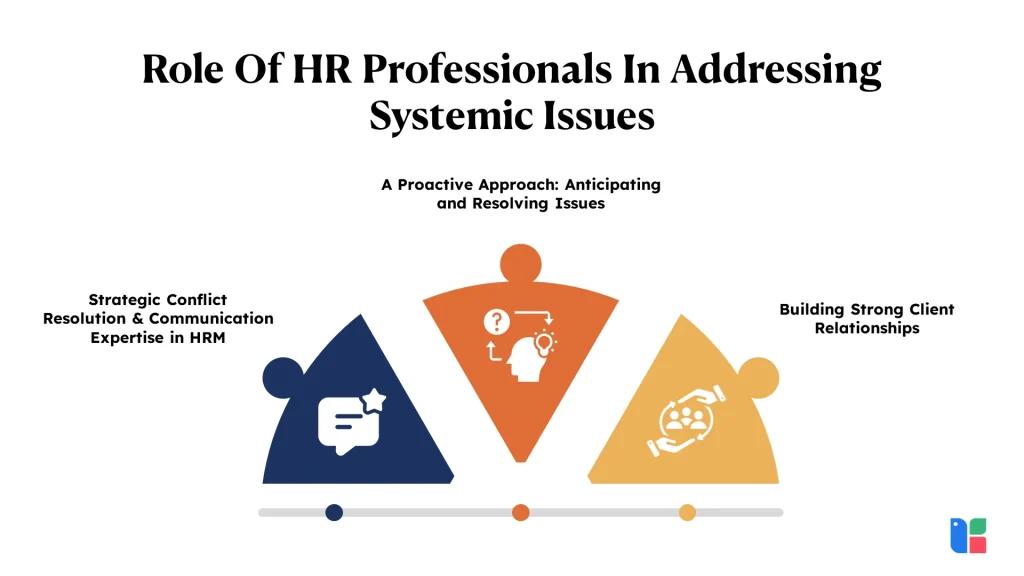
Strategic Conflict Resolution and Communication Expertise in HRM
Strategic conflict resolution in Human Resource Management (HRM) plays a crucial role in enhancing organisational culture and productivity. HR professionals leverage their qualifying experience, often backed by seven years or more in the field, and then often respond appropriately to disputes. Effective communication in languages like English is essential in these settings, enabling HR to navigate complexities and promote inclusivity.
In the United Nations Secretariat, where diverse backgrounds and languages are the norm, two-way communication in working languages like English is vital. HR professionals with progressively responsible experience take responsibility for resolving conflicts through alternative dispute resolution methods. They tailor language to suit the clients’ environment, ensuring clarity and understanding. Responsible for following duties across various departments, they gather information to address systemic issues and qualify experience.
A Proactive Approach: Anticipating and Resolving Issues
A first-level university degree, coupled with seven years of qualifying experience, enables HR professionals to respond appropriately to challenges and meet timelines effectively. By fostering a culture of respect and responsiveness, they build productive partnerships and encourage staff members to voice concerns. Anticipating problems before they escalate allows for timely intervention and maintaining productive working relationships.
By addressing conflicts proactively, HRM professionals play a pivotal role in creating a supportive and thriving organisational culture.HR professionals start with progressively responsible roles that require them to correctly interpret messages and often demonstrates openness for a deep understanding of clients’ perspectives. This proactive approach resolves conflicts promptly and fosters a culture of mutual respect and collaboration across different departments and duty stations.
Conflict management in Human Resource Management (HRM) is crucial for fostering productive partnerships and maintaining a harmonious work environment. Advanced university degrees often equip HR professionals with the competencies to navigate disputes effectively. They must demonstrate openness and client orientation to correctly interpret messages and identify clients’ points of view. Systemic issues, such as sexual harassment or status quo challenges, require proactive approaches to ensure equal participation and anticipate problems.
Building Strong Client Relationships
HRM professionals play a pivotal role in creating a supportive and thriving organisational culture. They start with progressively responsible roles that require them to correctly interpret messages and demonstrate openness for a deep understanding of clients’ perspectives. By practising active listening and empathy, HR professionals tailor their approach to meet specific client needs, fostering trust and respect. Consistent and transparent communication is vital; keeping clients informed about policies, changes, and updates within the organisation helps address issues promptly and effectively. Regular check-ins and feedback sessions strengthen the client relationship.
To meet diverse client needs, HR professionals offer customised solutions, leveraging their expertise to provide tailored advice and strategies aligned with clients’ goals. Building trust is essential, and HR professionals achieve this by being reliable and delivering on promises, establishing a reputation for dependability and integrity. Continuous professional development ensures HR professionals stay updated with industry trends and best practices, enhancing the value they bring to client relationships.
Proactive problem-solving, where potential issues are anticipated and addressed before they escalate, helps maintain a positive work environment. Seeking regular feedback and being open to constructive criticism enables HR professionals to refine their approaches and improve services. This proactive approach creates an environment where clients feel supported and valued, contributing to the organisation’s overall success and stability.
Every workplace conflict presents HR with an opportunity to strengthen collaboration instead of simply restoring order. Helping leaders navigate these moments with confidence is an important part of how Kapable approaches leadership development.
Which Conflict Management Styles Are Most Effective?
Understanding and effectively applying various conflict management styles is crucial for HR professionals handling workplace disputes. Each style has its unique approach and is suitable for different situations, depending on the nature of the conflict and the desired outcomes.
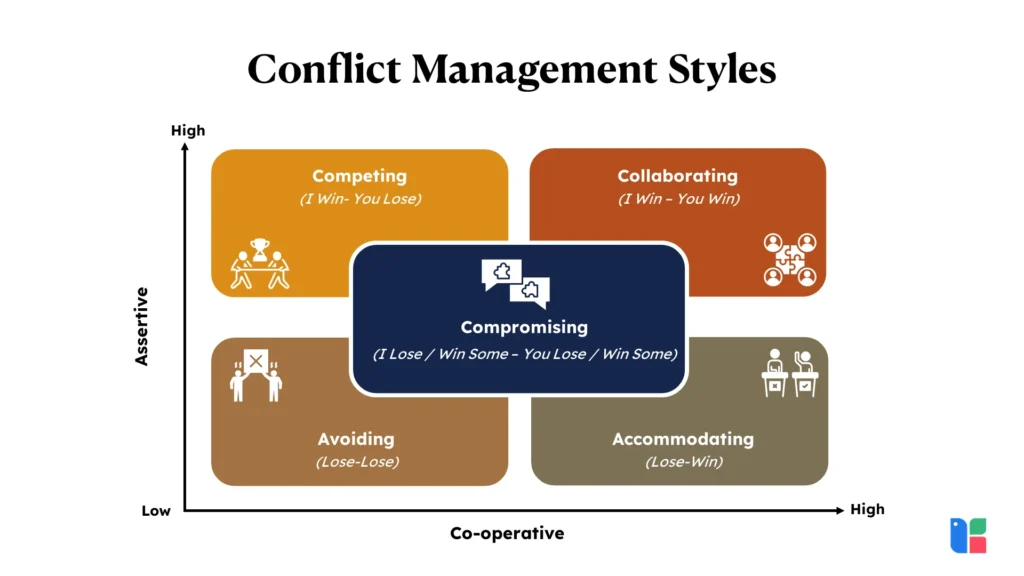
Collaborating
This style involves working together with all parties to find a win-win solution that satisfactorily resolves the conflict for everyone involved. Collaboration is most effective when the issue is complex, requiring input and commitment from various stakeholders. When departments conflict over resources, HR could facilitate collaborative meetings to discuss each department’s needs and goals, aiming to reach an agreement that benefits the entire organisation. Ken Blanchard’s insight, “None of us is as smart as all of us,” encapsulates the spirit of collaboration, emphasising that collective wisdom surpasses individual insights, leading to more sustainable and innovative solutions
Competing
A competitive approach is assertive and uncooperative, focusing on winning the conflict at the other party’s expense. This style may be appropriate when quick, decisive action is needed, such as during emergencies or when making unpopular but necessary decisions. For example, a manager might need to enforce new safety protocols firmly if a safety issue arises and an immediate action plan is required despite team resistance. Howard Cosell noted, “The ultimate victory in competition is derived from the inner satisfaction of knowing that one has done his or her best,” highlighting that the drive to compete can also foster a high standard of performance and accountability.
Compromising
The compromising style aims for solutions that partially satisfy everyone involved. It’s particularly useful when the parties are equally powerful and a quick, mutually acceptable solution is needed. For instance, when two employees vie for promotion, and both are equally qualified, HR might facilitate a compromise where each individual receives some form of advancement. Statistics reveal that more than 50% of workplace conflicts are resolved through compromise, reflecting its effectiveness in maintaining operational continuity and preventing stalemates.

Avoiding
This style involves deliberately avoiding confrontation or actively withdrawing from a dispute when the issue is trivial or when the costs of confrontation outweigh the benefits. When an employee complains about minor and temporary inconveniences, HR might avoid escalation, anticipating that the situation will resolve itself. Dale Carnegie’s advice, “The only way to get the best of an argument is to avoid it,” supports this approach, suggesting that not all conflicts require direct engagement and that strategic withdrawal can sometimes preserve energy and resources for more significant systematic issues.
Accommodating
Accommodation involves yielding to the other side’s demands, often at one’s own expense, to maintain harmony and stability. This style is effective when the issue matters more to the other party or maintaining peace is crucial. For example, accommodating a senior employee’s request for a specific office space can help preserve respect for seniority and maintain office harmony. Maya Angelou’s observation that you can tell a lot about a person by how they handle minor irritations reflects the accommodating style’s essence, highlighting the value of grace and flexibility in preserving relationships.
Each of these styles serves a purpose in conflict resolution. HR’s role in understanding when and how to employ each style effectively, considering the organisational culture and the specific circumstances of each conflict, is vital. Training employees and managers to recognise and apply these styles can lead to more adept conflict handling, enhancing the overall workplace environment.
When Should HR Get Involved?
Conflict management in Human Resource Management (HRM) is crucial for maintaining a harmonious workplace environment. It’s imperative to prevent personal attacks and monitor ongoing developments inside the organisation to address issues before they escalate. HR professionals also have to maintain productive partnerships and incorporate gender perspectives to foster inclusivity and equality, which is essential in a diverse workforce. Advanced education, such as a master’s degree, equips HR professionals to handle conflict prevention and keep clients informed with expertise.
Human Resources is critical in managing workplace conflicts, but knowing when to step in is key to effective conflict resolution. HR’s involvement is generally warranted under specific circumstances that significantly impact the broader organisational climate or where the issues are complex and beyond the scope of immediate supervisors.
Here are some guidelines to help determine when HR should intervene:
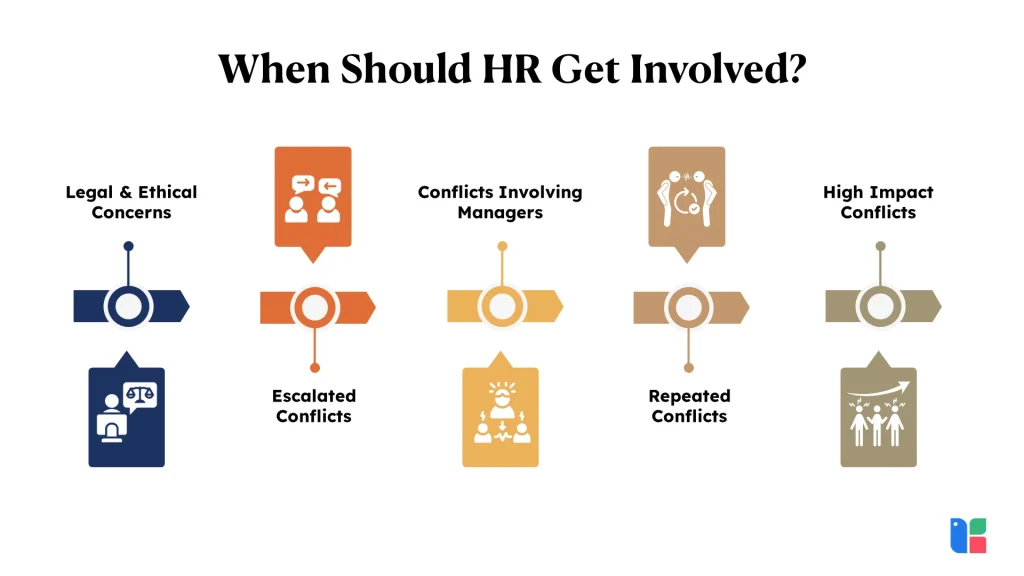
Legal And Ethical Concerns
HR must intervene immediately if a conflict involves potential legal ramifications, such as allegations of discrimination, harassment, or violations of workplace laws. These issues are sensitive and require careful handling to protect the employees and the organisation from legal exposure. For instance, if an employee reports sexual harassment, HR must conduct a thorough investigation, ensuring confidentiality and impartiality while adhering to legal standards and organisational policies.
Escalated Conflicts
When disputes escalate to the point of affecting workplace productivity or the emotional well-being of employees, HR needs to step in. These conflicts often require a neutral party to mediate and propose solutions that individual managers may not be positioned to provide. An example might be a long-standing feud between two employees that has begun to disrupt team cohesion and negatively affect their colleagues’ work environment.
Conflicts Involving Managers
Situations where managers are part of the conflict can benefit from HR intervention to ensure fairness and objectivity. Managers may have a conflict of interest, and their involvement could skew the resolution process, necessitating HR’s impartial perspective. For example, if a manager is accused of favouritism, HR should assess the situation independently to ensure that all employees are treated equitably.
Repeated Conflicts
If the same conflict recurs despite attempts at resolution, it indicates that the underlying sensitive issues have not been effectively addressed. HR should get involved in diagnosing the deeper problems and implementing more strategic interventions. A typical scenario might involve interdepartmental disputes over resource allocation, where HR could facilitate restructuring resource management practices.
High Impact Conflicts
Conflicts involving key personnel or high-stakes projects require HR’s attention because they can significantly impact the organisation’s operations and reputation. For instance, if a senior executive clashes with a board member over strategic direction, HR might facilitate discussions to ensure both parties can express their viewpoints and reach a consensus that aligns with the company’s long-term goals.

Which Conflict Management Styles Are Most Effective?
Before stepping in to manage a conflict, HR professionals must carefully assess the situation to determine the most appropriate course of action. Here are some critical questions that HR should consider asking to effectively evaluate the situation:
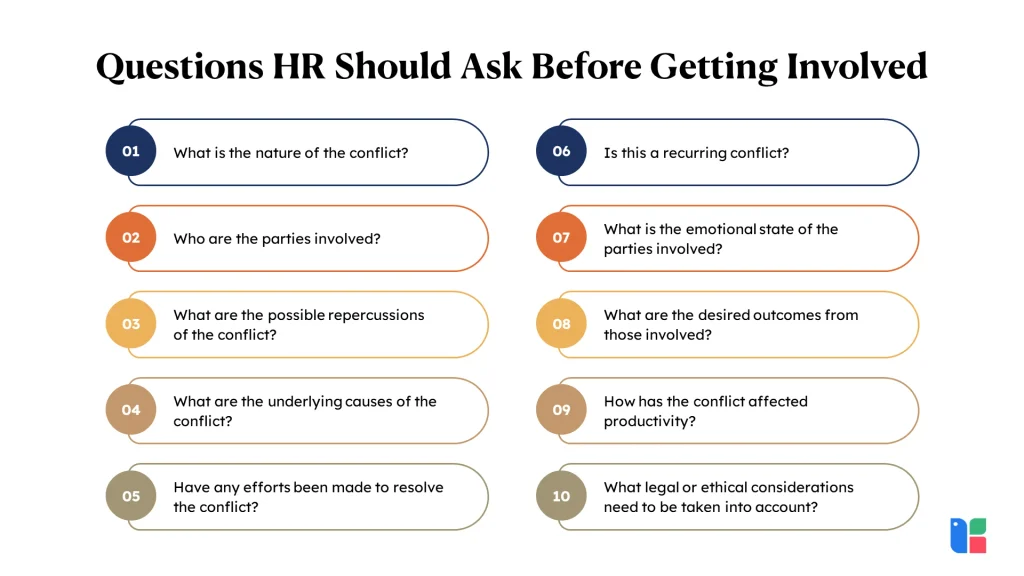
- What is the nature of the conflict?
Understanding the type of conflict (interpersonal, intragroup, intergroup) helps identify the appropriate resolution strategy. Is it related to personality clashes or work styles, or is it a procedural conflict about how tasks are performed?
- Who are the parties involved?
Identifying all involved parties is crucial. Are they peers, a manager and subordinate, or groups from different departments? This can influence the dynamics of the conflict and the approach needed.
- What are the possible repercussions of the conflict?
Assessing the potential impact of the conflict on team dynamics, project outcomes, and overall workplace environment is vital. How severe is the conflict, and what could be the consequences if it remains unresolved?
- What are the underlying causes of the conflict?
Digging deeper to understand the root causes, such as resource shortages, communication barriers, or unaligned expectations, can lead to more sustainable solutions.
- Have any efforts been made to resolve the conflict?
Knowing what has been attempted and failed helps avoid repeating ineffective strategies and provides insight into the issue’s complexity.
- Is this a recurring conflict?
If the conflict has occurred before, it might indicate systemic issues that require a different approach or more comprehensive solutions from HR.
- What is the emotional state of the parties involved?
Assessing the emotional impact on the parties can guide how to approach the conflict sensitively and respectfully, ensuring that solutions address emotional and practical needs.
- What are the desired outcomes from those involved?
Understanding each party’s desired resolution can help craft acceptable solutions to all involved, potentially leading to a more lasting peace.
- How has the conflict affected productivity?
Determining the impact on work can prioritise conflict management efforts, especially in high-stakes or high-impact situations.
- What legal or ethical considerations need to be taken into account?
Identifying any legal risks or ethical dilemmas early in the process is crucial for managing the conflict appropriately and protecting the organisation and its employees.
For example, suppose two team members conflict with project responsibilities. In that case, HR should first determine the nature of their dispute, is it a misunderstanding, a clash of personalities, or perhaps a lack of clarity in role definitions? By understanding the specifics, HR can choose whether a simple mediation, a clarification meeting, or team restructuring might be the most effective resolution method.
These preparatory questions enable HR to intervene in conflicts with a well-informed, strategic approach that considers all aspects of the situation. By meticulously assessing the conflict before taking action, HR can ensure that their involvement is appropriate and constructive, leading to more effective resolutions.
How Can You Implement Effective Conflict Management Strategies?
Effective conflict management is essential for maintaining a healthy workplace environment. HR professionals play a crucial role in designing and implementing strategies that resolve conflicts and prevent them from escalating. Here are several practical tips and strategies for effective conflict management:
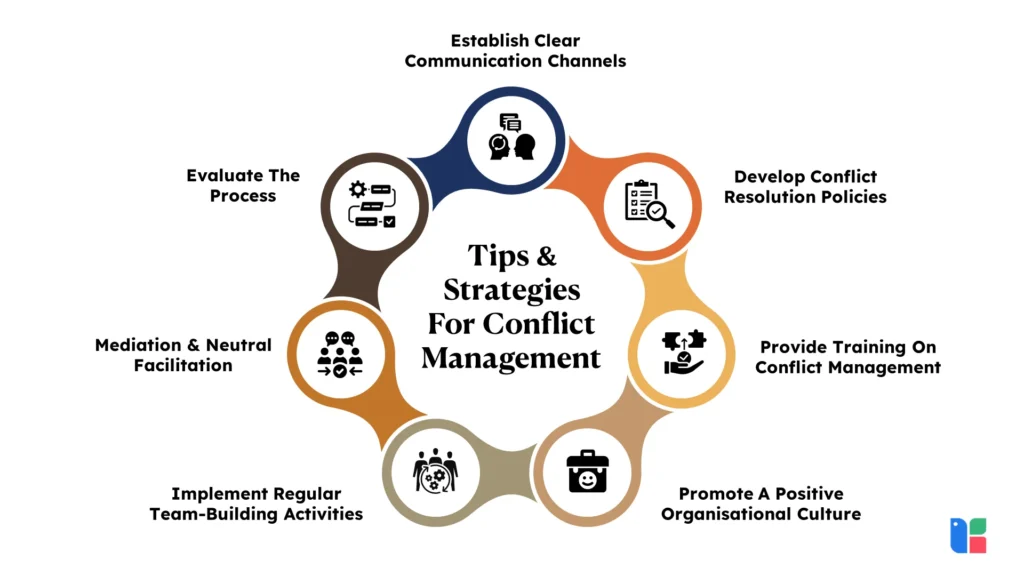
Establish Clear Communication Channels
Ensure that there are well-defined channels to facilitate communication within the organisation. Encourage open dialogue and regular feedback sessions, which can help prevent misunderstandings and nip potential conflicts in the bud.
Develop Conflict Resolution Policies
Having clear, written policies regarding conflict resolution helps standardise the approach to handling disputes. These policies should outline the steps to be taken when a conflict arises and define the roles and responsibilities of everyone involved.
Provide Training On Conflict Management
Regular training sessions on conflict resolution skills can empower employees and managers to handle disputes more effectively. Workshops can cover negotiation techniques, emotional intelligence, and effective communication.
Promote A Positive Organisational Culture
Foster a workplace culture that values respect, inclusivity, and teamwork. Recognising and rewarding collaborative behaviour can discourage conflict and promote harmony among employees.
Implement Regular Team-Building Activities
Team-building exercises can improve relationships and understanding among team members. These activities should be designed to enhance trust, cooperation, and communication.
Mediation And Neutral Facilitation
Consider using a neutral third party to mediate when internal resolution efforts fail. Professional level mediators can offer unbiased solutions and help resolve conflicts without taking sides.
Evaluate The Process
Continuously monitor the effectiveness of the conflict resolution processes in place. Solicit feedback from employees to improve and adapt strategies as necessary.
Conclusion
Effective conflict management is not merely about resolving disputes; it’s a strategic component of organisational health that fosters a positive work environment and enhances overall productivity. HR professionals play a pivotal role in this process by implementing proactive strategies that prevent conflicts from escalating and by nurturing a culture that values communication and collaboration.
By equipping employees with the tools to handle disagreements constructively and viewing conflicts as opportunities for growth, organisations can resolve immediate issues and build a stronger, more cohesive workforce. Mastering conflict management in HRM means committing to continuous improvement and adaptability, ensuring that the organisation thrives amidst challenges and changes.
If conflict resolution has become a growing part of your HR responsibilities, it may be worth exploring whether Kapable aligns with the leadership capabilities you want to strengthen.


