


Executive presence for women is the observable ability to project gravitas, clear communication, and credibility so others trust your judgement and see you as ready to lead, even under pressure. It is not a personality you are born with, it is learnable. These behaviours build the confidence that decides whether your expertise is recognised or quietly overlooked in the rooms that shape your career.
It’s 2026, and a senior manager just closed her best quarter: revenue up 18%, top-decile engagement, zero attrition. Her review? “Strong results, but you need more executive presence.” No one explains what to change, and she leaves more frustrated than she arrived which makes the stakes higher and the feedback vaguer for women. Executive presence bridges the gap between competence and recognition: research from the Center for Talent Innovation (now Coqual) found it accounts for about 26% of what senior leaders say it takes to earn the next promotion. Perception, not performance alone, decides who advances.
What you’ll learn: what executive presence is, why it works differently for women in India, the three pillars and how to build each, the traps to avoid, and a 3–6 month roadmap to make your leadership visible with real confidence.
Quick self-check: how present are you right now? Answer yes/no:
- Do you lead with your recommendation in the first 30 seconds, before the reasoning?
- Do you finish your point when interrupted, rather than yielding the floor?
- Do you state your own view before asking the room’s (“Here’s my read: what am I missing?”)?
- Do you claim credit in the first person (“I led…”) with senior stakeholders?
- Do you stay visibly composed (steady voice, no rushed apology) when challenged?
Three or fewer “yes” answers means presence, not competence, is likely what’s capping your recognition, and every item below is trainable.
Why Executive Presence Matters More for Women Leaders in India
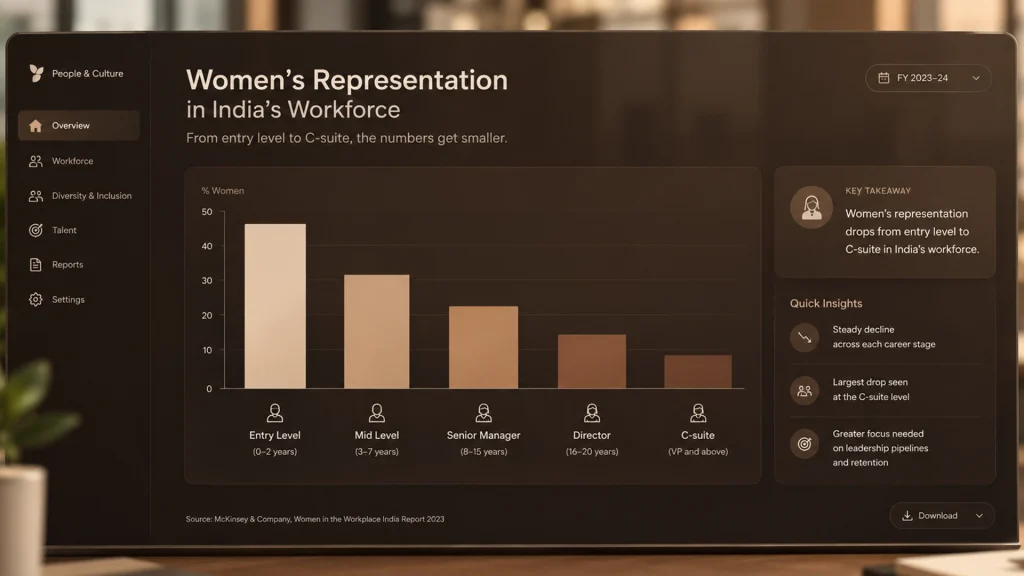
The representation numbers make the problem concrete. According to McKinsey’s Women in the Workplace 2025 report on India, women make up just 33% of entry-level workers and only 24% of managers, the sharpest fall comes at the very first rung into management, India’s so-called “broken rung.” Globally the pattern echoes at the top: McKinsey’s 2025 data shows women holding just 29% of C-suite roles.
What compounds the problem right now:
- The broken rung hits hardest early. In India the steepest drop is at the first promotion into management. Counter it: volunteer to lead one visible, cross-functional deliverable each quarter; visible ownership, not tenure, is what gets you read as manager-ready.
- Hybrid work creates visibility gaps. When your best thinking happens off-camera or in chat, it doesn’t register as presence. Counter it: schedule one 10-minute camera-on check-in a week with a skip-level leader, and speak at least once, unmuted, in every large meeting.
- Perception outweighs performance. Promotions and stretch assignments turn on perceived readiness, not results alone. Counter it: send a three-line monthly “impact note” to your manager quantifying what you shipped, so your record is in the room when your name comes up.
The good news: executive presence is developed through practice, not inherited. This guide breaks it into concrete, behaviour-based strategies, grounded in research and adapted for the Indian workplace.
Why this matters for you specifically: in Indian corporate culture, where hierarchy is deeply respected, women who master executive presence tend to vault past the “senior manager” ceiling; the point where relationship skills plateau and command of the room becomes the primary promotion criterion. That is often why peers with weaker execution reach the VP role first.
The Double Bind: How Gendered Expectations Distort Executive Presence

Researchers call it the double bind. You’re expected to be warm and collaborative (because you’re a woman) and simultaneously strong and decisive (because you’re a leader). Show too much of one and you’re criticised for lacking the other. Women are often penalised for assertive behaviour that, in men, gets labelled “leadership”:
- A man interrupts: “decisive.” A woman does the same: “aggressive.”
- A man gives pointed feedback: “strategic.” A woman does the same: “cold.”
- A woman shows concern: “too emotional.” She withholds it: “not collaborative.”
Executive Presence in Indian Corporate Culture: MNCs, Family-Run Businesses, and Government
Executive presence isn’t read the same way everywhere in India. The woman who calibrates to the context wins the room. In a multinational or global capability centre (GCC), the prized register is direct, data-led and headline-first, close to the Western default. In a promoter-led or family-run business, decisions flow through relationships and seniority. Presence there means holding a clear point of view while still visibly respecting hierarchy; push a position too flatly and it can read as disrespect, not confidence. In the public sector and PSUs, process and consensus carry the weight. Authority comes through preparation and procedural command, not assertive volume. Diagnose which system you’re in before deciding how hard to push.And it isn’t that women are “too emotional.” Women are penalised for visible emotion (a cracking voice, tearing up) while men’s anger and frustration routinely pass as “passion.” The issue is which emotions get coded as executive-appropriate, not emotional expression itself. This is well documented: Catalyst’s 2007 report, The Double-Bind Dilemma for Women in Leadership: Damned if You Do, Doomed if You Don’t, mapped exactly this no-win pattern across thousands of managers. Executive presence for women helps counter the bias, but only once you can see the system you’re operating in.
Cultural Nuances: Balancing Deference, Hierarchy, and Authority
The sharpest tension for Indian women leaders sits between culturally valued humility and the self-assertion that Western presence advice assumes. You don’t have to pick a side. The workable path is respectful assertion: acknowledge seniority and context first (“Building on what you’ve said…”), then state a clear, well-reasoned position. Deference to rank and conviction in your own analysis aren’t opposites. Pairing them is what reads as mature authority in an Indian room, where raw self-promotion can backfire but so can silence. There’s a structural reason this works: India scores high on Geert Hofstede’s power-distance index, so respect for hierarchy is a strong cultural expectation. Show that respect first, and it’s what earns your assertion a hearing instead of resistance.
What Executive Presence Really Means for Women Leaders
Executive presence for women is the consistent ability to project clarity, credibility, and calm so others trust your judgement under pressure. It signals readiness for senior leadership and isn’t about being the loudest voice in the room. Three myths need clearing:
| Myth | Reality |
| You need to be extroverted and charismatic to have presence. | Presence is about mental clarity and choosing when to speak, not how much you speak. A quiet leader who says one precise, well-timed thing in a meeting registers as more in control than someone filling the room with talk. |
| Presence means being “on” at all times, performing confidence in every interaction. | What actually reads as presence is composed behaviour in the moments that matter, a tense negotiation, a tough question from a senior stakeholder, not a constant performance. Trying to be “on” all day is exhausting and, worse, it flattens the moments where real composure would stand out. |
| Presence is about polish: how you dress, how you speak, how put together you look. | Polish helps you get noticed, but it isn’t what earns trust. What people are actually evaluating is whether they trust your thinking when a hard decision lands, whether your judgement holds up under pressure. Polish without that is forgettable; that without polish still gets remembered. |
These myths persist because the leaders we remember are the loudest and most visible, so we mistake visibility for presence. That confusion is what sends capable women chasing charisma instead of clarity; naming it is the first correction.
This “manage the display, don’t fake the feeling” distinction is grounded in Sylvia Ann Hewlett’s Center for Talent Innovation research, which found gravitas (composure and decisiveness under pressure) is the element senior leaders weight most heavily (about 67% of the presence signal).
The Three Pillars of Executive Presence
The classic model, first framed by researcher Sylvia Ann Hewlett, rests on three elements, and every serious framework since is a variation on them:
- Gravitas: how seriously people take your thinking: composure, decision-making, integrity, conviction.
- Communication: how clearly and decisively you convey your expertise. Clear communication is essential for strong executive presence.
- Appearance / professional poise: how steady and credible you appear when stakes are high.
These pillars don’t ask you to become someone else. Many women already excel in the substance of leadership; the pillars make that excellence visible: clear thinking feeds confident communication, which supports steady behaviour under pressure and builds the standing that earns trust with teams, peers, and senior leadership.
Rate yourself on each pillar (1 = rarely, 5 = consistently):
| Pillar | Observable indicator | Score (1–5) |
| Gravitas | I stay composed and decisive when a senior leader challenges me | |
| Communication | I lead with my recommendation and finish my point when interrupted | |
| Appearance / poise | My presentation is consistent enough that nobody comments on it |
Your lowest score is where to start. The pillars also read differently across Indian workplaces: gravitas in a hierarchical, promoter-led MNC often means measured deference to seniority plus a clear point of view, where the same restraint in a flat startup can look like under-confidence; communication in a consensus-driven family business rewards building agreement before stating a position, while a global-capability centre prizes the direct, headline-first style; appearance shifts from formal business wear in Mumbai BFSI to smart-casual in Bengaluru tech.
Gravitas: Quiet Authority That Makes Your Leadership Land
The women who gain the most credibility rarely speak the most, and there is a hard reason to speak selectively. Research by Yale’s Victoria Brescoll (Administrative Science Quarterly, 2011) found female leaders who talked more than their peers were judged less competent, a penalty their male counterparts did not face. So the move is a “calculated voice”: speaking when you can clearly shift an outcome. That’s gravitas; not volume, not title, but the clarity and influence that come from having thought it through. How to make ideas land visibly:
- Pause before responding. A two-second pause signals deliberation, not hesitation.
- Summarise trade-offs. “Here’s what we gain and what we risk” shows you’ve assessed the full picture.
- Distinguish facts from assumptions. “The data shows X; I’m assuming Y, which we should test.”
- Lead with your recommendation. Don’t build to the conclusion, start with it.
In high stakes conversations (steering a chaotic meeting, answering a CEO’s challenge on numbers) gravitas separates someone perceived as “senior” from someone “solid but not ready.”
Communication: Making Your Expertise Visible and Memorable

Communication carries your expertise into the room so it can influence decisions and careers; it requires clarity, conciseness, and impact. Women often face bias here, being interrupted and not reclaiming the floor, over-explaining to pre-empt objections, softening messages with qualifiers (“just,” “maybe”), or speaking last. This is not imagined: studies of mixed-gender meetings find women receive more negative interruptions and are penalised for talking “too much” (the volubility bias Brescoll documented), so reclaiming the floor is a learned discipline, not rudeness. Habits that build clarity and influence:
| Habit | What it sounds like |
| Lead with the headline | “My recommendation is X. Here’s why.” |
| Use short, decisive sentences | “We should pause the rollout. The risk outweighs the timeline gain.” |
| Slow your pace | Reduces filler words and projects calm confidence |
| Reclaim the floor after interruption | “I’d like to finish my point, it’s directly relevant.” |
| Use clear, jargon-free language | Name what you mean instead of hedging |
Voice and Speech Patterns That Command Attention
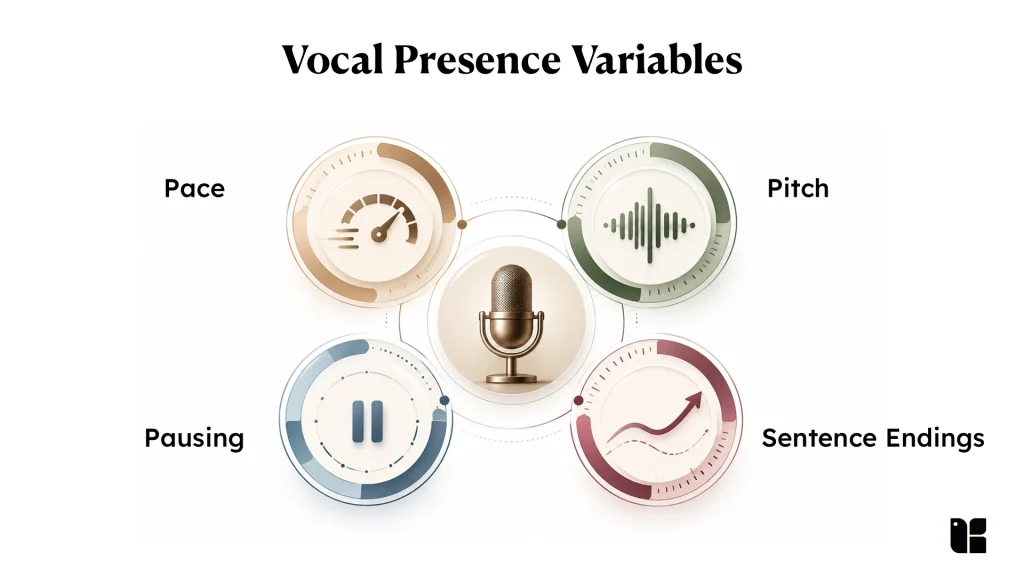
Every framework names “clarity and conviction,” but few give women the vocal mechanics. Your voice is a presence instrument:
- Pace. Slow down roughly 10–15%. Speed signals anxiety; steadiness signals authority, and on video, slowing further offsets digital compression.
- Pitch. Drop to the low, steady end of your natural range on key points, but don’t force it into strain. A University of Kansas study (Kim & Barker, 2022) found a lower pitch boosts male CEOs’ perceived credibility far more than women’s, so an artificial drop won’t buy the authority you’d hope, a grounded breath does more than a manufactured voice.
- Strategic pausing. A beat before a key point makes the room lean in; a beat after lets it land.
- Sentence endings. End on a downward inflection so a recommendation reads as a decision, not a question.

Strategic Self-Promotion Without the Likeability Penalty
“Let your work speak for itself” is quietly career-limiting for women, because achievements get attributed elsewhere in the conversations you’re not in. The first step is accepting that visibility is part of the job, and the second is choosing language that claims credit without costing you likeability.
- Use “I led” with senior stakeholders. “I led the restructuring that cut costs by 14%.”
- Use “we delivered” with peers. the same fact, framed for a different audience.
- Anchor the claim to a business outcome, not effort. Numbers travel; hours don’t.
Professional Poise: Staying Steady When Stakes Feel High

Professional poise is visible steadiness and calm influence: how you sit, breathe, listen, and respond when discussions turn tense. It’s not the absence of emotion; it’s managing your nervous system so your values, not your fears, drive your behaviour. Executive presence includes nonverbal cues such as posture and eye contact, and poise is where they matter most:
- Grounded posture. Feet flat, back supported, hands visible, physical grounding reduces vocal tension.
- Deliberate eye contact. Look at the person you’re addressing, not your notes, it reads as quiet influence, not deference.
- Ask clarifying questions instead of reacting defensively. “Can you help me understand what’s driving that concern?” buys time and shows active listening.
- Breathe before responding to a challenge. One deep breath is invisible to others but resets your nervous system.
A lived model: Arundhati Bhattacharya, the first woman to chair the State Bank of India, is widely credited for her calm, deliberate command while steering SBI through a landmark merger with its associate banks, steadiness, not volume, is what registered as authority.
“Earlier, I was often focused on getting people to do what needed to be done. If someone didn’t understand what I was asking, I would get frustrated and repeat the same expectation. Kapable made me more conscious of the other person’s perspective and taught me to pause before reacting. I now think more deliberately about what the situation needs from me, how I can communicate the same expectation differently, and how I can create an environment where people take greater ownership.”
– Chirag Shah, Founder IronThrone Engineering
Body Language and Spatial Presence in Meetings

Spatial strategy is presence you can practise before you say a word. Indra Nooyi’s habit of arriving early to claim a central seat and open pre-meeting conversation is a masterclass, latecomers land in peripheral seats, literally and figuratively outside the power centre.
Executive Presence in Remote and Hybrid Settings
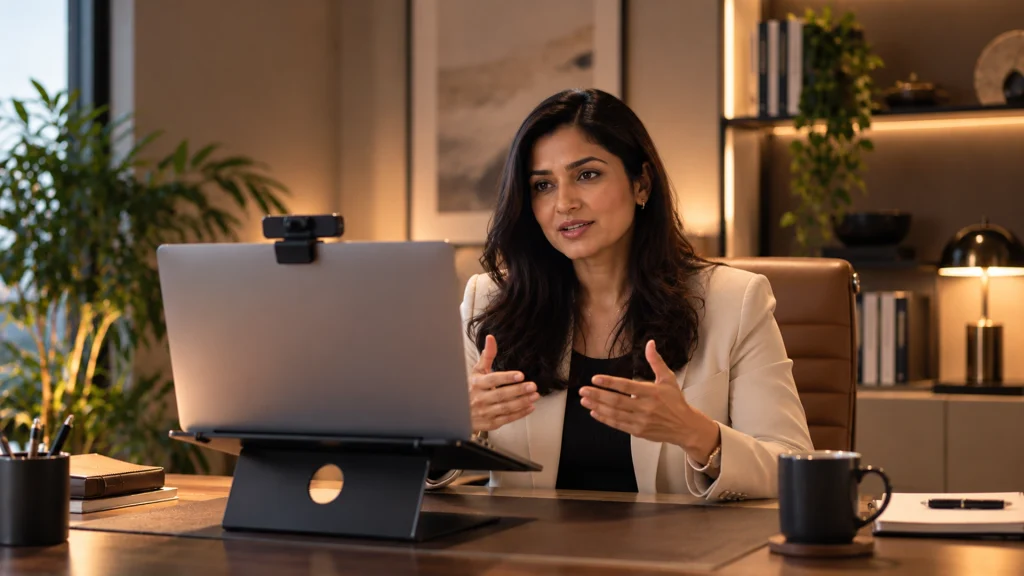
Post-2020, much of executive presence happens on screen, and India’s hybrid corporate culture makes this a core skill, not an afterthought. Camera framing, lighting, background, and how gracefully you handle a tech failure all shape whether you read as a leader on a call.
Microsoft’s own research into hybrid meetings has mapped how turn-taking and interruptions distort who gets heard, and a 2021 review of mixed-gender virtual meetings found women receive more negative interruptions in person, a distortion video meetings can actually reduce. Use that: adopt a “video-on, audio-on by default” habit with structured turn-taking, and treat the lower-pressure everyday call as a rehearsal space to build vocal confidence before you transfer those reps to high-stakes in-person moments.
Watch: How to Elevate Your Presence in a Virtual Meeting and Get Noticed: practical tactics for establishing leadership presence in digital environments where women can struggle to be heard.
Common Presence Traps Many Women Fall Into (and How to Avoid Them)
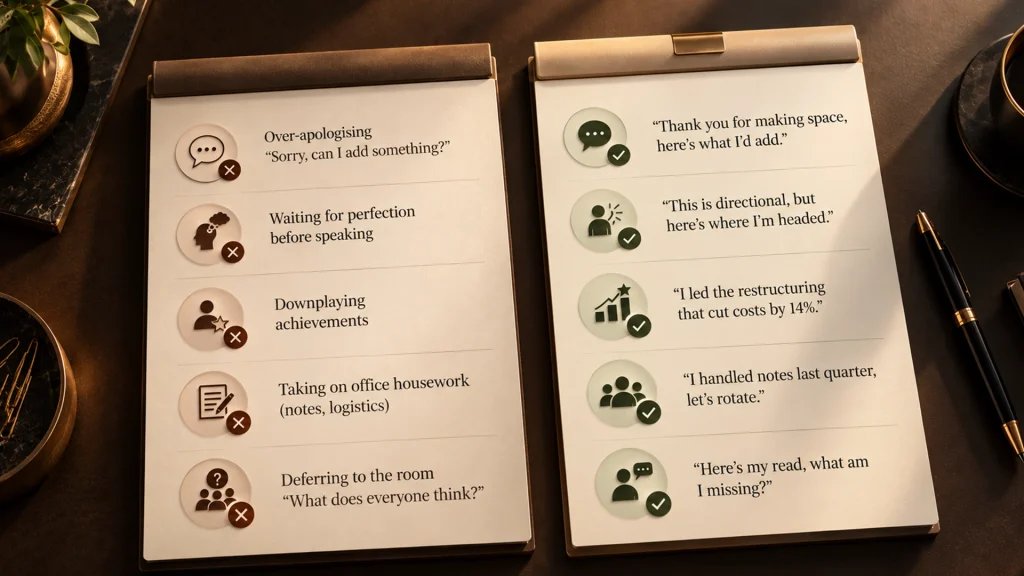
These traps reflect the double bind and years of conditioning, not personal weakness. Recognising them is the first step:
| Trap | Impact on presence | Better alternative |
| Over-apologising (“Sorry, can I add something?”) | Makes your judgement look tentative | “Thank you for making space, here’s what I’d add.” |
| Waiting for perfection before speaking | Others claim the idea first | “This is directional, but here’s where I’m headed.” |
| Downplaying achievements | Reduces attribution for your leadership potential | “I led the restructuring that cut costs by 14%.” |
| Taking on office housework (notes, logistics) | Keeps you in support roles | “I handled notes last quarter, let’s rotate.” |
| Deferring to the room (“What does everyone think?”) | Signals lack of conviction | “Here’s my read, what am I missing?” |
These aren’t trivial. The “office housework” trap is the costliest: research by Linda Babcock and colleagues (Harvard Business Review, 2018) shows women are disproportionately asked to do, and to volunteer for, “non-promotable” tasks, and Lean In’s data finds managers are 44% more likely to assign such tasks to women than men (Princeton, 2022). The fix is small, consistent replacements, not a personality overhaul.
Managing Up vs Managing Down: Two Different Presence Skills

Most guides treat presence as one skill. It isn’t. The presence that lands with your C-suite is often the opposite of what works with your team, and women frequently excel at one while struggling with the other.
- Managing up rewards being concise, decisive-sounding, and strategically self-promoting: lead with the recommendation, quantify impact, signal strategic value and influence early rather than over-delivering quietly and waiting to be noticed.
- Managing down rewards warmth, availability, and credit-sharing: bring only your “managing up” face to your team and they experience you as demanding, stop bringing you problems early, and starve your information flow, so your decision quality degrades.
The skill is deliberate code-switching, not one fixed style, the same underlying confidence and influence, calibrated to the audience. Leadership researchers at the Center for Creative Leadership describe this adaptive range (shifting between directive and participative styles by audience) as a hallmark of the leaders rated most effective; the skill is the switch itself, not a single default. And if feedback that “presence is your gap” is really code for “you need more business acumen,” presence tactics won’t fix a strategy problem.
“Earlier, I thought leadership was largely about giving clear directions and getting the work done. Kapable made me more conscious of how my behaviour and communication affect the people around me. I’ve learned to pause, understand what someone is dealing with and adapt my approach without losing clarity about what needs to be achieved. That shift has helped me become more deliberate about how I use my strengths in planning and strategic thinking to bring people along.”
– Atul Moghe, Associate Vice President
Recovering When You Stumble
No guide tells women what to do after they lose composure, make a visible mistake, or hear that they “lack presence”, yet the recovery playbook is exactly what protects you. In a corporate India where women leaders are still a small enough group that individual stumbles get disproportionately remembered and attributed to gender rather than an ordinary off day, recovery is protective, not optional.
The move is a brief, unshowy reset: name it plainly if it’s visible (“Let me restate that more clearly”), avoid over-apologising, and re-anchor to the substance. Recovering cleanly builds more credibility than never stumbling, it demonstrates the composure the whole concept rests on.
Executive Presence for First-Time and Newly-Promoted Women Leaders
If you’ve just stepped into your first leadership role, the task is different: you’re building credibility from scratch, often as the only woman in the room, while managing the identity shift from doing the work to leading it. There is data behind the wobble: Zenger Folkman’s analysis of 360-degree reviews (Harvard Business Review, 2019) found women rate their own confidence markedly lower than men early in their careers, a gap that only closes around age 40, even though their measured effectiveness is already higher. Two moves matter early: claim the new identity in how you speak (“As the lead on this, my call is…”) rather than deferring upward, and treat imposter feelings as a normal transition signal, not evidence you don’t belong. Build the confidence now, in low-stakes meetings, before the career-defining moment arrives.

Risk, Uncertainty, and the Myth of the “Bold” Executive
Traditional images of presence equate leadership with bold, visible risk-taking, modelled on outdated norms shaped by top executives who happened to be men. But many women manage risk strategically and cautiously, protecting the business in ways that don’t get labelled “visionary.” Reframe your approach:
- Narrate your risk logic aloud. “I chose this path because the downside was contained and the upside measurable.”
- Quantify upside and downside. Numbers create credibility that vague confidence doesn’t.
- Label decisions as “strategic bets.” This signals strategic thinking without theatrical boldness.
The evidence rebuts the stereotype directly: in Zenger Folkman’s 360-degree data, women out-scored men on taking initiative (55.6th vs 48.2nd percentile), one of the traits long assumed to be male. Kiran Mazumdar-Shaw built Biocon from a garage enzymes venture into one of India’s largest biopharma companies through exactly this kind of calculated, high-conviction risk-taking. Grounded confidence, not recklessness, earns real influence, and many women already have it. The work is making it visible.
Making Your Presence Count: Sponsorship, Visibility, and Advancement

Strong executive presence accelerates career mobility by showcasing leadership potential, but presence alone doesn’t climb the ladder. It needs channels. Women receive less sponsorship than men, and the distinction matters: mentorship gives advice; sponsorship gives access. A sponsor stakes their reputation on you, and presence makes sponsors more willing to do that because you reduce their risk.
A viability check: do you have at least one senior sponsor, not a mentor, in the decision-making meetings where your name comes up? Presence matters most in rooms you’re not in.
Consider a documented example: a regional manager spent six months on presence coaching focused on reframing self-talk and building strategic communication, and was promoted to Director of Store Operations overseeing 200 stores. The mechanism was consistent: small, repeated wins in composure, clarity, and confidence changed how senior leaders read her readiness and her influence. To build that visibility yourself, lead a key agenda item in your next review, present to senior leadership at least once a year, and own a high-impact cross-functional initiative.
Role Models: Indian Women Leaders Who Show What Presence Looks Like
Presence is easier to build when you can see it. A few Indian women leaders model different facets of it. Roshni Nadar Malhotra, chairperson of HCLTech and the first woman to lead a listed Indian IT company, projects quiet, strategy-led authority. Arundhati Bhattacharya, the first woman to chair the State Bank of India and now CEO of Salesforce India, where she grew the South Asia team more than six-fold, models composure and reinvention across banking and tech. Debjani Ghosh, the first woman president of NASSCOM and a former Intel India leader, shows agenda-setting influence in a male-dominated industry. Alongside global figures like Indra Nooyi and Biocon’s Kiran Mazumdar-Shaw, they share the same core: measured conviction, not volume.
Developing Executive Presence: A Practical Roadmap for Women Leaders
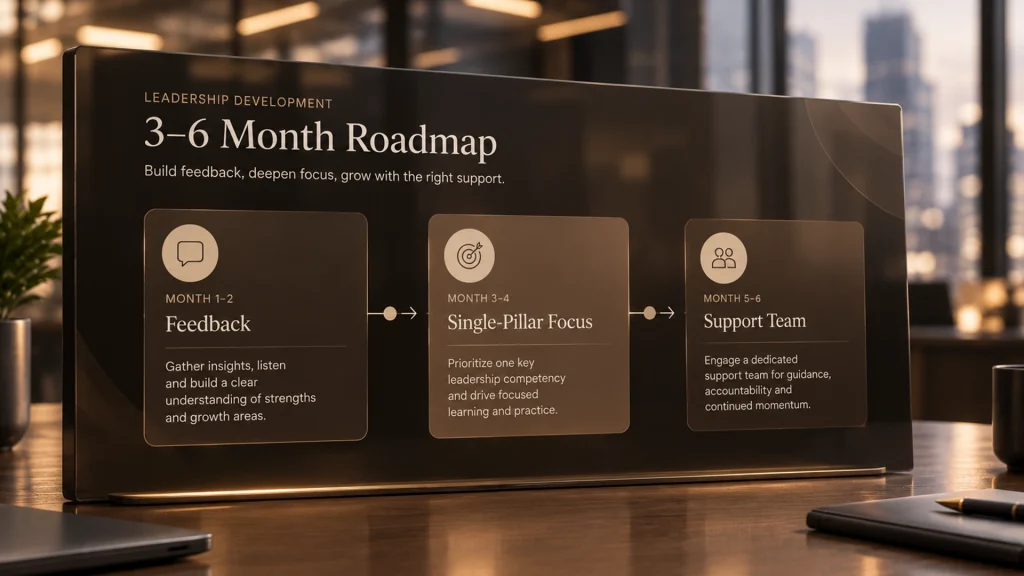
Developing executive presence is a 3–6 month practice, not a weekend workshop, built through daily interactions, not rare moments.
- Month 1–2: Gather data. Run a structured 360; India-based platforms such as Mercer | Mettl, or global tools like SHL and Korn Ferry, are widely used in Indian corporates, or DIY it with three specific questions: “When do I come across as most and least credible in meetings?”, “Where do I over-explain or hedge?”, and “What would make you more likely to put my name forward for a stretch role?” Vague praise moves nothing; specific feedback does.
- Month 3–4: Focus on one pillar. Pick gravitas, communication, or poise; practise 2–3 behaviours and track them in a journal. Self-awareness grows through reflection, not rumination.
- Month 5–6: Build a support team. Find a sponsor, and join or create a women’s peer-coaching circle for candid feedback and psychological safety. The most common failure mode is skipping the sponsor step and grinding on self-improvement alone, presence you build in rooms you’re in still needs someone to carry your name into the rooms you’re not.
Measuring Your Executive Presence Progress
Most women are left guessing whether they’re improving. Make it measurable: pick 5–6 countable behaviours: filler words per meeting, times you reclaimed the floor, whether you led with your recommendation; and self-assess weekly instead of relying on vague or biased feedback. Record yourself in one real meeting a month and score the same behaviours. Objective self-measurement turns presence from an abstract label into something you can move, and watching the numbers improve is where durable confidence comes from.
Building Executive Presence That Feels Authentic and Sustainable
This is not about acting like someone you’re not. Developing executive presence is about amplifying your strengths so others can reliably see and trust them. Authenticity and emotional intelligence are components of presence, not obstacles to it.
A practical anchor: choose 3–4 leadership adjectives (“calm, decisive, inclusive, strategic”), use them as a daily compass before meetings, and let go of needing all the answers. One honest caveat: authenticity is not the same as never adapting. “Be authentic” becomes a trap when read as “never adjust your natural style”, presence is inherently somewhat performative, and women who refuse all adaptation often plateau while calling it integrity. Adapt the delivery; keep the substance yours.
Conclusion
Executive presence for women is learnable, and the fastest route isn’t becoming someone else, it’s making the leadership you already have visible in the moments that decide recognition. Gravitas, communication, and poise, adapted for the Indian workplace and practised over three to six months, close the gap between doing the work and being seen to lead. Pick one pillar, choose a handful of countable behaviours, secure a sponsor, and measure your progress. Presence is one lever among several: real outcomes also depend on your organisation’s culture, your sponsors, and how consistently you execute, so treat this as a practice rather than a guarantee. Remember the figure this guide opened with: presence accounts for roughly 26% of what decides the next promotion, the single largest factor after results themselves. The room is already reading you; this is how you make sure it reads your capability.
Frequently Asked Questions
Q1. What is executive presence for women?
Executive presence for women is the observable ability to project gravitas, clear communication, and credibility so others trust your judgement and see you as ready to lead. It bridges competence and recognition, and it is a set of learnable behaviours, not an innate trait.
Q2. What are the 7 C’s of executive presence?
The most widely cited “7 C’s” framework (popularised via Forbes and Business Insider) lists Composure, Connection, Charisma, Confidence, Credibility, Clarity, and Conciseness. They expand the classic three pillars (gravitas, communication, and appearance) into more granular, practisable behaviours.
Q3. What are the three C’s of executive presence?
The foundational model has three elements (gravitas, communication, and appearance) first framed by researcher Sylvia Ann Hewlett. When people say “three C’s,” they usually mean a compression into confidence, credibility, and communication. All the popular C-frameworks trace back to these same pillars.
Q4. What are the five C’s of women’s work?
A different concept, and a common confusion. The “five C’s of women’s work” (cleaning, caring, clerical, cashiering, and catering) is a sociology term for the low-paid sectors where women’s labour has historically been concentrated. It describes occupational segregation, not executive presence.
Q5. How do you demonstrate confidence without appearing aggressive as a woman?
Anchor confidence in clarity, not volume: lead with your recommendation, pause before responding, and reclaim the floor calmly. Context-switch your register, lean assertive to establish credibility and influence, lean warm to build coalition, rather than trying to be both at once.
Q6. How do you develop executive presence as a woman?
Treat it as a 3–6 month practice: gather 360-degree feedback (months 1–2), focus on one pillar and repeat 2–3 behaviours (months 3–4), then build a sponsor relationship and peer-coaching circle (months 5–6). Measure a few countable behaviours weekly to build confidence you can see.
Q7. What daily habits build executive presence for women?
Lead meetings with your headline recommendation, pause two seconds before responding, slow your pace 10–15%, reclaim the floor after interruptions, state contributions directly, and take one breath before answering a challenge. Consistency across ordinary meetings builds the confidence and muscle for high-stakes ones.
Q8. What executive presence traits do successful female CEOs share?
They use “calculated voice” (speaking when they can shift an outcome), maintain composure under pressure, communicate decisions rather than suggestions, and manage spatial and vocal authority deliberately; think Indra Nooyi claiming a central seat early, or Kiran Mazumdar-Shaw’s calm, high-conviction style in building Biocon. They adapt delivery while keeping their substance authentic.
Q9. Are female CEOs more successful?
Research increasingly challenges old stereotypes: studies rate women leaders highly on both communal and assertive behaviours, and reviews link women’s leadership to positive organisational outcomes. Success depends far more on context, sponsorship, and culture than on gender, the gap is in access to top roles, not performance.
Q10. Can executive presence be learned, or is it innate?
It is learned. Executive presence is a set of observable, practisable capabilities: composure, clear communication, decisive framing, and poise; developed through daily repetition and specific feedback, not a personality you’re born with.


