


TL;DR
- Universal Skillset: Negotiation is a daily, purposeful conversation to find mutually agreeable solutions, fundamental for personal and professional success by building stronger relationships and advancing careers.
- Pivotal Competencies: Success is driven by core skills like emotional intelligence, which maintains constructive dialogue, and adaptability, allowing you to effectively pivot when new information emerges.
- Strategic Frameworks: Negotiation spans five key strategies, from Competitive (“I Win-You Lose”) to Collaborative (“I Win-You Win”), with the BATNA technique serving as a crucial, empowering safety net for every discussion.
- Continuous Refinement: Improvement relies on thorough preparation and confident communication, requiring you to embrace compromise while offering multiple solutions within a clear, focused timeline.
Ever find yourself negotiating without even realising it, like deciding where to go for a family trip or convincing your friend to watch your favourite movie? It’s not just for serious business talks; it’s part of our everyday lives. Did you know people negotiate around six times before grabbing breakfast? Negotiation is all around us, from convincing your little sibling to share toys to figuring out what’s for dinner.
In this blog, we’ll take a closer look at the art of negotiation—breaking it down from the big boardrooms to the little moments where we finesse our way through decisions. Ready to uncover the secrets behind successful negotiations? Let’s dive in!
What Is Negotiation?
In its simplest form, negotiation is like a conversation with a purpose. It’s a back-and-forth where people try to reach an agreement that works for everyone involved. Consider finding common ground in a world with different wants, needs, and goals. Imagine it as a puzzle where each piece has different shapes and colours. The challenge is to put them together so that everyone nods in agreement.
In everyday life, negotiation happens all the time. Whether deciding on a movie to watch with friends or working out who does the dishes, it’s about finding a middle ground where everyone feels satisfied.
Now, when we zoom into the professional world, negotiation becomes more complex. It’s not just about movies or chores; it’s about salaries, project plans, and business deals. It involves discussing, sometimes debating, and ultimately finding a solution that suits all parties.
“This 3-month journey has been enlightening, as I transitioned from an ambitious manager to an inspiring leader. Applying Kapable’s techniques, I confidently delivered a 30-minute speech at our Annual Planning Session, receiving positive feedback from my team. Kapable has been instrumental in helping me reach my full potential.”
– Sailesh Gadalay (Sr Account Director – Enterprise Sales At Linkedin)
Why Are Negotiation Skills Important?
Negotiation skills are not just a tool in the professional toolkit but a fundamental aspect of personal and professional success. Understanding why these skills matter can motivate you to invest time and effort into honing them.

Effective Communication
Being good at negotiation really helps you talk things out well, both in your personal life and at work. If you can express your thoughts clearly and listen carefully during negotiations, it stops misunderstandings and fights from happening. In your personal life, it makes sure everyone understands each other better. At work, negotiation for agreements ensures everyone is happy with the decisions.
Strong Relationships
Knowing how to negotiate is like building strong friendships. When you can find common ground and work out differences in a positive way, it makes trust and respect grow. This is true for your relationships and also when you work with others. If you can handle negotiations well, it improves relationships and helps them stay strong when there are challenges.
Professional Advancement
If you can talk about things like your salary, getting a promotion, and plans for your work smartly, it puts you in a good position for success. When you can stand up for what you need through negotiation, it gives you more control. Companies like having employees who are good at negotiations, so if you want to do well and grow, it’s important to work on these skills.
Having established the importance of negotiation skills, let’s now zoom in on the specific skills that are pivotal in shaping positive negotiation results.
Effective negotiation comes from balancing preparation, communication, and adaptability, and Kapable helps professionals strengthen each of these capabilities through structured leadership development.
What Are The Most Important Negotiation Skills?
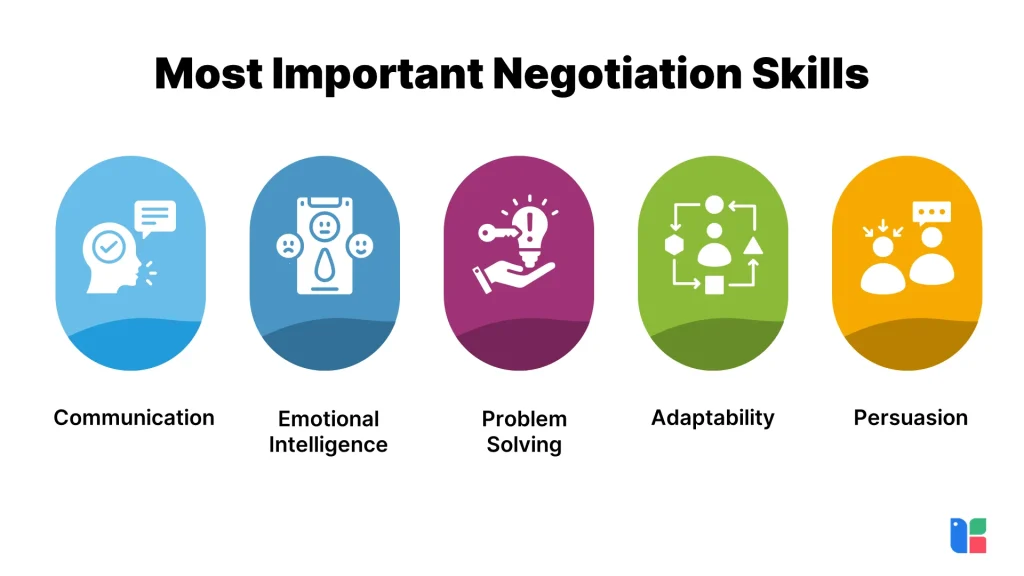
Negotiation skills go beyond just having strategies in your toolkit; they are the dynamic elements that breathe life into successful discussions. Let’s explore these skills in more detail, highlighting how each plays a crucial role in shaping positive negotiation outcomes:
Communication
Clear communication is the key to effective negotiation. Consider a salary negotiation scenario: expressing your expectations and reasons clearly to your employer helps foster understanding. Likewise, actively listening to their considerations ensures a more productive and empathetic conversation, creating a foundation for a satisfactory agreement.
Emotional Intelligence
In the heat of negotiations, emotions often come into play. Imagine negotiating project timelines with a team member. Recognising and managing your emotions and theirs is vital for maintaining a constructive atmosphere. Emotional intelligence enables you to navigate disagreements with empathy and tact, fostering a more positive negotiation environment.
Problem-Solving
Negotiations inherently involve problem-solving. Picture a scenario where two business partners are discussing a potential collaboration. The ability to identify potential roadblocks, offer creative solutions, and collaboratively address challenges ensures a smoother negotiation process. Problem-solving skills turn obstacles into opportunities for mutual benefit.
Adaptability
Negotiations rarely follow a scripted path. Being adaptable is akin to having a flexible map that adjusts to unexpected detours. Suppose you are negotiating a business deal, and new information comes to light. The ability to pivot your strategy and approach ensures that you can respond effectively to changing circumstances, increasing the likelihood of a successful outcome.
Persuasion
Persuasion is a pivotal negotiation skill involving influencing others by crafting compelling arguments aligned with their interests. It goes beyond presenting facts, requiring the ability to tailor messages effectively. Whether negotiating a contract or seeking buy-in, persuasive skills enhance the likelihood of a positive outcome by swaying opinions and highlighting mutual benefits.
Now that we’ve uncovered the essential negotiation skills let’s broaden our perspective and explore individuals’ various strategies in different negotiation scenarios.

What Are The Different Types Of Negotiation Strategies?
Negotiation strategies are diverse and impactful, influencing the dynamics of discussions. Let’s take a closer look at each strategy:

Competitive Negotiation (I Win- You Lose)
In this way of negotiation, the main focus is winning, sometimes without thinking about the other person. It means using strong tactics, and it’s all about personal goals, not so much about building a good relationship. For example, in a business deal, someone might insist on the highest price, not considering if the other person can afford it, which can strain the business relationship. The key skill here is persuasion, requiring crafting compelling arguments to influence decision-making.
Collaborative Negotiation (I Win – You Win)
Collaborative negotiation is like teamwork, where both people want to win. It’s about talking openly, solving problems, and finding creative solutions. Think about two business partners talking about how to share profits, thinking about each other’s contributions, and working together so that both are happy with the result and their partnership strengthens. The skills crucial in collaborative negotiations are effective communication and solving problems collectively.
Compromising Negotiation (I Lose / Win Some – You Lose / Win Some)
Compromising negotiation is like finding a middle ground. It’s giving and taking from both sides to reach an agreement. Imagine you’re buying something, and the seller wants a high price, but you want it lower. In a compromise, you might agree on a fair price that works for both, or in a business contract, both parties might give up a bit on what they want to make a deal that satisfies both. Adaptability and problem-solving skills are essential to identify solutions that satisfy the needs of both parties.
Avoidant Negotiation (I Lose – You Lose)
Avoidant negotiation is when people avoid talking about things to skip possible problems. While it might seem like a quick fix, it often leads to more significant problems later. For instance, if coworkers avoid discussing who should do what tasks, it can create confusion and resentment, making the team less efficient and satisfied in the long run. In scenarios where team members avoid discussing responsibilities, emotional intelligence becomes crucial. Understanding and managing emotions are vital in preventing long-term issues stemming from unresolved conflicts.
Accommodating Negotiation (I Lose – You Win)
Accommodating negotiation is about keeping the relationship good, even if it means giving in to the other person. It’s like saying, “I’ll let you have your way because our relationship is important.” In a group project, someone might agree to a teammate’s idea, even if it changes the plan, to keep the group happy and maintain a positive working atmosphere. It’s about valuing the relationship over personal preferences, ensuring everyone feels respected and heard. The skills here include emotional intelligence and building and sustaining positive relationships.
What Is The Key Negotiation Technique Known As BATNA?
Now that we’ve covered the essential negotiation skills let’s dive into a crucial technique that can be your secret weapon – BATNA, or the Best Alternative to a Negotiated Agreement.
Understanding BATNA
BATNA is essentially your backup plan, your safety net. It represents the best course of action you can take if the current negotiation doesn’t lead to an agreement that meets your needs. Developing a strong BATNA is like having a plan B, ensuring you’re not left vulnerable.
How BATNA Works
Let’s break it down with an example. Imagine you’re negotiating a job offer. Your BATNA could be another job offer you’ve received or exploring new job opportunities. Knowing you have a viable alternative empowers you during the negotiation. If the terms don’t align with your expectations, you can confidently consider your BATNA, allowing you to renegotiate or pursue a different opportunity.
- Competitive Negotiation: In a competitive negotiation, a strong BATNA is crucial. Knowing your Best Alternative allows you to confidently pursue your interests without resorting to overly aggressive tactics, providing a safety net to walk away if needed.
- Collaborative Negotiation: BATNA is valuable in collaborative negotiations, fostering transparency and trust. Knowing your Best Alternative ensures a mutually beneficial outcome, guiding the discussion with a clear understanding of your limits.
- Compromising Negotiation: In compromising negotiations, BATNA plays a pivotal role in assessing the fairness of concessions. If the negotiated agreement doesn’t surpass your BATNA, it prompts a reconsideration of the compromise’s viability.
- Avoidant Negotiation: In situations where people avoid negotiations, a strong BATNA is a preventive measure. Knowing your Best Alternative encourages proactive problem-solving, reducing the inclination to avoid discussions.
- Accommodating Negotiation: BATNA remains valuable even in accommodating negotiations, where relationships are prioritised. It ensures concessions maintain balance, providing a benchmark to evaluate the accommodation’s impact on your overall position.
If the terms of the current negotiation don’t align with your goals, having a strong BATNA allows you to pivot confidently, ensuring you don’t end up in a deal that doesn’t serve your business interests.
How To Improve Your Negotiation Skills?
Negotiation, like any art, thrives on continuous improvement. Let’s dive deeper into these actionable tips to not only enhance your negotiation skills but to add significant value to the negotiation process:

Prepare Thoroughly
Go beyond surface-level knowledge. Understand the motivations, priorities, and potential challenges of all parties involved. Equip yourself with relevant data and insights. By being thoroughly prepared, you boost your confidence and position yourself as a knowledgeable and credible negotiator.
Embrace Compromise
Negotiations are a delicate balance of give and take. Embrace the art of compromise while being mindful of your non-negotiables. Finding common ground, even in areas of disagreement, fosters collaboration, laying the foundation for enduring and positive relationships.
Set A Clear Timeline
Time management is often overlooked in negotiations. Establish a realistic and transparent timeline that outlines key milestones and deadlines. A well-structured timeline ensures that discussions remain focused and adds a layer of accountability, encouraging all parties to work efficiently toward resolution.
Present Multiple Solutions
Elevate your negotiation approach by offering a variety of solutions. This showcases your flexibility and demonstrates a genuine commitment to finding mutually beneficial outcomes. The richness of options allows for a more nuanced exploration of possibilities, fostering creativity and collaboration.
Speak With Confidence
Confidence is infectious and pivotal in negotiation settings. Project confidence through clear and assertive communication. Maintain eye contact, articulate your points with conviction, and exude a sense of assurance. Confidence not only instils trust but also strengthens your ability to influence the direction of the negotiation.
Choosing the right learning experience is an important step towards becoming a more effective negotiator, and Kapable helps you evaluate whether its approach is the right fit.
Conclusion
Whether it’s making deals in business, solving problems in a team, or just getting along with people in our lives, negotiation is the key to finding solutions that make everyone happy. It’s not just about making agreements; it’s about talking in a way that makes sure everyone’s thoughts and needs are considered. So, no matter what you’re dealing with, negotiation is like the secret sauce that helps things go smoothly and brings success to the table.


