


TL;DR
- Rational Process: Critical thinking is a process of disciplined, rational thought that breaks down complex ideas and connects them logically to arrive at well-reasoned, active decisions.
- Broad Significance: It is crucial for driving innovation, economic competitiveness, and forms the essential basis for reliable scientific and democratic processes.
- Key Personal Benefits: Cultivating this skill is vital for career success, as it builds independence, promotes critical self-reflection, and helps navigate misinformation effectively.
- Mastery Methods: Developing this skill is achieved through deliberate practices such as challenging assumptions, breaking down problems, and consistently utilising a reflective learning cycle.
Can you recall a time when you questioned a commonly accepted belief or practice at work? Maybe it was a long-standing procedure that didn’t seem to fit with the current situation or a new strategy that seemed off. It’s those moments of doubt and curiosity that can really test our decision-making skills. When faced with conflicting viewpoints, how do you determine which source or perspective to trust? Do you go with your gut feeling, or do you dig deeper to understand the reasoning behind each side?
These are the scenarios where critical thinking becomes essential. It’s not just about challenging what’s been accepted for the sake of it but about finding clarity and making informed choices. So, how exactly do we approach this process of questioning and evaluating effectively? The answer lies in understanding and applying the principles of critical thinking.
What Is Critical Thinking?
Critical thinking is the ability to think critically and rationally, understanding the logical connection between ideas. It involves evaluating information and arguments, identifying patterns and connections, and making decisions based on well-reasoned analysis rather than emotional responses or assumptions.
Critical thinking is about being an active, rather than a passive thinker. It’s not just about having thoughts; it’s about having the right kind of thoughts, those that are carefully considered and well-supported. The key aspects of critical thinking include:
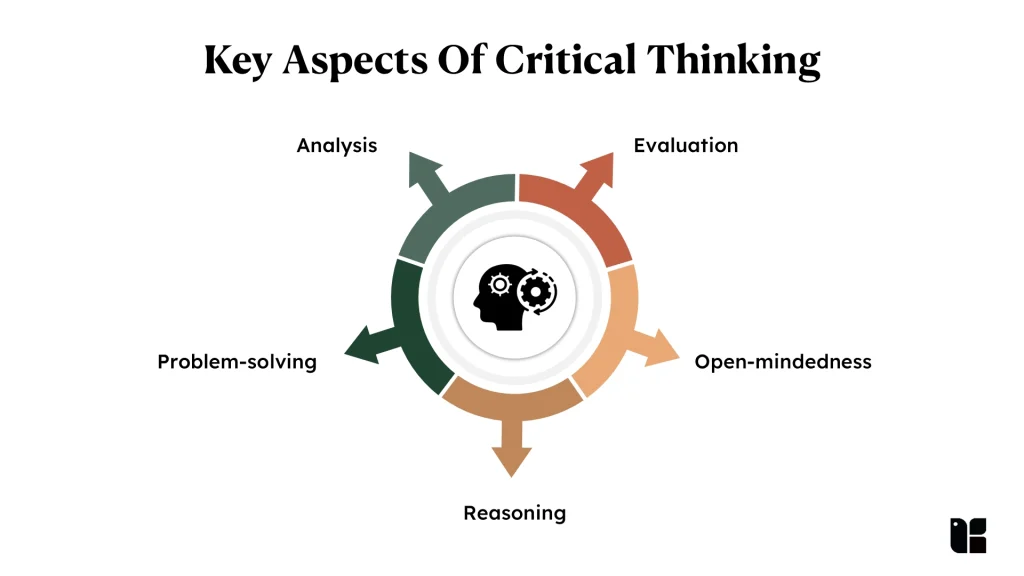
- Analysis: This means breaking down complex information into smaller, more manageable parts. It’s like taking a big puzzle and figuring out how each piece fits together.
- Evaluation: Here, you assess the credibility and relevance of information. This involves questioning the reliability of sources and the strength of arguments.
- Reasoning: Critical thinking requires using logic to connect ideas and draw conclusions. It’s about following a clear path from premises to conclusion without falling into logical traps.
- Open-mindedness: Being open to different viewpoints and willing to consider new evidence is crucial. It means not just sticking to your initial beliefs but being willing to adjust your thinking in light of new information.
- Problem-solving: Applying critical thinking to solve problems involves identifying possible solutions, weighing their pros and cons, and choosing the most effective course of action.
Someone with critical thinking skills and problem-solving skills can transform complex information into actionable insights and make well-informed decisions. For instance, they can:
- Understand connections: See how different pieces of information relate, like linking customer feedback and market trends to address a drop in sales.
- Determine relevance: Focus on what truly matters, such as highlighting key experiences in a job interview that align with the job requirements.
- Identify weaknesses: Spot and address flaws in arguments or plans, like noticing a gap in a marketing campaign’s budget plan.
- Ask thoughtful questions: Probing deeper to reveal more, such as questioning the assumptions behind a new business strategy.
- Reflect on assumptions: Re-evaluate beliefs based on new data, like reassessing a market strategy in light of changing conditions.
These abilities not only enhance decision-making and problem-solving but also contribute to more effective and informed outcomes. Next, we’ll explore why these critical thinking skills are so important and how they impact various aspects of life and work.

Why Critical Thinking Matters?
Critical thinking isn’t just an abstract skill, it has a tangible impact on how we navigate daily life and the broader world. Let’s look at the difference that critical thinking makes:

Critical thinking Is Universal
Critical thinking is a versatile tool that’s useful in almost every situation. Imagine you’re choosing between job offers, assessing a new gadget, or discussing a complex issue with friends. In each case, critical thinking helps you cut through the clutter and get to the heart of the matter.
It’s not just about having thoughts but about having the right thoughts, those that are well-reasoned and clear. By applying critical thinking, you can make informed decisions, solve problems effectively, and understand issues more deeply, no matter the context.
Crucial For The Economy
Companies rely on leaders who can analyse market trends, anticipate challenges, and devise innovative solutions. Employees with strong critical thinking skills are better equipped to tackle unexpected problems and adapt to changes. This skill set drives productivity and keeps businesses competitive. It’s not just about managing tasks but about steering the company toward growth and success through insightful decision-making and creative problem-solving.
Improves Presentation Skills
Effective communication is key in almost every professional setting, and critical thinking sharpens this skill. According to the experts in leadership development, when you think critically, you can organise your ideas logically and present them in a compelling way.
Whether you’re preparing a report, delivering a presentation, or engaging in a conversation, clear thinking helps you express your points more convincingly. You can structure your arguments, highlight key facts, and address potential counterarguments, making your communication more effective and impactful.
Promotes Creativity
Critical thinking and creativity go hand in hand. By questioning assumptions and exploring different perspectives, you open yourself up to new ideas and solutions. Rather than stifling innovation, critical thinking encourages it. It’s about approaching problems from various angles and challenging the status quo. This mindset not only helps you think outside the box but also fosters a more inventive approach to problem-solving. It allows you to break free from the conventional thinking and discover creative solutions that others might overlook.
The Basis Of Science And Democracy
In science, it’s about rigorously testing hypotheses, analysing data, and drawing conclusions based on evidence. This methodical approach ensures that scientific findings are reliable and valid. In democracy, critical thinking helps individuals evaluate diverse opinions, make informed choices, and participate meaningfully in discussions. It supports a well-functioning democratic process by encouraging informed debate and thoughtful decision-making. Both science and democracy rely heavily on critical thinking.
Free From Research Bias
We have seen how critical thinking helps minimise bias in research and decision-making. By thoroughly examining evidence and questioning the credibility of sources, you avoid letting personal biases or assumptions skew your conclusions. This careful scrutiny ensures that your decisions and findings are based on objective, reliable information rather than skewed or incomplete data. It leads to more accurate and trustworthy outcomes, whether you’re conducting research or making important decisions.
Understanding these facets of critical thinking reveals why it’s such a valuable skill. It not only enhances personal and professional effectiveness but also enriches our understanding and contributions to the world around us.
“Kapable transformed my ability to communicate clearly and confidently, helping me transition from a technical role to a leadership position. I can now present ideas and build rapport effectively, enabling me to take on a role with significantly greater responsibility.”
– Satrajit Sengupta (Principal Business Manager At SAP)
What Are The Key Benefits Of Critical Thinking?
Critical thinking does more than sharpen your mind, it equips you with tools that can shape your success, relationships, and personal growth. Let’s take a closer look at the importance of critical thinking in everyday life:

Key For Career Success
Critical thinking helps you navigate challenges and solve problems efficiently at work. It’s what allows you to look at a situation from all angles, consider different solutions, and choose the one that fits best. Over time, this approach makes you better at decision-making, more adaptable to change, and more valuable to any team or organisation. Ultimately, it sets you apart, paving the way for a career with opportunities.
Creates Independence
By thinking critically, you rely less on others to make decisions for you. Instead, you develop the ability to analyse situations, weigh the pros and cons, and come to your own conclusions. This independence leads to greater confidence in your choices, allowing you to trust your own judgement and move forward without constantly second-guessing yourself.
Greater Self-Reflection
Critical thinking helps you question not just the world around you but also your own beliefs and assumptions. By reflecting on your actions, decisions, and thought processes, you gain a deeper understanding of yourself, what drives you, what you value, and where you need to grow. This self-awareness leads to personal development and a clearer sense of direction in life.
Keeps You Well-Informed
Critical thinking pushes you to seek out credible information and evaluate it thoroughly before forming opinions or making decisions. Instead of relying on surface-level details or assumptions, you dig deeper to understand the facts and context. This approach keeps you well-informed even when information is constantly changing which makes you smarter, with better thoughtful decisions in all areas of life.
Navigates Through Misinformation
With so much information out there, it’s easy to be misled. Critical thinking helps you spot false or misleading claims by encouraging you to question sources, verify facts, and consider multiple perspectives, ensuring that the choices you make are based on truth rather than assumption or misinformation.
Confidence Amplification
When you think critically, you have a clear and logical basis for your decisions, which naturally boosts your confidence. Knowing that your conclusions are well thought out gives you the assurance to stand by them, whether in a meeting, a negotiation, or a personal conversation. Over time, this confidence makes you more assertive and capable in both your personal and professional life.
Understanding these key benefits shows that it is more than just a skill; it’s a tool that improves various aspects of life, from career advancement to personal growth. And now that we’ve seen how it helps, we can appreciate why it’s worth developing.
Which Examples Best Represent Critical Thinking Skills?
Here are key examples of the skills that make up strong critical thinking, which breaks down what you need to do and how to do it:
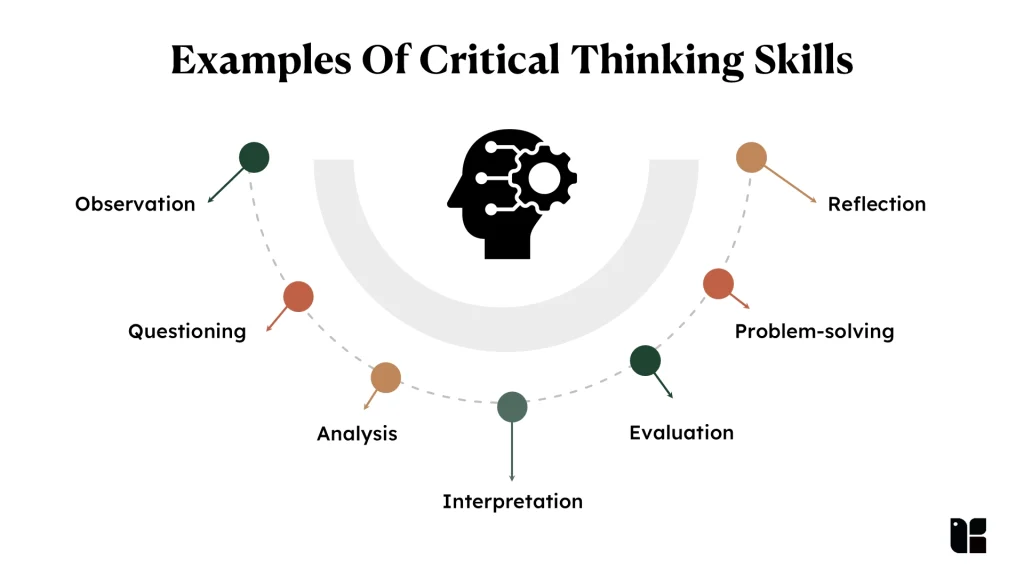
- Observation
The first skill is noticing details others might overlook. Stay alert and fully present, whether in meetings or casual conversations. Carefully gathering facts ensures that you have a solid foundation before jumping to conclusions. For instance, actively listening to a team discussion helps you identify patterns or key points others may miss. - Questioning
Effective critical thinkers are always curious. They don’t accept information at face value and ask thoughtful questions like, “Is this data reliable?” or “What assumptions are being made?” Constantly digging deeper allows you to challenge the information and identify gaps that need filling.
- Analysis
A critical thinker can break complex situations into manageable parts. Organising information through lists, charts, or mapping connections is key. For example, when evaluating a business plan, break it down into key sections, such as costs, risks, and potential gains, to analyse each aspect separately. - Interpretation
This skill involves understanding the meaning behind the information you’ve gathered. It’s about connecting the dots to see the bigger picture. For instance, if sales numbers drop after a product launch, interpreting the data might reveal underlying issues like pricing or customer feedback. - Evaluation
Knowing how to assess the credibility of information is critical. This involves weighing the strengths and weaknesses of the evidence. Whether you’re reviewing a report or making a business decision, evaluating the sources and evidence ensures you don’t rely on weak or faulty information. - Problem-solving
Critical thinking naturally leads to effective problem-solving. After analysing the situation, evaluate all possible solutions and pick the best one. Think through the pros and cons of each option to choose the most practical and impactful solution for your scenario. - Reflection
After any decision or problem-solving effort, reflecting on the process is essential. Ask yourself what worked well and what could have been done better. This self-reflection ensures that you continuously improve your approach and apply better judgment in the future.
By sharpening these critical thinking skills, you can handle challenges thoughtfully and make informed decisions in any situation, and Kapable helps you build these skills through structured learning and feedback.
How To Think Critically?
Mastering critical thinking involves more than just asking questions or listening actively. It’s about applying deliberate, practical techniques that push your thinking to new levels.
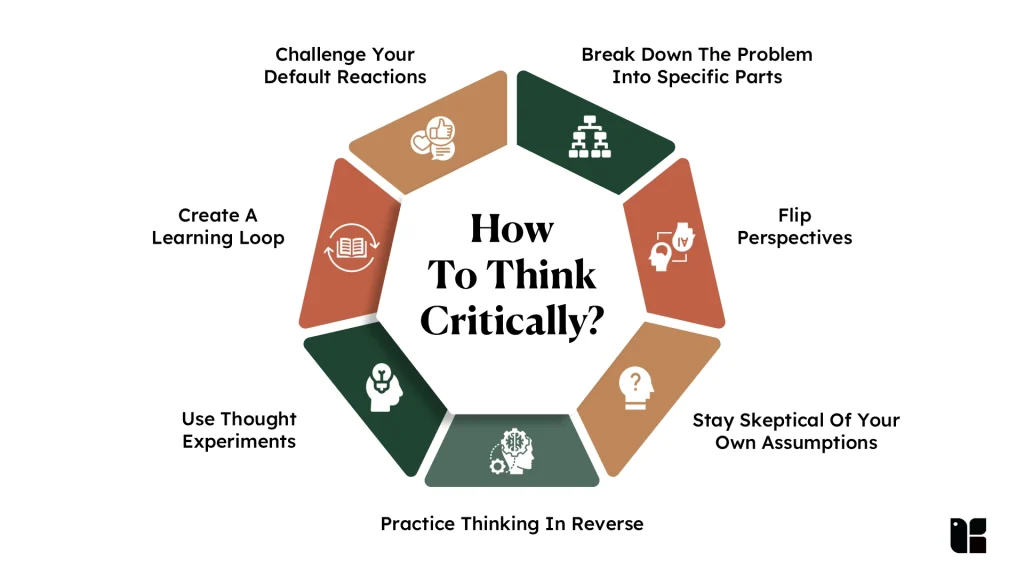
Challenge Your Default Reactions
Instead of instantly reacting to a situation or piece of information, pause and examine your initial response. Ask questions why you’re reacting a certain way. Is it based on habit, assumptions, or personal bias? By challenging your gut reactions, you create space for more thoughtful, measured responses.
Break Down The Problem Into Specific Parts
When faced with a complex issue, break it down into smaller, more manageable pieces. Ask what the core issue is, what factors are contributing, and which areas need attention. For example, if your team isn’t meeting a deadline, separate the issue into workflow problems, communication gaps, and resource allocation. This targeted approach helps you tackle the right part of the problem instead of making sweeping changes that might miss the mark.
Flip Perspectives
This is one of the most effective ways to enhance your thinking is by putting yourself in others’ shoes. For example, if you’re facing a business decision, consider how different stakeholders would view the problem. What would a customer, competitor, or an employee think? This shift helps uncover insights and solutions that might not be obvious from your current perspective.
Stay Skeptical Of Your Own Assumptions
It’s easy to fall into the trap of believing that your assumptions are facts. Regularly test your own thinking by asking, “What if I’m wrong?” or “Could there be another explanation?” This practice of self-skepticism keeps your thinking fresh and open to new ideas.
For example, if you assume that a marketing strategy isn’t working because of poor timing, ask yourself what other factors can be in play, like the message itself or the target audience.
Practice Thinking In Reverse
Start at the desired outcome and work backward to identify the steps that would logically lead to that result. This reverse-engineering technique can help you uncover gaps in your plan or find more efficient solutions. For example, if you want to increase sales by 20%, trace the process back, what customer behaviour or internal changes need to happen first?
Use Thought Experiments
Create hypothetical scenarios to test your thinking. For instance, “What would happen if we slashed the marketing budget by 50%?” or “How would our company function if we adopted a remote-only work policy?” These experiments push your thinking beyond current limitations and open the door to creative problem-solving.
Create A Learning Loop
After making decisions or solving problems, revisit them to regularly assess their success. Were your judgments sound? Did your solution work as expected? This continuous feedback loop helps refine your thinking and builds the habit of reflecting on the effectiveness of your approach.
With these practical techniques, you’ll turn developing critical thinking into a natural habit, enhancing your ability to tackle challenges and seize opportunities with confidence.
Conclusion
Critical thinking isn’t just an isolated skill; it’s a way of engaging with the world that opens doors to deeper understanding and more effective action. You not only use critical thinking to improve how you process information but also how you interact with others and solve problems. This shift can have a profound impact, enhancing both personal growth and professional success.
For those eager to develop these skills further, engaging in specialised training and workshops can offer valuable insights and practical techniques, whether through immersive learning experiences or interactive tools, continuing your journey in critical thinking for effective leadership and innovative solutions in your field.
Strong thinking skills create long-term value across every role and industry, and Kapable helps you determine whether its approach matches your growth needs.


