


TL;DR
- Cognitive Foundation: Thinking skills are essential mental tools that allow us to analyse information, solve complex problems, and make effective, well-considered decisions in all areas of life.
- Diverse Mental Models: Mastering a spectrum of thinking from the objective, methodical logic of Analytical and Critical thinking to the flexible, idea-generating approaches of Creative, Divergent, and Lateral thinking is key to navigating complexity.
- Practical Skill Development: Techniques like Socratic questioning, Brainstorming, Mind mapping, and the “Five Whys” are structured processes that can be intentionally used to sharpen cognitive abilities and drive innovative problem-solving.
Think about the first time you learned to ride a bicycle. At first, it’s all about following instructions: pedalling, balancing, and steering. But as you practice, something changes. You start noticing how the bike moves, how your body reacts, and how to make adjustments when things go wrong. You begin thinking, planning your movements, and using problem-solving skills to stay balanced. Before you know it, riding the bike becomes second nature. This is a perfect example of how different thinking skills are essential in any learning process. By understanding and developing these thinking styles, learners can gain a deeper insight into their challenges and improve their ability to master any skill they pursue.

What Are Thinking Skills?
Thinking skills are the mental abilities we use to understand, analyse, and apply information in order to solve problems and make decisions. These skills allow individuals to assess situations, reflect on different perspectives, and arrive at well-considered conclusions. They are essential in everyday life as they help us navigate complex tasks, adapt to changing circumstances, and evaluate various options. By improving our thinking skills, we become better at interpreting data, questioning assumptions, and tackling challenges in a methodical way.
At their core, thinking skills involve the ability to be self-aware of how we process information, enabling us to refine our approaches to problem-solving. Key components of these skills include critical thinking, creativity, and decision-making, which go beyond just processing facts. They help us generate new ideas, assess risks, and identify effective solutions. The process of using different types of thinking skills can help you identify the problem and then develop a solution effectively. Strong thinking skills are crucial in both personal and professional life, contributing to better decision-making, innovation, and successful outcomes in various contexts.
Understanding thinking skills lays the foundation for exploring the different types, each playing a vital role in our cognitive processes and influencing how we approach challenges.
Which Types Of Thinking Skills Are Most Common?
Thinking skills are the mental processes that empower us to evaluate, analyse, and make decisions. Understanding the various types can open up new ways of approaching challenges and making smarter choices in all areas of life:

Critical Thinking
Critical thinking means using your mind to carefully analyse and assess information. It’s about questioning what you hear or read, not just accepting things as they are. Instead of jumping to conclusions, critical thinkers take the time to evaluate the evidence and think logically before making decisions. The following given below are the characteristics of critical thinking:

- Being open-minded and objective
- Thinking logically and clearly
- Challenging assumptions and questioning what is accepted
- Focusing on facts and evidence
- Recognising biases or flaws in reasoning
For instance, Mahatma Gandhi used critical thinking during India’s fight for independence. Rather than following violent methods of protest, he critically assessed how nonviolence could be a more effective way to bring about change. Gandhi’s decisions were based on a thoughtful evaluation of the situation, an understanding of human nature, and the desire for peace.
Creative Thinking
Creative thinking is all about looking at problems from new angles and coming up with fresh ideas. It’s the ability to think outside the box, imagine new possibilities, and find unique ways to solve problems. Let’s explore the characteristics of creative thinking:

- Coming up with original and fresh ideas
- Being flexible and open to different possibilities
- Willing to experiment and take risks
- Seeing connections between unrelated ideas
- Embracing new and unusual ways of thinking
For instance, Leonardo da Vinci was a master of creative thinking. Not only was he an artist, but he also invented machines and studied human anatomy. His most famous paintings, like the “Mona Lisa,” changed the way art was perceived. Da Vinci’s ability to combine art, science, and engineering helped him come up with revolutionary ideas and inventions.
Analytical Thinking
Analytical thinking is about breaking down complex problems into smaller, easier-to-understand parts. It involves looking at the details, spotting patterns, and using logical steps to make decisions. If you are able to use analytical thinking, it can improve how you approach problem-solving, and then lead to more effective decision-making. The characteristics of analytical thinking are as follows:
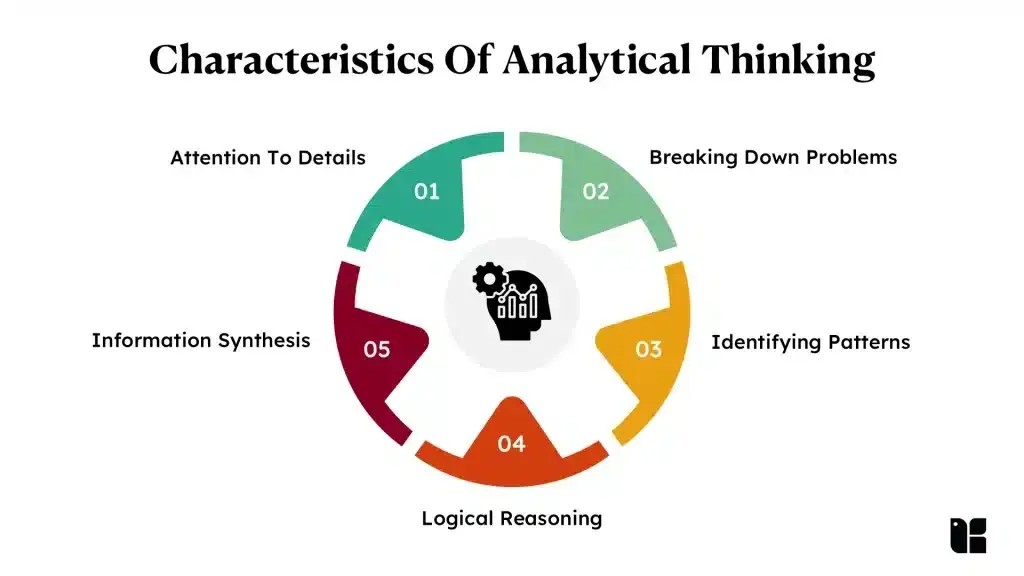
- Paying attention to details
- Breaking down problems into smaller parts
- Looking for patterns and connections
- Using clear and logical reasoning
- Combining information from different sources to form a conclusion
For instance, Charles Darwin showed excellent analytical thinking when developing his theory of evolution. On his travels, he carefully observed different species and collected data. He noticed patterns in nature, such as how species change over time, which led him to conclude that species evolve through natural selection. Darwin’s ability to analyse data and form clear conclusions changed the way we understand biology.
Critical, creative, and analytical thinking each support different kinds of decisions. At Kapable, professionals strengthen their ability to use the right style at the right time.
Abstract Thinking
Abstract thinking is the ability to think beyond what we can see or touch. It’s when we think about ideas, concepts, or situations that aren’t directly in front of us. Instead of focusing on the details of what’s happening right now, abstract thinkers can imagine future possibilities, connect different ideas, and understand complex situations that aren’t straightforward. The characteristics of the same are as follows:

- Being flexible in thinking approach or way when new information comes up.
- Find new ways to solve problems by looking at the bigger picture.
- often come up with new ideas and imagine things that don’t exist yet.
- Understanding future possibilities, linking ideas, and that shape our thoughts.
For instance, Walt Disney is a great example of abstract thinking. He didn’t just want to create a regular theme park; he imagined a world where fantasy and reality mixed. Disney thought about creating an experience, not just a place to visit. His ability to imagine an entire world of adventure, even before it was built, helped create Disneyland. His visionary thinking transformed the way we think about entertainment and created something much bigger than what people had seen before.
Linear Thinking
Linear thinking is when we approach problems step by step. It’s a straightforward way of thinking where each step follows logically from the one before. Think of it like following a recipe, each ingredient and instruction leads you to the next, until you have the final result. It’s very focused on solving problems by breaking them down into smaller, manageable tasks. The characteristics are as follows:

- Follow a step-by-step approach, completing each task before moving to the next.
- Use logical thinking, focusing on causes and facts to guide decisions.
- Stay focused on key results, working efficiently to reach goals.
- Expect predictable outcomes, as the process is clear and structured.
A great example of linear thinking can be seen in Steve Jobs and his approach to designing Apple’s products. Jobs didn’t just jump from idea to idea; he followed a clear, structured process to develop his products. For example, when he created the iPhone, he first identified a gap in the market for a better phone, then worked through each step, from design to production, to make sure everything was perfect. His methodical, step-by-step approach helped Apple become one of the most successful companies in the world, with products that meet people’s needs exactly.
Non-Linear Thinking
Non-linear thinking means approaching problems in creative and unexpected ways. Instead of following a straight path, you look at problems from different angles and explore various solutions. The characteristics of non-linear thinking are as follows:
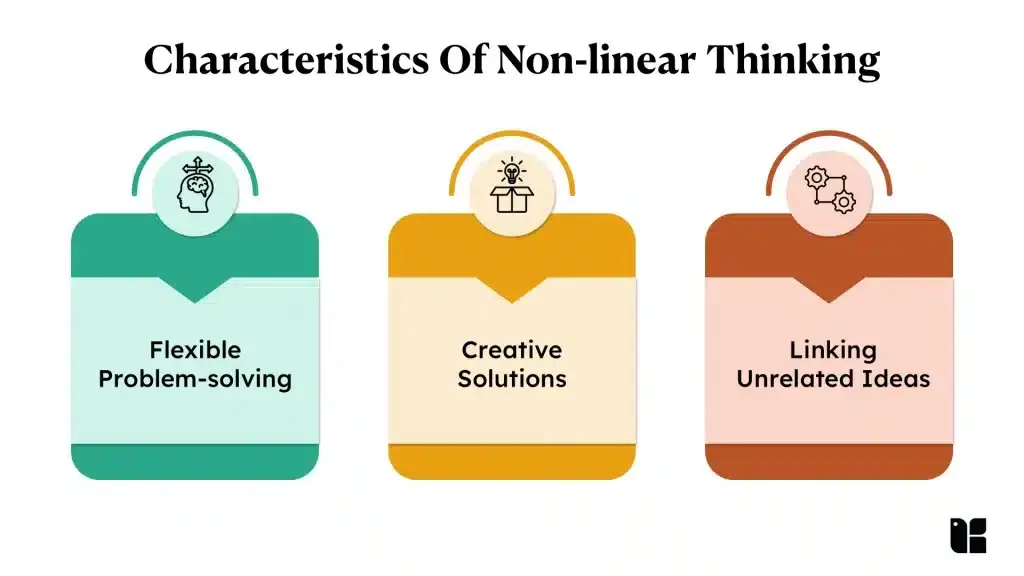
- Embrace flexible problem-solving by adapting your approach as new ideas emerge.
- Apply creative solutions by thinking outside the box & exploring fresh ways to tackle challenges.
- Recognise connections between seemingly unrelated ideas.
For instance, Richard Branson exemplifies non-linear thinking by venturing into industries like airlines, space travel, and healthcare. He applies customer-focused strategies from Virgin Records to disrupt sectors like aviation with Virgin Atlantic. His willingness to take risks and innovate in unexpected areas, such as combining aviation and space tourism with Virgin Galactic, drives his success
Divergent Thinking
Divergent thinking is about coming up with many different ideas and solutions to a problem. It’s the opposite of just sticking to one answer, it’s about exploring many possibilities. The characteristics of the same are as follows:

- Engage in idea generation by coming up with a lot of different ideas.
- Explore different possibilities by thinking about new ways to solve a problem.
- Engage in creative thinking by letting your imagination flow freely, without restrictions.
For instance, Albert Einstein demonstrated divergent thinking by exploring diverse scientific concepts, leading to his groundbreaking discoveries like the theory of relativity. He didn’t limit himself to conventional ideas, using thought experiments, such as imagining riding a beam of light, to consider alternative perspectives. This openness to multiple possibilities helped shape his revolutionary work.
“The experience has greatly boosted my confidence and transformed my communication skills. Frameworks like CARE and Mind-Mapping are now second nature, and feedback on my improved eye contact has been encouraging. Kapable has played a vital role in my growth, and I’m excited to continue this progress.”
– Govind Tegur (Group Project Manager At HCLTech)
Convergent Thinking
Convergent thinking means focusing on finding one correct or best solution to a problem. It’s about narrowing down options and using facts to make decisions. The characteristics of the same area are as follows:

- Exploring a single solution after weighing all available options.
- Assessing each choice thoroughly to identify the optimal one.
- Making a well-considered decision by selecting the most effective solution.
Imagine you are tasked with choosing the best route to get to a meeting on time. You have several options, including taking a faster highway, a scenic route, or a more familiar back road. The use of convergent thinking would allow you to assess each option based on factors such as travel time, traffic, and distance. After weighing all the available choices, you decide that the highway is the optimal route because it is the quickest and most direct. You narrow down your options to one well-considered solution based on the facts at hand.
Lateral Thinking
Lateral thinking is about solving problems in creative ways by thinking outside the box. It’s not about following a traditional path but finding new, unexpected solutions. The characteristics of the same are as follows:

- The non-linear approach moves away from step-by-step problem-solving, promoting fluid idea exploration.
- It challenges assumptions and encourages unconventional solutions.
- Focuses on generating multiple alternatives rather than settling on one.
- Uses indirect methods to find surprising connections or alternatives.
For instance, Edward de Bono, who coined the term “lateral thinking,” used this approach to help businesses come up with innovative ideas. He taught people to look at problems in new ways, leading to fresh solutions. In one case, companies applied lateral thinking to rethink product designs and marketing strategies, moving beyond conventional methods. This shift allowed them to discover unique opportunities and out-of-the-box solutions that competitors overlooked.
Concrete Thinking
Concrete thinking is about focusing on real, tangible facts and details. It’s straightforward thinking that deals with things you can see and touch, not abstract ideas. The characteristics of the same are as follows:

- The approach is practical, focusing on what is tangible.
- It is detail-oriented, emphasising specifics and facts.
- It considers what is feasible and practical in the present.
For instance, when cooking, concrete thinking involves following a recipe step by step, using precise measurements, and focusing on the practical aspects of cooking, such as heat levels, timing, and ingredient combinations, to achieve a successful dish.
Having explored the different types of thinking skills, it’s important to consider strategies to enhance these skills, enabling us to maximise our potential and tackle challenges with greater creativity and confidence.
How Can Thinking Skills Be Enhanced Effectively?
Enhancing thinking skills is essential for effective problem-solving, decision-making, and creativity. Here are some straightforward strategies to help you develop and improve your thinking skills:

Socratic questioning
Socratic questioning involves fostering a dialogue that promotes critical analysis through open-ended inquiries. By asking questions such as, “What evidence supports this claim?” or “What are the implications of this argument?” participants are encouraged to think deeply and consider various perspectives. This technique not only sharpens critical thinking but also nurtures a culture of curiosity and open-mindedness.
Brainstorming
Brainstorming is a group activity where people come together to share as many ideas as possible without worrying about being judged. A timer is often set to encourage quick thinking and free expression. After this idea-generation phase, the group reviews the ideas to find and develop the best ones, creating a space for creativity and teamwork. In brainstorming, participants gather to quickly share ideas within a set time, allowing everyone to contribute freely without fear of criticism.
Mind mapping
Mind mapping is a way to visually organise thoughts and ideas around a central topic. This technique helps people see how different ideas connect, making it easier to understand complex subjects. By using colours, images, and keywords, mind maps boost creativity and help with remembering information.
In mind mapping, individuals draw a diagram that connects related ideas to a main topic, using colours and images to make the information clearer and more memorable.
Flowcharting
Flowcharting is a visual tool that outlines a process in a sequential manner, allowing individuals to pinpoint tasks, decisions, and potential obstacles clearly. By creating a structured visual roadmap, flowcharting enhances problem-solving capabilities and efficiency. This technique is particularly beneficial in project management, where a clear path is essential for achieving desired outcomes.
Role-playing
Role-playing involves simulating different scenarios to explore problems from various perspectives. This technique promotes creative problem-solving and helps uncover new insights by allowing participants to embody different roles. By stepping into the shoes of others, individuals can develop empathy and discover innovative approaches to challenges, making it an effective tool for team dynamics and conflict resolution.
Word association
The word association technique involves generating a list of words related to a starting word, fostering free-flowing ideas and connections. This exercise encourages participants to break free from conventional thought patterns and explore a wide range of possibilities. By allowing creativity to flourish, this technique opens the door to innovative solutions and new ways of thinking. For instance, starting with the word “ocean,” participants might quickly list “waves,” “marine life,” “beach,” and “adventure,” sparking diverse ideas for a new project.
Five whys
The “Five Whys” technique is a problem-solving approach designed to uncover the root cause of an issue by asking “why” multiple times. Typically, this involves repeating the question five times in succession to discover the underlying reason for a problem. This method reveals deeper issues that go beyond the surface, enhancing understanding and guiding efforts toward the most effective solution. By identifying these fundamental problems, individuals can create thorough solutions instead of merely addressing superficial symptoms.
Provocation technique (PO)
The Provocation Technique, introduced by Edward de Bono, encourages participants to challenge existing assumptions by making provocative statements. For instance, asking, “What if we changed our entire business model?” stimulates out-of-the-box thinking and allows teams to explore unconventional ideas. This approach fosters creativity and encourages innovative problem-solving by breaking through mental barriers.
By applying these unique techniques, individuals can enhance their thinking skills, improve their problem-solving abilities, and approach challenges with greater creativity and effectiveness across various contexts. Each type of thinking skill contributes significantly to personal and professional growth, enabling better decision-making and innovative solutions.
Conclusion
Understanding various thinking skills is essential for enhancing our cognitive abilities and achieving success in different areas of life. These skills enable us to tackle challenges with clarity, fostering effective problem-solving and innovative thinking. By recognising our thinking processes, we can leverage our strengths and identify areas for improvement, promoting personal growth and collaboration. This awareness equips us to navigate complex situations more effectively, fostering resilience and adaptability in a rapidly changing environment, ultimately leading to more meaningful and productive outcomes.
Different roles demand different thinking styles, making continuous development increasingly important. Kapable gives you a way to assess whether its approach matches your professional needs.


