


TL;DR
- Core Competencies: Critical thinking is valued for its role in problem-solving, strategic decision-making, and driving innovation, encompassing key abilities like analytical evaluation, adaptability, and creativity.
- Targeted Resume Application: Successfully showcase these skills by integrating specific, quantifiable examples of your analytical abilities and their impact throughout the Experience, Achievements, Skills, and Summary sections.
- Avoiding Resume Pitfalls: Move beyond vague, generic statements by always providing context, detailing the method you used, and quantifying the positive results of your critical thinking to be convincing.
- Continuous Skill Enhancement: Sharpening these abilities involves engaging in regular practice like strategy games, actively seeking peer or mentor feedback, enrolling in relevant courses, and reading widely to broaden your perspective.
Imagine giving a job interview with confidence and your ability to break down complex problems, consider different viewpoints, and make smart decisions. This ability to think critically is not just an impressive trait; it’s also highly valued by employers. 81% of employers today prepare you well for the future of work. There is a skill that helps you excel in today’s challenging work environments by standing out and contributing to your organisation’s success. In this blog, we’ll explore why critical thinking is so important in the job market and give you practical tips for highlighting this and eventually creating a critical thinking skills resume.
Why Is Critical Thinking Important On A Resume?
Critical thinking is a valuable quality that can make you stand out from other candidates. It’s a powerful skill that employers actively seek:

- Problem-solving excellence: Employers generally look out for employees who can easily solve difficult problems. Highlight instances where your critical thinking resulted in effective solutions, showcasing your ability to break down challenges and create practical solutions.
- Strategic decision-making: It shows how critical thinking improves your capacity to make accurate and precise strategic judgments. The strategic approach delivered outcomes demonstrating your decision-making ability.
- Flexibility: It emphasises how critical thinking strengthens your ability to adjust to new difficulties and changing circumstances. It helps us to adjust to uncertain changes that happen in our personal and professional lives,
- Driving innovation: It helps in driving organisational efficiency and promotes innovation. By giving examples of how your new ideas or process improvements have benefited your previous organisation.
Understanding why critical thinking is crucial helps you see its impact on your resume. Now, let’s explore the essential critical thinking skills you should highlight to showcase your strengths effectively.

Which Critical Thinking Skills Should Be Highlighted On A Resume?
In order to stand out in the job market, showcase your critical thinking skills on your resume. These skills are key to tackling complex problems, making well-informed decisions, and adapting to changing situations. Here are the critical thinking skills that can make a difference:
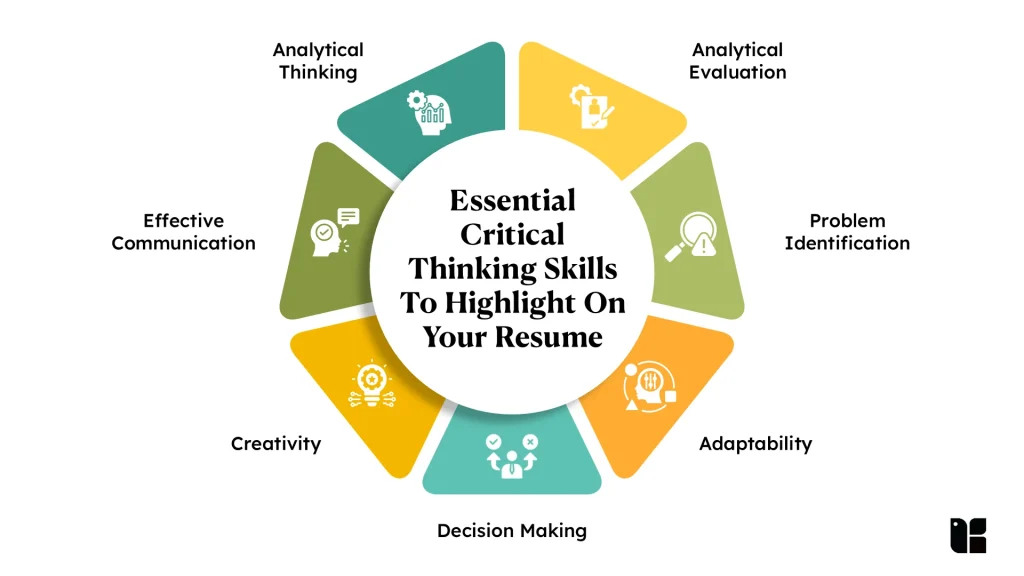
- Analytical thinking: Breaking down complex information into manageable parts. For example, simplifying a challenging project or analysing business reports for key trends.
- Problem identification: Spotting and defining challenges clearly. For instance, identifying issues in a group project or recognising inefficiencies in team processes.
- Analytical evaluation: Assessing options and their impacts. Entry-level employees might compare methods for a task, while experienced professionals evaluate strategies for better performance.
- Decision-making: Making informed choices based on data. Freshers might decide on project approaches, while experienced leaders make strategic decisions affecting broader outcomes.
- Adaptability: Applying critical thinking to new challenges. New graduates might adjust to changes in a project, while experienced managers adapt strategies to market shifts.
- Creativity: Generating new ideas and improving processes. Freshers might solve academic problems creatively, while seasoned professionals develop strategies that drive growth.
- Effective communication: Convey complex ideas with clarity. A graduate might present project findings, while an experienced leader communicates plans to teams and stakeholders.
Now that we’ve covered what critical thinking skills to highlight, let’s look at how to add these critical thinking skills examples to your resume and demonstrate the ability to think critically to potential employers.
Learn more about Kapable’s approach to helping professionals build workplace experiences that demonstrate critical thinking on resumes and in interviews.
How Can You Highlight Critical Thinking Skills Effectively On Your Resume?
To make a lasting impression in a competitive job market, it’s essential to highlight your critical thinking skills. This means showcasing your ability to analyse, interpret, and solve complex problems. Here’s how to present these skills effectively in different sections of your resume:
In The Experience Section
When showcasing your work history, it’s essential to highlight how your critical thinking has driven impactful results. This section helps you to show applications of your analytical skills and the significant effects they have had on your previous roles:

- Specific examples: Highlight how you addressed challenges by analysing data, identifying issues, evaluating options, and implementing solutions. For instance, describe a situation where you examined a declining sales trend, pinpointed inefficiencies in the sales process, and introduced a new CRM system that improved sales tracking and resolved communication gaps.
- Showcasing results: Provide details about the scenarios you encountered and the outcomes of your actions. For example, explain how you proposed a new workflow to streamline operations, which reduced processing time by 20% and enhanced client satisfaction.
- Problem-solving methodologies: Mention any problem-solving frameworks or methodologies you employed. For example, “Applied Six Sigma and Root Cause Analysis to tackle recurring defects and utilised Lean techniques, resulting in a 15% increase in efficiency over three months.” This illustrates your ability to leverage structured approaches for effective problem resolution.
In the Achievements Section
Achievements are a powerful way to highlight the direct impact of your critical thinking skills. Emphasise how your analytical prowess has led to measurable improvements and recognition, reinforcing the value you bring to potential employers:
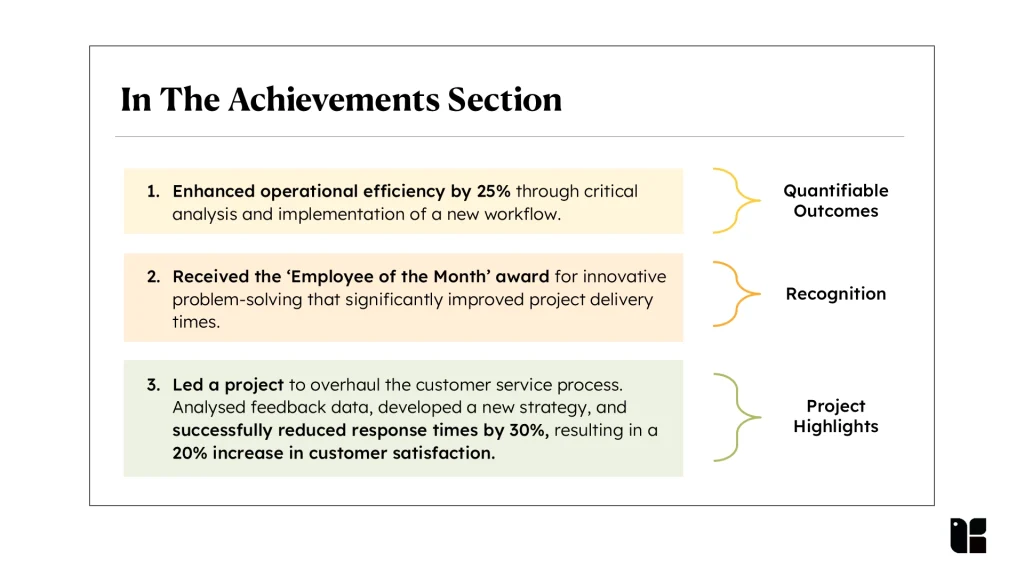
- Quantifiable outcomes: Highlight achievements where your critical thinking led to measurable improvements. Use specific figures or percentages to showcase the tangible impact of your problem-solving abilities. For example: “Enhanced operational efficiency by 25% through critical analysis and implementation of a new workflow.”
- Recognition: Include any awards or positive feedback that indicates your critical thinking skills. This external validation reinforces the value of your abilities. For instance: “Received the ‘Employee of the Month’ award for innovative problem-solving that significantly improved project delivery times.”
- Project highlights: Provide brief case studies or project highlights where your critical thinking was essential. Describe the challenge, your approach, and the outcome to give depth to your achievements. For example: “Led a project to overhaul the customer service process. Analysed feedback data, developed a new strategy, and successfully reduced response times by 30%, resulting in a 20% increase in customer satisfaction.
In The Skills Section
The Skills section is where you can prominently feature your critical thinking abilities. Highlight your core skills and provide examples of how these skills have been applied in various situations, demonstrating their significance and relevance to potential employers:

- Core skills: Make critical thinking a standout skill on your resume. Clearly list it and provide brief examples of how you’ve applied it in previous roles. For instance: “Critical Thinking: Applied analytical skills to evaluate market trends, leading to a 15% increase in strategic decision-making accuracy.”
- Related skills: Highlight other skills that complement your critical thinking, such as analytical thinking and strategic planning. This demonstrates a well-rounded approach to problem-solving. For example: “Analytical Thinking and Strategic Planning: Leveraged these skills to develop a new workflow, reducing project turnaround time by 20%.”
- Skill application examples: For each skill listed, offer a brief example of how you used it effectively. For critical thinking, mention specific projects or scenarios where your analytical abilities led to successful outcomes. For example: “Critical Thinking: Successfully led a project to streamline operations by analysing bottlenecks and implementing solutions that improved efficiency by 25%.
In The Summary Statement
Your resume summary or objective is the initial opportunity to make a compelling case for your candidacy. Use this section to quickly convey how your critical thinking skills are a perfect fit for the role and how they align with the company’s strategic goals.:
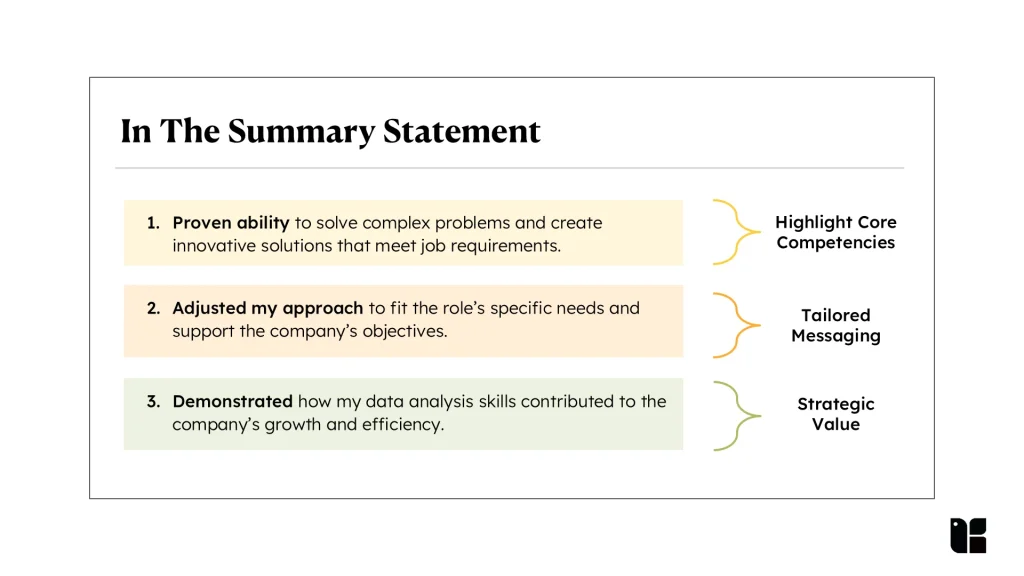
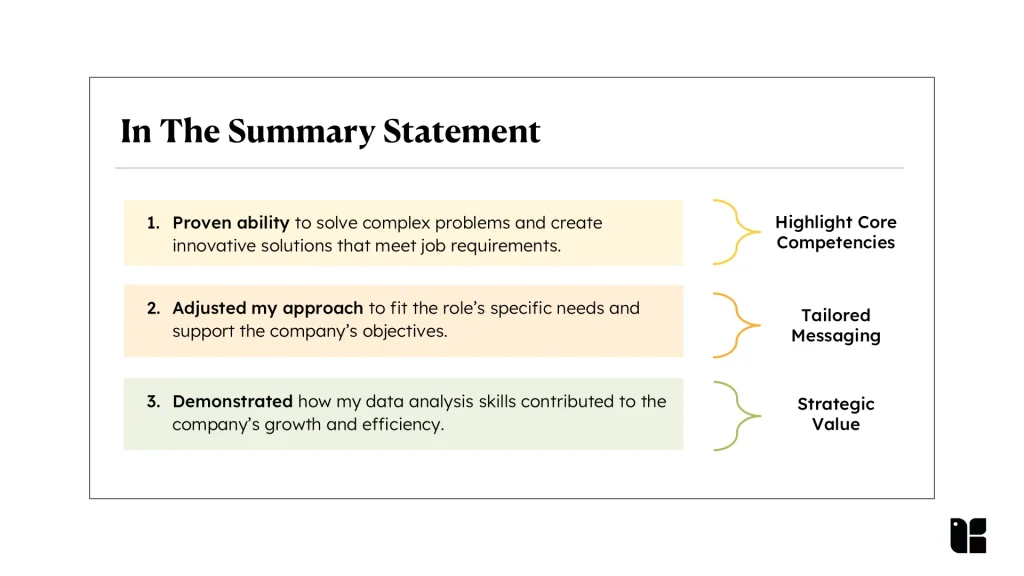
- Highlight core competencies: Use this section to emphasise your critical thinking skills and their relevance to the position. For example: ‘Proven ability to solve complex problems and create innovative solutions that meet job requirements.'”
- Tailored messaging: Customise your summary for each job application. Use phrases like ‘Addressed key challenges’ or ‘Aligned with company goals.’ For instance: ‘Adjusted my approach to fit the role’s specific needs and support the company’s objectives.
- Strategic value: Show how your critical thinking helps the organisation. Use terms like ‘Drove successful outcomes’ or ‘Supported strategic goals.’ For example: ‘Demonstrated how my data analysis skills contributed to the company’s growth and efficiency.'”
In the Education And Certifications Section
Education and professional development play a significant role in honing your critical thinking abilities. This section allows you to highlight coursework and certifications that have sharpened your analytical skills and prepared you for complex problem-solving in your career:
- Relevant coursework: Use terms like Studied, Analysed, Explored, or Applied to emphasise how specific courses enhanced your analytical abilities. For example: “Studied advanced problem-solving techniques in [course name], which significantly improved my capacity to analyse and address complex issues.”
- Certifications: Include action verbs such as Earned, Acquired, Demonstrated, or Achieved to showcase your professional development. For instance: “Earned a Six Sigma Green Belt certification, demonstrating my expertise in data analysis and process optimisation.”
- Practical projects: Highlight hands-on experience with words like Led, Developed, Researched, or Solved. For example: “Led a capstone project where I solved [specific problem] by applying detailed research and analysis, resulting in [measurable outcome].”
Now that you know how to highlight your critical thinking skills, let’s address some common mistakes to avoid to make sure your resume is as effective as possible.
“Kapable has helped me transform my communication skills, enabling me to speak with clarity and assertiveness. I can now handle team dynamics effectively and confidently team members which is a significant improvement from where I started.”
– Shyam Sundar AM (Team Lead At TCS)
What Common Mistakes Should Be Avoided In A Resume?
Effectively indicating your critical thinking abilities on a resume can have a major influence. To present these skills in the best light, avoid the following typical blunders and provide clear, convincing examples:
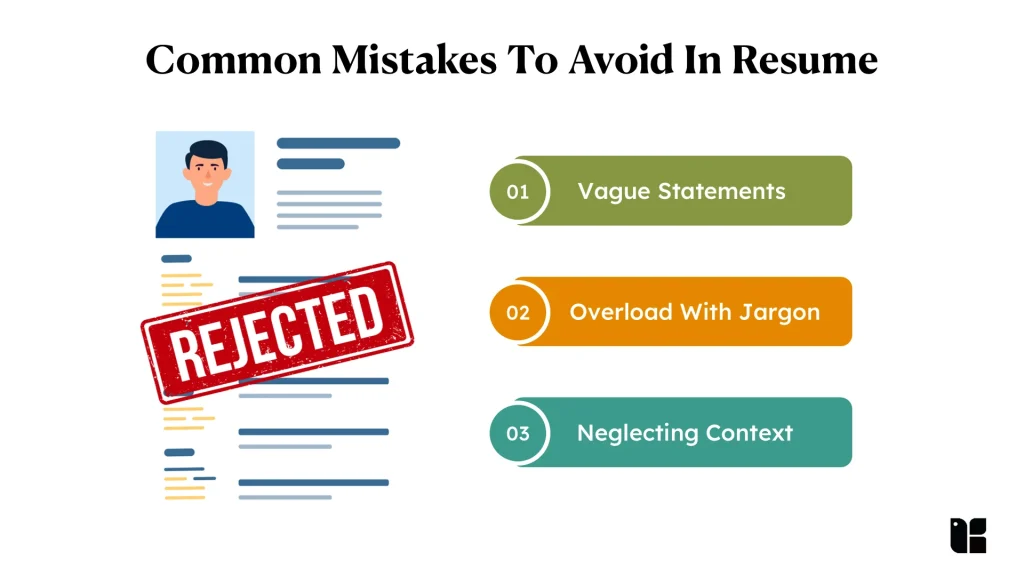
- Vague statements: Avoid using generic phrases like “strong problem-solving skills” without providing concrete instances. Instead, show your critical thinking by describing particular instances. For example, instead of just saying, “I improved team performance,” describe how you identified an obstacle in the team’s workflow and implemented a new process that increased efficiency by 20%.
- Overload with jargon: Remove any technical jargon or industry-specific words that could obscure your message. Instead of saying, “Utilise complex statistical models to drive operational improvements,” use simple language such as, “Analysed data trends to improve operations, resulting in a 15% cost savings.” This makes your accomplishments more attainable and understandable.
- Neglecting context: So the context is essential for exhibiting critical thinking abilities. Avoid using imprecise sentences like “I devised a new strategy.” Instead, describe the situation you encountered, the method you used, and the results you obtained. Like the following: “When faced with declining sales, I created a targeted marketing campaign that boosted sales by 25% within six months.” This approach emphasises not just your thought process but also its impact.
Now that we’ve identified key resume pitfalls to avoid, let’s shift focus to developing the critical thinking skills that can help you stand out in your career.
How Can Critical Thinking Skills Be Enhanced For Career Growth?
Critical thinking skills in the workplace empower you to tackle complex problems, improve decision-making skills, and approach challenges from various perspectives. Strong critical thinking skills empower you to analyse data, evaluate arguments, and identify potential solutions in your work experience. Critical thinkers are better equipped to handle tough decisions and contribute valuable insights to their organisations. To improve your critical thinking, you need to challenge assumptions, actively seek different perspectives, and evaluate potential outcomes before taking action. These habits not only enhance your reasoning abilities but also demonstrate critical thinking skills in professional settings.
When it comes to showcasing these abilities, your resume and cover letter play a pivotal role. For your resume, add examples of critical thinking skills by referencing specific achievements that highlight your ability to solve problems and make informed decisions. In your cover letter, align your experiences with the job description to show that you are a candidate who excels in decision-making and problem-solving. Demonstrate critical thinking and decision-making skills to convey that you have the cognitive abilities employers value. By highlighting critical thinking in your work experience, you position yourself as a professional capable of meeting workplace challenges with insight and efficiency.
Strong critical thinking boosts career growth, and applying it to your resume can make a big impact. Let’s explore some tips in the next section that will help to enhance your resume.
What Are The Best Tips For Strengthening Critical Thinking Skills For Your Resume?
Improving your critical thinking skills not only benefits your career but also makes your resume stand out. Here are some practical tips to help you develop these skills and effectively highlight them on your resume:
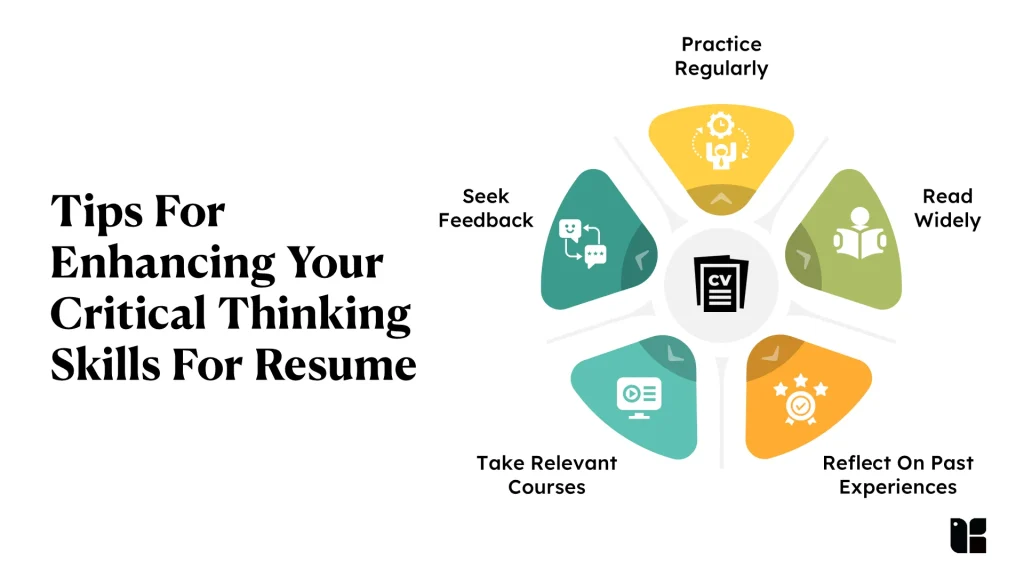
- Practice regularly: Engage in activities that challenge your reasoning and analytical skills. For example, solve complex puzzles, play strategy games, or participate in debate clubs. Playing strategy games like Chess or solving Sudoku and Crossword Puzzles can enhance your ability to foresee potential outcomes and make strategic decisions. These activities exercise your brain, helping you to refine your analytical skills, which you can then showcase on your resume.
- Seek feedback: Request feedback from peers or mentors on your approach. This can bring new perspectives and identify possibilities for improvement. For example, hiring a mentor to examine a project analysis report can help you uncover weaknesses in your reasoning and enhance your ability to deliver well-balanced arguments. Incorporating this feedback into your resume can indicate your commitment to constant improvement as well as your capacity to react to constructive criticism.
- Take relevant courses: Enrol in courses or workshops that enhance critical thinking, logic, and problem-solving. For experienced leaders, leadership courses that focus on strategic thinking can be valuable. Online platforms like Coursera and edX offer free or affordable options. Listing these courses under Education or Certifications on your resume highlights your commitment to skill development and staying updated with industry practices.
- Reflect on past experiences: Analyse past projects or decisions to understand how your critical thinking impacted outcomes. Make a note of these reflections to use as examples on your resume. Demonstrating how your approach led to positive results highlights your ability to tackle complex challenges effectively.
- Read widely: This broadens your perspective and improves your ability to analyse information from various aspects. Books like “Thinking, Fast and Slow” by Daniel Kahneman or “The Art of Thinking Clearly” by Rolf Dobelli can improve your ability to approach problems creatively, which eventually helps you to enhance your critical thinking.
After addressing common resume mistakes, let’s explore the tips for enhancing critical thinking skills.
Conclusion
Showcasing your critical thinking skills on a resume can make a significant impact in attracting the attention of hiring managers. Instead of utilising generic jargon, share specific examples of how you’ve applied these talents in real-world situations. Describe the challenges you encountered, the approach you followed, and the outcomes you obtained. By offering this type of important context, you will not only demonstrate your analytical and problem-solving ability but also position yourself as a distinctive prospect. With these ideas, you’ll be able to progress your career by creating a CV that is both compelling and authentic to you.
If you’re looking for practical experiences that help you demonstrate critical thinking to recruiters rather than simply listing it as a skill, Kapable’s program fit can help you evaluate your next step.


