

TL;DR
- Key Models & Principles: Emotional intelligence, popularised by Daniel Goleman and formalised by Salovey and Mayer, hinges on two main principles: Awareness (Self and Social) and Management (Self and Relationship).
- Prominent Theories: The concept is explained through three major models: the Four-Branch Model (Salovey & Mayer), the Mixed Model (Bar-On), and Goleman’s Five Components (Self-Awareness, Self-Regulation, Internal Motivation, Empathy, and Social Skill).
- Workplace Impact: High emotional intelligence is characterised by strong communication, effective leadership, conflict resolution, adaptability, and empathy, leading to improved team performance and employee satisfaction.
- Strategies for Growth: EI is a learned skill, and it can be improved through practical methods such as expanding emotional vocabulary, employing active listening, and consistently expressing gratitude.
“It is very important to understand that emotional intelligence is not the opposite of intelligence, it is not the triumph of heart over head — it is the unique intersection of both.” – Reuven Bar.
Emotional intelligence isn’t about feelings versus smarts. This means emotional intelligence isn’t separate from cognitive abilities; instead, it’s where they meet and complement each other.
This blog explores the fundamentals of emotional intelligence: its origins, key principles, how it functions, and its practical applications. Understanding these elements isn’t just about theory; it’s about recognising how emotional intelligence profoundly influences personal and professional success. By simplifying these concepts in a clear and accessible manner, we aim to provide you with practical insights to enhance your emotional intelligence effectively.
“Kapable helped me overcome my fear of spontaneous speaking and taught me to balance diplomacy with assertiveness, ensuring my voice is heard. I now communicate with confidence and clarity, a transformation that has made a remarkable difference in my journey.”
– Anupam Bajaj (Design Head At SAMSUNG)
What Are The Origins Of Emotional Intelligence?
Early ideas about managing emotions emerged in the 1950s. Maslow, known for his “Hierarchy of Needs,” recognised the importance of emotions and their influence on human behaviour. He emphasised the need for self-awareness and the ability to manage emotions effectively.
In 1990, psychologists Peter Salovey and John Mayer published a landmark paper titled “Emotional Intelligence.” This paper formally defined emotional intelligence as “the ability to monitor one’s own and others’ feelings and emotions, to discriminate among them, and to use this information to guide one’s thinking and actions.” Their work provided a framework for understanding and measuring emotional intelligence, laying the foundation for further research and development.
Daniel Goleman’s 1995 book “Emotional Intelligence: Why It Can Matter More Than IQ” truly brought the concept to the forefront of public consciousness. Goleman’s bestseller book popularised the idea of emotional intelligence and its impact on personal and professional success. For a thorough overview of the history of emotional intelligence, check out the video below.
Understanding and managing emotions is gradually gaining momentum and evolving into the powerful skill set we know today. From early theoretical foundations to the mainstream recognition it enjoys today, the concept has come a long way, solidifying its importance in navigating the complexities of human interaction.
The field continues to evolve, with new research and models emerging. However, the core principles remain the same: understanding and managing our own emotions and being attuned to the feelings of others.
Understanding emotional intelligence theory provides a strong foundation, while Kapable helps leaders transform these concepts into behaviours that strengthen trust, collaboration, and leadership effectiveness.
Which Principles Guide Emotional Intelligence?
Emotional intelligence is about being aware of one’s own emotional state and its impact on thoughts, behaviours, and relationships. It’s also about using this awareness to effectively regulate emotions and build strong, positive connections with others.
Emotional intelligence hinges on two fundamental principles: awareness and management. These two principles work together seamlessly, forming the foundation of emotional intelligence.
Awareness includes:
- Self-awareness: This means knowing what you’re feeling at any moment and understanding why. For example, if you feel frustrated during a meeting, self-awareness helps you pinpoint whether it’s due to a particular comment or stress from a tight deadline. By understanding these triggers, you can better control your reactions and make thoughtful decisions.
- Social awareness: This involves recognising the emotions of others and understanding their perspectives. For instance, if a coworker seems upset but isn’t vocal about it, social awareness allows you to notice their body language and tone, helping you respond with empathy. It helps in grasping their needs and fostering better interactions.
Management includes:
- Self-management: This is about handling your own emotions in a constructive way. It means not letting your feelings, like anger or anxiety, control your actions. Strategies such as practising deep breathing or stepping away for a moment can be effective in managing stress and stabilising your emotions.. For example, if you’re feeling overwhelmed by a project, self-management involves using strategies to stay calm and focused rather than reacting impulsively.
- Relationship management: This principle focuses on building and maintaining positive interactions with others. It includes clear communication, resolving conflicts effectively, and showing empathy. For example, if a disagreement arises with a colleague, relationship management helps you address the issue calmly and find a solution that respects both parties’ views. It’s about creating an environment where people feel valued and understood.
Understanding and applying these principles helps you become more effective in both personal and professional settings. It enhances your ability to communicate, lead, and collaborate with others. Let’s explore some prominent models of emotional intelligence that offer deeper insights into these skills.
How Do Key Models Explain Emotional Intelligence?
While the core principles of emotional intelligence provide a foundation, understanding the different models can offer a more structured approach to developing and applying this crucial skill set. Here are three of the most prominent models of emotional intelligence, along with their key components.

Salovey & Mayer Four Branch Model
Salovey and Mayer developed the Four-Branch Model of Emotional Intelligence. The four branches consist of:
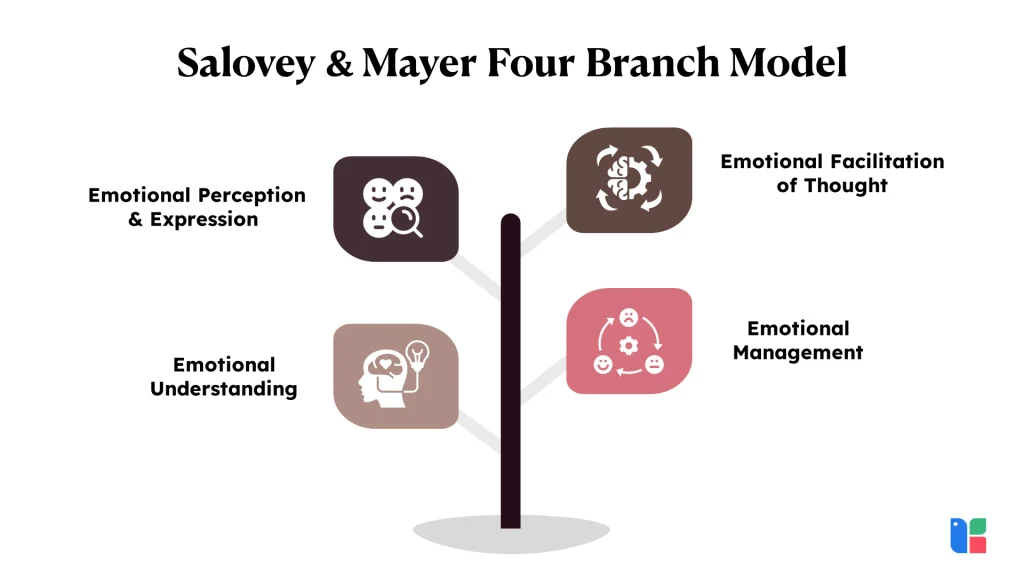
Emotional Perception And Expression
This branch focuses on recognising and expressing emotions accurately. It includes identifying and expressing one’s own emotions appropriately and discerning between genuine and misleading feelings. For example, being able to tell when someone is truly happy versus just putting on a smile helps build trust and clear communication. Mastery of this branch is foundational for developing emotional intelligence. According to Salovey and Mayer, achieving emotional intelligence is only possible with these competencies in the first branch.
Emotional Facilitation Of Thought
This aspect deals with using emotions to enhance cognitive processes like thinking and problem-solving. Emotions can guide our attention and influence how we approach tasks. For instance, feeling excited about a project can boost creativity and focus, while feeling frustrated might push us to tackle a problem more persistently. Understanding how emotions affect our thinking helps in using them constructively to improve decision-making and problem-solving.
Emotional Understanding
This branch involves comprehending the nature of emotions and their causes. It includes recognising how different feelings relate to one another and understanding what they reveal about relationships and situations. For instance, understanding how a person’s frustration might evolve into satisfaction when a problem is resolved helps in managing interactions and expectations more effectively. It also involves grasping complex emotions and transitions between different feelings, like moving from anger to relief.
Emotional Management
Effectively handling emotions is a crucial component of emotional intelligence. Self-management involves regulating your emotions to foster personal growth and maintain a balanced perspective. This skill means being open to experiencing a range of emotions and using strategies to handle them constructively. For example, managing stress by recognising when you’re feeling overwhelmed and employing relaxation techniques helps in maintaining emotional and intellectual growth.
The Bar-On Model
Dr. Reuven Bar-On is a leading clinical psychologist known for his extensive work in emotional intelligence. His research and numerous publications have made him a key figure in the field. The Bar-On Model is well-known and is considered a “mixed model” because it combines various aspects of emotional and social skills.
According to the Bar-On model, emotional-social intelligence is a mix of various emotional and social skills that help us understand and express ourselves, interact with others, and handle everyday challenges. The model is built around five main areas, known as meta-factors, which were confirmed through detailed research and analysis. These areas reflect how well we manage our emotions and relationships in different situations.
The Bar-On Model looks at five core factors and various sub-components:

1. Intrapersonal Skills
These involve understanding and expressing your own emotions. Key components include:
- Self-regard: Acknowledging and valuing your self-worth.
- Emotional self-awareness: Recognising your emotions and their impact on your behaviour.
- Assertiveness: Clearly expressing your thoughts and feelings.
- Independence: Making decisions and managing emotions autonomously.
- Self-actualisation: Pursuing personal growth and achieving your potential.
2. Interpersonal Skills
These skills are about effectively interacting with others and maintaining positive relationships. They include:
- Empathy: The ability to recognise and connect with the emotions of others.
- Social responsibility: Acting in ways that benefit others and contribute to the community.
- Interpersonal relationships: Building and nurturing healthy and constructive relationships.
3. Stress Management
This area focuses on how well you handle stress and control your emotions. Key aspects are:
- Stress tolerance: Managing stress effectively.
- Impulse control: Regulating immediate emotional reactions.
4. Adaptability
This involves adjusting to change and handling new situations. Key factors include:
- Reality testing: Accurately assessing situations and making realistic decisions.
- Flexibility: Adapting to new circumstances and changes.
- Problem-solving: Finding solutions to challenges.
5. General Mood
This area relates to maintaining a positive outlook and self-motivation. It includes:
- Optimism: Viewing situations with a hopeful perspective.
- Happiness: Experiencing and promoting a joyful attitude.
Reuven Bar-On continues to research and develop his model and theories around emotional intelligence. Like the others, his work is a valued contribution to the field.
The Daniel Goleman Model
In his 1995 book, “Emotional Intelligence: Why It Can Matter More Than IQ,” Daniel Goleman presented a groundbreaking view on how emotional intelligence (EQ) impacts success. Goleman, a leading expert in the field, argued that emotional intelligence is crucial for predicting job performance and career success—perhaps even more so than traditional measures of cognitive intelligence. He built on the concept of emotional intelligence introduced by Salovey and Mayer in 1989.
Goleman emphasised that emotional intelligence is often more important than cognitive intelligence when it comes to achieving success. He believed that emotional intelligence significantly enhances work relationships, problem-solving skills, efficiency, and the development of new strategies. Unlike cognitive intelligence, which affects academic and technical performance, emotional intelligence influences how we manage our emotions and interact with others. Daniel Goleman describes emotional intelligence as the capacity to identify, comprehend, and manage both personal emotions and those of others, including groups.
Goleman developed a performance-based EQ model to assess employee emotional intelligence and identify areas for improvement. The model consists of five components of emotional intelligence, which are stated below.

- Self-Awareness
People with high emotional intelligence are attuned to their own thoughts and emotions, and they recognise how these feelings affect their interactions with others. Being aware of and accepting your emotions is often the crucial first step in managing them effectively. - Self-Regulation
Managing one’s impulses and emotions is vital. Acting impulsively or without careful consideration can lead to errors and potentially harm relationships with clients or colleagues. Controlling your reactions helps maintain professionalism and respect in interactions. - Internal Motivation
Goleman argues that relying solely on financial or material incentives is not ideal for emotional intelligence. Instead, a genuine passion for your work drives sustained motivation, enhances decision-making, and aligns with the broader goals of the organisation. - Empathy
Understanding your own emotions is important, but recognising and responding to the emotions of others is equally crucial. Being able to detect and appropriately react to the feelings of colleagues or clients strengthens relationships and fosters better communication. - Social Skill
Social skills go beyond just being friendly. Goleman refers to them as “friendliness with a purpose,” where politeness and respect are combined with the strategic use of relationships to achieve personal and organisational goals.
Goleman asserts that individuals who cultivate these emotional intelligence traits significantly increase their chances of success compared to those who do not. Importantly, emotional skills are not inbuilt but can be developed through learning. Moreover, these skills are interrelated, meaning that improving one skill can enhance others, leading to greater overall benefits.
Goleman also clarifies that cognitive intelligence and emotional intelligence are not opposing concepts but are different areas that both require attention. He does not imply that cognitive intelligence is unimportant; rather, he suggests that equal emphasis should be placed on developing both cognitive and emotional intelligence.
By exploring these prominent models and understanding their practical applications, individuals can gain deeper insights into various aspects of emotional intelligence. Emotional knowledge provides a foundation for personal growth and the development of stronger emotional intelligence skills, contributing to a more rewarding and successful life.

What Are The Characteristics Of Emotional Intelligence?
Individuals with high emotional quotient exhibit a distinct set of characteristics that set them apart in the workplace. These characteristics are not in built talents, but rather learned skills that can be developed through conscious effort and practice. Let’s explore some of the most prominent characteristics of emotionally intelligent people:

Communication Skills
People with high emotional intelligence communicate their thoughts and feelings effectively. They don’t just speak; they convey their messages in a way that’s easy to understand. For example, they avoid jargon and get straight to the point, ensuring that everyone is on the same page. They’re not just waiting for their turn to talk; they genuinely listen. This means they pay attention, ask relevant questions, and show they value others’ input. This makes conversations more meaningful and productive. When they provide feedback, it’s not about criticism but about helping others grow. They offer suggestions in a supportive manner, which encourages improvement without diminishing self-confidence.
Conflict Resolution
Handling conflicts effectively means addressing issues without letting emotions take over. They focus on finding solutions that satisfy all parties, ensuring that relationships remain strong and positive. They’re skilled at calming tense situations. By managing their own emotions and understanding others’ feelings, they prevent conflicts from escalating and work towards peaceful resolutions. They consider everyone’s viewpoint in a disagreement, which helps in finding a middle ground and fosters mutual respect.
Effective Leadership
Great leaders with high emotional intelligence don’t just direct; they motivate. They use their understanding of emotions to encourage and inspire their teams, fostering an environment of trust and collaboration. They recognise that each team member is unique. By understanding these individual needs and strengths, they can guide their team effectively towards shared goals. Their ability to connect on an emotional level helps in creating a supportive and engaged team. This leads to better teamwork and higher productivity.
Adaptability
They handle stress gracefully and adjust to changing circumstances with ease. Their self-regulation skills help them stay calm under pressure, which is crucial for making clear-headed decisions. Instead of getting stuck, they think outside the box when faced with challenges. Their adaptability helps them find innovative solutions even in tough situations. They maintain their composure during disruptions, which helps in managing the situation effectively and guiding others through uncertainty.
Empathy
They genuinely care about others’ feelings and perspectives. This empathy helps in building strong, supportive relationships and creates an inclusive and positive environment. Their ability to relate to others promotes mutual respect and cooperation. By showing they value others’ emotions, they encourage a team spirit and enhance collaboration. Their empathetic approach contributes to a work culture where everyone feels valued and understood, leading to higher morale and productivity.
Reflect on your own experience. Do you recognise these traits in yourself? If so, how do you showcase them in your workplace? How do these skills manifest in your daily interactions, and how do they contribute to a positive and productive work environment? Understanding and applying these characteristics can significantly enhance your professional relationships and overall success.
How Can Leaders Use Emotional Intelligence In The Workplace?
Imagine a workplace where emotions are poorly managed, leading to a toxic environment where negativity and anxiety are the norm, leading to constant friction and resentment. We can clearly judge that leadership and communication at this workplace are ineffective. This bleak scenario paints a picture of a workplace environment destroyed by low emotional intelligence. It highlights the importance of cultivating this crucial skill set to foster a more positive, productive, and fulfilling work environment for everyone.
The impact of emotional intelligence in the workplace is undeniable. It can have both positive and negative consequences, shaping the dynamics of teams, influencing leadership styles, and impacting overall productivity and morale. Here’s a look into its significance and how it manifests in the workplace:

Enhanced Communication
Effective communication goes beyond the mere exchange of words. With high emotional intelligence, communication is not just clear but also deeply engaging. For example, knowing when to be more assertive or empathetic based on the emotional climate can prevent misunderstandings and foster more meaningful exchanges. By encouraging open dialogue, they ensure that everyone’s voice is heard, leading to more innovative and collaborative solutions.
Effective Leadership
Leadership is not only about guiding a team but also about inspiring and empowering them. Leaders with high emotional intelligence understand what drives each team member and tailor their motivational strategies accordingly. They go beyond generic encouragement, offering personalised support that resonates with individual needs and aspirations. Such leaders handle criticism with composure and use it as an opportunity for growth rather than a setback. This fosters a culture of resilience and continuous improvement within the team.
Reduced Conflict
Conflicts are inevitable, but how they are managed can make a significant difference. Rather than just addressing the surface-level problems, emotionally intelligent individuals dig deeper to understand the root causes of conflicts. This approach leads to more effective resolutions and prevents recurring issues. By managing their own emotions and empathising with others, they ensure that conflicts are resolved without damaging professional relationships.
Improved Team Performance
Members work together more effectively, making use of each other’s strengths and compensating for weaknesses. This collaborative spirit enhances overall team performance and productivity. Teams are better equipped to handle stress and setbacks. Emotional intelligence allows team members to support each other through challenges, maintaining morale and focusing on collective goals.
Increased Employee Satisfaction
High EI fosters an environment where employees feel valued and understood. This sense of belonging and respect boosts overall job satisfaction and reduces turnover rates. Emotionally intelligent workplaces recognise and accommodate the balance between work and personal life, contributing to higher employee contentment and well-being.
Let’s take an example of a workplace scenario now with High Emotional Intelligence:
Situation: During a team meeting, a member presents an idea that is initially met with resistance from others. He acknowledges the differing viewpoints by saying, “I understand that some of you have concerns about this proposal. Let’s hear everyone’s thoughts openly and respectfully.”
The team members’ reaction is quite predictable now. They will express their concerns thoughtfully by saying, “I appreciate you taking the time to explain your idea further. I can see where you’re coming from…” and they will feel welcome to offer alternative solutions.
This scenario demonstrates how emotional intelligence can transform a potentially tense situation into a collaborative and productive discussion. By actively listening, acknowledging emotions, and focusing on finding solutions, teams can navigate challenges effectively and achieve better outcomes.
Having witnessed the stark contrast between a workplace with low and high emotional intelligence, it’s clear that developing this crucial skill set is essential for fostering a positive, productive, and fulfilling work environment.
What Strategies Improve Emotional Intelligence?
While emotional intelligence is a lifelong journey, there are many practical ways to improve this valuable skill set in the workplace. Here are some actionable ways you can implement:
Self-Awareness
- Emotional vocabulary expansion: Go beyond basic emotions like “happy” and “sad.” Learn and actively use more nuanced words like “frustrated,” “apprehensive,” or “content.” This helps you label your emotions more accurately and communicate them effectively.
- The power of “Why”: When experiencing a strong emotion, ask yourself “Why am I feeling this way?” This introspection helps you understand the root cause of your emotions and allows for more mindful responses.
- Body language check-in: Throughout the day, take a moment to notice your posture, facial expressions, and muscle tension. This can reveal hidden emotions and provide clues about how you’re presenting yourself to others.
Social Awareness
- Mirroring and matching: Subtly mirror the body language and tone of voice of the person you’re interacting with. This creates a sense of rapport and builds trust.
- Active listening: Go beyond just hearing the words. Pay attention to the speaker’s emotions, body language, and any unspoken messages they might be conveying.
- Seek diverse perspectives: Actively engage with colleagues from different backgrounds and experiences. This broadens your understanding of how emotions can manifest differently and fosters empathy.
Relationship Management
- The art of “Thank You”: Expressing gratitude, even for small things, shows appreciation and strengthens bonds.
- Give feedback with grace: When providing feedback, focus on specific behaviours and offer constructive solutions. Use “I” statements to avoid blame and maintain a positive tone.
- Celebrate successes (Big and Small): Recognising individual and team-based achievements boosts morale and fosters a sense of accomplishment.
Remember, emotional intelligence is a continuous journey. By incorporating these practical hacks into your daily routine, you can steadily strengthen your emotional intelligence and become a more effective and well-rounded professional.
Conclusion
By honing your emotional intelligence, you’ll not only better understand emotions but also improve your relationships, communication skills, and leadership abilities. This journey doesn’t end with reading; it begins with applying these insights in your daily interactions. Embrace the challenge of developing your emotional intelligence, and you’ll discover its profound impact on every aspect of your life.
If emotional intelligence theory has shown you why these skills matter, Kapable can help you evaluate whether its approach matches your leadership development goals.


