


TL;DR
- Values-Driven Approach: This generation of leaders moves past traditional hierarchy by prioritising authenticity, empathy, and collective purpose to foster a highly collaborative team environment.
- Quantifiable Positive Results: This values-led style drives tangible success, evidenced by a boost in employee engagement, better retention, and a commitment to inclusive, tech-forward performance.
- Structural Development Gaps: Millennial leaders frequently contend with a lack of structured guidance and formal mentorship, compounded by age bias and significant pressure leading to widespread burnout.
- Adaptive Management Toolbox: They actively overcome challenges by implementing flexible strategies like reverse mentorship, deep-work “Silent Hours,” and using emotional check-ins to build psychological safety and trust in their teams.
If your boss shares updates over WhatsApp instead of calling a meeting, ask the team “what do you think?” before making a decision, and doesn’t mind admitting when they’re unsure, you’re probably working under a millennial leader. In fact, they bring a quieter and more collaborative approach that is gradually changing workplace norms through everyday choices rather than bold moves. In this blog, we look at the numbers behind this shift and how millennial leadership is quietly changing how things get done at work.
Who Are Millennial Leaders?
Millennial leaders are those born between 1981 and 1996 who’ve grown into roles where they guide teams, make decisions, and influence how things work day to day. They’re part of the generation that saw the shift from landlines to smartphones, and that mix of old and new shows in how they lead. They’re not big on formality, don’t expect you to follow blindly, and are more likely to ask for your input than give top-down instructions. Their style is usually straightforward, flexible, and focused on keeping things real, not perfect.
You’ll often find them leading from the middle rather than the top. They prefer group chats over lengthy memos, honest conversations over vague policies, and shared goals over solo wins. Millennial leaders prioritise not only results but also the emotional well-being of their teams, making workplace experience a key part of their leadership approach. As their influence grows across industries, it’s important to first understand who millennial leaders are and what sets them apart.

How Millennials Stand Out In Generational Leadership?
Millennial leadership becomes clearer when compared to Gen X and Baby Boomer generation styles. The stats below show how millennials are reshaping leadership expectations across generations:
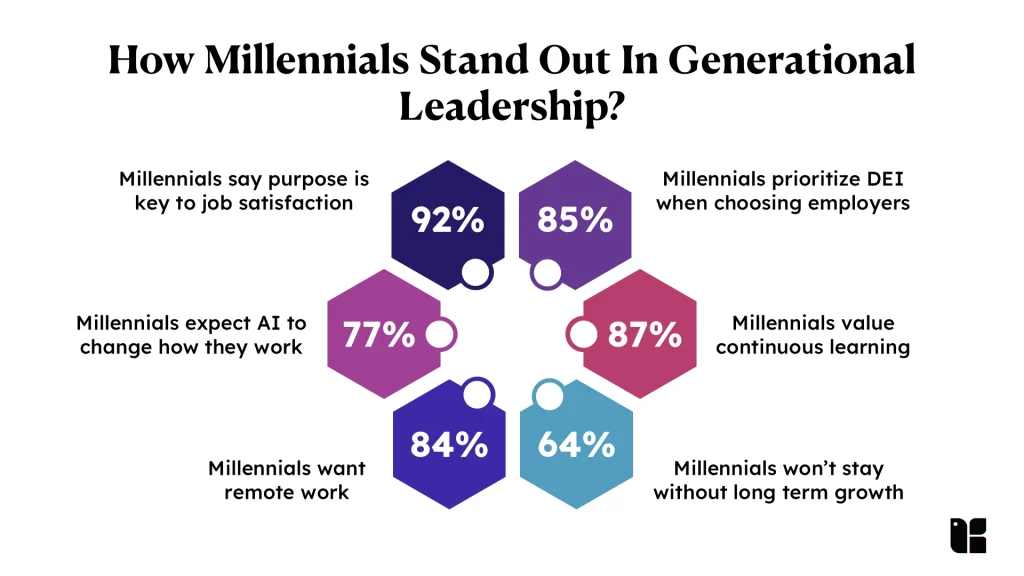
- Sense of purpose: A total of 92% of millennials believe that having a clear purpose is essential for job satisfaction. Gen X and Boomer professionals, by comparison, show a lower dependency on purpose and tend to focus more on job security or personal achievement.
- Gen AI expectations: Among millennials, 77% expect AI to significantly change the way they work in the near future. Gen X leaders appear more cautious and slower in adapting to emerging technologies.
- Flexible work schedules: Roughly 84% of millennials prefer remote work options, and 66% want autonomy over their schedules. Older generations, including 42% of Gen X and 37% of Boomers, are less likely to demand flexibility, often accepting traditional work structures.
- DEI importance: Around 85% of millennials view diversity and inclusion as a top priority when choosing an employer. Gen X follows at 63%, and Boomers at 48%, showing a generational difference in how equity and representation are valued in leadership.
- Growth focus: A strong emphasis on learning is seen among 87% of millennials, who consider continuous development essential. In comparison, only 62% of Gen X professionals place equal value on structured growth opportunities.
- Career mobility: Among millennials, 64% are not willing to remain with the same employer for over nine years unless they see career progression. In contrast, just 30% of Boomers share that outlook, indicating a stronger drive for advancement in younger leaders.
These differences become more evident in the upcoming sections, where we explore how millennial leadership styles contrast with those of previous generations.
How Millennial Leadership Styles Differ From Previous Generations?
Literature suggests that millennial leaders, shaped by major events, prefer a more ethical, human-centred, and adaptable approach. They are shaping the workplace leadership style when compared to previous generations. It can be seen in the following ways:
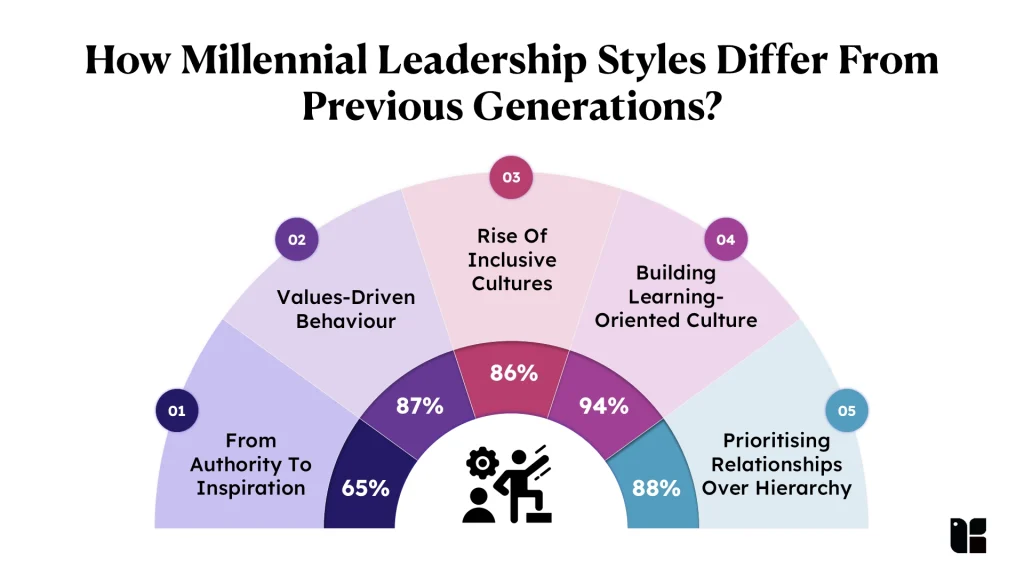
From Authority To Inspiration
Instead of relying on direct supervision, millennials lean on transformational leadership styles that build trust and shared ownership.
- Transformational leadership refers to a style where leaders inspire and motivate rather than command. This is common among millennials who emphasise rewarding innovation, developing leaders, and creating meaningful relationships with their teams. Unlike highly autocratic directive leaders, they focus more on trust than control.
- A survey found that 65% of millennials believe a successful business should focus on improving society and supporting people, not just making profit. They also prefer the empowering leadership style, encouraging individuals to make their own decisions, aligned with the leader’s own values. Their style reflects less of an exchange relationship (do this to get that) and more of a collaborative partnership.
Values-Driven Behaviour
Shaped by major events and influenced by generational theory, millennials see ethics as the most important leadership trait, not status or hierarchy.
- Millennial leaders often make decisions guided by professional ethics and their own characteristics, rather than purely profit or tradition. According to Gallup, 87% of millennials rate “professional development and career growth” as important to them in a job, reflecting a values-based decision-making mindset.
- This aligns with trends in leadership behaviour showing a rise in soft skills and emotional intelligence as critical to success. Many endorse openness and lead differently compared to leaders of the same age in previous eras.
Rise Of Inclusive Cultures
Millennials differ by rejecting rigid models such as directive leadership and supporting inclusive systems built on flexibility.
- Instead of rigid leadership typologies, millennials embrace hybrid and flexible methods. They often endorse leadership styles that prioritise diversity, inclusiveness, and adaptability, traits that suit a modern, fast-paced workplace.
- PwC report showed that 86% of millennials consider inclusiveness and diversity as key to workplace success. They are more likely to adapt their leadership traits to evolving needs and address the knowledge gap across generations.
Building Learning-Oriented Culture
Based on transformational leadership, millennials emphasise continuous growth through mentoring and feedback, rather than control.
- With a strong emphasis on continuous learning, often shaped by their graduate school experiences, millennial leaders understand the importance of data analysis, feedback, and mentorship.
- LinkedIn’s Workplace Learning Report revealed that 94% of employees would stay longer at a company that invests in their learning and millennials are leading this shift. They view developing leaders as an ongoing process, not just a job title.
Prioritising Relationships Over Hierarchy
Unlike traditional business leaders, millennial leaders value emotional connection, often aligning with qualities seen in charismatic leaders and great leaders preparing the next generation.
- Where other generations may have emphasised formal structures and task-driven approaches, millennial leaders focus on fostering meaningful relationships and supporting their millennial workforce.
- A study by PGI found that 88% of millennials want a collaborative work culture over a competitive one, which highlights their people-first approach. Their leadership is rooted in understanding the target population, encouraging ownership, and providing purpose.
These evolving leadership patterns highlight a major generational shift that, in the next section, is supported by data showing how millennials are redefining the workplace.
“This journey transformed my confidence and communication skills, enabling me to deliver impactful presentations, including a town hall for 500 people and a compelling business pitch to a senior stakeholder. Kapable has been a game-changer in my professional growth.”
– Ajay Deshmukh (Director At JPMorgan Chase)
How Millennial Leadership Statistics Are Redefining The Workplace?
Millennials are stepping into leadership and transforming it in their own way. From technology adoption to purpose-driven decision-making, here’s what the latest statistics are telling us about how they lead:
Millennials In Management
Millennials have moved past junior roles and are now managing teams, driving results, and influencing decisions. The numbers show just how quickly they’ve stepped into leadership.
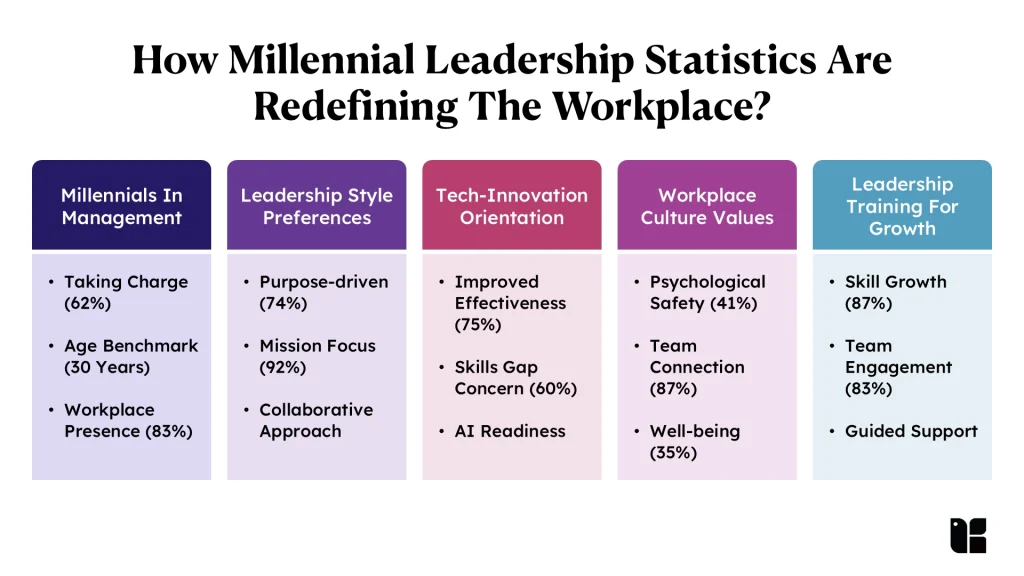
- Taking charge: Over 62% of millennials have direct reports, which shows that they’re actively managing teams and making key decisions. They’re often the go-to person when problems arise or direction is needed on the ground.
- Age benchmark: 30 is the average age of first-time millennial managers, which means they start leading earlier and gain more experience shaping team culture over time
- Workplace presence: About 83% of U.S. employees have worked under a millennial manager, which shows that more than 8 in 10 staff members report having a millennial boss at some point. Millennial leadership is all around us, changing how teams and offices work every day.
Leadership Style Preferences
Millennials are reshaping their preferred leadership styles by valuing meaning, collaboration, and shared purpose over traditional hierarchy. The numbers reflect this clear shift in their values and expectations:
- Purpose-driven: Over 74% of millennials say they want work that matters, showing that meaning and contribution drive their leadership style more than personal recognition.
- Mission focus: About 92% consider a sense of purpose critical to job satisfaction, reinforcing how mission alignment has become a baseline for how they lead and what organisations they commit to.
- Collaborative approach: Millennial managers favour team-based decision-making, valuing input from diverse voices and encouraging open collaboration across levels.
Tech-Innovation Orientation
Millennial leaders use technology to support innovation, improve efficiency, and reshape traditional leadership models. The numbers clearly reflect this expectation in the following ways:
- Improved effectiveness: PwC’s Millennials at Work report found that 75% of millennials believe access to workplace technology improves their effectiveness. Tools like Slack and Asana are popular for enabling better collaboration and streamlined workflows.
- Skills gap concern: According to Workday’s Global State of Skills report, 60% of millennial leaders express concern about a potential skills deficit emerging in the next three years.
- AI readiness: Deloitte’s 2025 Gen Z & Millennial Survey found that 77% of millennial respondents expect generative AI to significantly impact how they work within the coming year.
Workplace Culture Values
Millennial leadership is reshaping how workplace culture is defined, placing a strong emphasis on inclusivity, flexibility, and employee well-being.
- Psychological safety: Leaders in this group tend to encourage openness. They avoid blame, invite feedback, and try to make space for honest conversations. Still, a report by Mental Health America found that only 41% of millennials feel psychologically safe at work. Many leaders are now trying to change this by being more transparent and approachable.
- Team connection: Millennial managers often focus on how teams relate to each other. It’s common to see them running regular check-ins or setting up channels where people can speak freely. According to research conducted by EY, almost 87% of employees believe that shared empathy with their leaders boosts their productivity.
- Well-being: Stress at work isn’t seen as a badge of honour anymore. A Deloitte survey from 2024 showed that 35% of millennials feel anxious or stressed most of the time. Many millennial leaders are responding by making workloads more realistic and encouraging flexible schedules.
Leadership Training for Growth
Millennial leaders don’t treat development as a one-time task. For them, learning is part of how they manage growth and support others.
- Skill growth: According to Gallup’s report, 87% of millennials rate professional or career growth and development opportunities as important to them in a job. They push for learning that delivers immediate value over future credentials. It’s less about ticking boxes and more about staying sharp in real time.
- Team engagement: Over 83% say leadership training helps teams stay more involved. For them, development creates focus, trust, and energy at work. They use it to avoid disconnection and improve performance. If teams aren’t learning, they see that as a red flag.
- Guided support: Millennials prefer guiding over giving orders. They rely on feedback and formal reviews. They’d rather have a working conversation than a performance script. This makes their teams more open, responsive, and less afraid to try new things.
While global trends show how millennial leadership is reshaping workplaces at large, it’s equally important to explore how these shifts are happening specifically within the Indian context.
Leadership Trends Among Indian Millennials
Millennials are now shaping India’s workforce, bringing distinct strengths and facing key challenges. This overview explores the current state of millennial leadership in India, supported by data.
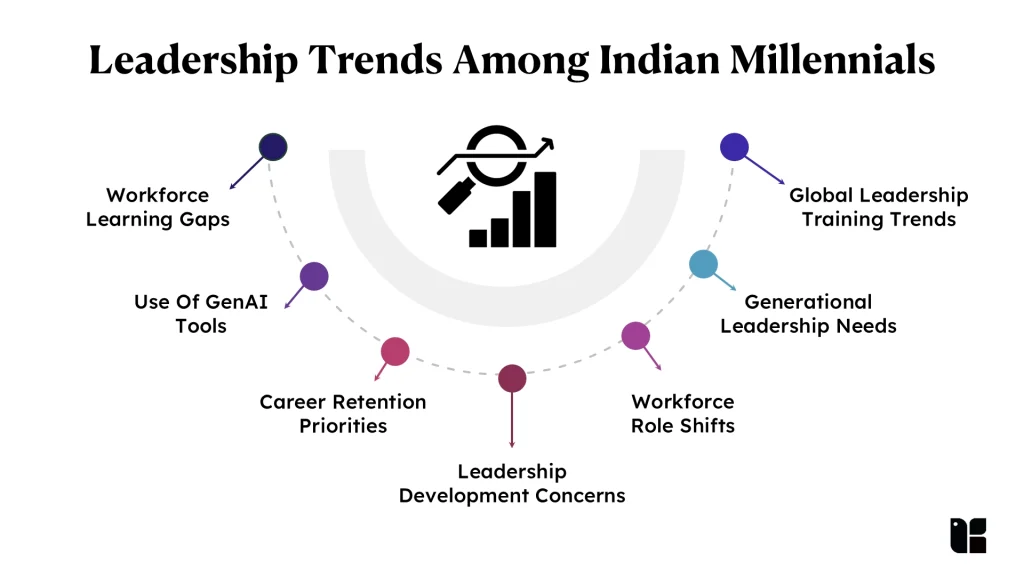
- Workforce learning gaps: A survey by Deloitte Gen Z & Millennials revealed that 97% of Indian millennials prefer learning through practical, on-the-job experiences rather than traditional classroom formats. However, only 47% say they receive meaningful guidance from their organisations, despite 56% actively seeking mentorship. This gap between learning preference and available support reflects a key challenge in leadership development.
- Use of GenAI tools: Millennials in India have almost adapted to digital tools, with 85% already using generative AI in their daily work. Most report that these tools improve productivity, save time, and enhance work-life balance. Their comfort with technology is not only about reshaping workflows but also influencing how leadership and innovation are evolving inside organisations.
- Career retention priorities: Another report by Deloitte India found that millennials prioritise career choices based on a combination of money, purpose, and personal well-being. These factors heavily influence job satisfaction, loyalty, and engagement. Employers who overlook this balance may find it harder to retain millennial talent, regardless of job titles or promotions.
- Workforce role shifts: According to a Great Place to Work India study, millennials now represent about 70% of the Indian workforce, with 39% having reached managerial roles. While their numbers in leadership are increasing, only 52% of them express confidence in their current leaders’ decision-making. This signals a growing influence but also highlights unresolved trust issues in the leadership pipeline.
- Leadership development concerns: A Times of India workplace analysis showed that 63% of millennials in India feel their leadership development is insufficient. They cite a lack of structured guidance, unclear career paths, and minimal exposure to strategic decision-making as major concerns. This suggests that while millennials are willing to lead, they often don’t feel fully prepared to take charge.
- Generational leadership needs: A recent study published in Asian Business & Management examined leadership preferences across generations in Indian companies. It found that Gen X, Gen Y (millennials), and Gen Z each respond best to different management and workplace leadership styles. For millennials, empowerment and feedback-based leadership are most effective, showing the importance of personalisation in leadership development.
- Global leadership training trends: A study from Administrative Sciences examined what millennial leaders expect from leadership development. While not India-specific, the insights are relevant to millennials across the world who want structured mentorship, experiential learning, digital skills training, and emotional intelligence support. These expectations echo the gaps reported by Indian millennials as well.
Building on these leadership trends, it’s important to see how they are actively shaping the way workplaces function today.
How Is Millennial Leadership Development Changing The Workplace?
Millennial leaders are reshaping leadership development through innovation, purpose, and hands-on growth opportunities that align with the changing workforce.
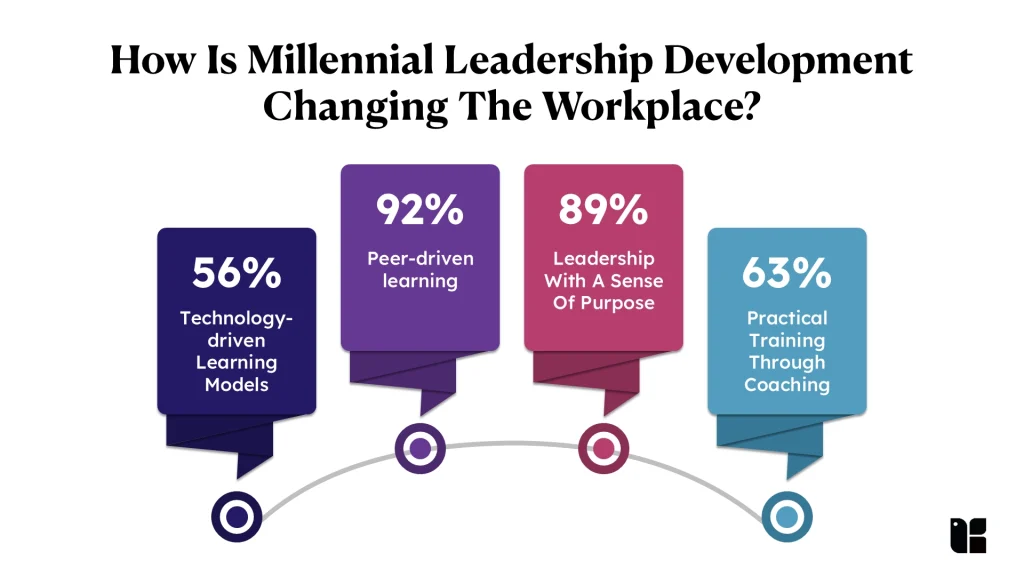
- Technology-driven learning models: Over 58% of L&D leaders highlight skill gaps and delayed AI adoption as key challenges. This has led to a rise in AI-powered and virtual learning platforms. Tools like Coursera for Business are enabling millennial leaders to upskill quickly, offering flexible, real-time learning aligned with workplace needs.
- Peer-driven learning: About 92% of millennial leaders see peer learning and skill development as vital for economic progress, compared to 76% of Gen X leaders. Platforms like Degreed are supporting this shift by enabling collaborative learning and knowledge sharing within teams.
- Leadership with a sense of purpose: Around 89% of millennials say a strong sense of purpose is important to their job satisfaction and overall well-being. Purpose-driven programs such as LinkedIn’s Career Pathways help align individual goals with broader social impact and organisational missions.
- Practical training through coaching: Over 63% of millennials believe they lack adequate leadership training, highlighting the rising demand for hands-on learning like job rotations and one-on-one coaching. Programs like BetterUp and Kapable are addressing this gap by offering personalised coaching and developmental pathways for emerging leaders.
As millennial leadership continues to evolve, its real influence becomes clear when we examine the tangible impact it has on business outcomes.
Explore Kapable’s leadership approach to see how organisations can develop millennial leaders who thrive in collaborative and fast-changing workplaces.
Impact Of Millennial Business Leadership In Today’s Time
Millennial leaders’ purpose-led leadership style is leading to measurable improvements in critical business areas in the following ways:
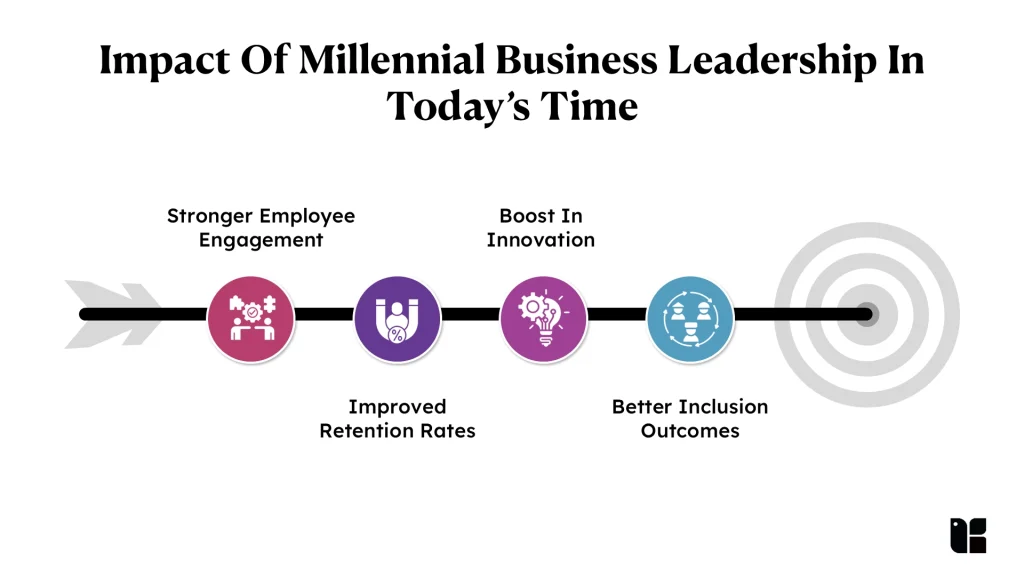
Stronger Employee Engagement
Millennial leaders often prioritise real-time feedback, open dialogue, and emotional connection with team members. This people-first approach has been linked to tangible boosts in team engagement.
- By working with team members to collaboratively set goals and priorities, millennial managers ensure clarity and purpose. Gallup data shows that 56% of millennials who receive accountability are engaged, and 72% who have defined priorities are engaged
- Another research reveals that millennial leaders frequently hold check‑ins that cover both personal well‑being and work topics, creating spaces where employees feel heard and valued. This empathetic, open communication fosters trust and engagement
Improved Retention Rates
Younger leaders are more likely to retain employees by aligning work with personal growth and flexibility. They also prioritise well-being and meaningful recognition, which strengthens loyalty and reduces turnover.
- According to the LinkedIn Workplace Learning Report 2023, employees working under millennial managers are 28% more likely to stay in their roles for at least three years. This retention trend is strongly tied to millennial leaders’ focus on development opportunities, flexible work setups, and work-life integration.
- Additionally, 60% of millennials are open to new opportunities, underscoring the retention challenge. These figures indicate that millennial leaders’ emphasis on mentorship and meaning contributes directly to long-term employee commitment.
Boost In Innovation
Millennial leaders are often at the forefront of adopting new technologies and driving innovation. They encourage experimentation and are quick to integrate digital tools that improve collaboration and efficiency.
- Individuals between the ages of 35 and 44, many of whom hold managerial or team leadership roles, consistently report high levels of experience and enthusiasm for artificial intelligence. This makes them natural drivers of digital transformation within their organisations. In fact, millennials are currently the most engaged generation when it comes to AI usage in the workplace.
- According to the Harvard Business Review, organisations led by millennials experience product development cycles that are up to 35% faster, thanks to their readiness to embrace AI and make agile, tech-enabled decisions.
Better Inclusion Outcomes
Inclusivity is not a checkbox for millennial leaders; it’s built into how they operate. They focus on creating safe spaces where diverse voices are heard, valued, and reflected in decision-making.
- A Deloitte Global survey reported that organisations with millennial leaders in executive roles showed a 33% improvement in diversity performance scores compared to their Gen X and Boomer-led counterparts. This shift is more than symbolic. It translates to diverse hiring practices, equitable promotion paths, and team structures that reflect different backgrounds and ideas.
- Research from McKinsey & Company also found that companies with inclusive teams are 36% more likely to outperform on profitability, reinforcing how millennial values are linked with strong financial outcomes. Understanding the impact is just the start; millennial leaders also focus on specific metrics that reflect their values and drive meaningful success.
To understand this impact more clearly, it helps to look at the key metrics that millennial leaders focus on to guide their decisions and measure success.
How Millennial Leaders Use Metrics To Shape Company Culture?
Millennial leaders are redefining success at work. Rather than focusing only on financial results or strict KPIs, they emphasise people-first metrics like team well-being, learning, innovation, and inclusion.
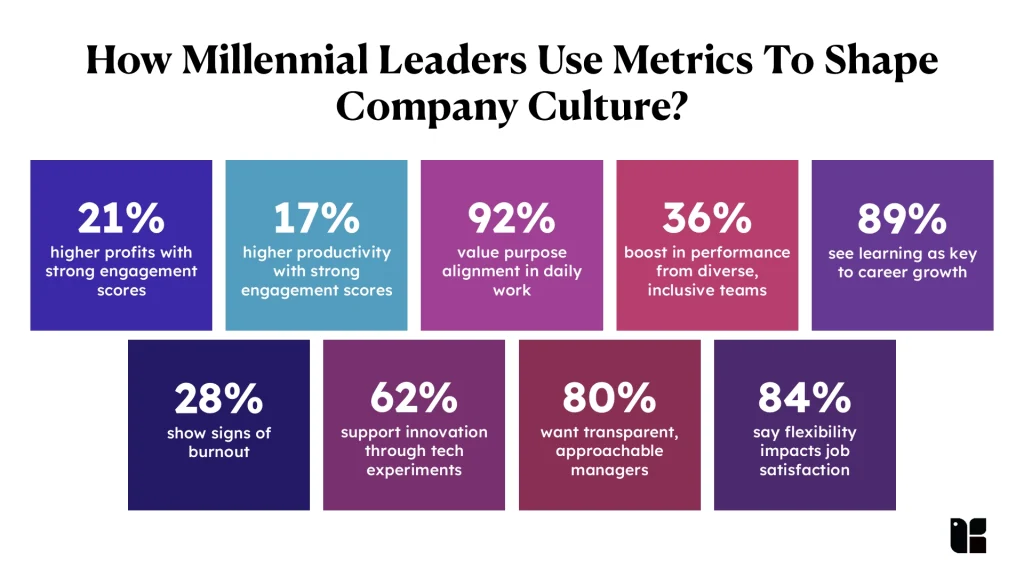
- Employee engagement score: Millennial leaders value how their teams feel and not what they produce. They regularly use tools like CultureAmp or Officevibe to gather feedback on employee morale, motivation, and sense of connection. According to a report, teams with high engagement show 21 % higher profitability and 17 % higher productivity. These results show why engagement has become a core metric for performance.
Purpose alignment index: This generation of leaders often checks whether team members understand how their work contributes to a larger mission. Purpose-alignment surveys or team discussions help them track this connection. Deloitte’s Global Millennial Survey found that 92 % of millennials consider working for a company with a strong purpose essential for job satisfaction. - DEI progress: Millennial managers pay attention to how inclusive their teams are. They monitor gender and ethnic representation and receive feedback from employees about inclusion and belonging. McKinsey’s report found that companies with strong diversity are 36% more likely to outperform others on profitability. For millennial leaders, DEI is not a side effort but a performance strategy.
- Skill development engagement: Millennials strongly believe in ongoing growth. They track how often team members complete courses, attend training, or apply new skills at work. Tools like Coursera, LinkedIn Learning, and internal systems help measure this. LinkedIn’s report showed that 89% of millennials see learning as vital for career development. This explains why development is treated as a measurable business need rather than a personal choice.
- Burnout risk indicators: Millennial leaders pay close attention to signs of burnout. They monitor paid time off usage, long working hours, emotional fatigue, and reduced engagement during team meetings. Gallup’s findings reveal that 28% millennials feel burned out very often or always, and 73% experience burnout at least sometimes. These numbers highlight the importance of well-being as a tracked metric.
- Innovation activity score: These leaders focus on how frequently new ideas are tested and implemented. They look at AI adoption, team participation in experiments, and how quickly tools are integrated to improve processes. Companies using modular, Millennial managers are also more likely to champion AI experimentation on the ground. A recent report revealed that 62% of millennial leaders actively support piloting new technologies within their teams. They see innovation as part of their core responsibility, not a separate initiative.
- Measuring manager approachability: Millennial leaders want to know how approachable they are. They encourage upward feedback and regular check-ins to ensure team members feel safe, supported, and heard. According to a study from MIT Sloan shows that 80 % of millennials value transparency from leadership, a higher percentage than older generational leaders.
- Flexibility utilisation rate: Offering flexibility is one thing, and tracking how it’s used is another. Millennial managers observe how often employees work remotely, use asynchronous tools, or adjust their schedules for better balance. The Future Forum Pulse Survey revealed that 84% of millennials say flexibility is one of the most important factors when it comes to job satisfaction and retention.
While these metrics highlight what drives millennial leaders, they also face specific challenges that can impact how effectively they lead.
What Are The Challenges Millennial Leaders Face In Business Management?
Millennial leaders may be redefining leadership with values of inclusion and purpose, but their journey is far from smooth. Here is the list of challenges that are affecting their growth:
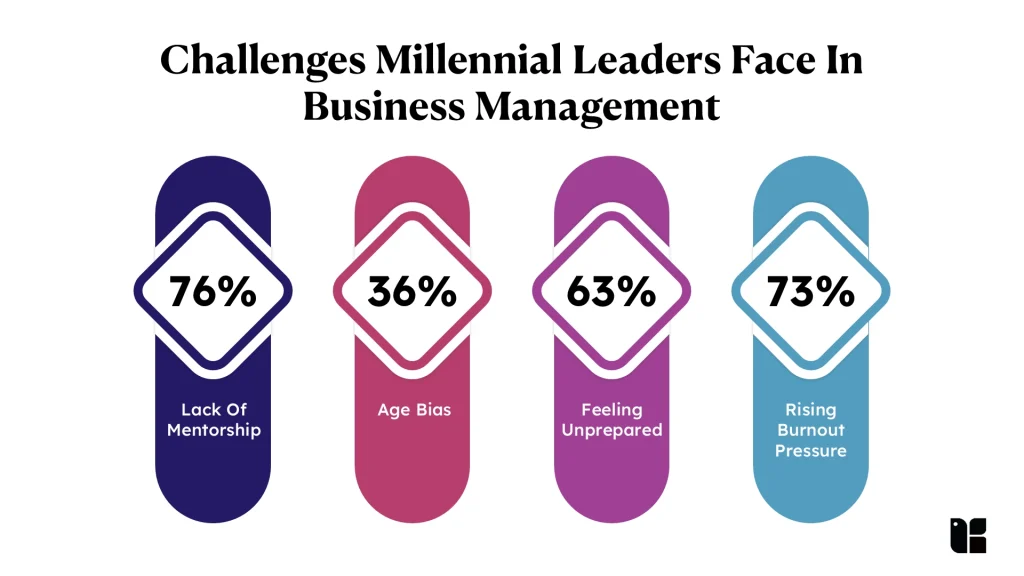
- Lack of mentorship: Structured mentorship remains a major gap for millennial leaders, where younger professionals are often left to ‘figure things out’ on their own without proper guidance. While 76% believe having a mentor is important, only 37% have one, highlighting a disconnect between need and access.
- Age bias: Despite their capabilities, millennials often face generational bias where youth is equated with inexperience. It was reported that 36% of young professionals report having encountered age-based discrimination at work, making it the most common form of workplace bias, ahead of gender or race.
- Feeling unprepared: The perception that millennials should lead without formal development shows a structural neglect in grooming young leaders. 63% of millennials say their leadership skills are not being fully developed, exposing a gap in training and organisational investment.
- Rising burnout pressure: High stress levels among millennial leaders indicate a cultural bias that values hustle over wellbeing, leaving little room for balance. Gallup reports 28% of millennials feel “very often” or “always” burned out at work, with 45% feeling burned out sometimes, adding up to 73% facing burnout.
While the challenges are significant, millennial leaders are actively responding with focused strategies that help them support their teams and create lasting impact for millennials in the workplace.
What Are The Key Strategies Every Millennial Leader Should Use Today
Millennial leaders are not responding to change; they’re guiding it with strategies built on trust, experimentation, and inclusion. Below are key strategies every millennial leader should use today:
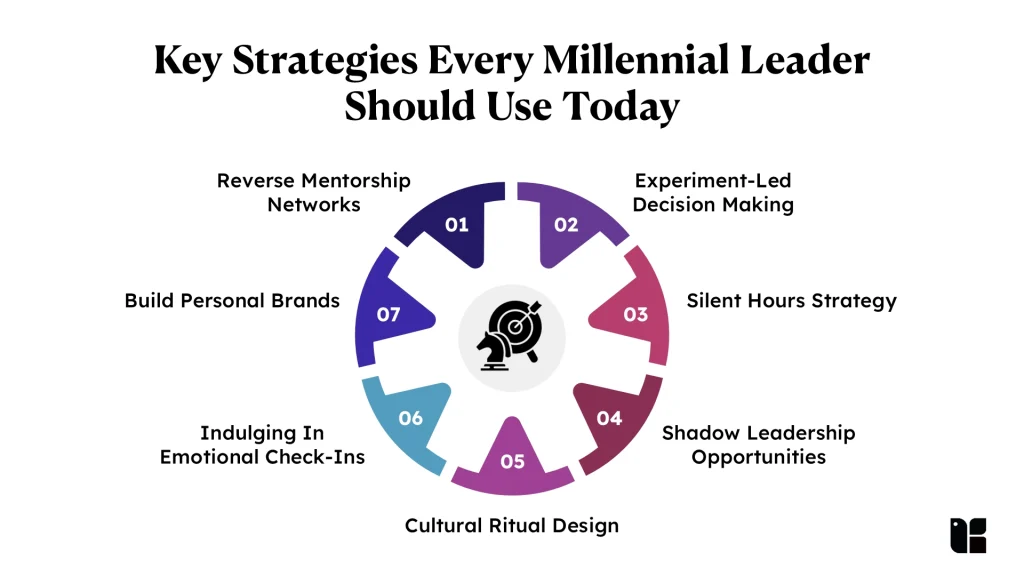
Reverse Mentorship Networks
Many millennial leaders actively involve younger team members in offering constant feedback and insights, especially in areas like tech, digital habits, and cultural relevance.
- In fact, a report by Deloitte shows that companies with inclusive mentoring structures, including reverse mentoring, see up to 30% higher engagement and retention. The shared learning strengthens generational understanding and helps leaders stay in touch with emerging perspectives.
- Curate a rotating “Trend Pairing” system where junior employees are matched with senior leaders every fortnight to co-analyse a specific digital, cultural, or consumer trend and present a joint perspective to the larger team.
Experiment-Led Decision Making
Instead of committing to rigid plans, millennial leaders often test ideas in smaller stages to learn and adapt.
- A McKinsey study found that organisations that adopt a test-and-learn approach are more than twice as likely to outperform their peers in innovation metrics. This mindset reduces risk and builds a team culture that views experimentation as progress, not failure.
- Introduce a “24-Hour Live Test Loop” where any idea under discussion must be converted into a prototype, mock flow, or mini-process and tested within a single workday using real team input or customer feedback.
Indulging In Emotional Check-Ins
Millennial leaders are shifting focus from output to emotional well-being. They check in on how team members feel, along with what they’re working on.
- Research from Harvard Business Review found that leaders who promote psychological safety see a 27% increase in employee performance skills and 76% higher engagement. Checking in emotionally helps spot issues before they escalate and builds stronger, trust-based relationships.
- A simple and popular technique is using “Red-Yellow-Green” check-ins at the start of team meetings, where team members share how they’re feeling by picking a colour (red = struggling, yellow = okay, green = good), allowing leaders to quickly gauge emotional pulse without forcing oversharing.
Silent Hours Strategy
To reduce distractions, many millennial-led teams block out specific hours for deep work. It helps improve focus and overall work quality.
- According to a study by RescueTime, professionals lose up to two hours daily to distractions, and 70% say they work best in quiet, focused environments. By creating silent periods during the workweek, leaders help teams concentrate better and reduce digital fatigue.
- A widely adopted technique is implementing “No-Meeting Blocks” on shared calendars, commonly from 10 a.m. to noon or 2 p.m. to 4 p.m., where team members are not allowed to schedule calls, send messages, or initiate interruptions, ensuring predictable windows for deep focus.
Cultural Ritual Design
Millennial leaders focus on turning abstract values into everyday actions that teams can relate to. They emphasise living values through experience over merely expressing them.
- A study by Gallup found that employees who feel connected to company culture are 3.7 times more likely to be engaged. These rituals offer a consistent way to bring values to life.
- They introduce small, repeatable rituals like “gratitude circles” or “failure story sessions” to reinforce what matters most. These rituals offer a consistent way to bring values to life. An effective way to use these rituals is by linking them to regular team routines, like starting weekly meetings with a quick “value shoutout” to highlight actions that reflect key values.
Shadow Leadership Opportunities
Millennial leaders take a more open approach by allowing younger employees to observe meetings, strategic decisions, and important discussions, giving them early exposure to leadership in action.
- According to a LinkedIn Learning report, 94% of employees say they would stay longer at a company that invests in their development, and shadowing is a practical way to do exactly that.
- A commonly used technique is “Observe-Debrief-Apply”, where employees first shadow a live meeting, then immediately debrief with the leader to unpack what happened, and finally apply a small related task (like drafting a follow-up email or proposal) to turn learning into action.
Build Personal Brands
Millennial leaders are not afraid to speak publicly, share ideas, and create a visible leadership identity, especially online.
- A recent survey by Edelman revealed that 63% of employees trust leaders who communicate openly on social platforms more than those who don’t. Personal branding is not only about visibility, but it also builds authenticity with external and internal trust.
- One actionable technique is to lead a micro-campaign every quarter, a focused series of 3 to 5 posts tied to one leadership theme (like decision-making, failure, or team culture), each linked to real moments from their work. This approach gives structure to personal branding, builds consistency, and avoids scattered or one-off messaging.
Conclusion
The statistics show these leaders are doing more than changing business outcomes; they’re creating workplaces where people feel heard, valued, and motivated to grow. Whether you’re a manager, team member, or leader yourself, understanding how millennials lead helps us all build environments that support well-being and collaboration. Their way of leading puts people at the heart of leadership and prepares us for a future where everyone does well.
As leadership expectations continue to evolve, Kapable’s fit check helps you determine whether the programme matches your development needs.


