

TL;DR
- Core Capability: Critical thinking is an essential soft skill that governs how we manage complexity, solve problems, and make decisions based on logic and evidence rather than impulse.
- Driving Professional Growth: In fast-paced work environments, this skill is crucial for adaptability, continuous learning, and effective collaboration across all areas, from leadership to communication.
- Internal Barriers: Its consistent application is often undermined by natural human tendencies, including confirmation bias, prioritising emotion, and a general aversion to change or failure.
- Actionable Frameworks: Proven methodologies such as Critical Incident Analysis and the OODA Loop offer structured ways to systematically analyse situations and consciously strengthen one’s rational judgment.
What separates a good leader from a great one? Often, it’s the ability to think critically, adapt, and make well-informed choices. Critical thinking isn’t just a skill; it’s the foundation of key soft skills. The purpose of the blog is to understand how critical thinking interacts with and strengthens soft skills that can help personal and professional growth.
What Is Critical Thinking?
Critical thinking is the ability to assess situations, evaluate evidence, and make logical decisions instead of reacting on impulse or emotion. It involves analysing information thoroughly, questioning assumptions, and reasoning step-by-step to arrive at sound conclusions. It affects nearly every decision we make, whether it’s a small choice like planning your day or a big decision like deciding on a career path.
Only 26% of adults worldwide feel confident in their ability to solve complex problems – a clear indicator that many individuals lack the necessary critical thinking skills. This shows how vital these abilities are in both personal and professional settings. The components of critical thinking skills are:
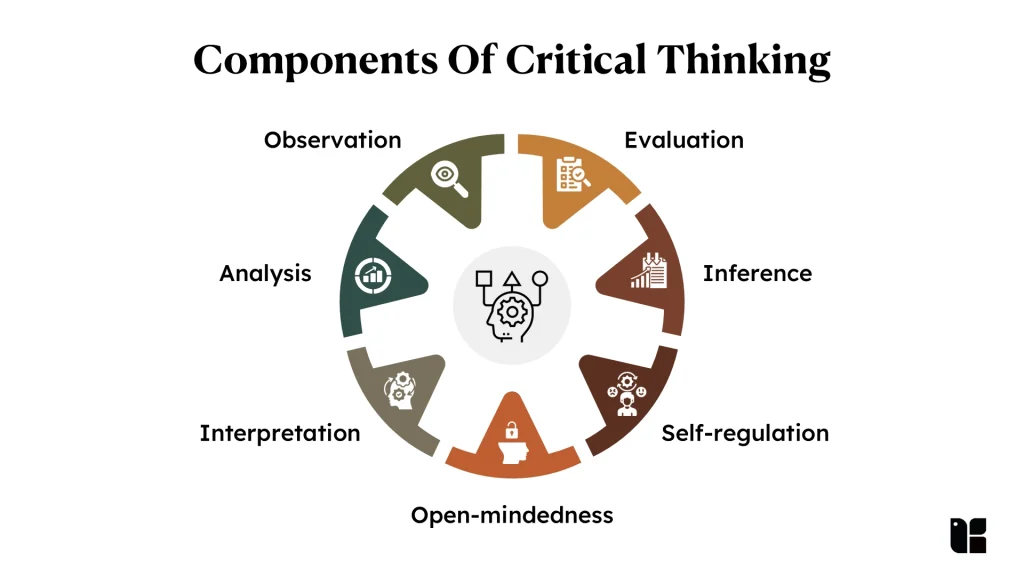
- Observation: It is the first step to improve critical thinking skills, requiring careful attention to details, patterns, and inconsistencies in a situation. It sets the foundation for meaningful analysis.
- Interpretation: It involves understanding and contextualising the information collected. It ensures that facts, opinions, and experiences are connected to the larger context effectively.
- Analysis: It breaks down complex issues into manageable parts, revealing relationships, assumptions and implications. It helps in understanding the root of problems.
- Evaluation: It assesses the credibility of sources and the quality of evidence. It ensures decisions are made using reliable, unbiased, and well-verified information.
- Inference: It allows logical conclusions to be drawn from evidence while considering alternatives. It strengthens reasoning and supports sound judgments.
- Self-regulation: It involves reflecting on one’s thought process, identifying biases, and reassessing assumptions. It ensures objectivity and continuous improvement.
- Open-mindedness: It is about embracing new perspectives and questioning preconceived notions. It broadens understanding and enhances critical thinking.
Having looked at what critical thinking is, let’s now examine whether it qualifies as a soft skill and how it fits into the broader context of personal and professional development.

Is Critical Thinking A Soft Skill?
While critical thinking involves logical analysis and reasoning, it qualifies as a soft skill because it emphasises interpersonal adaptability, communication, and decision-making in varying situations. Just as emotional intelligence allows us to manage feelings, critical thinking allows us to manage complexity, problem-solving, and teamwork effectively. Critical thinking aligns with soft skills for the following reasons:

It Influences Social Interaction
Soft skills focus on how individuals interact with others in group settings and conflict situations. Critical thinking enables one to approach interpersonal challenges with logic, objectivity, and problem-solving, improving communication and cooperation. It empowers individuals to listen actively and respond to differing opinions with clarity and respect.
It Depends On The Context
Soft skills are flexible, adapting to various environments and challenges. Critical thinking shares this trait by allowing individuals to assess situations from multiple angles and adjust their responses based on circumstances. This flexibility allows leaders and employees to respond effectively to unforeseen challenges without rigid thinking.
It Relates To Emotional Intelligence
Emotional intelligence includes self-awareness, empathy, and interpersonal communication – areas that overlap with the rational assessment and problem-solving processes for critical thinking. It enhances emotional intelligence by promoting objective responses to emotionally charged situations and improving self-reflection.
It Focuses On Non-Technical Decision-Making
Unlike hard skills, which refer to measurable, job-specific technical expertise, soft skills are abstract and relational. Critical thinking falls into this abstract, adaptive decision-making space. It allows individuals to make sound judgments even without clear-cut information, relying on logical reasoning and analysis of context.
Now that we’ve established whether critical thinking is a soft skill, let’s explore how it plays a key role in enhancing other soft skills and overall personal growth.
What Is The Role Of Critical Thinking In Soft Skills?
The modern workplace is fast, uncertain, and constantly changing, thanks to technology and innovation. This is where critical thinking becomes even more valuable. Here’s how critical thinking supports adaptability:

- Analysing change: Technology introduces change at lightning speed, and critical thinking helps employees process these shifts thoughtfully. It allows them to separate fear of change from logical analysis, focusing instead on opportunities and solutions.
- Handling uncertainty: Sometimes the path forward isn’t clear. Critical thinking allows people to weigh options, explore patterns, and find logical next steps even when the situation feels ambiguous.
- Continuous learning: In workplaces where new tools, skills, and technologies are introduced regularly, critical thinking supports lifelong learning. It helps individuals approach new challenges with an open mind and the ability to apply new knowledge effectively.
- Problem-solving skills: Critical thinking empowers individuals to assess situations, identify problems, and find practical solutions efficiently. It promotes a structured approach to tackling challenges by breaking them into manageable steps and weighing pros and cons to determine the best course of action.
- Decision-making under pressure: In fast-paced environments, employees often face high-pressure decisions. Critical thinking equips them with the ability to analyse risks, evaluate alternatives, and make informed choices even in time-sensitive situations, ensuring they maintain composure and confidence.
- Effective communication: Critical thinking fosters clarity and precision in communication. When individuals think critically, they can articulate ideas, provide logical reasoning, and actively listen to others, leading to better teamwork, reduced misunderstandings, and stronger workplace relationships.
Having understood the role of critical thinking in soft skills, let’s now look at its practical applications in real-world situations.
“My journey with Kapable has been truly valuable. The sessions helped me gain confidence and handle impromptu speaking and assertiveness. I successfully led high-level meetings, which I used to avoid, and received positive feedback from my director. I now feel confident and empowered.”
– Ruchika Bagga (Senior Manager At Mankind Pharma)
How Is Critical Thinking Applied In Real-World Soft Skill Scenarios?
Critical thinking is a practical skill that helps employees and leaders solve problems, make decisions, and navigate daily challenges with clarity and logic. It allows teams to stay focused, address issues effectively, and foster better communication and collaboration. Here’s how critical thinking is applied in common workplace scenarios:

Leadership Management
Leaders use critical thinking to evaluate team performance, spot risks, and set strategies. For example, a manager reviewing a quarterly report might notice a department lagging. Using logical reasoning, they can identify the root issue, like a training gap, and implement targeted solutions such as additional training or process adjustments.
Communication
Clear communication prevents misunderstandings, and critical thinking ensures clarity by analysing messages and interpreting intent. For instance, during a team meeting, a manager can ask for input and clarify expectations if team members appear uncertain, ensuring everyone is aligned.
Conflict Resolution
Disagreements are part of teamwork, but critical thinking helps mediate them effectively. It allows employees to listen to different perspectives, identify shared goals, and find practical solutions. A manager can resolve a team dispute by focusing on problem-solving rather than personal opinions.
Teamwork
Teams succeed when diverse perspectives are welcomed and logical reasoning guides decisions. For example, a team planning a product launch can use market trends, customer feedback, and competitor insights to brainstorm solutions and choose strategies backed by evidence.
Decision-Making Under Pressure
Critical thinking ensures rational, logical decisions during emergencies. For instance, when a technical issue halts production, a manager can evaluate options calmly, like contacting IT support or finding alternatives, rather than evaluating other choices.
While critical thinking proves valuable in real-world situations, it’s important to recognise the challenges that can come with developing and applying these skills effectively.
What Are The Common Challenges In Applying Critical Thinking As A Soft Skill?
Critical thinking challenges often get in the way and prevent us from making the most logical or effective choices. Here are some common hurdles that many people face when trying to use critical thinking in their lives:

Cognitive Biases
Have you ever found yourself favouring information that supports what you already believe, even if it may not be the full story? That’s a cognitive bias at work. These mental shortcuts can lead us down the wrong path because they make it harder to approach situations without preconceptions. For example, confirmation bias often makes us ignore evidence that contradicts our beliefs, while anchoring bias can lead us to stick to the first piece of information we hear instead of considering other possibilities.
Over-Reliance On Emotion
There are times when going with your gut can feel right, especially during stressful situations or big decisions. But when emotions are the driving force behind decision-making, logic can take a backseat. This can lead to impulsive choices or decisions clouded by stress, anger, or fear rather than clear reasoning. It’s easy to see why decisions based purely on emotions might not always end well.
Fear of Failure
Uncertainty is intimidating, and many of us are afraid to take risks or try new ways of doing things. The fear of making a mistake or failing can lead to sticking with the “safe” or familiar route, even if it’s not the best option. It’s much easier to choose what we know, even if it’s not ideal, than to face the unknown. This hesitation can stop us from exploring innovative solutions or stepping out of our comfort zones.
Resistance To Change
Change can be uncomfortable, even when it’s necessary. Many people resist change because sticking to routines feels easier and safer. This resistance can block us from stepping back, reassessing old strategies, and thinking of new ways to solve problems. When we’re unwilling to question how things are “always done,” critical thinking becomes more challenging.
Lack Of Formal Training
Lack of formal training in a critical thinker often leaves us relying on instinct or trial and error instead of structured reasoning. Without proper guidance or experience, it becomes much harder to apply logical thinking when needed. Leadership training can bridge this gap, providing the tools to develop these essential skills.
The Availability Of Pre-Analysed Information
Pre-analysed information is easily accessible in the digital age, offering convenience and saving time. However, relying on it can weaken critical thinking skills and growth. Dependence on ready-made conclusions limits our ability to challenge ideas or explore different perspectives, diminishing problem-solving skills. This emphasises the importance of fostering critical thinkers in a world driven by surface-level insights.
After identifying the challenges associated with critical thinking, let’s explore practical strategies to overcome these obstacles and strengthen your skills.
Which Strategies Strengthen Critical Thinking Abilities Within Soft Skills?
Enhancing critical thinking is essential for making informed decisions, solving complex problems, and fostering effective communication. Here’s how to improve your critical thinking abilities:

Critical Incident Analysis
This strategy involves reviewing and analysing specific situations (critical incidents) to derive lessons and insights. The steps to implement are as follows:
- Identify a critical incident (success, failure, or problem).
- Analyse the context, decisions made, and outcomes.
- Ask key reflective questions:
- What led to this incident?
- What could have been done differently?
- What can we learn from this?
- Apply these insights to future decision-making.
This reflective practice enhances judgment and decision-making by learning from experience. It encourages continuous growth and the ability to adapt to similar situations in the future.
Mind Mapping
Mind Mapping is a visual brainstorming tool that supports creativity while fostering analysis by connecting ideas and concepts. Here is how you can implement it:
- Start with the main idea at the center.
- Branch out into related subtopics or challenges.
- Connect thoughts, alternatives, and data points to find relationships between ideas.
This approach builds cognitive flexibility and helps organise complex information. Critical thinking, as a soft skill, enhances this process by allowing you to evaluate connections, identify patterns, and make well-informed decisions based on logical reasoning.
6W1H Framework
This framework provides a comprehensive approach to critical thinkers for solving problems by asking a series of fundamental questions. Ask the following seven questions about any situation:
- What is the problem or situation?
- Why is it happening?
- When does it occur?
- Where does it happen?
- Who is involved?
- How can the issue be resolved?
- How much will it cost, and/resources are required?
This approach ensures that decision-making considers all angles and underlying factors. Critical thinking, as a soft skill, empowers individuals to systematically analyse these questions, prioritise information, and arrive at logical, well-reasoned solutions.
OODA Loop (Observe, Orient, Decide, Act)
Originally developed for military strategy, the OODA Loop is a decision-making process emphasising rapid adaptation and feedback. The steps are as follows:
- Observe: Gather relevant information and monitor changes in your environment to identify patterns or trends.
- Orient: Interpret the data by comparing it to past experiences and considering external factors that may influence the outcome.
- Decide: Weigh options and select the response that addresses the situation effectively and logically.
- Act: Take the planned response and implement it while remaining flexible to feedback.
The OODA Loop encourages quick decision-making while maintaining flexibility to respond to dynamic and changing environments. Developing critical thinking as a soft skill enhances the ability to assess situations, adapt strategies, and make informed choices within the loop effectively.
With effective strategies in mind, let’s now examine real-life case studies to see how these approaches have been successfully applied.
Explore how Kapable’s learning framework helps professionals develop communication, collaboration, and decision-making by applying critical thinking in real workplace situations.
How Do Case Studies Demonstrate Critical Thinking As A Soft Skill In Action?
Critical thinking enhances soft skills like decision-making, leadership, teamwork, and problem-solving by enabling logical analysis and informed decision-making. Here are real-life examples showcasing its practical application:

Tata
Ratan Tata’s strategic leadership with Tata Motors and the launch of the Tata Nano illustrates effective decision-making. By analysing market trends, engineering feasibility, and consumer demand, Tata made informed choices that aligned innovation with affordability – demonstrating leadership rooted in critical thinking. Critical thinking as a soft skill allowed Tata to evaluate diverse perspectives, foresee challenges, and make balanced, strategic decisions.
Thai Cave Rescue
The 2018 rescue of 13 boys and their coach from Tham Luang Cave showed teamwork under pressure. Rescue teams applied critical thinking by evaluating risks, assessing environmental challenges, and adapting strategies in real-time. Their logical decision-making ensured the safe extraction of all members. Critical thinking as a soft skill enabled the team to remain focused, prioritise actions, and solve complex, high-pressure problems effectively.
Google’s AI Disagreements
Google resolved a team conflict over AI projects by focusing on shared goals. Through critical thinking, they analysed root causes, facilitated feedback, and improved communication, allowing both teams to align strategies and innovate collaboratively. Critical thinking as a soft skill fostered mutual understanding, logical analysis, and creative problem-solving, bridging divides and aligning team objectives.
Conclusion
Critical thinking is a vital soft skill that empowers individuals to make clear, informed decisions and adapt to change. It supports effective leadership, teamwork, and communication by encouraging logical analysis and creative problem-solving. Developing this skill enhances your ability to think and improves your critical thinking skills in the workplace, helping you stay flexible, navigate uncertainty, and drive personal and professional growth.
If you’re ready to improve how you communicate, solve problems, and make sound decisions at work, Kapable’s program fit can help you evaluate your next step.


