


TL;DR
- Mechanism of Clarity: Effective speech relies on the coordinated action of the lips, tongue, palate, and vocal cords, which are the essential physical components that form accurate and understandable sounds.
- Articulation Difficulties Have Social Costs: Problems like mispronunciation and frequent misunderstandings signal deeper articulation issues that often manifest as frustration, social avoidance, and reduced confidence in daily interactions.
- Improvement Through Practice and Professional Help: Speech clarity is enhanced by integrating targeted exercises, such as regular tongue twisters and self-recording, with the expert, customised support of a Speech-Language Pathologist.
- Development is Continuous and Inclusive: Articulation skills evolve through predictable stages from infancy to adulthood, with support and therapy available and beneficial for people of all ages, not just children with severe difficulties.
Do you often have to repeat yourself or feel misunderstood? It can be really frustrating when communication doesn’t go smoothly. In this blog, we’ll explain what speech articulation is and how it affects how clearly you speak. We’ll look at common problems people face, like unclear pronunciation and inconsistent speech, and share practical tips to help you improve your speaking skills. Whether you want to speak more clearly or just learn more about communication, you’ll find useful advice and easy tips here. Understanding articulation and using these strategies can help you have clearer and more confident conversations.
Why Is Understanding Speech Articulation Important?
Speech articulation is all about how we form and use sounds to make our speech clear and accurate. It’s not just about the physical process of making sounds but also about how we use these sounds to communicate effectively. Good articulation helps ensure that your message is understood and reduces the chances of miscommunication.
Speech articulation is key to clear communication because it affects how well you express your ideas. When you speak clearly, it’s easier for others to understand you, which helps avoid misunderstandings. This is important in both professional situations, where clear speech can impact how others see your abilities, and in everyday conversations, where it makes interactions smoother and more engaging. Good articulation builds confidence and helps strengthen relationships by making communication more effective.
With a foundational understanding of speech articulation established, let’s now explore the specific functional components that come together to produce clear and precise speech.

What Are The Components Of Speech Articulation?
To understand clear speech, let’s look at the key parts of the mouth and throat involved in articulation. These components work together to shape the sounds we produce. The parts are as follows:

- Lips: They help form sounds by coming together or moving apart. For example, to make the ‘b’ sound, your lips come together and then release. They also help in producing rounded sounds, such as ‘o’ and ‘u’, by adjusting their shape.
- Tongue: The tongue changes shape and position to create different sounds. For instance, the ‘t’ sound is made by touching the tongue to the roof of your mouth. Its movement also affects vowel sounds, such as ‘e’ and ‘i’, by adjusting its height and position.
- Palate: This is the roof of your mouth. The hard palate (the front part) and the soft palate (the back part) help shape sounds. For example, the hard palate helps with sounds like ‘t’ and ‘d’. The soft palate is crucial for creating nasal sounds like ‘m’ and ‘n’ by blocking or allowing air through the nasal passage.
- Vocal cords: Located in your throat, these cords vibrate to produce sound. They control the pitch and volume of your voice. For instance, by stretching the vocal cords, you can produce a higher pitch, like when singing a high note, while relaxing them creates a deeper, lower pitch.
Having explored the components involved in speech articulation, it’s also important to understand the challenges that can arise.
What Are The Common Articulation Issues?
Here are some common problems people face with their speech, which can affect clarity and effective communication. Identifying and addressing these issues can significantly improve one’s speech quality.
Signs Of Articulation Issues
Articulation issues can manifest through various signs that affect how clearly and effectively individuals communicate. Recognising these signs is essential for understanding the extent of the difficulty and determining the appropriate steps for intervention:

- Difficulty pronouncing words: Individuals may consistently mispronounce words or sounds, making their speech less clear. For example, they might substitute, omit, or distort sounds, affecting overall intelligibility.
- Frequent miscommunication: Regular misunderstandings or repeated requests for clarification from others can indicate articulation problems. This often results in frustration for both the speaker and the listener.
- Hesitation in speaking: People might hesitate or avoid speaking in situations where they feel their articulation issues might be noticeable, such as in public speaking or during conversations with unfamiliar individuals.
- Overly simplified speech: To manage pronunciation difficulties, individuals may simplify their language, using less complex words or phrases to avoid challenging sounds. This can affect the richness and clarity of their communication.
- Nonverbal cues: Individuals with articulation issues might use excessive nonverbal communication, such as gestures or facial expressions, to supplement their speech. This can be a sign of difficulty in clearly articulating their thoughts verbally.
Recognising these signs of articulation difficulties is the first step in understanding how they can affect an individual’s daily life. The next crucial aspect to consider is how these articulation issues influence behavioural patterns and social interactions.
Clear speech articulation allows speakers to focus attention on their message instead of the way it is delivered. This practical communication approach is reflected throughout Kapable.
Behavioural Indicators
Behavioural changes often accompany articulation issues, revealing how these challenges impact individuals’ social interactions and emotional well-being. Identifying these behavioural indicators can provide insight into the underlying communication difficulties and guide appropriate support strategies:
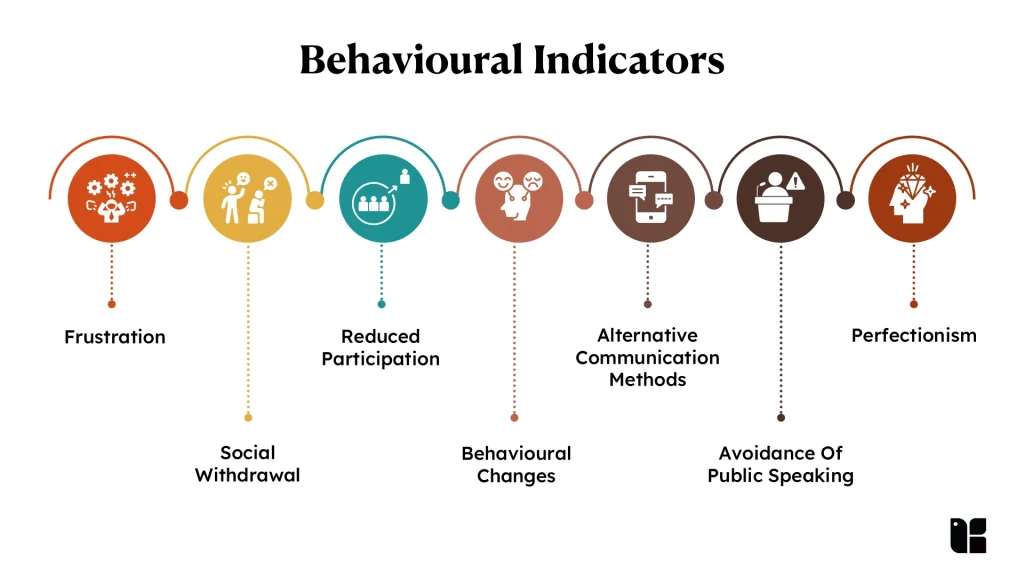
- Frustration: Articulation difficulties can lead to frustration or stress, especially when communication barriers hinder personal or professional interactions. This frustration may be evident through visible agitation or avoidance of speaking situations.
- Social withdrawal: To avoid the discomfort of their speech difficulties, individuals might withdraw from social interactions or avoid situations that require extensive verbal communication. This can include declining invitations or avoiding group discussions.
- Reduced participation: People may participate less in conversations or meetings if they feel their speech issues might be highlighted. This reduction in participation can impact their engagement and contributions in both personal and professional settings.
- Behavioural changes: Persistent articulation challenges can lead to changes in behaviour, such as increased anxiety about speaking or a decrease in confidence. This can affect overall motivation and willingness to engage in verbal activities.
- Alternative communication methods: Individuals might rely more on written communication, emails, or other non-verbal methods to convey their messages, opting for these approaches to circumvent their articulation difficulties.
- Avoidance of public speaking: Individuals may avoid situations that involve speaking in front of groups, such as presentations or public speaking events. This avoidance can be a way to escape the stress of potential speech difficulties being noticed.
- Perfectionism: Some individuals may develop a tendency towards perfectionism in their speech, striving for flawless communication and becoming overly critical of their own performance. This can lead to excessive self-monitoring and anxiety about speaking.
Understanding common articulation issues helps identify the root causes of speech difficulties. To effectively address these problems, it’s important to explore the underlying anatomy of speech and how various components contribute to clear communication.
What Are The Stages Of Articulation Development?
Articulation development unfolds through distinct stages, each crucial for mastering clear and precise speech. Understanding these stages offers valuable insights into how speech improves over time:
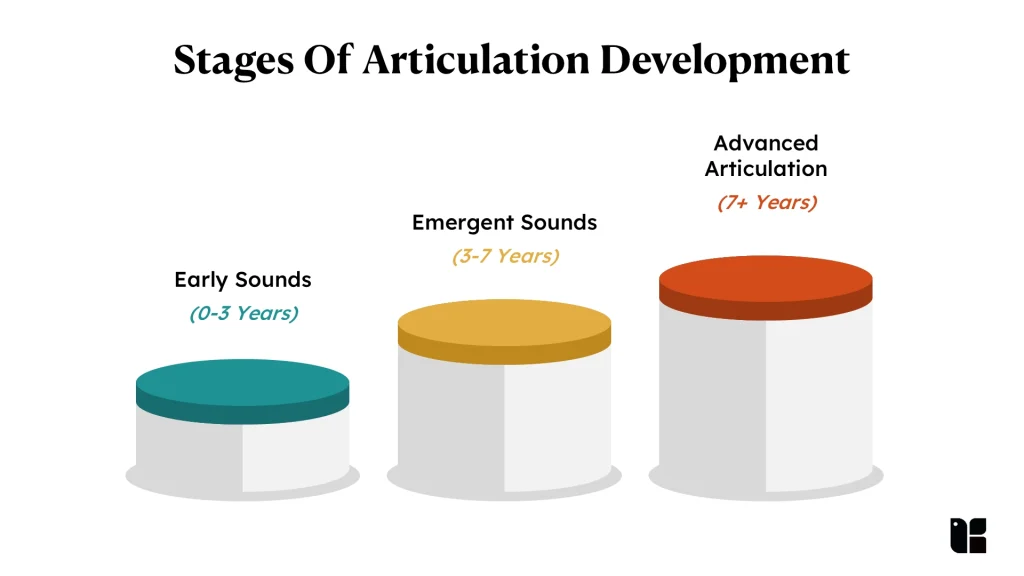
- Early sounds (0-3 years): Babies start by babbling and making simple sounds. For example, a baby might babble “ba-ba” while playing with toys. This stage is about experimenting with sounds and syllables. Activities might include mimicking sounds, identifying basic phonemes, and building the foundation for more complex speech.
- Emergent sounds (3-7 years): As children grow, they start to make more complex sounds and combinations. For instance, a child practices saying “spaghetti” without dropping any sounds. They improve pronunciation, though some errors may still occur. This stage focuses on practising difficult sounds, using feedback to correct errors, and learning to blend sounds together.
- Advanced articulation (7+ years): By this age, most children speak almost like adults. A child might clearly pronounce complex words like “enthusiastic” in conversation. Some may still have minor speech issues. At this stage, the focus is on fine-tuning speech clarity, fixing small pronunciation problems, and making speech flow naturally and fluently.
Having explored the stages of articulation development, we can now turn our attention to practical strategies and techniques for further enhancing and refining speech articulation at each developmental phase.
“Kapable has elevated my self-awareness to a degree I couldn’t have imagined. Some of the intrinsic aspects they touched upon impacted me emotionally, physically, and psychologically. It was a holistic approach, not just to how you operate at work, but also in your interactions with family and friends. The benefits of joining Kapable have been immense, and the learnings I’ve gained will stay with me for a long time.”
– Sreemoyee Banerjee (Service Delivery Leader At American Express)
How Can Speech Articulation Be Improved?
Improving speech articulation is important because it helps us communicate our messages clearly. When we speak clearly, it’s easier for others to understand us, which reduces confusion and leads to better interactions in all parts of life. Clear speech also boosts our confidence and can help us succeed in school, social situations, and work by making sure our ideas and intentions come across as we mean them. Improving speech articulation involves using different exercises, techniques, and sometimes professional help to make speaking clearer and more precise. Here’s a closer look at the methods:
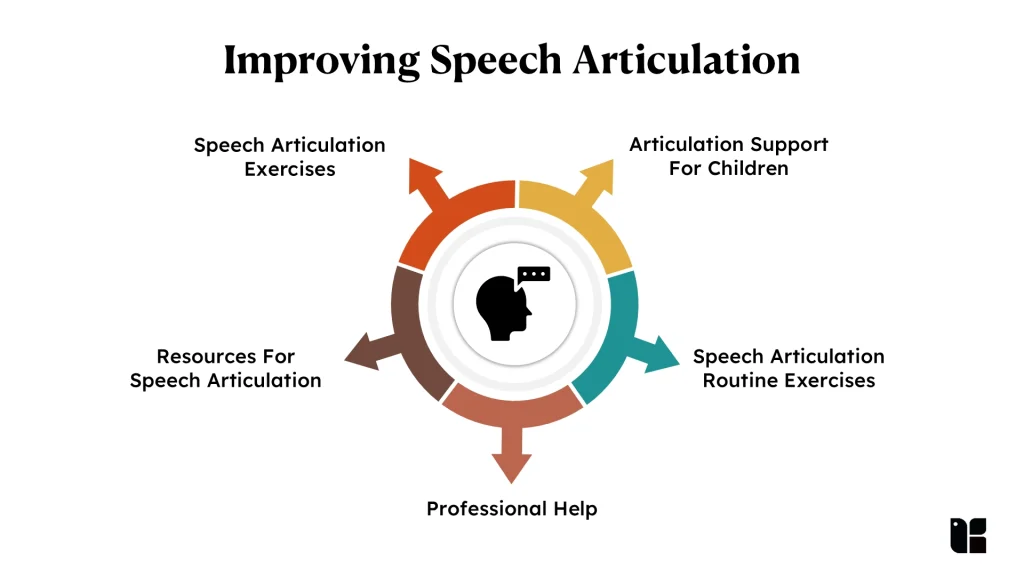
Speech Articulation Exercises
Enhancing your speech clarity and precision can open doors to more effective communication. To achieve this, engaging in targeted exercises can significantly refine your articulatory skills. Below are some practical techniques to help you develop clearer and more accurate speech:

Tongue Twisters
Tongue twisters are excellent for improving the flexibility and coordination of your tongue and mouth muscles, which is essential for clearer speech. Start with simpler tongue twisters and gradually move on to more challenging ones. For instance:
- Begin with phrases like “Red lorry, yellow lorry.”
- Progress to more complex twisters such as “How much wood would a woodchuck chuck if a woodchuck could chuck wood?”
Initially, articulate each tongue twister slowly and clearly, then increase your speed while maintaining clarity. Consistent practice will strengthen your articulatory muscles and improve your speech fluency.
Articulation Drills
These drills focus on improving the precision of your articulation for specific sounds that you find challenging. For instance, you can apply the following:
- Practise isolated sounds like “s,” “r,” or “th” by repeating them in isolation.
- Gradually use these sounds in syllables (e.g., “sa,” “se,” “si”) and then in words (e.g., “sand,” “sea,” “silk”).
Emphasise accuracy in each sound and syllable, paying close attention to the placement of your tongue and lips.
Mirror Practice
Using a mirror for practice can provide valuable feedback on your mouth movements and sound production. To utilise this technique effectively:
- Practice speaking sentences or tongue twisters while observing yourself in the mirror.
- Watch the movement of your lips, tongue, and jaw. This visual feedback will help you identify and correct any misarticulations, leading to more precise speech patterns.
By integrating these exercises into your daily routine, integrating daily practices can significantly bolster the effectiveness of speech therapy.
Speech Articulation Routine Exercises
To enhance your speech and communication skills, consider integrating the following daily practices into your routine. Some of the practices are as follows:
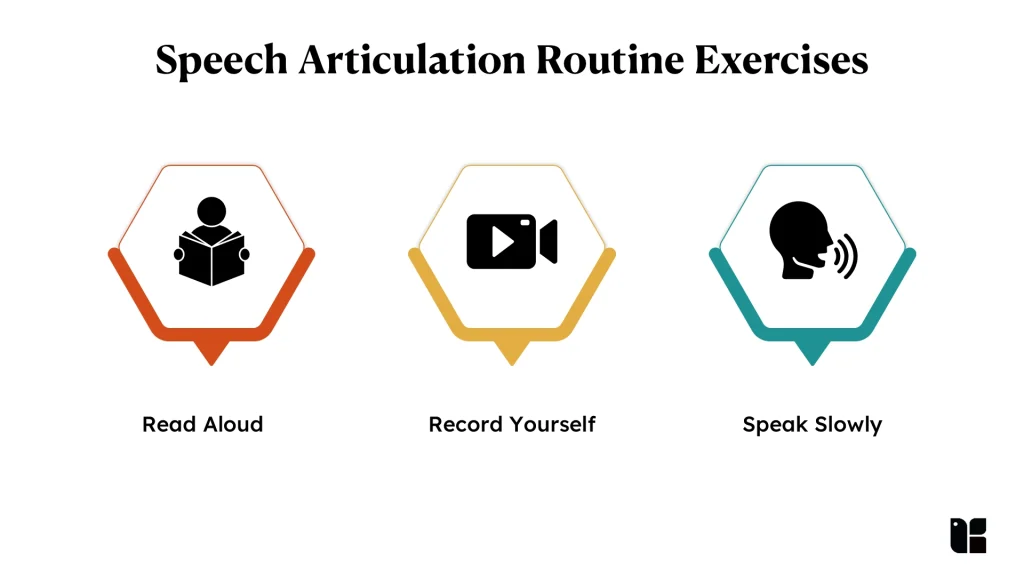
- Read aloud: Reading aloud helps you practise clear pronunciation and improves diction. Choose a variety of texts to read aloud, from books and articles to poems. Focus on articulating each word clearly and with proper intonation. This practice helps reinforce good speaking habits and improves fluency. For example, try reading a classic poem like “The Road Not Taken” by Robert Frost, paying attention to the enunciation of each word and the rhythm of the lines.
- Record yourself: Recording and listening to your speech helps you identify areas for improvement. Record yourself reading a passage or speaking on a topic. Playback the recording and listen for any areas where your articulation might be unclear or where you could improve. Compare recordings over time to track your progress. For instance, record yourself delivering a brief summary of a news article and review the recording to notice any pronunciation issues or unclear phrasing.
- Speak slowly: Speaking at a slower pace helps ensure that you pronounce each word clearly and can improve overall speech clarity. Practice speaking slowly and focus on articulating each sound fully rather than rushing through sentences. This practice can help you develop a habit of clear and precise speech. For example, read a short story aloud, intentionally slowing down your speech to clearly enunciate each word and sound.
Once you’ve established a consistent routine with these exercises, it’s valuable to explore additional resources that can further support and enhance your articulation skills.
Resources For Speech Articulation
A range of tools and resources are available to support and enhance your speech practice. These include helpful apps, software, books, and guides designed to aid in various aspects of speech development and communication skills. Here’s a look at some of the most effective options:
Apps and Software
These tools can help you practise speech:
- Articulation station: The app’s articulation power provides activities for practising different speech sounds.
- Pronunciation power: The app pronunciation power offers exercises and tools to improve pronunciation.
Books and Guides
Here are some useful books:
- “Articulation and Phonological Disorders: Speech Sound Disorders in Children“ by John E. Bernthal and Patricia A. Bankson.
- “The Articulate Advocate: New Techniques of Persuasion for Trial Lawyers“ by Brian K. Johnson and Marsha Hunter.
- “Speak Clearly: An Introduction to Phonetics and Phonology“ by K. Johnson.
Professional Help
If you’re still having trouble, seeing a speech-language pathologist (SLP) can be very helpful. They can assess your speech and provide customised strategies to help you improve.
Consulting with a speech-language pathologist (SLP) can be highly beneficial if you’re facing speech or language challenges. Here’s a summary of how they can help:

- Assessment: An SLP checks your speech and language skills through tests, observations, and your medical history to find out what issues you have, like articulation problems or language delays. For example, they might use standardised tests to assess your pronunciation of specific sounds.
- Personalised treatment plans: Based on the assessment, the SLP creates a treatment plan just for you. This might include exercises and strategies tailored to your needs. For instance, if you struggle with /r/ sounds, they may design exercises specifically to improve your pronunciation of that sound.
- Skill development: SLPs use different techniques to help you improve your communication. For example, they might work on better pronunciation or understanding language with specific exercises. They could use visual aids and repetition drills to help you master tricky words.
- Ongoing support: SLPs offer continuous help, including advice on practising at home, tracking your progress, and updating your treatment plan as needed. They might suggest daily practice routines and provide feedback on your progress during each session.
- Advocacy: They explain the issue to you and your family and provide strategies to support your improvement. For example, they may give you and your family strategies for incorporating speech exercises into daily activities.
- Collaboration with other professionals: SLPs might work with other healthcare providers to give you a complete treatment approach. They could collaborate with an occupational therapist to address related motor skills that impact speech clarity.
Overall, SLPs can significantly improve your communication skills and boost your confidence in various settings.
Speech articulation continues to improve through practice, feedback, and real-world experience. Discover whether Kapable supports the way you want to develop as a communicator.
Articulation Support For Children
Children with articulation difficulties may not be able to express themselves clearly, which can make their speech difficult to understand. To help with language and articulation, it is important to ensure that children receive the right support and resources.
The ability to articulate words correctly can be challenging for some children, but with your patience and support, they will be able to overcome these obstacles. Providing a nurturing environment, along with engaging activities that focus on improving their articulation skills, can greatly enhance their communication abilities. You can use the following:
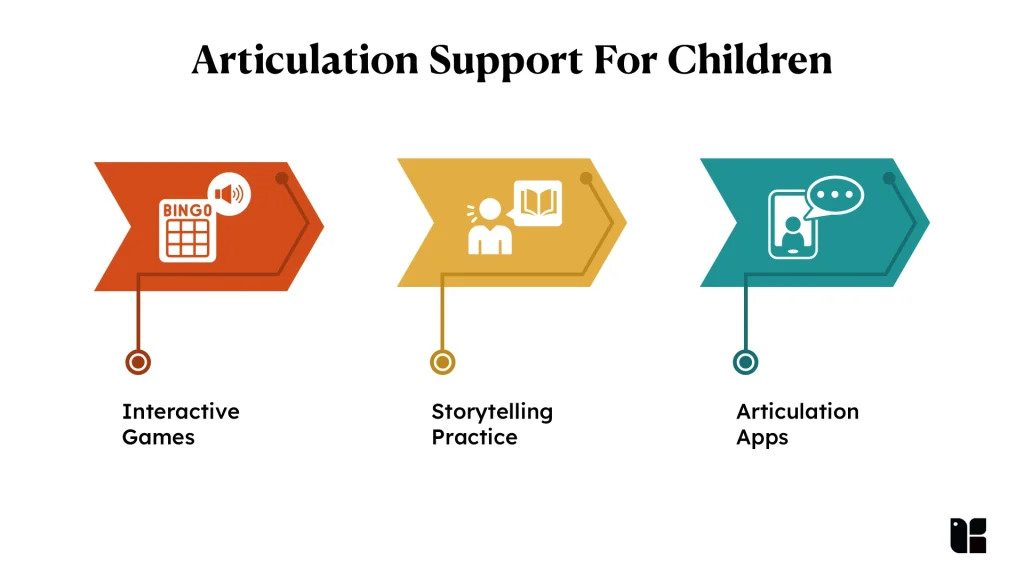
- Interactive games: Use games like “Sound Bingo“, where children match pictures of objects with the initial sound of the word. This makes learning fun and reinforces correct pronunciation.
- Storytelling practice: Read simple stories together, pause to emphasise and practise specific sounds, and encourage the child to repeat phrases or sentences to improve clarity.
- Articulation apps: Use educational apps designed for speech practice, such as “Articulation Station,” which offers interactive exercises and rewards for correct pronunciation.
As we explore effective strategies to enhance speech articulation, it’s crucial to address some common misconceptions that might hinder progress.
What Are The Common Misconceptions About Speech Articulation?
Understanding the basics of speech articulation and the benefits of personalised speech therapy can provide valuable insights into how to enhance speech clarity and effectiveness.

- “Speech problems are just about accents.”
While accents do affect pronunciation based on regional or cultural influences, they are not the same as articulation problems. Articulation issues involve difficulties with the precise formation of sounds. For example, someone might find it challenging to pronounce certain sounds accurately, which is distinct from having a regional accent. These difficulties typically stem from how the speech organs, such as the tongue, lips, and palate, are used to produce sounds. To use articulation effectively, you need to make sure the production of speech sounds is clear and easy to understand.
- “Only children need speech therapy.”
Speech therapy is not limited to children; it can be highly beneficial for adults as well. Adults may seek therapy for a variety of reasons, including neurological conditions, trauma, or long-standing speech habits that have developed over time. Improving communication skills through therapy
can significantly impact personal and professional life at any age.
- “Speech therapy is only for serious issues.”
Speech therapy can address both severe and mild articulation problems. Even minor issues, such as a slight lisp or difficulty with specific sounds, can be improved with therapy. Effective therapy can help enhance overall communication skills and self-confidence, addressing issues that may seem minor but still impact daily interactions.
By addressing these common misconceptions, we can better appreciate the fundamentals of speech articulation and the role of personalised therapy in overcoming speech challenges.
How Can Facts About Speech Articulation Be Clarified?
Understanding and improving speech articulation involves recognising that it is a skill that can be developed and refined through dedicated practice and personalised support:

- Developing articulation: Articulation is about using the speech organs to produce clear sounds. It’s a skill that can be improved with practice. Regular effort and specific exercises can help individuals speak more clearly. These exercises might strengthen the muscles used in speech or improve control for making precise sounds.
- Customised speech therapy: A major benefit of speech therapy is its personalised approach. Speech therapists look at each person’s unique speech patterns and difficulties to create a treatment plan just for them. This plan might include exercises, mental strategies, and specific practice tasks. Personalising therapy makes it more effective for each person’s specific needs.
- Ongoing monitoring: To keep making progress, speech therapy needs ongoing checks and adjustments. Therapists review each person’s progress and change the treatment plan as needed to meet changing needs and improve results. This flexible approach keeps motivation high and supports long-term success in speaking clearly and confidently.
To see how these ideas work in real life, let’s look at some examples of people who have successfully overcome their speech challenges.
What Are Some Real-Life Examples Of Overcoming Speech Challenges?
These prominent figures mentioned below faced and overcame significant speech challenges early in their lives, turning their personal struggles into sources of inspiration and success.

- Joe Biden: U.S. President Joe Biden has openly shared his experiences with stuttering, which he struggled with throughout his early years. Through intensive speech therapy and his own perseverance, Biden was able to significantly manage his stutter. His journey is well-documented in interviews and articles, reflecting his personal growth and the inspiration he provides to others facing similar challenges.
- James Earl Jones: The acclaimed actor James Earl Jones overcame a significant stutter during his childhood with the help of speech therapy and his passion for poetry. His distinctive voice, which is now iconic, was shaped by his efforts to manage his speech difficulties. His experience is often highlighted in interviews and profiles about his career and personal growth.
- Barbara Walters: Renowned journalist Barbara Walters had a slight speech impediment in her early career, which she worked to overcome through professional training. Her successful career in television journalism was built on her efforts to refine her articulation and delivery.
Conclusion
Mastering speech articulation is about more than just clear pronunciation; it’s about enhancing your overall communication skills. By understanding how speech works, practising regularly, and using available resources, you can improve your clarity and confidence in speaking. Embrace the journey of improving your speech, as it can lead to better personal and professional relationships. Remember, effective communication is a key to success in many areas of life.


