


TL;DR
- A Proactive Mindset and Skillset: Effective problem-solving moves beyond simple fixes, requiring a combination of critical thinking, creativity, and emotional intelligence to proactively anticipate challenges and drive innovative, lasting outcomes.
- A Structured Approach to Resolution: Success depends on a disciplined, six-step process that starts with correctly identifying the core issue, thoroughly exploring all possibilities, and ending with a clear-cut action plan followed by critical reflection.
- High-Value Organisational Impact: Strong problem-solving capabilities create tangible business value by accelerating the resolution of complex issues, significantly improving team collaboration, and building confidence in uncertain, high-pressure scenarios.
- Developing Practical Proficiency: Sharpening this skill involves adopting specific strategies like focusing on reverse engineering, learning from failure, and using strategic tools such as Fishbone Analysis and Design Thinking to ensure all angles are considered.
Problem-solving skills are in high demand, with 86% of employers actively seeking them on resumes, according to a 2022 survey. Whether it’s dealing with a difficult project, a frustrated customer, or a sudden team conflict. It’s these moments that truly test our ability to think on our feet. The ability to think critically, assess situations, and choose the best course of action can be the difference between stagnation and innovation.
What Are Problem-Solving Skills?
Problem-solving skills refer to your ability to identify challenges, think critically about them, and come up with solutions. It’s how you untangle complex issues, work through challenges, and create better outcomes. These skills go beyond fixing problems – they’re about improving processes, avoiding potential obstacles, and making informed decisions. Good problem-solvers are practical, adaptable, and proactive. They focus on understanding the root of the issue instead of jumping to quick fixes. This approach helps them stay ahead and find solutions that last.
Problem-solving comes into play everywhere – handling customer complaints, fixing project delays, or sorting out team disagreements. It’s about using clear thinking, being creative, and taking practical steps to find the best way forward. Mastering this skill makes you more dependable, both in personal and professional settings. When you get good at solving problems, people trust you more. It boosts your confidence, helps you work better with others, and makes it easier to handle tricky situations calmly. These are the skills that are highly valued no matter where you are.
What Are The Top Thinking Skills For Mastering Problem-Solving?
When it comes to solving problems effectively, certain skills make all the difference. These abilities can transform challenges into opportunities for growth.

- Critical thinking: The ability to analyse situations, understand various viewpoints, and make well-informed decisions is crucial for solving problems efficiently.
- Creativity: Thinking outside the box and coming up with innovative solutions can help you tackle problems from new angles.
- Adaptability: Being flexible and adjusting to unexpected changes helps you stay effective even when things don’t go as planned.
- Emotional intelligence: Recognising and managing your emotions, and understanding others’, helps you navigate conflicts and stressful situations more smoothly.
- Communication: Clear, effective communication ensures everyone is on the same page, reducing misunderstandings and speeding up problem resolution.
- Decision-making: The ability to make quick, sound decisions is vital, especially when faced with high-stakes or time-sensitive problems.
- Resourcefulness: Using available resources efficiently and finding solutions with what you have on hand is a key part of problem-solving.
- Collaboration: Working together with others brings diverse perspectives, helping to create well-rounded solutions to complex problems.
- Flexibility: Adjusting your approach when things change or new information comes to light is essential for continued success in problem-solving.
- Risk management: Anticipating potential risks and having a plan to mitigate them can help you avoid setbacks and solve problems before they escalate.
To improve your problem-solving skills in a corporate setting, you must make them second nature. Putting them into action with the right processes and techniques is key to mastering them, and that’s exactly what we’ll dive into next.

What Is The Process Of Effective Problem-Solving?
Solving problems effectively isn’t just about jumping to solutions – it’s a step-by-step approach. Here’s how to make the process work for you:
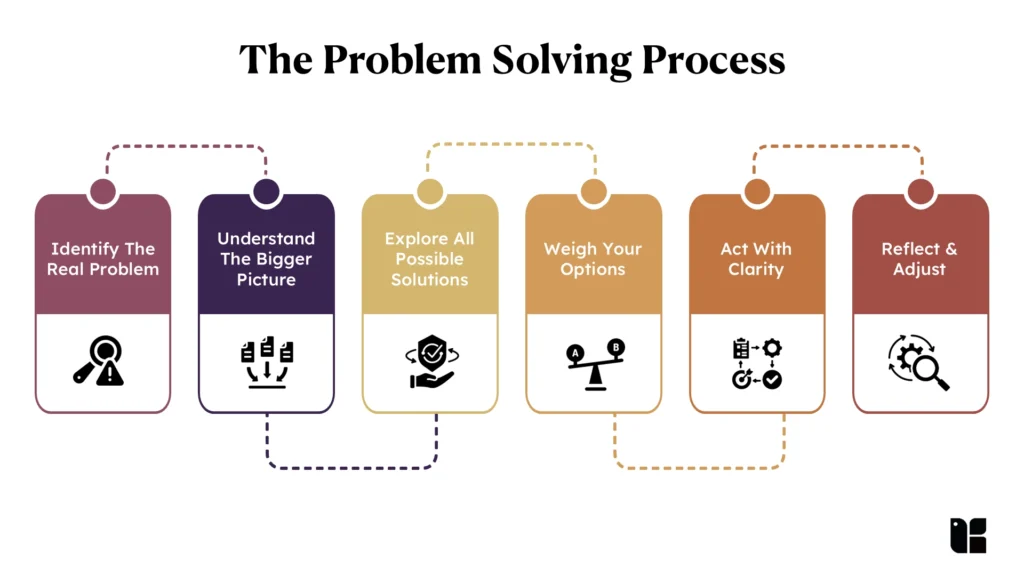
Identify The Real Problem
Start by pinpointing the core issue. What’s truly causing the problem? For example, if a team keeps missing deadlines, is it poor time management, unclear goals, or something else? Understanding the real problem is half the battle.
Understand The Bigger Picture
Gather all the details before making a move. Speak to people involved, review any relevant data, and consider how the problem impacts other areas. For instance, a delay in one department might be affecting others down the line.
Explore All Possible Solutions
Brainstorm ideas without limiting yourself. Even unconventional solutions can spark the perfect fix. Think creatively – what hasn’t been tried yet? Invite others to share their input for a broader perspective.
Weigh Your Options
Evaluate your solutions by looking at feasibility, resources, and potential risks. For example, fixing a process bottleneck might require additional training, can your team handle that right now?
Act With Clarity
Once you choose a path, break it into actionable steps. Assign responsibilities and set clear timelines. Small, measurable actions are easier to manage and track.
Reflect And Adjust
After implementation, analyse the outcome. Did the solution work as expected? If not, why? Treat every problem as a learning experience to sharpen your approach for next time.
This approach shows that problem-solving isn’t just about fixing issues, it’s about understanding them deeply and addressing them in a way that creates lasting impact.
What Is The Impact Of Strong Problem-Solving Skills?
Effective problem-solving creates real, tangible impacts in a job that make a difference in how we work, collaborate, and succeed.

Better Outcomes In High-Stakes Situations
When you solve problems well, you avoid mistakes that could cost time or money. This helps things go smoothly, especially when you’re under pressure, leading to better results in tough situations.
Improved Team Collaboration
To improve problem solving abilities, do it with a team. Solving problems together makes everyone feel heard and valued. It brings out new ideas and strengthens how the team works together, making it easier to handle challenges as a group.
Confidence In Uncertain Scenarios
When you know how to approach a problem, even unexpected changes or challenges don’t seem so scary. You can stay calm, make decisions faster, and help others feel more confident too.
Faster Resolution Of Challenges
If you use good problem-solving skills, you’ll be able to look for the cause of a problem and quickly find a solution to it. This means you spend less time fixing the same issue over and over again, speeding up the whole process.
Boosting Efficiency And Output
Improving your problem-solving skills helps you to use soft skills that help you to think outside the box and come up with a solution to a problem from a wide range of perspectives. This helps you get more done in less time, increasing your overall productivity.
Enhancing Job Satisfaction
Solving problems makes you feel accomplished. It gives you a sense of purpose and boosts your motivation, making your work feel more rewarding.
Building Stronger Client Relationships
When you solve your clients’ problems quickly and effectively, they trust you more. This helps you build long-lasting relationships and shows you’re dependable.
You can see just how powerful problem-solving is in driving results. It’s more than a skill; it’s a way to create positive change and elevate your work and relationships.
Which Examples Best Illustrate Problem-Solving Skills In The Workplace?
Everyone encounters problems in our work. It’s how you approach and tackle these challenges that sets you apart. Here are a few situations where problem-solving skills can come into play:
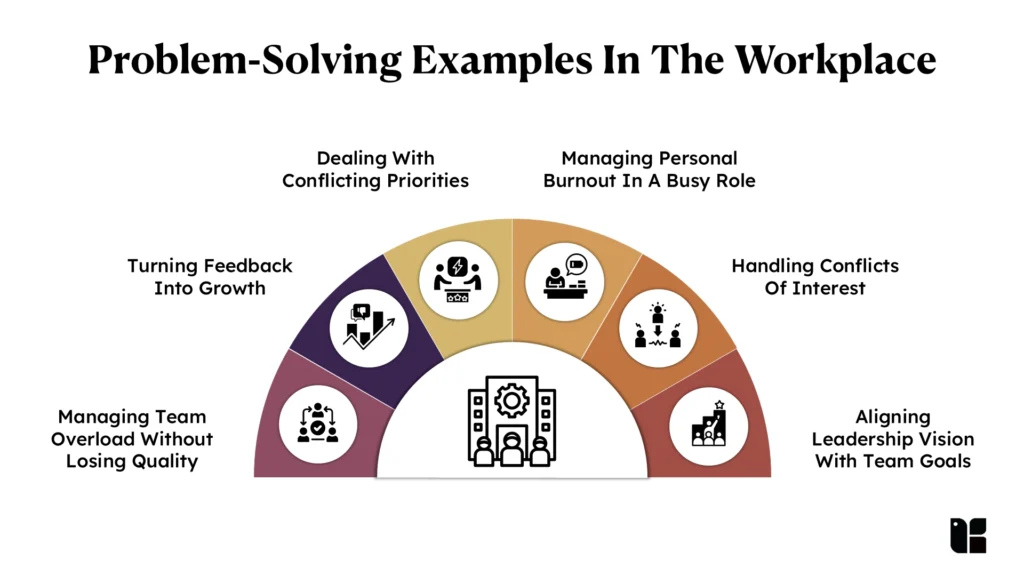
Managing Team Overload Without Losing Quality
When the team is overwhelmed with tasks, it’s hard to keep up with quality. Identifying the root cause of the overload and redistributing tasks can help maintain high standards without burning out.
Turning Feedback Into Growth
Receiving critical feedback can sting, but it’s a chance to improve. Instead of taking it personally, breaking down feedback into actionable steps helps you grow and get better at your role.
Dealing With Conflicting Priorities
When everything feels urgent, it’s tough to know where to focus. Recognising what’s truly important and what can wait helps you prioritise effectively without feeling stretched too thin.
Managing Personal Burnout In A Busy Role
Constantly pushing yourself can lead to burnout. Knowing when to step back, ask for help, and set boundaries is key to staying energised and productive long-term.
Handling Conflicts Of Interest
Conflicts of interest arise when personal and professional interests clash. Being upfront and transparent about these conflicts helps maintain trust and make unbiased decisions.
Aligning Leadership Vision With Team Goals
When leadership vision and team goals aren’t aligned, productivity suffers. Clear communication and regular check-ins help ensure everyone is working toward the same objectives.
By understanding how to approach these problems with a clear, structured mindset, you’ll be better prepared to handle whatever comes your way.
Solving workplace challenges requires structured thinking and sound judgement. Explore Kapable’s leadership journey to understand how these capabilities are built.
How To Develop Problem-Solving Skills?
Improving problem-solving skills is about actively changing the way you approach challenges. These strategies directly sharpen your ability to solve a problem effectively:

Think Like An Outsider
When you view a problem as if it’s not your own, you see details you’d usually miss. This fresh perspective helps you notice blind spots and question assumptions, opening up new and practical solutions.
Example: If a project isn’t moving forward, imagine how someone outside your team might diagnose the delay, this can reveal overlooked inefficiencies.
Ask Better Questions
Asking sharp, insightful questions trains your mind to dig deeper. This habit pushes you to identify the core issue, clarify uncertainties, and frame the challenge in a way that leads to actionable answers. Instead of asking, “Why did this fail?” ask, “What can we do differently next time?”
Set Constraints Intentionally
Working within set limits encourages resourcefulness. Constraints make you focus on essentials, helping you find smart, efficient solutions instead of overcomplicating the process. If you’re designing a marketing campaign with a tight budget, constraints can force you to focus on high-impact strategies rather than spreading resources thin.
Focus On Reverse Engineering
Starting from the desired result forces you to think systematically. It makes you consider every step critically, ensuring each action aligns with solving the core problem rather than just addressing symptoms.
For example, to improve customer retention, start by imagining a perfectly satisfied customer and trace back what needs to change in the current experience to achieve that.
Master The Art Of Prioritisation
Prioritisation sharpens your decision-making. By sorting tasks based on importance, you reduce overwhelm, channel your energy effectively, and prevent minor issues from distracting you from solving bigger problems. If you’re managing conflicting deadlines, addressing the task with the biggest impact first can reduce pressure and free up time for smaller priorities.
Strengthen Your Pattern Recognition
Recognising patterns in problems boosts your ability to anticipate challenges. This skill helps you draw connections, understand recurring issues faster, and apply tried-and-tested solutions with more confidence. For example, noticing that delays often happen at the handoff stage in a process can help you focus on fixing communication gaps to prevent future holdups.
Treat Failure As Data
Treating failure as a learning tool rewires how you respond to setbacks. Instead of feeling stuck, you train yourself to extract insights from what went wrong, turning mistakes into valuable stepping stones for better problem-solving. For example, after a project misses its target, analysing what factors contributed to the miss can inform better planning for similar tasks in the future.
Revisit The Problem Periodically
Stepping back and revisiting an issue gives you mental clarity. When you approach a problem with fresh eyes, you often uncover solutions that weren’t visible before, enhancing your problem-solving toolkit. Revisiting a stalled idea after a few weeks can reveal fresh opportunities or new approaches you hadn’t considered earlier.
Problem-solving isn’t a single skill – it’s the result of combining deliberate strategies that sharpen your thinking skills. By practicing these approaches, you build the flexibility and clarity needed to handle challenges more effectively every time.
What Are The Practical Frameworks For Problem-Solving?
Strategic tools help structure your thought process and ensure all angles of a problem are considered. Here’s how you can use them effectively:
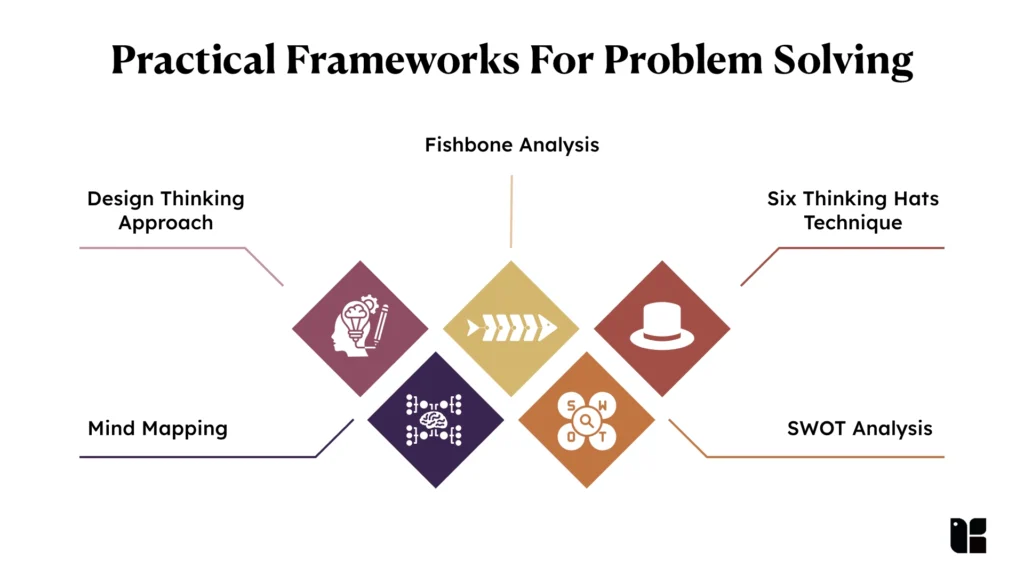
Mind Mapping
Mind mapping organises your ideas visually, breaking down the problem into its key components.
- Central Problem: Place the main issue at the center of the map.
- Causes: Add branches identifying what led to the problem.
- Potential Solutions: Expand with approaches that could resolve it.
- Barriers: Map challenges or limitations that may hinder progress.
- Outcomes: Visualise results for each possible path.
By showing relationships between causes, challenges, and solutions, this approach helps you pinpoint areas needing attention and encourages creativity. It’s invaluable for seeing the bigger picture while staying focused on actionable steps.
SWOT Analysis
This structured method identifies key internal and external factors influencing a situation.
- Strengths: Note internal resources or advantages you can use.
- Weaknesses: List internal obstacles limiting your effectiveness.
- Opportunities: Recognise external circumstances you can leverage.
- Threats: Identify external risks or challenges you must counter.
It creates a clear snapshot of your current state and possible directions, helping you align your strategy with your resources. The structured breakdown ensures no important aspect is overlooked.
Fishbone Analysis
This method categorises potential causes to identify the root of a problem.
- People: Examine how behaviors or communication gaps contribute.
- Processes: Identify any procedural inefficiencies or missteps.
- Equipment: Consider whether tools or technology are falling short.
- Materials: Check the quality and availability of necessary inputs.
By categorising and dissecting the causes, this method builds a strong foundation for finding the most effective solutions. It ensures you’re tackling the actual problem, not just its symptoms.
Six Thinking Hats Technique
This framework ensures a balanced evaluation of a problem by adopting different perspectives.
- White Hat: Focus on factual data and evidence.
- Red Hat: Explore emotional responses and instincts.
- Black Hat: Highlight risks and weaknesses in ideas.
- Yellow Hat: Look at the potential benefits and positives.
- Green Hat: Brainstorm innovative, out-of-the-box solutions.
- Blue Hat: Direct the overall process and maintain focus.
By forcing you to think beyond your usual patterns, this method expands your perspective and reduces blind spots. It ensures that logical, emotional, and creative angles are all considered before deciding.
Design Thinking Approach
This iterative and human-centric method solves problems with empathy and innovation.
- Empathise: Study the needs and challenges of those impacted.
- Define: Clearly state the core issue you’re addressing.
- Ideate: Brainstorm and explore potential solutions.
- Prototype: Develop small-scale models to test feasibility.
- Test: Apply prototypes and refine based on real feedback.
By diving into understanding the problem and testing solutions, it minimises risks of failure and builds practical, user-centric outcomes. This hands-on approach promotes continuous improvement and adaptability.
These practical frameworks are designed to sharpen your problem-solving skills. By practicing these tools, you’ll approach challenges with greater clarity, creativity, and precision.
“My journey with Kapable has been truly valuable. The sessions helped me gain confidence and handle impromptu speaking and assertiveness. I successfully led high-level meetings, which I used to avoid, and received positive feedback from my director. I now feel confident and empowered.”
– Ruchika Bagga (Senior Manager At Mankind Pharma)
How Can You Showcase Your Problem-Solving Skills Effectively?
Demonstrating your problem-solving skills effectively can position you as a capable professional ready for leadership roles. Here’s how solving problems in various aspects of your work will showcase your ability:

Focus On Transferable Skills
Highlight abilities like critical thinking, creativity, and decision-making in your discussions. For example, during a team meeting, explain how you analysed conflicting data to create a clearer roadmap for a project. When pitching an idea, demonstrate your ability to weigh risks and suggest balanced solutions that address long-term goals.
Quantify Your Impact
Use metrics to showcase your effectiveness. Instead of saying, “I improved team efficiency,” explain how your process changes increased productivity by 15% or reduced delays by two weeks. Metrics make your achievements undeniable and signal your readiness to manage larger responsibilities.
Showcase Collaborative Efforts
When discussing achievements, emphasise teamwork. For instance, share how brainstorming with a cross-functional team helped solve a supply chain bottleneck. You could mention your role in coordinating efforts and keeping the group aligned, highlighting your ability to lead collaborative problem-solving.
Demonstrate Adaptability
Bring up situations where you adjusted plans due to unforeseen challenges. For example, share how you restructured timelines to meet deadlines after unexpected staffing changes. Position this as your ability to stay calm and resourceful under pressure, an essential trait for leadership.
Highlight Your Thought Process
Explain the logic behind your decisions during meetings or evaluations. For example, describe how you identified the root cause of a recurring issue and implemented a step-by-step solution that prevented it from happening again. This shows your ability to think strategically and solve problems proactively.
Share Specific Examples
Have a few well-prepared stories that showcase your problem-solving in action. For example, talk about how you revamped an outdated process to align with evolving business goals, saving time and resources. Keep the focus on your initiative and how your actions created positive results.
Presenting your problem-solving skills with clarity, confidence, and strategic examples subtly conveys your readiness for leadership roles. Use every opportunity to show not just what you’ve done but how you think and adapt to challenges.
Strong problem-solving skills become more impactful when they’re backed by structured learning. Discover Kapable’s fit guide to see whether the program matches your professional goals.
Conclusion
Anticipating and preventing problems is the defining trait of a truly skilled problem-solver. Why are problem-solving skills important, and how can you improve them? It’s not just about reacting when issues arise but staying a step ahead by recognising patterns, identifying potential risks, and creating strategies to avoid setbacks. By being proactive, you not only save time and resources but also build trust as someone who ensures smooth operations. This mindset doesn’t just enhance your ability to solve problems – it positions you as a leader who can guide your team or organisation through both challenges and opportunities with foresight and confidence.


