

TL;DR
- Accessible Innovation: Contrary to the belief that creativity is an unpredictable, inborn talent, it is an accessible skill for generating novel ideas and solutions by fundamentally reimagining established thought patterns.
- Core Value Proposition: Adopting a creative mindset is essential for unlocking personal and organisational growth by highlighting unseen opportunities and improving decision-making through challenging preconceived notions.
- Techniques for Mastery: Diverse forms of creative thought, including divergent and lateral thinking, can be actively cultivated by applying strategic frameworks such as SCAMPER and encouraging collaborative, experimental environments.
- Impact and Trajectory: Real-world success across major industries, from animation and product design to market adaptation, demonstrates that creative thinking is the key driver of future innovation and career growth.
Many business leaders often view creativity and innovation as unpredictable forces, with over half (53%) of businesses admitting that their innovation happens by chance.
The uncertainty leads many to believe that creativity is something you either have or you don’t. But what if creativity didn’t have to be a matter of luck? What if we told you that creativity isn’t about waiting for a lightbulb moment or relying on chance? With the right strategies, anyone can tap into creative thinking on demand!
What Is Creative Thinking?
Creative thinking is the ability to approach problems and situations in novel and innovative ways. It involves generating new ideas and solutions that break away from traditional patterns. While it’s often associated with artistic endeavours or groundbreaking inventions, creative thinking is a valuable skill for everyone.
Creative thinking isn’t just about coming up with quirky ideas or brainstorming sessions; it’s about fundamentally changing how we approach problems and solutions. It’s more than the flashy innovations we see in the media; it’s about reshaping our thought processes to see things from new perspectives.
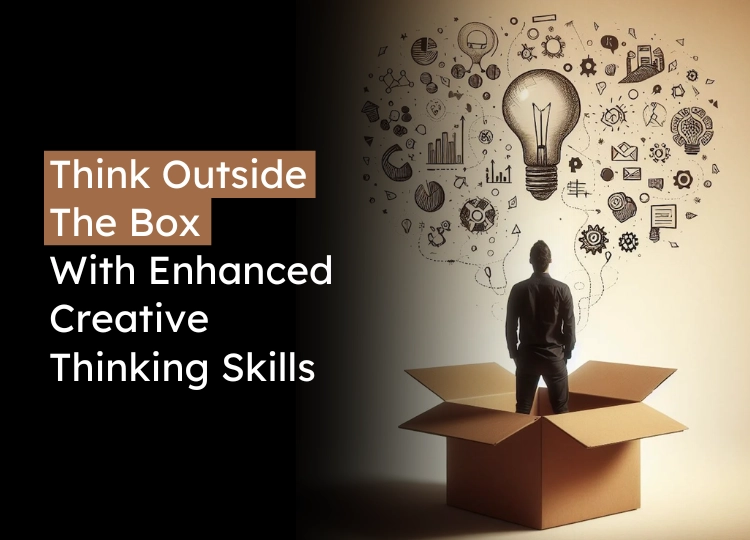
Despite common misconceptions, creative thinking is not reserved for artists or inventors. It’s a skill that anyone can develop. It involves challenging existing assumptions, exploring multiple viewpoints, and finding novel solutions. It’s not just about thinking outside the box; it’s about reimagining the box itself. Embracing this understanding can open doors to more effective problem-solving and innovation in every area of life.

Why Creative Thinking Is Important?
Creative thinking is essential because it goes beyond conventional approaches and frameworks, offering profound benefits for personal and professional growth. Here’s why it’s crucial:

Highlights Hidden Opportunities
Creative thinking is vital for uncovering opportunities that might otherwise go unnoticed. By encouraging us to explore unconventional solutions and think beyond the obvious, it reveals new possibilities that can lead to innovative breakthroughs and significant advancements. This openness to discovering hidden opportunities is essential for growth and success in a constantly evolving landscape.
Breaks Down Cognitive Biases
Our thinking is often limited by cognitive biases, preconceived notions and mental shortcuts that can cloud judgment. Creative thinking challenges these biases by encouraging us to question assumptions and consider multiple perspectives. This process is crucial for making more informed, objective decisions and avoiding the pitfalls of biased thinking that can hinder progress and innovation.
Customises Problem-Solving Approaches
One-size-fits-all solutions are rarely effective in addressing complex problems. Creative thinking enables us to tailor problem-solving approaches to fit individual needs and contexts. This customisation is essential for developing effective strategies that resonate with personal or organisational goals, rather than relying on generic frameworks that may not address specific challenges.
Promotes Ownership And Engagement
When creative thinking is embraced, it fosters a sense of ownership over the problem-solving process. By finding what works best for you personally, it increases engagement and motivation. This personal investment in creative solutions ensures that individuals are more committed and proactive in pursuing and implementing ideas that truly align with their interests and strengths.
Prepares For Future Uncertainty
In an unpredictable world, creative thinking equips us to navigate uncertainty with agility. It prepares us to adapt and respond to unforeseen changes by encouraging flexible and innovative thinking. This readiness is crucial for anticipating and managing future challenges, ensuring resilience and adaptability in the face of evolving conditions.
Creative thinking helps us spot opportunities that might otherwise stay hidden in many ways and keeps us ready for whatever the future holds.
What Are The Different Types Of Creative Thinking?
Creative thinking comes in various flavours, each offering a unique way to spark innovation and solve problems. Let’s explore these different types:

Divergent Thinking
Divergent thinking involves generating a wide array of ideas and possibilities. It’s about allowing yourself to explore various directions without immediately judging or filtering the ideas. This type of thinking thrives on curiosity and openness, encouraging you to consider many different solutions before narrowing them down.
Convergent Thinking
Convergent thinking is the process of focusing and refining ideas to identify the most effective solutions. It involves evaluating and synthesising the many possibilities generated during divergent thinking. This type of thinking is about making informed decisions and honing in on the most practical and feasible options.
Lateral Thinking
This type of thinking is all about breaking away from traditional patterns and thinking outside the box. Lateral thinking involves approaching problems from unconventional angles and using creative problem-solving techniques. It’s like finding a surprising shortcut or an unexpected solution that you wouldn’t have considered otherwise.
Aesthetic Thinking
When you use aesthetic thinking, you’re tuned into the beauty and design aspects of a problem or idea. It’s about considering how solutions or ideas resonate on an emotional level and how they look, feel, and impact people. This type of thinking ensures that creativity doesn’t just work well but also feels right.
Inspirational Thinking
Inspirational thinking is where your creativity is fueled by passion and motivation. It’s about drawing inspiration from experiences, people, and emotions to spark new ideas. This type of thinking connects deeply with your values and aspirations, turning them into powerful, motivating forces for innovation.
Each type of creative thinking brings its own spark to the table, helping us tackle challenges and explore new frontiers in unique and engaging ways.
“Kapable helped me overcome my fear of spontaneous speaking and taught me to balance diplomacy with assertiveness, ensuring my voice is heard. I now communicate with confidence and clarity, a transformation that has made a remarkable difference in my journey.”
– Anupam Bajaj (Design Head At SAMSUNG)
What Are The Key Benefits Of Creative Thinking?
Creative thinking isn’t just a skill; it’s the spark that lights up new possibilities and drives real change in how we approach work, relationships, and challenges.

Strengthens Cross-Disciplinary Collaboration
Creative thinking bridges the gap between different disciplines, leading to richer and more diverse collaborations. It allows people from varied backgrounds to contribute their unique perspectives, ultimately leading to well-rounded solutions. This kind of collaboration isn’t just beneficial; it’s essential in today’s complex work environments, where innovation often happens at the intersection of different fields.
Encourages Experiential Learning
One of the greatest benefits of creative thinking is that it promotes a mindset of learning through doing. Rather than relying on rigid structures, creative thinkers are more likely to come up with a range of ideas and experiment with new approaches. This creates a culture where failure isn’t feared but embraced as part of the learning process. Such an environment pushes boundaries and drives continuous improvement, making experimentation an invaluable tool for growth.
Faster And Broader Problem Recognition
Creative thinkers don’t just wait for problems to become crises before addressing them. They’re able to recognise challenges early, and they often spot potential issues that others may miss. This broad perspective enables quicker identification and resolution of problems, saving time and resources while also preventing bigger complications down the line.
Breaking Free From Thought Patterns
Creative thinking helps individuals escape rigid thought patterns and routines. This flexibility allows them to challenge the status quo and reimagine how things could be done differently. Breaking free from these established patterns unlocks the potential for breakthroughs, leading to innovations that wouldn’t have been possible by sticking to the same old ways of thinking.
Improved Problem-Solving Capabilities
Ultimately, creative thinking is a powerful tool for solving problems more effectively. It enables people to approach issues from multiple angles, considering alternative solutions that others may overlook. This expanded problem-solving capability not only leads to better outcomes but also enhances personal and team confidence in tackling even the most complex challenges.
Developing creative thinking helps professionals adapt, innovate, and make better decisions, and Kapable supports this growth through practical, experience-based learning.
When we embrace creative thinking, we give ourselves the tools to tackle problems more effectively and discover unexpected opportunities in all areas of life.
What Strategies Help Build Creative Thinking Skills?
Creative thinking is a muscle that grows stronger with the right exercises. Here are some inventive ways to flex that muscle and expand your creative horizons:

Be Aware Of How You Feel
Creativity advances on self-awareness. Next time you’re in a meeting or brainstorming, pause and check in with yourself. How do you feel? What emotions are driving your thoughts? Being mindful of your emotions opens doors to unexpected creative insights. Maybe that frustration can fuel a breakthrough, or that excitement can spark a new direction.
Create Space For New Ideas
Blank pages can be intimidating, but starting with something, even a small idea, can ignite creativity. It’s like adding a spark to kindling. Whether it’s a simple word, an image, or a half-formed thought, let it grow into something more. You don’t need to have the whole picture; sometimes a fragment will help you get the creative engine going.
Throw Yourself Into New Things
Feeling stuck? Dive headfirst into something completely unfamiliar. Whether it’s learning a new language, your first day at work, taking a cooking class, or picking up a hobby you’ve never tried, new experiences ignite fresh ways of thinking. It’s about giving your brain different stimuli to play with. And who knows? A pottery class might just inspire your next business idea.
Use Mind Maps And Flowcharts
When ideas feel jumbled, untangle them visually. Mind maps and flowcharts are fantastic for seeing connections between seemingly unrelated ideas. Imagine you’re planning a new project; sketch out all the possible angles. Suddenly, patterns emerge, and solutions you hadn’t considered begin to take shape. It’s like watching creativity unfold in front of you.
Challenge What’s Currently Working
What if the things that work well could work even better? Take something that’s running smoothly; whether it’s a routine, a system at work, or even your morning coffee ritual, and think about how it could be reimagined. Push yourself to ask, “Why do we do it this way?” This mindset unlocks innovative tweaks that can lead to big improvements.
Try The Snowball Technique
Start small and let ideas snowball. Take a basic concept and keep adding to it; no matter how silly it seems at first. For instance, consider the thought, “What if our office had a mascot?” At first, it might seem trivial, but as you build on this concept, you might develop ideas about creating a sense of community and fun. The mascot could be used in team-building activities, branded merchandise, and even social media campaigns to boost team morale and company culture. This simple idea can snowball into a unique and engaging way to enhance workplace camaraderie and employee satisfaction.
Collaborate With Your Team
Two heads are better than one, and five are even better. Creative thinking flourishes in collaborative environments. Bounce ideas off your colleagues, even those from different departments. A marketing idea could benefit from a finance perspective, and vice versa. The beauty of collaboration is that it opens you up to viewpoints and ideas you’d never encounter alone.
SCAMPER Technique
This technique is a creative problem-solving method designed to spark innovation by encouraging you to think differently about existing ideas or processes. SCAMPER stands for:

- Substitute: Replace a part of a product or process with something else. For example, using a different material to create a lighter, more durable product.
- Combine: Merge two ideas or elements to create something new. Think about combining a coffee shop and a bookstore, which led to the popular concept of “book cafés.”
- Adapt: Modify an existing idea to suit a new purpose. A company might adopt a successful marketing strategy from one industry and apply it to another.
- Modify: Change the size, shape, or design of something. A classic example is resizing smartphones to fit different user preferences.
- Put to another use: Repurpose an existing product or idea for a new function. Think of how bubble wrap was originally intended as wallpaper!
- Eliminate: Remove an element to simplify or improve efficiency. For instance, eliminating unnecessary features in an app can make it more user-friendly.
- Reverse: Flip the process or product on its head. An example could be switching from a traditional retail store to an online-only business model.
SCAMPER encourages you to explore all angles of a challenge, making it a versatile tool for driving creativity in any field.
Combine Unrelated Concepts
Innovation often happens when unrelated ideas collide. Take, for example, the creation of “book cafés.” Who would’ve thought that books and coffee could create such a perfect synergy? Try this in your own work. Pair two things that don’t naturally go together, and see what happens. You might just stumble upon your next big idea.
Encourage Creative Thinking In Others
Fostering creativity isn’t just about your ideas; it’s about cultivating it in those around you. Ask thought-provoking questions in meetings, encourage brainstorming sessions without judgment, and give your team the space to experiment. When people feel supported, their creative potential soars, leading to more collaborative, innovative environments.
Work, Daydream, Work
Sometimes the best ideas come when you’re not actively working on them. Step away from your desk and let your mind wander. A walk outside, a quiet moment with a coffee, or even doing nothing at all can trigger moments of brilliance. Creative thinking and problem-solving skills often thrives in those in-between moments, so don’t feel guilty for letting your mind drift.
By practising these strategies, you’ll not only sharpen your creative thinking skills but also infuse a fresh energy into every aspect of your life, whether at work, in education, or in daily routines.
Which Examples Best Show Creative Thinking In Action?
Creative thinking isn’t just for brainstorming sessions or art studios, it’s a powerful tool that drives real-world success across industries.

- Imagination: Pixar Animation Studios
Pixar is renowned for its imaginative storytelling. Films like Toy Story and Inside Out emerged from creative concepts that pushed the boundaries of animation and narrative. Their success comes from encouraging employees to think creatively and explore imaginative ideas, even those that seem unconventional. - Problem-solving: Tesla
Tesla’s approach to problem-solving is evident in their development of electric vehicles. They tackled the problem of battery life and charging infrastructure with innovative solutions like the Supercharger network and advancements in battery technology, revolutionising the automotive industry. - Learning: Duolingo
Duolingo transformed language learning by gamifying the process. They incorporated engaging quizzes, interactive exercises, and a reward system to make learning a new language more enjoyable and effective, setting a new standard in educational technology. - Design: Apple
Apple’s redesign of its products, such as the iPhone, with a focus on user experience and minimalist design, showcases their commitment to creating user-friendly and visually appealing devices. This approach has set trends in product design and user interface. - Communication: Nike
Nike’s “Just Do It” campaign is a prime example of creative communication. The campaign’s powerful messaging and emotional appeal helped build a strong brand identity and connect deeply with consumers on a personal level. - Resourcefulness: IKEA
IKEA’s flat-pack furniture model is a classic example of resourcefulness. By designing furniture to be disassembled and packed flat, IKEA reduces shipping costs and storage space, making their products more affordable and accessible. - Innovation: Netflix
Netflix’s shift from DVD rentals to a streaming service was a groundbreaking move in the entertainment industry. Their innovative use of technology and data analytics to recommend content has changed how people consume media. - Adaptability: Amazon
Amazon’s expansion from an online bookstore to a global e-commerce and tech giant highlights their ability to adapt to market changes. They continuously innovate by introducing new services like Amazon Prime and AWS, staying ahead of evolving consumer demands.
These real-world examples illustrate how creative thinking can drive significant advancements and success in various fields.
Conclusion
Creative thinking has proven to be a powerful tool in shaping the future of both individuals and industries. As we continue to innovate and push boundaries, the demand for creative talent is rapidly growing. Top areas for creative hiring will be in web and mobile development, where innovative solutions are key to driving growth, as well as in user interface and interaction design, where creativity directly enhances user experiences. Additionally, creative development and visual design will play pivotal roles in helping companies stand out in an increasingly crowded market. Creativity isn’t just a skill; it’s the driving force behind future success.
If you’re looking to strengthen your creative thinking skills, Kapable helps you evaluate whether its learning approach aligns with your professional growth goals.


