


TL;DR
- Inspirational Foundation: This leadership style moves past transactional management to create a motivational environment by championing a clear purpose and empowering individuals, directly resulting in organisational commitment and greater business profitability.
- Internal Friction Points: Effectiveness is compromised when leaders fail to follow through on their own vision or values, overlook the need for personalised employee development, and allow communication to become inconsistent or unclear.
- Strategies for Influence: Leaders build trust and encourage growth by visibly living their stated values, genuinely acknowledging team members’ contributions, and creating safe opportunities for employees to experiment and learn.
- Next-Gen Leadership: The model is adapting to a modern workplace by integrating a strong human element, empathy, and inclusivity with sophisticated data-driven approaches to guide strategic decisions and support a mission-first workforce.
People want leaders who do more than just assign tasks; they want leaders who inspire growth and show them how their work matters. Transformational leadership is all about that, but to really understand its impact, we need to look at the data. The statistics reveal why this leadership style is becoming so popular and how it drives real results in the workplace. With concrete numbers backing it up, we can see organisational effectiveness by embracing this approach. In this blog, we’ll explore what the numbers reveal and why this leadership style is gaining traction in today’s workplaces.
What Makes Transformational Leadership Work?
Transformational leadership is all about inspiring people to do their best by sharing a clear vision and encouraging new ideas. Unlike transactional leadership, which relies on extrinsic motivation and structured job behaviours, transformational leadership dimensions encourage creative thinking, personal growth, and employee performance across the entire organisation. A meta-analytic review revealed that transformational leadership, by emphasising core values and fostering self‑determination, plays a crucial role in transforming followers and enhancing job performance, as demonstrated through rigorous data analysis.
Behaviours like individualised consideration, intellectual stimulation, and inspirational motivation have shown a positive association with employee outcomes such as job satisfaction, organisational commitment, and psychological well-being. Transformational leaders often challenge employees and encourage creative thinking, which helps drive organisational innovation and improve employee performance across the entire organisation. A Gallup study found that teams with engaged employees are 21% more profitable and have less turnover. Another report showed that low engagement is costing the global economy $8.8 trillion. So, when people feel respected and know their work matters, they’re more likely to stay and do their best.

What Are The Core Elements Of Transformational Leadership?
Transformational leadership is a collection of guiding principles that shape how leaders influence, inspire, and support their teams. These core elements help create a work environment where people feel motivated to grow, think differently, and contribute meaningfully:
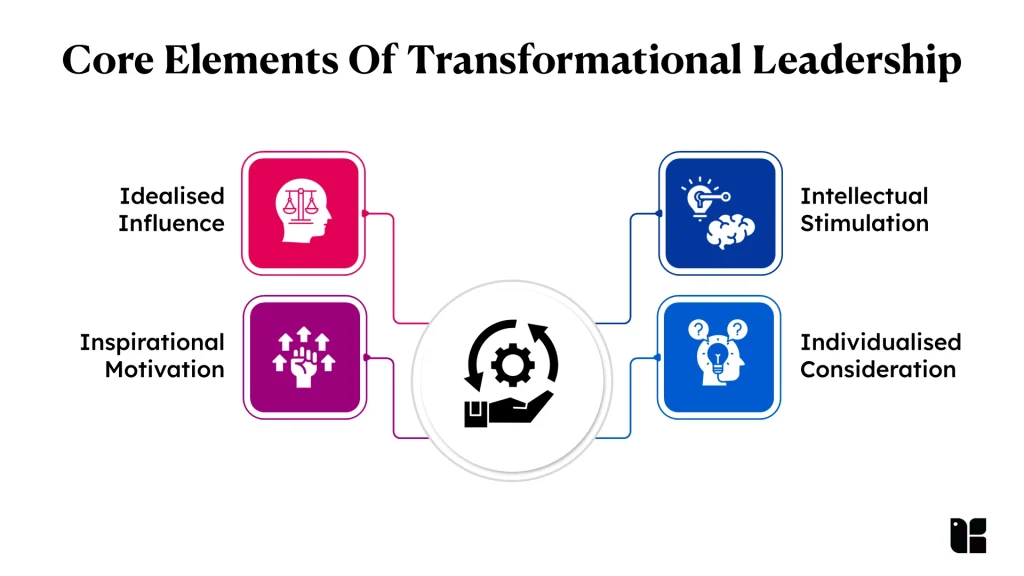
- Idealised influence: Leaders become trusted role models by consistently showing integrity, fairness, and commitment. Their behaviour sets the tone for the team, encouraging others to follow not out of obligation, but through respect and belief in their vision.
- Inspirational motivation: A clear and meaningful vision helps people see beyond daily tasks. Transformational leaders use encouraging communication to bring energy and focus to shared goals, helping team members find purpose in their work.
- Intellectual stimulation: Challenging the usual way of thinking is central to this approach. These leaders invite curiosity, question old habits, and support new ideas, making innovation a team effort rather than a top-down directive.
- Individualised consideration: Every team member brings different strengths, goals, and challenges. Transformational leaders take time to understand each person’s journey and provide the guidance, feedback, and opportunities that suit their individual growth path.
While the principles behind transformational leadership explain why it’s effective, the real impact becomes clearer when we look at the numbers.
Explore how Kapable’s learning framework helps leaders strengthen vision, influence, motivation, and individualised leadership to create lasting organisational impact.
Which Transformational Leadership Statistics Are Worth Knowing?
The true influence of transformational leadership becomes clearer when we look at the numbers driving its success across industries. These statistics highlight how this leadership style translates vision into measurable outcomes.
Employee Performance Driven By Effective Management
When leaders focus on inspiring their team rather than just managing them, the results often go far beyond expectations. This is the core of transformational leadership, a style that motivates employees by sharing a clear vision, encouraging creativity, and offering personal support. Here’s what the data shows:
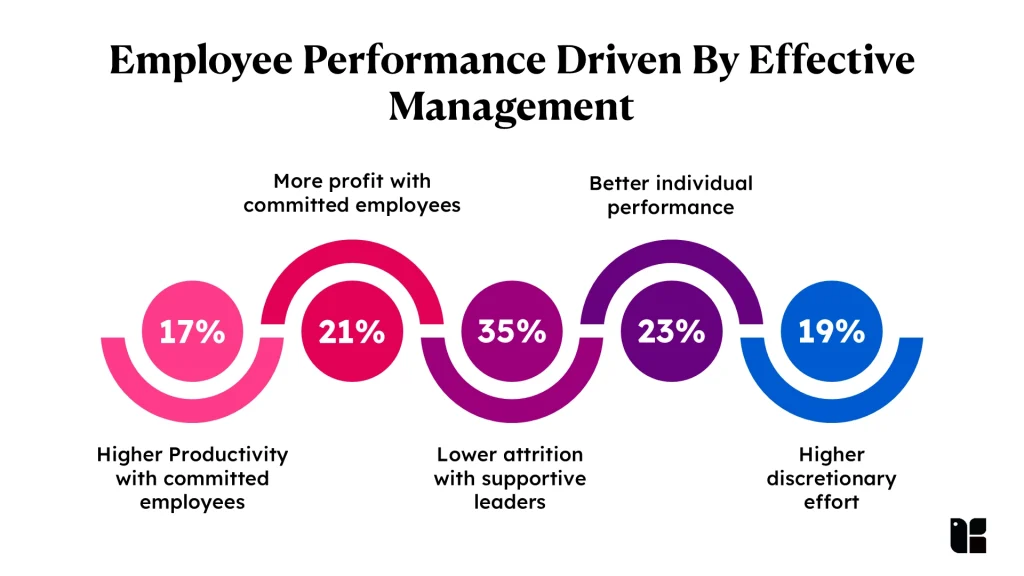
- Stronger employee commitment: When employees feel connected to their work, they’re more productive. Gallup’s global report showed that companies with engaged employees had 17% higher productivity and 21% more profit, thereby providing evidence of a positive relationship between these two dependent variables. Transformational leaders help create this kind of environment by giving meaning to the work people do.
- Reduced attrition: A study found that when leaders are supportive and encouraging, employees are 35% less likely to leave their jobs. This is because transformational leaders listen to employees, care about their growth, and recognise their efforts, all of which make people want to stay.
- Better individual performance: A meta-analysis published in The Leadership Quarterly found that transformational leadership is associated with a 23% improvement in individual task performance. Employees are more likely to meet or exceed performance expectations when they feel inspired and supported by their leaders.
- Increased discretionary effort: A CEB (now Gartner) Corporate Leadership Council report found that discretionary effort, the willingness to go above and beyond one’s basic job duties, increases by 19% under transformational leadership initiatives
Stronger Retention For Better Organisation Outcomes
Employees are more likely to stay in a job where they feel valued, supported, and part of something meaningful. Transformational leaders help make this happen by giving regular feedback, recognising efforts, and connecting people to a bigger purpose. Let’s look at how each of these elements helps reduce employee turnover, with real statistics to back it up.
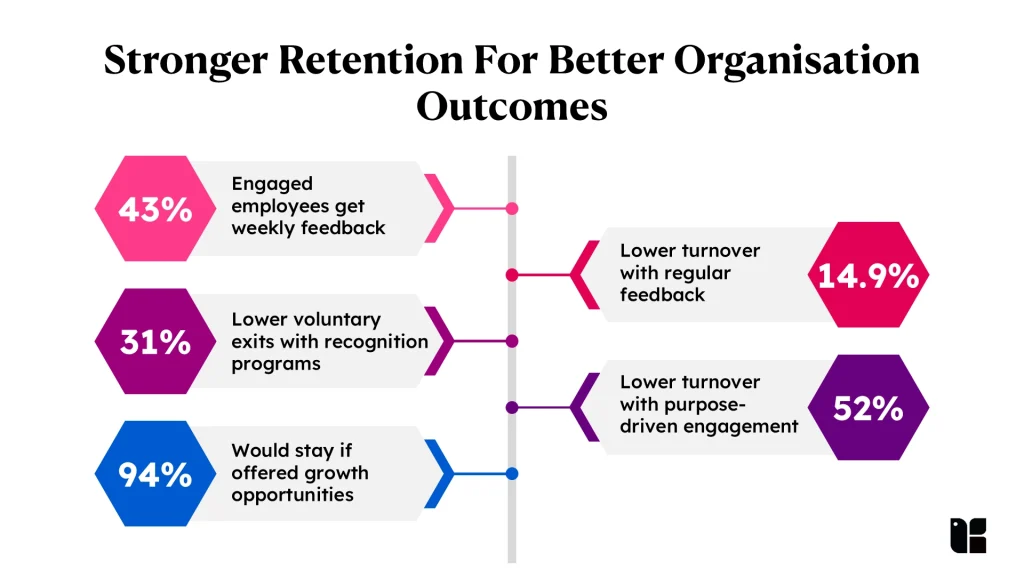
- Consistent Feedback: Employees who receive frequent feedback are drastically less likely to leave. Over 43% of highly engaged employees receive feedback at least once a week, and teams with regular feedback report 14.9% lower turnover than those without it. When people know how they’re doing and where they can improve, they feel supported and more connected to their work. This makes them less likely to feel overlooked or disengaged, reducing their urge to quit.
- Regular recognition: The Society for Human Resource Management (SHRM) found that companies with formal recognition programs see a 31% drop in employees leaving on their own. Feeling appreciated boosts morale and motivation. When employees know their efforts are noticed, they’re more likely to stay loyal and committed to the organisational goals.
- Sense of purpose: New hires who engage in purpose-driven programs like volunteering or giving exhibit 52% lower turnover than their peers . People want to feel that their work has value beyond just a paycheck.A clear sense of purpose is a key personal factor that helps them stay emotionally invested in their role and the company’s success.
- Opportunities for growth: According to LinkedIn’s Workplace Learning Report, 94% of employees said they would be more likely to stay with an organisation that actively invests in their skill development and learning opportunities. When individuals can clearly see ways to grow and advance within their role or the company, they’re more likely to remain committed. Transformational leaders create these paths by encouraging learning, offering support, and helping people reach their full potential, making long-term retention more likely.
Shaping A Stronger Workplace Culture
A strong organisational culture is the outcome of intentional leadership. Transformational leaders play a key role in shaping this culture by encouraging trust, ethical behaviour, innovative ideas and learning. The following data highlights just how significant their impact can be.
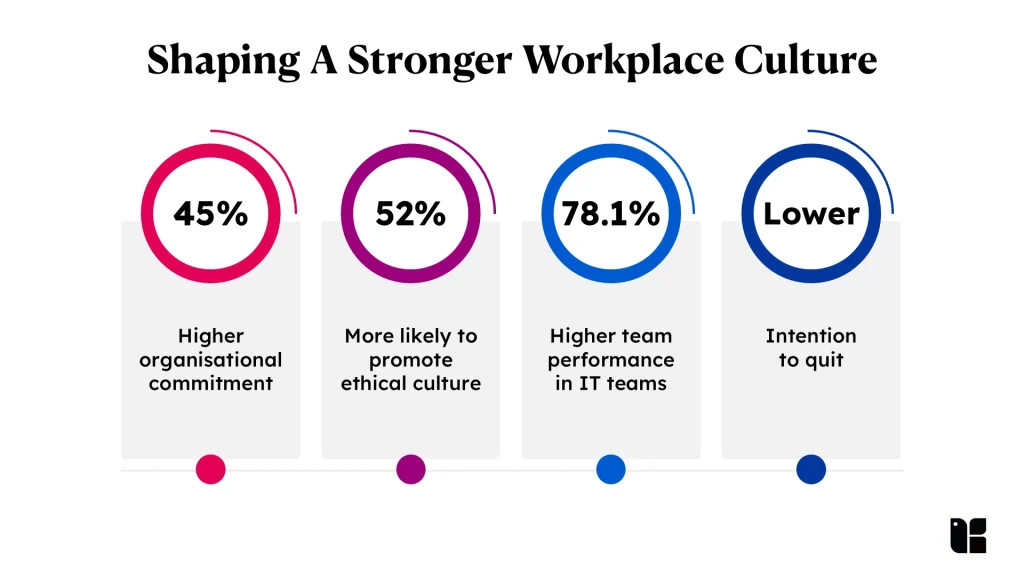
- Boost in organisational commitment: A study found that transformational leadership leads to a 45% increase in how committed employees feel toward their organisational objectives. These leaders foster connection and shared purpose, laying the foundation for a culture where people want to stay and grow.
- Promote ethical culture: Over 52% more likely to foster ethical norms throughout their organisations. These leaders reinforce values like transparency, accountability, and fairness, which strengthen the moral fabric of the culture.
- Enhanced team performance: In a study focused on IT teams, transformational leadership led to a 78.1% increase in team performance. It strengthens employee loyalty and reduces turnover, which stabilises team dynamics.
- Reduces turnover intentions: A study found that transformational leadership boosts trust and engagement, which in turn lowers the intention to quit. Although no exact percentage was given, the study demonstrated a clear chain effect. It helps retain top talent by creating a culture of empowerment and belonging.
While the numbers highlight the strong impact of this leadership style, it’s equally important to explore how it adapts across different groups and environments, leading us to the role of diversity.
How Does Diversity Shape Transformational Leadership?
The presence of diverse voices is not only a matter of representation but also a key factor in stronger outcomes and team morale. The statistics below highlight the current state of transformational leadership diversity:
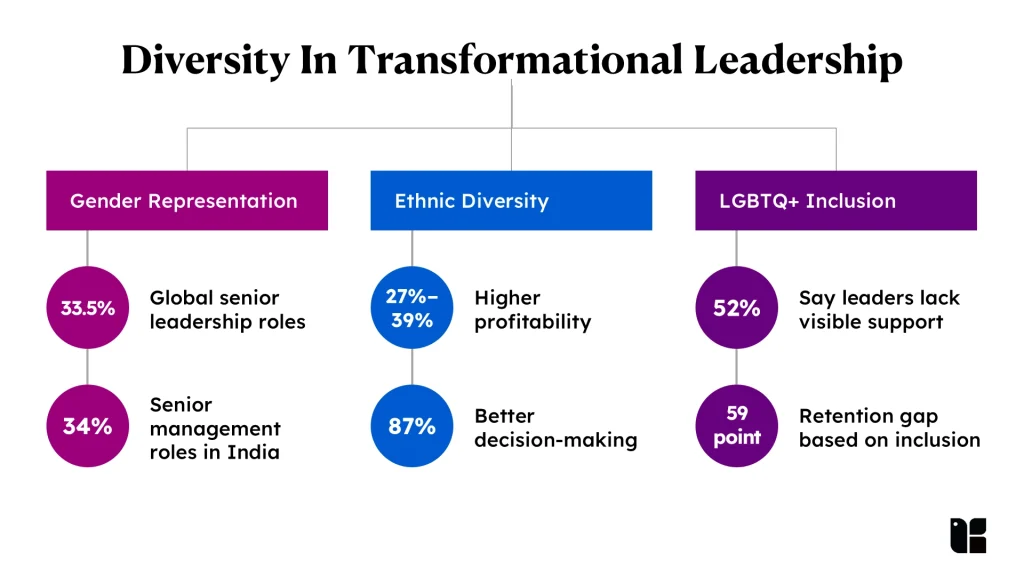
Gender Representation In Transformational Roles
Women often demonstrate strong transformational attributes like empathy, vision-building, and personal mentoring, yet these strengths remain undervalued in traditional power structures that often overlook the role of organisational justice in effective leadership.
- As of 2024, 33.5% of senior leadership positions globally are held by women, a number that reflects ongoing progress, but not yet equity.
- In India, women represent 34% of senior management roles, with uneven distribution across sectors. Leadership in education and social development shows better gender inclusion than corporate boardrooms.
Ethnic Diversity In Leadership
Leaders who show transformational qualities, like openness to learning and sensitivity to cultural perspectives, can drive innovation by making team members feel genuinely included.
- Companies with ethnically and culturally diverse leadership teams are 27% to 39% more likely to exceed average profitability, pointing to the clear advantage of representation.
- Research shows that ethnically diverse teams decide better 87% of the time and make decisions twice as fast, reducing groupthink by 60%, with overall outcomes which thereby makes it more efficient.
LGBTQ+ Inclusion In Leadership
Inclusive policies alone are not enough; leaders must model acceptance and respect in everyday decisions to foster real change.
- Around 52% of LGBTQ+ employees believe their leadership lacks visible support for inclusion, which often leads to lower levels of trust and engagement.
- A study shows that 97% of LGBTQ+ employees working in inclusive environments plan to stay for at least another year, compared to only 38% in less inclusive workplaces, a massive 59-point retention gap.
Understanding how diversity shapes transformational leadership sets the stage for examining how this style plays out across various industries and professional settings.
“This journey transformed my confidence and communication skills, enabling me to deliver impactful presentations, including a town hall for 500 people and a compelling business pitch to a senior stakeholder. Kapable has been a game-changer in my professional growth.”
– Ajay Deshmukh (Director At JPMorgan Chase)
What Impact Does Transformational Leadership Have Across Different Industries?
Transformational leadership plays a powerful role across industries where innovation drives measurable improvements in performance, culture, and engagement. The examples below show how it creates real impact, backed by credible data.
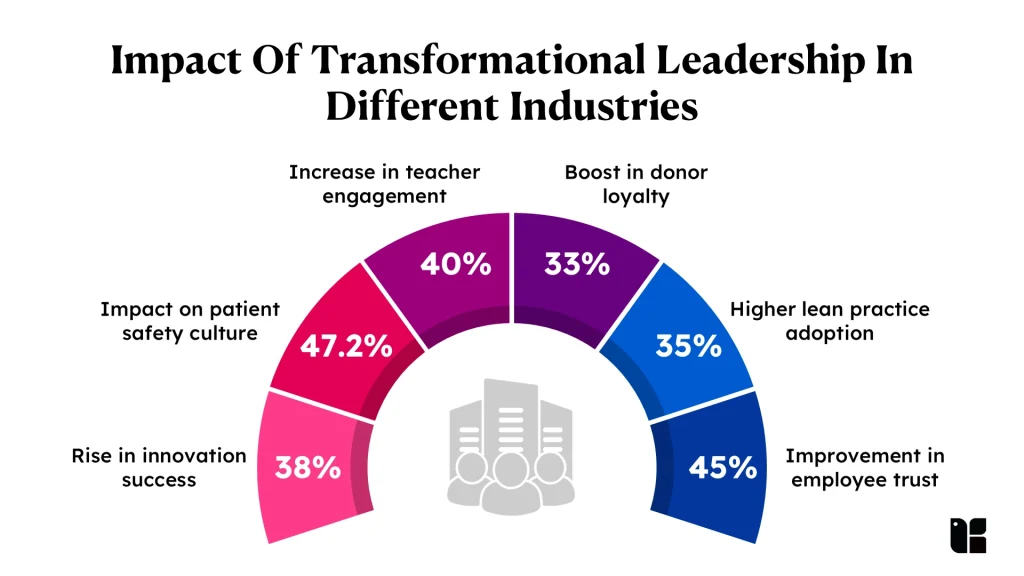
- Technology industry: A recent study published in Frontiers in Psychology found that transformational leadership in IT firms led to a 38% rise in innovation success, largely due to enhanced psychological capital and thriving workplace dynamics. In a space where constant evolution is the norm, leaders who promote vision and flexibility enable teams to push boundaries and adopt new technologies with confidence.
- Healthcare sector: A research study determined that transformational leadership explained 47.2% of the variance in patient safety culture and 25.4% of overall safety perceptions in nursing homes. Effective leadership helps medical teams work better under pressure, improve communication, and foster a culture of safety that directly impacts patient care.
- Education sector: A study in Educational Management, Administration & Leadership reported that schools with transformational leadership at the helm experienced a 40% increase in teacher engagement and curriculum innovation. Educators are more inclined to take initiative, develop new teaching methods, and inspire learners when guided by a leader who values growth and empowerment.
- Nonprofit sector: Studies in nonprofit literature show that organisations led by transformational leaders experience a 33% boost in donor loyalty and about 28% increase in volunteer participation. A compelling vision and mission-driven leadership approach helps nonprofits build stronger bonds with supporters and energise teams working toward community goals.
- Manufacturing sector: A report from the International Journal of Industrial Engineering found that transformational leaders focus on lean practices in factories by 35%, resulting in reduced waste and improved productivity. Leaders who empower shop-floor workers to make decisions and improve processes help align day-to-day operations with long-term strategic aims.
- Financial services: According to research in the Journal of Business Research, transformational leadership in the financial sector is associated with a 45% improvement in employee trust and a 32% increase in customer satisfaction. In high-stakes financial environments, leaders who promote ethical values and inclusivity foster loyalty among teams and trust with clients.
While transformational leadership shows promise across industries, it’s not without its challenges. Let’s now look at the common barriers that can hinder its effectiveness.
What Are The Barriers To Effective Transformational Leadership?
Even the most inspiring leaders can fall short when fundamental elements of transformational leadership are overlooked; these subtle but significant gaps often go unnoticed until performance, trust, and culture begin to decline.
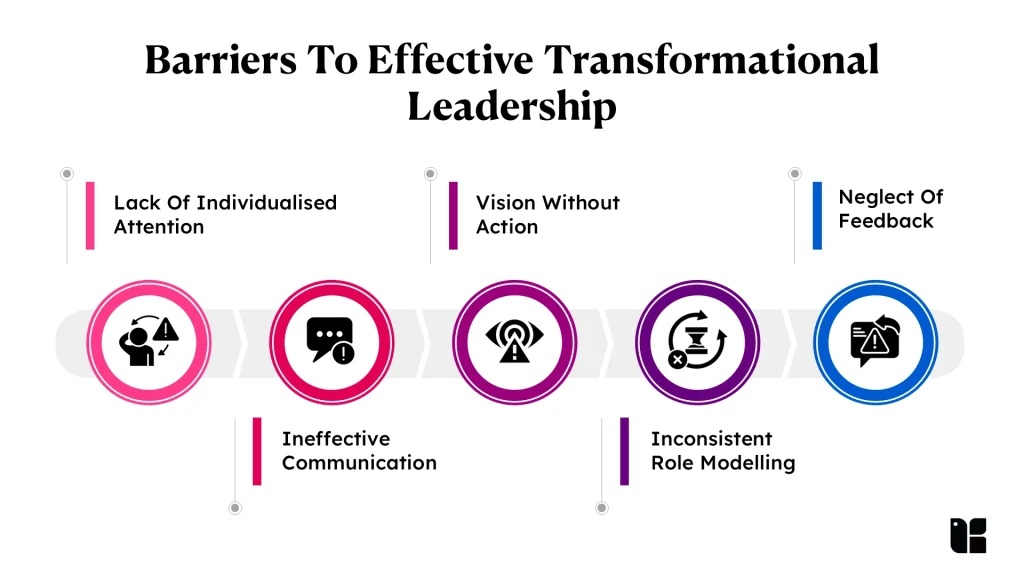
Lack Of Individualised Attention
Transformational leadership relies heavily on addressing the unique aspirations, strengths, and growth needs of each team member, referred to as individualised consideration. When leaders fail in this area, team members often feel undervalued, overlooked, and disconnected from their own development path. One of the most commonly overlooked aspects of transformational leadership behaviours are the failure to provide individualised attention. This gap has been observed across various sectors and is supported by research:
- Additionally, a 2024 study by DDI revealed that employees are 5.3 times more likely to trust leaders who show vulnerability, an indirect but important reflection of leaders’ willingness to connect on an individual level.
- A study by eLearning Industry (2025) found that 69% of employees are willing to put in more effort when their achievements are recognised, while 82% link poor leadership directly to disengagement at work.
Ineffective Communication
For a transformational leader, communication is about inspiring a shared vision, motivating change, and encouraging intellectual growth. When communication is weak, these outcomes are severely limited. This communication gap can directly affect team performance, trust, and the success of leadership initiatives.
- A 2023 McKinsey report revealed that teams with effective communication are up to 3.5 times more likely to perform better and show stronger commitment to change initiatives.
- A 2025 report found that 86% of employees and executives cite ineffective collaboration and communication as the main cause of workplace failures, while teams that communicate well can see up to a 25% boost in productivity.
Vision Without Action
While transformational leaders are often praised for casting a strong vision, it’s the ability to translate that vision into concrete action that truly drives change. Without clear implementation and visible commitment, visionary ideas remain abstract and ineffective. This disconnect between vision and execution can seriously undermine trust, performance, and follow-through.
- Harvard Business School data shows up to 90% of organisations fail to successfully execute their strategies, underscoring that flawless vision alone isn’t enough without rigorous follow-through.
- Research highlights that although 80% of leaders are confident in their company’s strategy, only 44% feel they’re good at implementation, pointing to a major execution deficiency.
Inconsistent Role Modelling
Transformational leaders are expected to lead by example, demonstrating the values, work ethic, and integrity they want to see in their teams. However, when leaders fail to consistently embody these traits, it creates a disconnect between words and actions. This inconsistency can damage credibility, reduce employee commitment, and breed cynicism.
- A research by Edelman Trust Barometer report found that 67% of employees say they expect their leaders to “walk the talk,” but only 37% feel their leaders consistently live up to this expectation.
- Similarly, a PwC Global Culture Survey (2023) revealed that organisations where leaders model desired behaviours are 3.8 times more likely to achieve strong business outcomes than those where leadership behaviour contradicts stated values.
Neglect Of Feedback
A core trait of transformational leadership is encouraging open dialogue and learning. Yet, when leaders disregard employee feedback or fail to foster an environment where people feel safe to share ideas or concerns, it impacts innovation and engagement.
- A survey by Qualtrics showed that only a third (35%) of employees were being asked for feedback more frequently than once a year. But, in 2025, this has risen to nearly half (48%).
- In addition, a study by Forbes indicated that companies with strong feedback cultures enjoy 14.9% lower turnover rates and higher levels of team creativity.
Recognising the barriers to effective transformational leadership is the first step; now let’s look at actionable ways leaders can overcome these challenges and lead with real impact.
How Can Leaders Create A Strong Transformational Impact?
Incorporating transformational leadership means going about building a culture of trust, purpose, and continuous development. Here are four impactful ways to do that, supported by research:
Build Connection Through Recognition
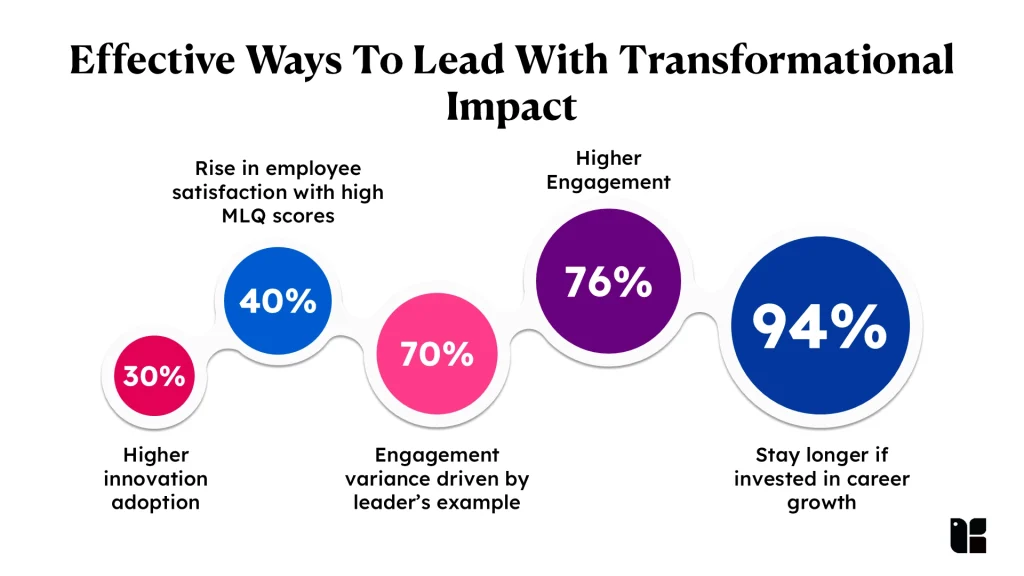
Transformational leaders work to build strong emotional bonds by recognising individual contributions, not only through rewards, but with genuine appreciation. A Catalyst study found that employees with highly empathetic leaders report 61% greater innovation and 76% higher engagement, compared to teams led by less empathetic leaders. Keep a recognition log where you note weekly wins, and use them to offer direct praise during 1:1s or team calls. Move beyond generic praise. Take time to acknowledge specific efforts, personal growth, or resilience shown by individuals.
Measure Your Leadership Impact
To lead with sustained transformational impact, it’s important to reflect on how your leadership style is experienced by others. Tools like the Multifactor Leadership Questionnaire (MLQ) help measure transformational leadership by assessing dimensions such as idealised influence, inspirational motivation, and individualised consideration. These tools capture how a leader motivates others, supports proactive personality traits, and leverages team members’ cognitive abilities to improve work outcomes. Regular use of such assessments also helps identify leadership blind spots that may unintentionally contribute to work stress, allowing you to make a significant contribution to both your own development and your team’s overall well-being and performance. Leaders scoring high on MLQ transformational scales saw up to a 40% rise in employee satisfaction and a 30% boost in productivity, showing the clear impact of transformational styles.
Lead By Example
Transformational leaders set the tone for the culture they want by demonstrating the same accountability, transparency, and resilience they expect from their teams. A Gallup study shows that managers account for nearly 70% of the variance in employee engagement, highlighting how much individual leadership behaviour matters. Share your thought process openly during team meetings (e.g. “Here’s how I approached that tough deadline”) and consistently follow through on commitments, so your team sees integrity in practice. Be visible in your efforts. Don’t just talk about values, show them through your actions, especially under pressure.
Encourage Risk-Taking
Transformational leaders create environments where experimentation is encouraged and failure becomes a learning opportunity. A study found that companies led by transformational leaders experienced a 30% higher rate of innovation adoption than their peers. Normalise experimentation by highlighting both successes and lessons learned. Introduce a “Fail Fast, Learn Faster” initiative, invite teams to pitch risky ideas monthly and reward those who took the leap, regardless of outcome. Make it clear that taking bold steps, even with uncertain results valued more than playing it safe.
Invest In Individual Growth
Transformational leaders view talent development as a shared journey, where each person’s progress strengthens the team as a whole. The LinkedIn Workplace Learning Report shows 94% of employees would stay longer in a company that invests in their careers. Use quarterly check-ins to co-create learning goals with each team member, then match them with relevant projects or training. Offer coaching sessions, mentorship programs, and personalised development plans. This not only builds individual capability but also boosts motivation and retention by showing that their growth truly matters.
After exploring practical ways to lead with transformational impact, it’s worth looking ahead at how upcoming trends and data are shaping the future of this leadership approach.
What Future Research Trends Are Emerging In Transformational Leadership Style?
As leadership continues to evolve, the traits and tools that define success are shifting. These trends highlight how transformational leadership and transactional leadership are both adapting to meet the needs of modern teams, emerging technologies, and values-driven workplaces.

- Rise of tech-first managers: According to Korn Ferry, 71% of CEOs believe AI will improve leadership effectiveness, while 73% are concerned about its potential downsides. This shows a growing need for leaders who can combine technology with empathy and ethical decision-making. AI is changing how leaders operate by handling routine tasks and providing data insights. However, it cannot offer ethical judgment or emotional intelligence, but transformational leaders can fill that gap by encouraging innovation and human-centred thinking.
- Shift toward empathetic management: According to Businessolver, companies that focus on empathy can reduce turnover costs by up to 180 billion dollars each year. Employees in empathetic workplaces are 18% less likely to leave. Empathy is also linked to higher engagement and lower burnout. These findings reinforce the role of transformational leaders who lead through understanding, active listening, and emotional support.
- Growth of inclusive cultures: Inclusive companies are three times more likely to outperform their peers and 45 percent more likely to improve market share, according to Deloitte. In India, inclusive workplaces have seen nearly 50 percent higher profits. Transformational leaders support this shift by promoting fairness, empowering diverse voices, and creating psychologically safe spaces where innovation can grow.
- Surge in purpose-driven careers: Workforce trends are shifting toward meaning over routine. According to a survey cited by Access Perks, 58% of employees consider purposeful work a must-have when choosing to stay or leave a job, and 74% intend to remain when they feel purpose at work. Employees today want to contribute to missions that align with their values. Transformational leaders play a critical role here by framing everyday tasks within a larger narrative, helping teams understand what they do and why it matters.
- Move to data-led decisions: Organisations using data-driven strategies are 3× more likely to report significantly improved decision-making. This marks a growing move away from gut-based decisions to empirical evidence-backed strategies. Transformational leaders are evolving by blending data analytics with a human touch by interpreting trends, adapting to feedback, and ensuring data serves both performance and people. It is not only about the numbers; it’s about what leaders do with them to drive meaningful growth.
With these future trends in mind, it becomes even more important to reflect on the overall impact and potential of transformational leadership.
If your goal is to prepare for the evolving demands of transformational leadership, Kapable’s fit assessment can help you decide whether it’s the right next step.
Conclusion
Transformational leadership style, supported by effective leadership behaviours and a clear inspiring vision, contributes to improved organisational outcomes. The success of transformational leadership is reflected clearly in the data. It shows measurable improvements in how people perform, engage with their work, and stay committed to their teams. Whether it’s higher productivity, stronger collaboration, or reduced turnover, the statistics highlight the value of leaders who motivate with purpose and lead with empathy. For any organisation aiming to build a resilient and future-ready workforce, transformational leadership offers a proven path forward.


