


TL;DR
- Core Dysfunction: Ineffective leadership stems from a failure to provide clear direction and make sound decisions, often rooted in behaviours like micromanagement, poor communication, or unchecked arrogance.
- Organisational Impact: The effects of poor leadership are immediate and long-term, showing up as high employee turnover, significant mental health strain, and organisational stagnation that compromises future viability.
- Focus Areas for Prevention: Leaders can preempt failure by prioritising open communication, developing self-awareness, increasing adaptability, and encouraging team autonomy through trust and empowerment.
- Structured Improvement Methods: Proven tools like 360-degree feedback, the Situational Leadership Model, and Cognitive Behavioural Coaching provide frameworks to adjust behaviour and build greater resilience and clarity.
Have you ever seen a team struggle not because of the work, but because of the person leading it? Leadership failure is more common than we think, and its effects are easy to spot: confusion, low morale, missed deadlines, and quiet exits. It doesn’t always start with bad intentions; often, it begins with misaligned expectations or simply a poor fit between leader and team. And when it happens, the whole system feels it. In this blog, we’ll explore what leadership failure is, what the data tells us about why it happens and how to prevent it.
What Is Leadership Failure?
Leadership failure occurs when those in senior management positions cannot provide clear direction, make effective decisions, or create an environment where their teams can perform and grow. It often involves unclear communication, inconsistent decisions, or an ongoing struggle to respond to what the situation demands. A leader may lose the ability to set direction or connect with the people they’re meant to support. This kind of failure can surface during visible moments of pressure, or slowly build in quieter ways, a team that becomes uncertain, disconnected, or stuck in cycles of low performance.
The impact rarely stays limited to one person. It can shape how people work, how teams function, and how the organisation moves forward. When leadership begins to falter, progress becomes harder to sustain. Gallup estimates that poor management costs U.S. businesses between $960 billion and $1.2 trillion every year. Globally, the figure reaches nearly $7 trillion, which is close to 10 per cent of the world’s GDP. These numbers reflect more than lost profit. They reflect how much is at stake when leadership falls out of sync with the people it’s meant to support. To understand how these failures unfold, it’s important to look closely at the patterns and leading causes behind them. Next, let’s look at what causes leadership to fail.

What Causes Leadership Failure?
Leadership failure doesn’t happen all at once. It usually builds from recurring behaviours and patterns that erode trust, weaken teams, and stall performance. Here are a few causes:
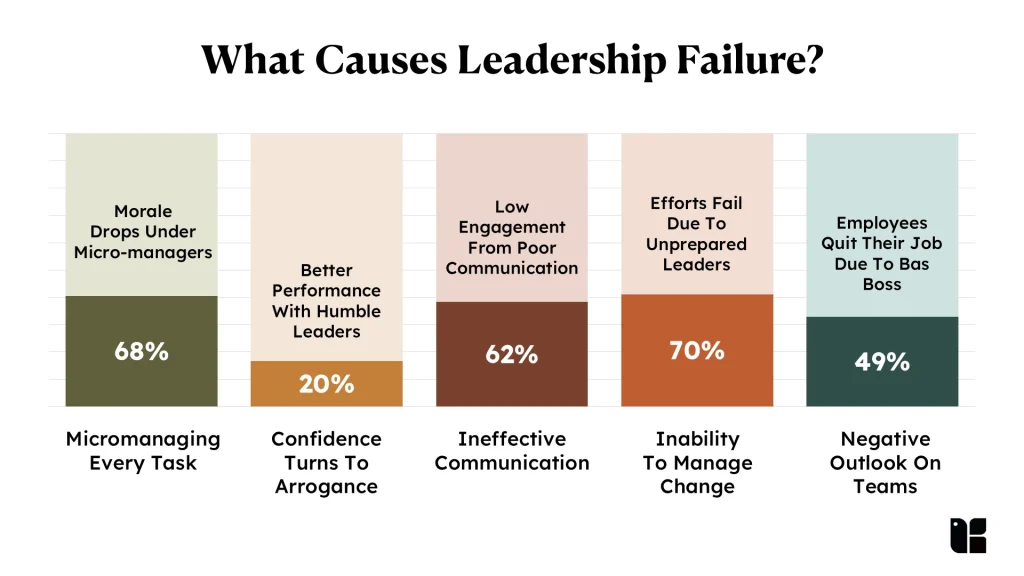
Micromanaging Every Task
Micromanagement creates an environment of control instead of trust. Leaders who over-monitor their teams end up reducing motivation, slowing progress, and limiting innovation.
- A survey revealed that 68% of employees working under micromanagers reported a drop in morale, while 59% felt the micromanagement negatively affected their productivity, highlighting how pervasive this issue is in the workplace.
- Micromanagement hampers output and efficiency. According to Psychology Today, this leadership style often causes employees to disengage and perform below expectations.
- A doctoral study found that among 25 employees surveyed in hybrid and remote settings, 24 experienced declining team morale directly tied to micromanagement and reported increased intentions to quit, despite financial incentives.
Ineffective Communication
When influential leaders fail to share clear, consistent messages, teams lose alignment and trust. Miscommunication not only slows execution but also creates frustration across the organisation.
- Gallup research shows that employees who feel communication is poor are 62% less likely to be engaged, highlighting how critical clarity is for motivation.
- A survey by the Project Management Institute found that 25% of project failures are directly linked to poor communication.
- According to a study, companies with effective communication practices are 3.5 times more likely to outperform peers, proving how much clarity drives results.
Confidence Turns To Arrogance
Confidence inspires trust, but unchecked, it quickly turns into arrogance, leading to dismissive behaviour, poor decisions, and alienated teams.
- Research shows a 97% correlation between humility and effective management, and some studies indicate that teams led by humble individuals perform 20% better than those with more self-centred leadership.
- A study by Zenger Folkman, reported in Forbes, found that high-quality leaders who demonstrate humility, specifically those who actively seek feedback and listen, are perceived as more effective than arrogant leaders
- Great Learning notes that confidence often slips into arrogance when leaders dismiss feedback and alienate their teams. This behaviour erodes respect and discourages collaboration, ultimately slowing innovation
Inability To Manage Change
Adaptability is a core leadership skill. Leaders who resist or mishandle change often cause stagnation and disengagement.
- Studies show that 70% of organisational change efforts fail, often due to leaders not preparing teams adequately for transitions.
- A Gartner report reveals that 73% of employees affected by change experience moderate to high stress levels, and those individuals perform 5% worse than the average employee.
- McKinsey’s research shows that around 70% of change programs fail to meet their objectives, largely because new leaders don’t adapt effectively
Negative Outlook On Teams
A leader’s mindset often sets the tone for the entire team. Leaders who consistently focus on problems instead of possibilities create a culture of pessimism and fear.
- Gallup highlights that employees who perceive their leaders as negative are 23% less likely to feel engaged in their daily work.
- A study published shows that negative leadership behaviours are directly linked to increased employee burnout symptoms, which reduces resilience and long-term performance
- A Robert Half study found that 49%(nearly half) of professionals have quit a job because of a bad boss, underlining how negative leadership in leadership positions directly drives turnover.
Understanding the causes of leadership failure is only half the story. The real impact shows up in how teams function, how employees feel, and how businesses perform when leadership breaks down.
“My journey with Kapable has been truly valuable. The sessions helped me gain confidence and handle impromptu speaking and assertiveness. I successfully led high-level meetings, which I used to avoid, and received positive feedback from my director. I now feel confident and empowered.”
– Ruchika Bagga (Senior Manager At Mankind Pharma)
What Are The Consequences Of Leadership Failure?
Leadership failure shows up in measurable ways across the workplace. From employee engagement to financial performance, the effects are significant and long-lasting.
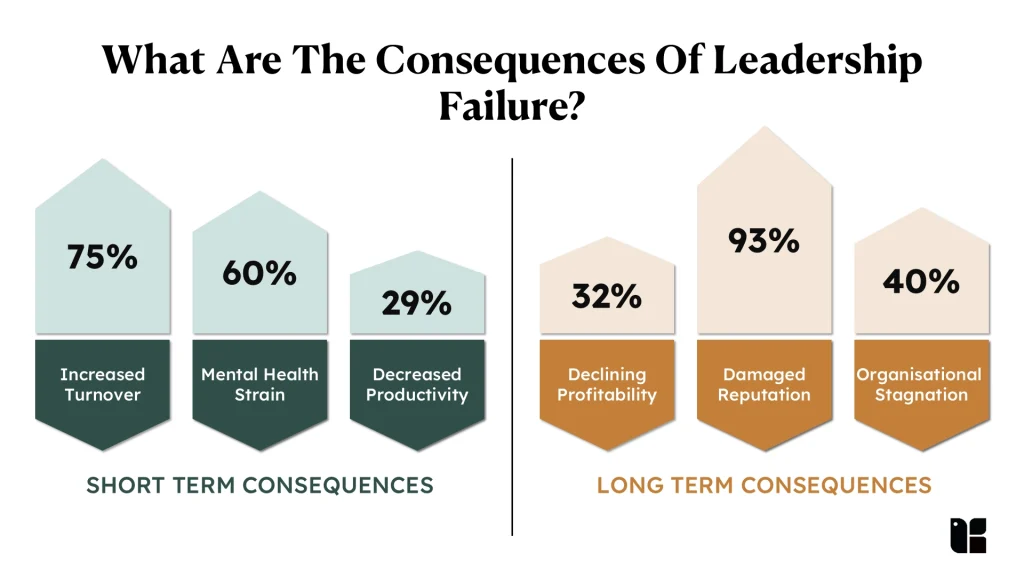
Short-Term Consequences
When leadership starts to falter, employees and teams feel the effects quickly in ways that can disrupt day-to-day performance.
- Increased turnover: Gallup research shows that 75% of voluntary turnover is influenced by managers, meaning poor leadership choices directly push employees to leave. High churn doesn’t just reduce headcount; it drains momentum and forces constant rehiring.
- Mental health strain: A UKG survey revealed that 60% of employees say their job is a critical factor affecting their mental health, with poor leadership behaviours like lack of support or negativity amplifying work-related stress and leadership burnout. This immediate strain reduces focus and team energy.
- Decreased productivity: According to the Center for Creative Leadership, organisations with ineffective leadership suffer a 29% reduction in productivity and a 23% increase in employee turnover, clearly showing how poor leadership can immediately undermine team effectiveness and stability
Long-Term Consequences
When leadership failure persists, the negative impact compounds. Over time, it slows growth, damages trust, and puts the organisation at a disadvantage in its market.
- Declining profitability: According to a Burns Leadership Consulting study, ineffective leadership can be responsible for up to 32% of voluntary turnover, which not only increases rehiring costs but also erodes productivity and revenue potential over time.
- Damaged reputation: A 2024 PwC trust survey reveals that 93% of business executives agree that the ability to build and maintain trust improves the bottom line, statistics showing how leadership failure can significantly undermine stakeholder confidence.
- Organisational stagnation: PwC’s 2023 Global CEO Survey reports that 40% of CEOs believe their organisation won’t be economically viable in 10 years if it continues on its current path, highlighting the long-term danger of weak leadership and lack of evolution.
Understanding the potential consequences highlights why leadership matters so deeply. The next step is to look at the areas leaders should strengthen to avoid repeating the same failures.
What Can Leaders Focus On To Prevent Failure?
While leadership failure has serious consequences, it isn’t irreversible. Leaders can adopt specific practices to rebuild trust, strengthen teams, and create sustainable growth opportunities.
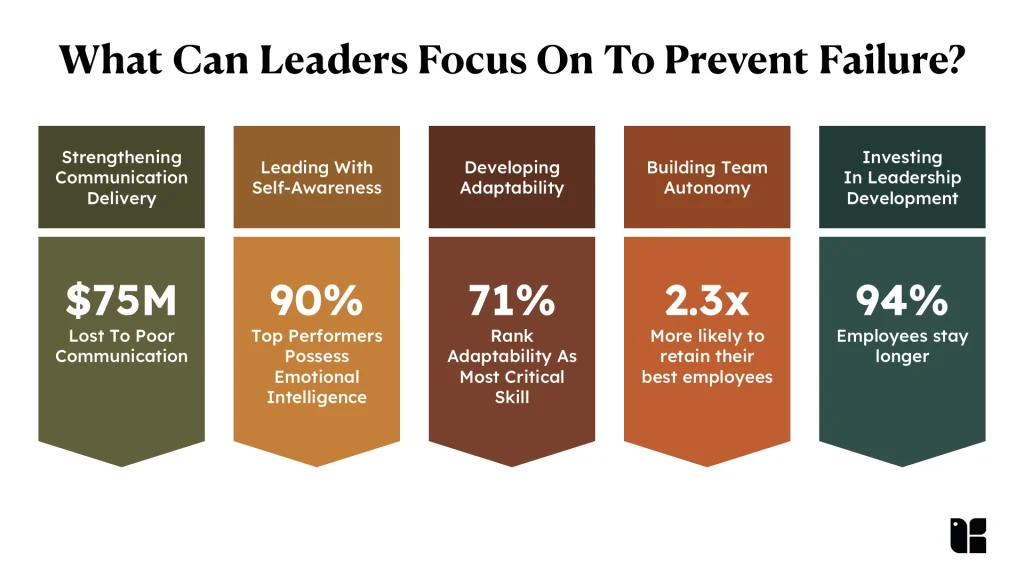
Strengthening Communication Delivery
Consistent, open communication is one of the fastest ways to regain alignment and rebuild confidence. Leaders who communicate effectively create trust and improve collaboration across the organisation.
- A Towers Watson study found that companies with highly effective communication practices deliver 47% higher total returns to shareholders compared to peers with poor communication.
- 85% of employees are motivated by effective internal communications. When leaders are transparent and communicate well, it directly boosts employee morale and engagement.
- For every $1 billion spent on a project, companies risk $135 million, and $75 million of that is put at risk by ineffective communications.
Leading With Self-Awareness
Self-awareness helps strong leaders recognise blind spots, adjust behaviour, and strengthen relationships with their teams. Without it, growth is nearly impossible.
- Korn Ferry found that companies with higher rates of self-aware leaders outperform others financially by 20%.
- A study published in Harvard Business Review reported that 83% of executives believe self-awareness is essential for leadership success, yet only 10-15% of people are truly self-aware.
- A study from TalentSmart found that 90% of top performers possess high emotional intelligence, of which self-awareness is a foundational component.
Developing Adaptability
Adaptable leaders can guide their teams through change with resilience and clarity. The ability to adjust strategies in uncertain environments is now a defining trait of strong leadership.
- PwC’s Global CEO Survey revealed that 71% of CEOs rank adaptability as the most critical skill for future leaders.
- Research revealed that organisations with the highest levels of agility, which is driven by adaptable leadership, generated 29% more shareholder returns than less agile companies.
- Deloitte research shows that companies prioritising adaptability in leadership training are 1.7 times more likely to be innovation leaders in their industry.
Building Team Autonomy
When leaders trust their teams to make decisions, it reduces dependence on micromanagement and strengthens accountability. Autonomy gives employees the freedom to take ownership, which improves engagement and overall performance.
- Companies that provide high levels of autonomy are more than 2.3 times more likely to retain their best employees compared to those that don’t.
- According to a study by Zenger Folkman, business leaders who empower their teams achieve 21% higher overall effectiveness ratings from their employees.
- In a study, those who felt a high level of empowerment ranked in the 79th percentile for engagement. In stark contrast, their peers who felt disempowered and lacked autonomy landed at just the 24th percentile for engagement.
Investing In Leadership Development
Consistent leadership development ensures organisations build pipelines of effective leaders who can adapt, communicate, and inspire.
- LinkedIn’s Workplace Learning Report shows that 94% of employees would stay longer at a company that invests in their continuous learning and development, proving its impact on retention.
- Deloitte’s research reveals a significant trust issue, with 61% of managers and 72% of workers admitting they could not trust their organisation’s performance management process. Effective leadership development is key to rebuilding this trust and fostering a high-performance culture.
- Organisations with high-quality leadership development programs are 4.2 times more likely to outperform those without them.
While these practices show the path to recovery, leaders also need structured approaches to apply them consistently. That’s where proven frameworks and techniques can provide the guidance to strengthen leadership qualities over the long term.
Explore Kapable’s leadership approach to learn how leaders can avoid common leadership failures by strengthening communication and team trust.
What Approaches Improve Leadership Effectiveness?
Leadership improvement thrives on tools that are both practical and grounded in experience. Here are three proven frameworks to help leaders build stronger skills, shift their mindset, and lead more effectively.
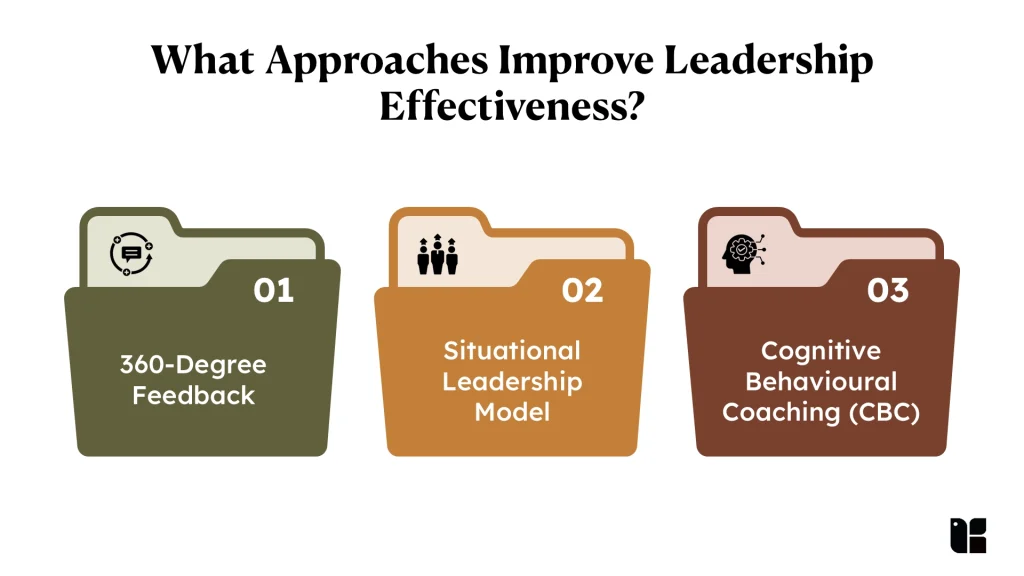
360-Degree Feedback
360-degree feedback gathers input about a leader’s behaviour from managers, peers, and direct reports to create a holistic view of how they show up at work. It matters because it exposes blind spots, confirms strengths, and grounds leadership development in evidence rather than assumptions.
How it works
- Feedback is collected anonymously from multiple directions upward, sideways, and downward to give a leader perspectives they can’t see on their own. Once compiled into a report, the data shows where self-perceptions align with or diverge from others’ views.
- A coach or HR partner helps decode the results, identifying consistent strengths and recurring issues. From there, leaders develop two or three focused behaviour goals and put an action plan in place, such as what to start, stop, and continue doing.
- The process doesn’t end with a report. Leaders share what they’re working on with their team, apply changes in daily interactions, and revisit progress after a set period. This turns feedback into a cycle of ongoing improvement rather than a one-time event.
360-degree feedback closes the gap between how leaders think they’re leading and how others actually experience them. Acting on feedback builds credibility because people see changes happening in real time. It also reinforces humility and accountability, showing that leadership isn’t about perfection but about learning and adjustment. Over time, it strengthens communication, sharpens decision-making, and creates teams that are more engaged and aligned.
Situational Leadership Model
The Situational Leadership Model, developed by Paul Hersey and Ken Blanchard, teaches leaders to adapt their style to the needs of their team members. Instead of sticking to a single way of leading, it encourages flexibility, directing when clarity is needed, coaching when skills are developing, supporting when confidence is low, and delegating when competence is high. This matters because no two employees are the same, and mismatched leadership often creates disengagement or frustration.
How it works
- Leaders begin by assessing the readiness of each team member for a given task, looking at both competence (skills and knowledge) and commitment (confidence and motivation). This assessment determines how much direction or support is required.
- Based on that assessment, the leader chooses a style: more hands-on for beginners (directing), guidance and encouragement for learners (coaching), reassurance for capable but hesitant contributors (supporting), or autonomy for experienced performers (delegating). The style isn’t static; it shifts as the person grows in skill and confidence.
- Success with this model comes from revisiting these assessments regularly. As people develop, leaders gradually adjust their approach, ensuring no one feels abandoned or smothered. The dynamic nature of the model keeps leadership relevant and responsive rather than rigid.
This model gives leaders a toolkit for flexibility. Instead of micromanaging capable employees or leaving inexperienced ones without enough guidance, leaders know exactly when to step in and when to step back. This reduces frustration, accelerates learning, and builds trust because employees feel supported at the right level. Over time, it develops more independent, confident teams and leaders who can adapt seamlessly to new challenges.
Cognitive Behavioural Coaching (CBC)
CBC is adapted from Cognitive Behavioural Therapy (CBT) and focuses on helping leaders recognise and reshape unhelpful thought patterns. It matters because how leaders think directly affects how they communicate, decide, and react under workplace stress. By addressing negative assumptions and replacing them with constructive perspectives, CBC strengthens resilience, clarity, and emotional control, all core senior leadership skills.
How it works
- The process begins with identifying limiting thoughts that may block performance, such as “I always fail in high-pressure meetings” or “conflict will only make things worse.” Awareness is the first step in shifting behaviour.
- These thoughts are then challenged through guided reflection, asking whether they’re based on facts or assumptions. Leaders examine evidence for and against their beliefs, opening the door to alternative viewpoints.
- Finally, the leader practices reframing those thoughts into balanced and solution-focused beliefs, for example, “I’ve handled pressure before, and preparation will help me do it again.” Regular coaching sessions reinforce the new thinking, ensuring it translates into real-world behaviour.
CBC helps leaders break the cycle of negative self-talk that fuels anxiety and indecision. By reframing their thinking, they communicate with more confidence, stay composed under work-related stress, and focus on solutions instead of problems. Over time, this mental clarity translates into better conflict resolution, stronger articulation of ideas, and a leadership presence that inspires steadiness in teams, especially in high-stakes situations.
Frameworks provide structure, but their impact depends on how leaders use them day after day. Lasting leadership comes from steady choices that shape trust and culture over time.
Conclusion
Leadership takes shape in daily work in the pauses before responding, the questions asked in meetings, and the space created for others to speak. These moments decide whether leaders feel connected to their team’s well-being and work-life balance, or whether missed opportunities become a significant factor in holding women back across various sectors. That’s why supporting new hires and experienced managers in making informed choices and facing challenges must be a top priority, because culture is written in behaviour, and behaviour starts with leaders.
Reducing the likelihood of leadership failure often starts with choosing the right development journey. Review Kapable’s suitability check to see if it aligns with your needs.


