


TL;DR
- Engaged Leadership Drives Connection: Effective leadership, built on trust, transparency, and vulnerability, creates the essential emotional and psychological foundation that motivates employees to commit and perform.
- Hidden Tax on Business: Unengaged employees impose profound global and corporate financial penalties, manifesting as lost productivity, massive turnover costs, and reduced team efficiency.
- The Engagement Killers: A lack of clear communication, persistent micromanagement, and the failure to prioritise employee well-being are key leadership behaviours that actively suppress morale and increase staff turnover risk.
- Actionable Growth Strategy: Long-term, high engagement is secured through purposeful investment in leadership capabilities, granting employee autonomy, and cultivating a culture of psychological safety.
Have you ever felt truly engaged at work, like your contributions mattered and your team actually valued? Chances are, your leader made a big difference in that experience. Employee engagement grows when people feel connected and motivated to do their best, and leadership plays a central role in shaping that experience every day. The latest employee engagement statistics reveal that actively disengaged employees remain a major challenge for organisations, directly impacting business success and employee retention. In this blog, we’ll explore why employee engagement matters more than ever, what gets in the way of it, and how the way we lead can either boost commitment or quietly drain it, all backed by insights that help you lead better.
What Is Leadership And Employee Engagement?
Employee engagement often starts with how people experience their leaders. When leadership is clear and supportive, employees are more likely to feel connected to their work and to the organisation’s goals. Engagement shows up in the energy people bring, the care they take in their tasks, and their willingness to go beyond what’s expected. It’s shaped by how leaders communicate, recognise effort, create psychological safety, and build everyday trust. When these behaviours are present, engagement becomes a shared experience across teams.
According to DDI, employees are 5.3 times more likely to trust leaders who show vulnerability, and 7.5 times more likely to maintain trust when leaders acknowledge their shortcomings. These authentic behaviours create an environment where people feel connected and committed. To understand what this makes possible at scale, the next step is to look at the broader value of employee engagement across a team or organisation.

What Are The Benefits Of High Employee Engagement?
Engaged employees stay longer, contribute more, and help build stronger workplace cultures. Here are the key benefits for both individuals and organisations.
Organisational Benefits
Highly engaged teams and highly engaged business units consistently outperform others, proving that engaged employees provide stronger results for overall business success.
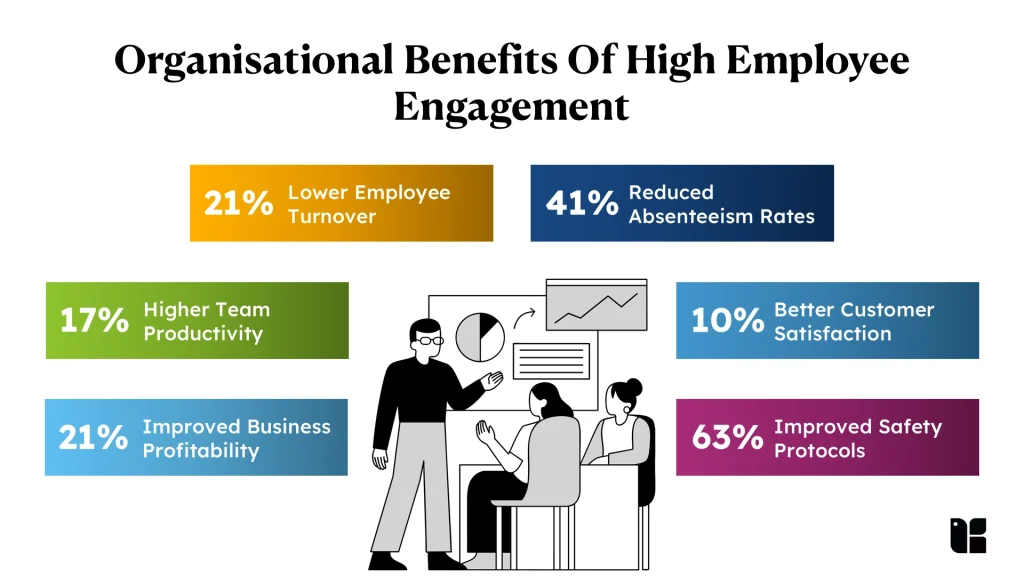
- Improved business profitability: Companies with highly engaged employees report 21% higher profitability and can grow profits up to three times faster than their competitors. This reflects the direct connection between engaged teams and stronger financial outcomes.
- Higher team productivity: Engaged teams are 17% more productive, as people tend to focus better, collaborate more effectively, and take greater initiative. This increased output leads to faster execution and better-quality results.
- Lower employee turnover: High engagement reduces turnover by 21% in high-churn industries and by 51% in low-churn ones, leading to major savings in recruitment and training costs. Engaged employees are more likely to stay and grow with the company.
- Reduced absenteeism rates: Highly engaged employees are 41% less likely to be absent, which helps teams maintain continuity and meet deadlines more reliably. Fewer absences also reduce the strain on other team members.
- Better customer satisfaction: Engaged employees are more present, positive, and committed to delivering excellent service, leading to a 10% boost in customer loyalty and satisfaction. Their enthusiasm often carries through to customer interactions.
- Improved safety protocols: Companies with high engagement see 63% fewer safety incidents and 32% fewer quality defects. Engaged employees pay closer attention to detail and feel more accountable for their work.
Individual Benefits
For senior leaders, prioritising leadership engagement and consistent employee communication is key to building an engaged workforce.
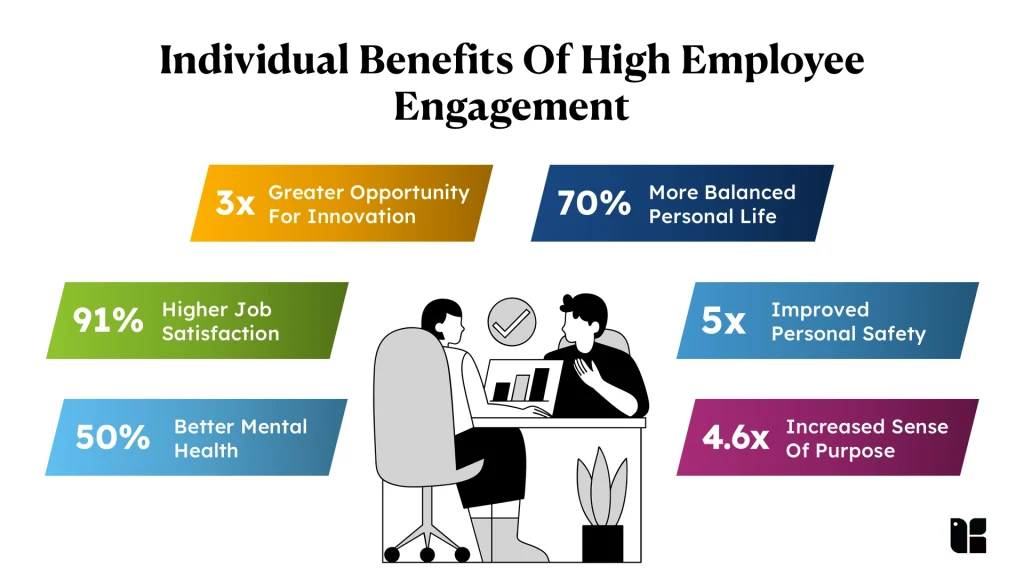
- Better mental health: Engaged employees are significantly less likely to experience burnout or depression. Burnout is halved when employees feel included at work. While inclusion is broader than engagement, high engagement strongly correlates with feelings of inclusion.
- Higher job satisfaction: 91% of highly engaged employees report being satisfied with their professional development opportunities. While this is specific to development, it indicates a broader satisfaction derived from their engagement.
- Greater opportunity for innovation: Individuals in highly engaged workplaces are 3x more likely to be high performers and 6x more likely to be high innovators. Engagement strengthens personal initiative, creativity, and the confidence to share new ideas.
- More balanced personal life: Engagement at work contributes to better well-being outside of work, too. Highly engaged employees are 70% more likely to say they’re thriving in life. This reflects the wide-reaching impact of a positive work experience on the overall quality of life.
- Improved personal safety: Employees who are engaged are 5 times less likely to experience a safety incident and 7 times less likely to face lost-time injuries. Focus and care in their work lead to safer outcomes.
- Increased sense of purpose: Engaged employees are significantly more likely to feel a sense of purpose and meaning in their work. They are 4.6 times more likely to feel empowered to perform their best work. This sense of contribution makes their daily tasks more meaningful.
Knowing how engagement strengthens teams sets the foundation. Now, let’s look at what happens when that engagement fades and why disengaged teams come at such a high cost.
Explore Kapable’s learning journey to understand how everyday leadership behaviours translate into stronger employee commitment, collaboration, and performance.
What Are The Hidden Organisational Costs Of Disengaged Employees?
Low engagement may not always be visible, but its effects show up in turnover, missed goals, and lost morale. Here’s what organisations risk when teams check out.
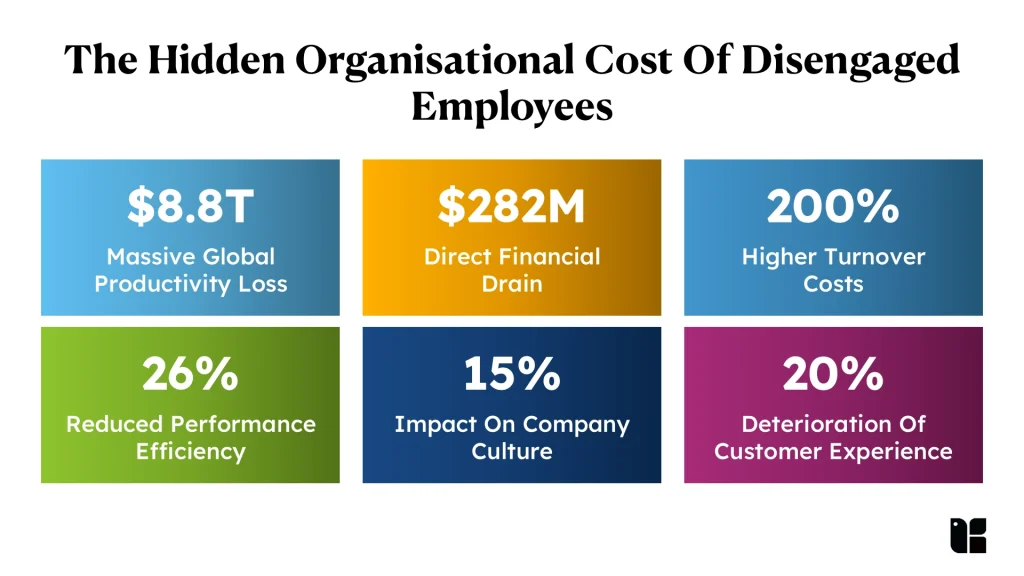
Massive Global Productivity Loss
When employees are disengaged at work, the impact goes far beyond individual performance. It affects output at a national and global level, reducing the overall economic contribution of entire workforces.
- Disengaged employees cost the global economy $8.8 trillion every year, which is around 9% of the world’s total GDP.
- The global economy loses approximately $1.48 million every second of the workday, adding up to nearly $5.33 billion every hour in potential lost value.
Direct Financial Drain
Disengaged employees create ongoing costs for companies. These costs show up in daily performance, lost hours, and reduced returns, all of which affect the bottom line.
- Companies lose between 18% to 34% of a disengaged employee’s annual salary due to lost productivity, absenteeism, and higher turnover.
- A median S&P 500 company loses around $282 million per year due to employee disengagement and attrition.
Higher Turnover Costs
Disengaged employees are more likely to leave, and replacing them isn’t cheap. The cycle of hiring, onboarding, and training creates ongoing costs for teams and HR functions.
- Replacing a single employee can cost between 50% to 200% of their annual salary, depending on the level and role.
- Companies with low engagement see 21% higher employee turnover in high-churn industries.
Reduced Performance Efficiency
When employees aren’t engaged, they don’t perform at their full potential. This leads to slower output, lower energy, and a drop in day-to-day performance across teams.
- Disengaged employees are 18% less productive than those who are engaged in their work.
- These employees report a 26% drop in energy, motivation, and interest, which directly affects the quality of their work.
Impact On Company Culture
When employees are not fully engaged, it affects how teams function. It can lower day-to-day motivation, reduce open communication, and make teamwork feel less connected.
- A single disengaged employee can reduce the efficiency of their team by 15%, just by lowering morale.
- Teams with low engagement report significantly higher conflict and disruption, spending up to 2.8 hours per employee per week dealing with interpersonal disputes instead of focused work.
Deterioration Of Customer Experience
Disengaged teams affect how customers are treated and how much they trust the business. This shows up in lower satisfaction, weaker loyalty, and lost revenue.
- Companies with engaged employees have 10% higher customer loyalty compared to those with disengaged teams.
- Companies with highly engaged employees see customer satisfaction scores that are 20% higher than those with disengaged teams. This means lower engagement can significantly reduce how customers experience and rate the service.
Seeing the impact of disengagement highlights what’s at stake. Let’s explore how leadership directly influences employee engagement for better or worse.
“As I advanced to working with C-suite leaders, I often felt nervous and struggled to structure my thoughts. Kapable’s hands-on approach, with practical exercises and personalised techniques, helped me build clarity and balance assertiveness with empathy. I can now confidently influence and engage leaders and teams, and both my growth and confidence are clear to those around me.”
– Marwa Mahgoub (Senior HR Business Partner At Al Tayar Insignia)
How Does Leadership Impact Employee Engagement?
Leadership plays a crucial role in determining how engaged employees feel at work. Certain leadership behaviours can either drive high engagement or contribute to disengagement and dissatisfaction.
Qualities That Reduce Employee Engagement
Some leadership habits often unintentionally drain motivation and connection. Here are the traits that can lower engagement across teams.
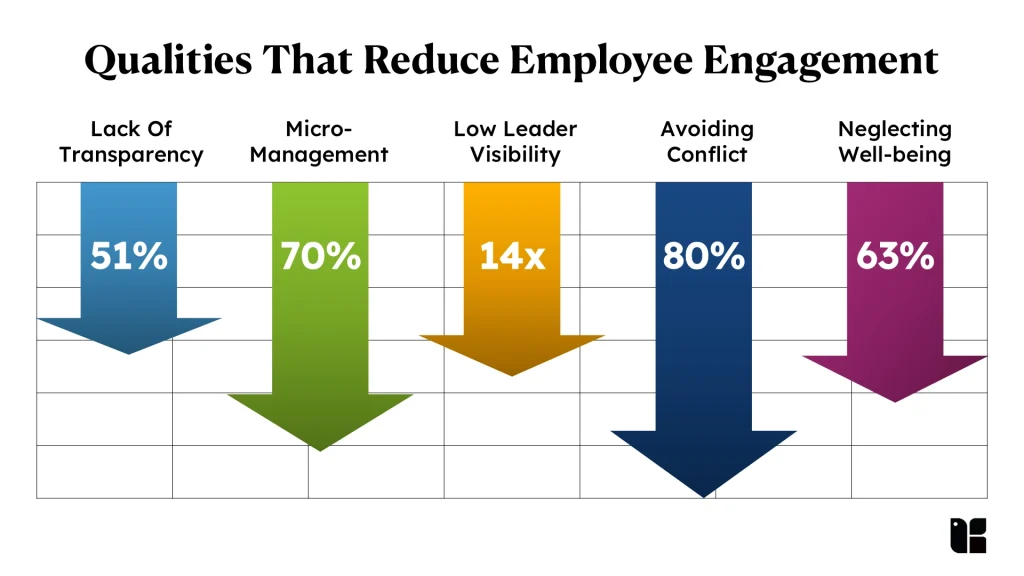
- Lack of transparency: Unclear communication from leaders often leads to anxiety and disengagement. When employees are not informed about goals, expectations, or decisions, it creates confusion and reduces trust. Studies show that 51% of employees report that poor communication increases their anxiety. This reflects how critical transparent and clear communication is to employee well-being and overall engagement.
- Micromanagement: Micromanaging employees signals a lack of trust and undermines autonomy, which negatively impacts creativity and morale. When employees feel constantly monitored, their confidence and engagement tend to drop. 70% of employees think about quitting due to micromanagement; surprisingly, 30% actually quit. This highlights the connection between micromanagement and reduced employee satisfaction and retention.
- Low leader visibility: When leaders are hard to reach or seem disengaged, it weakens team connection and makes collaboration more difficult. This gap in visibility can lead to disengagement and lower overall morale. Studies show that employees who trust their leaders are 14 times more engaged. This shows that when leaders are more accessible, trust and engagement within teams increase significantly.
- Avoiding conflict: Leaders who avoid difficult conversations or conflict allow problems to grow, weakening trust and morale. Addressing conflicts directly can foster a more positive and productive work environment. Over 80% of employees actively avoid at least one difficult conversation at work. This demonstrates the negative impact of unresolved issues and how they affect team dynamics and employee satisfaction.
- Neglecting well-being: When leaders fail to prioritise employee well-being or work-life balance, employees are more prone to burnout, leading to disengagement. Without proper support, employees’ engagement and productivity diminish. Burned-out employees are 63% more likely to take a sick day and are 2.6 times more likely to actively seek new jobs. This indicates that a lack of well-being support contributes significantly to absenteeism and turnover.
Qualities That Boost Employee Engagement
Leaders who show up with purpose, empathy, and clarity create the kind of environment where people want to contribute. These qualities make a measurable difference.
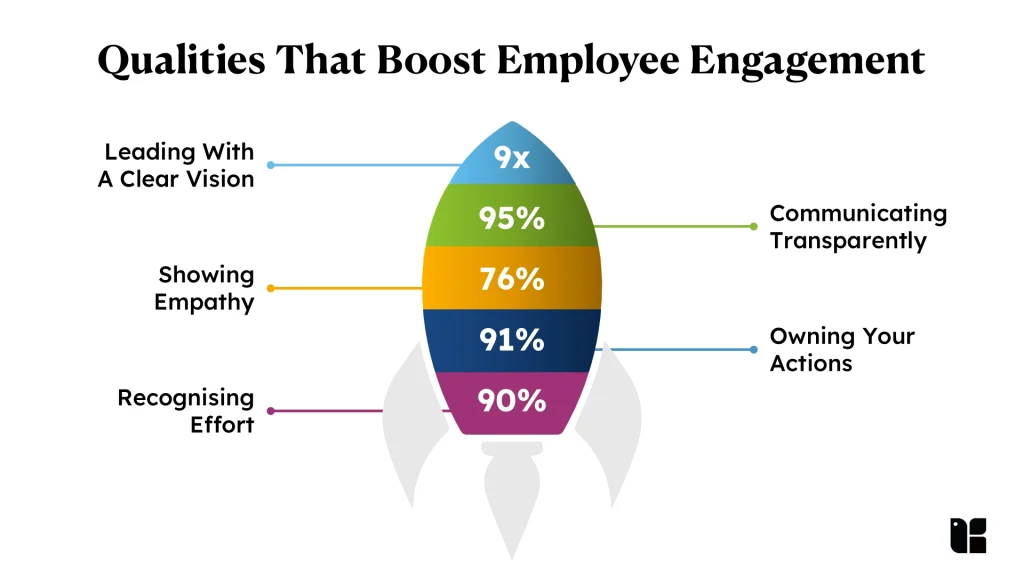
- Leading with a clear vision: When leaders set a clear vision, they motivate their teams by showing how every task contributes to a bigger goal. Employees feel more connected to their work and more committed to the company’s success. Studies show that employees with a strong sense of purpose are 9X more likely to be engaged and 2.4X more likely to stay with the company. This proves that a clear vision helps leaders keep their teams focused and loyal.
- Communicating transparently: Leaders who communicate openly and clearly with their teams build trust and keep everyone on the same page. This reduces confusion and strengthens the bond between leadership and employees. 95% of employees trust leaders who communicate well. This shows how communication is vital for creating a trustworthy environment where engagement thrives.
- Showing empathy: Leaders who understand and care about their team’s feelings create a more supportive environment, where employees feel valued. When leaders show empathy, employees are 76% more likely to feel engaged. This shows that showing genuine care for employees’ well-being can significantly boost morale and drive engagement.
- Owning your actions: Leaders who take responsibility for their actions and foster a culture of trust empower. Research shows that 91% of high-performing HR teams meet most or all of managers’ needs. When HR professionals partner closely with management, they help raise employee engagement levels across the organisation. This highlights the importance of accountability in strengthening employee loyalty and motivation.
- Recognising effort: Leaders who take the time to recognise and appreciate their employees’ efforts make them feel seen, boosting their motivation and engagement. 90% of employees say that recognition motivates them to work harder. This proves that consistent recognition is one of the easiest ways to keep employees engaged and excited about their work.
Understanding how leadership affects engagement sets the stage for action. Now, let’s look at proven strategies leaders can use to build a more engaged, motivated workforce.
Which Data-Backed Strategies Help Build A More Engaged Workplace?
Engagement strategies such as stress management, career advancement opportunities, and employee development encourage employees to feel heard and supported.
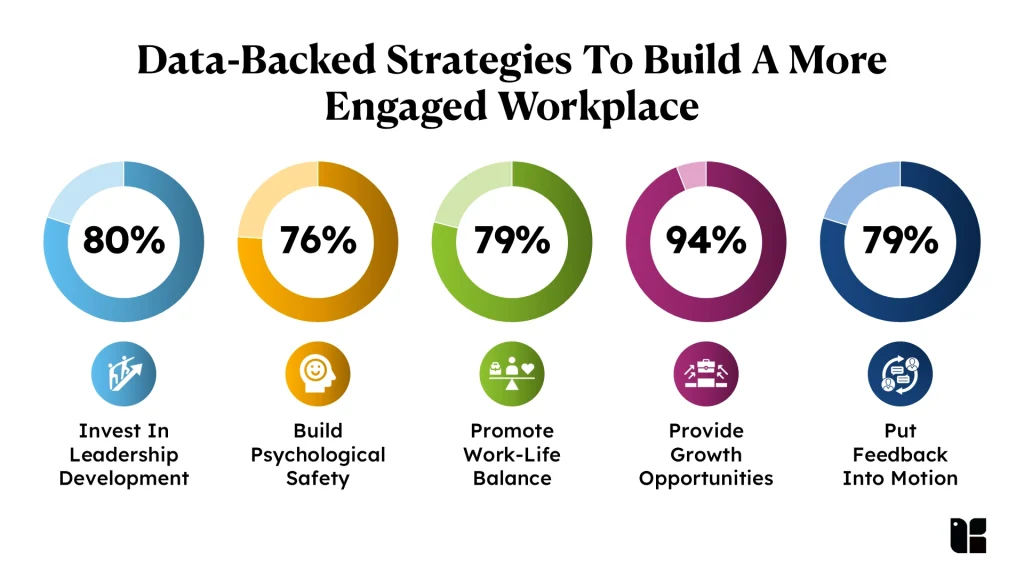
Invest In Leadership Development
Companies that invest in employee experience and give space for employee voice build a highly engaged workforce that thrives in various sectors.
- Leadership development programs that align with business goals have an 80% higher success rate, leading to more effective leaders who drive engagement.
- Employees are 1.7 times more likely to be fully engaged when their leaders excel at developing people.
Build Psychological Safety
Creating a safe environment where employees can take risks, admit mistakes, and share ideas without fear of backlash promotes open communication and drives innovation.
- 76% more engagement and 27% lower turnover risk are seen in teams with high psychological safety. This shows how feeling safe directly impacts employee engagement and retention.
- Employees who feel psychologically safe are 10 times less likely to describe their workplace as toxic compared to those with low psychological safety. A healthy, non-toxic environment is key to long-term engagement.
Promote Work-Life Integration
A healthy work life balance and opportunities for a better work life balance are top employee expectations, especially among younger workers, remote employees, and frontline workers.
- 67% of employees with access to flexible work options are more engaged. A focus on well-being and work-life balance boosts motivation and productivity.
- 79% of employees globally report chronic workplace stress as a major issue, and 57% experience negative effects due to work-related stress, often leading to burnout and disengagement.
Provide Growth Opportunities
Invest in your employees’ growth by offering learning opportunities and career advancement paths. This shows you’re committed to their future and keeps them engaged.
- 94% of employees would stay longer at a company that invests in their career development. Continuous learning and growth increase engagement and retention.
- 68% of employees say their engagement is influenced by opportunities for career advancement through learning programs.
Put Feedback Into Motion
Give employees autonomy, delegate responsibility, and actively listen to their feedback. This makes them feel valued and boosts their engagement.
- Companies that seek regular feedback have 14.9% lower turnover rates than those that don’t.
- Employees with more autonomy report 79% higher engagement, showing a strong link between having control over their work and staying motivated.
Improving employee engagement not only boosts employee morale but also ensures that employees feel motivated, whether they are remote workers or in-office, and when most employees are actively engaged.
Conclusion
Employee engagement grows through consistent leadership choices, the kind made in everyday conversations, feedback, and decisions. Small moments shape trust. Ongoing behaviours influence how supported and connected people feel. Over time, these actions set the tone for how teams show up and work together. Research in the Harvard Business Review shows that employees agree that organisations with a positive work culture see stronger team engagement across the global workforce. Whether you’re managing a small team or guiding an entire organisation, the opportunity is to create an environment where people feel motivated to contribute and grow.
If you want your leadership to inspire commitment instead of compliance, Kapable’s suitability guide can help you decide whether the program fits your goals.


