


TL;DR
- Visionary Guidance: Change leadership is the essential skill of guiding people through transitions by creating a clear purpose, inspiring belief, and building organisational alignment, distinct from mere process management.
- The Misalignment Gap: Transformation failure is primarily driven by internal breakdowns like poor communication skills, a lack of shared vision across teams, and the absence of structured digital support for change programs.
- Burnout & Resistance Cycle: Continuous, unsupported change creates a heavy emotional toll, resulting in high burnout rates for leaders and a deep, productivity-sapping fatigue and resistance among employees.
- Actionable Momentum: Successful leaders drive change by embracing vulnerability, clarifying the “why,” empowering influential team members, and strategically securing and celebrating short-term, visible progress.
Change is constant, but leading it well is not guaranteed. As organisations face growing pressure to adapt to technological shifts, economic uncertainty, and evolving global workforce expectations, the success of change efforts often relies on senior leadership positions. KPMG’s Global Transformation Study found that 96% of organisations are in some transformation phase, yet many still struggle to make those changes stick. This blog shares key statistics that reveal the challenges and opportunities leaders face, from failure rates and resistance to emotional strain. The goal is to help leaders turn disruption into lasting, confident progress.
What Is Change Leadership?
Change leadership is the ability to guide individuals, teams, aspiring future leaders and entire organisations through transitions, whether strategic, structural, cultural, or technological. While change management focuses on implementing processes and systems, change leadership is about setting a clear vision, inspiring people to accept change, and aligning efforts across the organisation.
Good change leaders know how to deal with uncertainty, listen to concerns, and build trust during times of transition. In a world where everything’s moving fast, this skill is more important than ever. Research shows a significant gap, that over 79.7% of organisations need to revamp their business strategies every 2 to 5 years just to stay competitive. As markets shift, customer needs evolve, and new technologies emerge, effective change leadership helps organisations stay ahead by energising people, managing resistance, and driving momentum toward the future. Now that we understand change leadership, let’s look at the key factors that drive successful change.

What Are The Key Factors That Impact Successful Change?
Successful change depends on how ideas are led, supported, and executed. Research highlights four critical factors that can make or break a change effort:
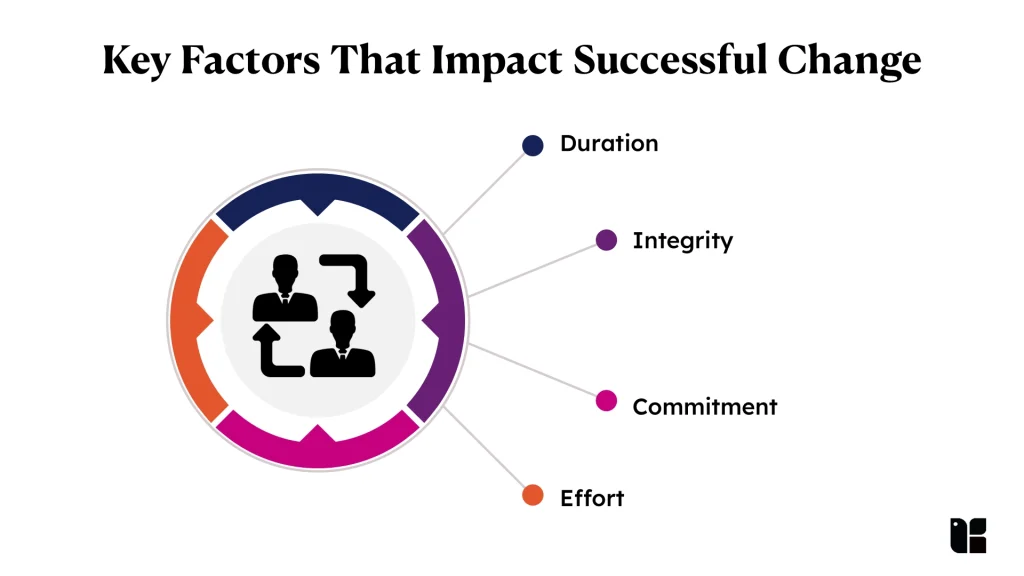
- Duration: Change efforts are more successful when they are reviewed regularly, even if they take longer to complete. Regular check-ins keep progress on track and allow for timely adjustments.
- Integrity: Choosing the right team leaders is essential. Leaders must be trustworthy and clearly communicate about team roles and responsibilities to build confidence and transparency across the organisation.
- Commitment: Lasting change requires visible support from senior leaders and genuine investment in employees. When leadership shows they’re invested, it encourages teams to do the same.
- Effort: Change should not overwhelm staff. Adding more than 10% to their normal workload can result in resistance and burnout. Set realistic expectations and plan carefully to avoid fatigue.
While these factors influence the success of change, it’s equally important to understand what triggers the need for change leadership in the first place.
What Are The Main Causes That Lead To Change In Business Leadership?
Change leadership is often a strategic response to specific challenges. Identifying these causes early can help organisations lead with intention rather than react out of urgency.
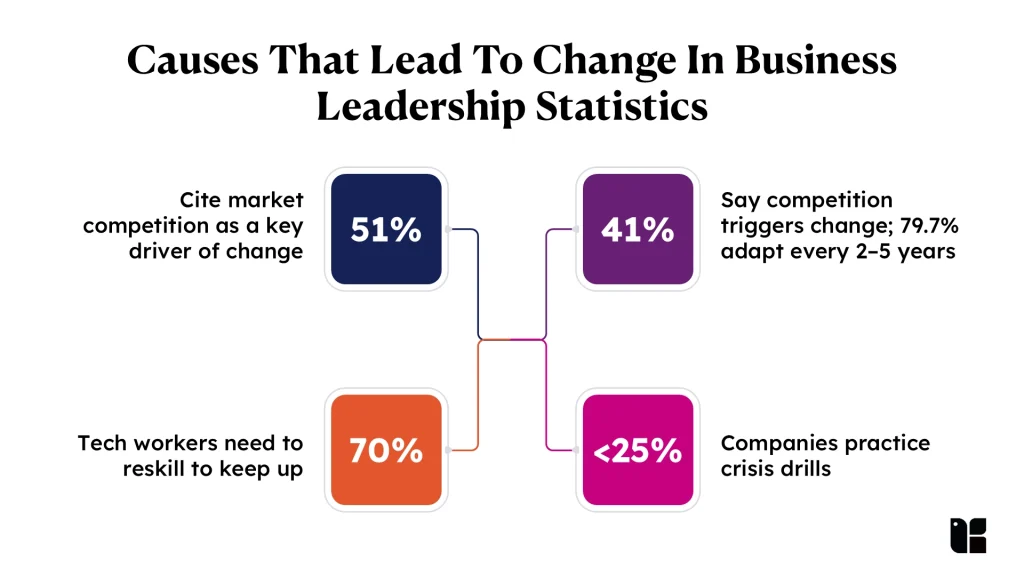
- Market shifts: According to research by principal analyst Brian Solis, 51% of survey respondents cite market competition and growth opportunities as major triggers for organisational change. The push to innovate and differentiate in a crowded marketplace compels businesses to evolve continuously.
- Rising competition: 41% of participants identify competitive pressure as the leading reason for initiating change. In dynamic markets where new startups regularly emerge, 79.7% of organisations report the need to adapt every two to five years just to remain competitive in markets where new startups are constantly emerging.
- Digital shifts: Technology remains a dominant force behind change. Yet, while innovation moves rapidly, organisations often struggle to keep pace. To avoid disruption, businesses must proactively upskill their workforce, communicate updates clearly, and support employees throughout transitions to maintain performance and morale. Around 70% of technology workers report that they need to reskill to keep pace with technological change
- Crisis response: Crises, whether economic, operational, or reputational, require swift and strategic responses. Less than 25% of companies practice crisis plans and conduct active drills. While company leaders focus on crafting and implementing solutions, it’s equally important to consider employees’ experience of the change. Acknowledging their concerns, involving them in the process, and reinforcing their value helps ensure alignment and resilience during uncertain times.
While understanding the causes sets the stage, the next section shows how organisations can turn those changes into meaningful outcomes.
Why Most Change Efforts Don’t Deliver What Leaders Expect?
Despite the effort and investment organisations put into change initiatives, most still fail to deliver the results leaders expect, making success the exception rather than the norm.
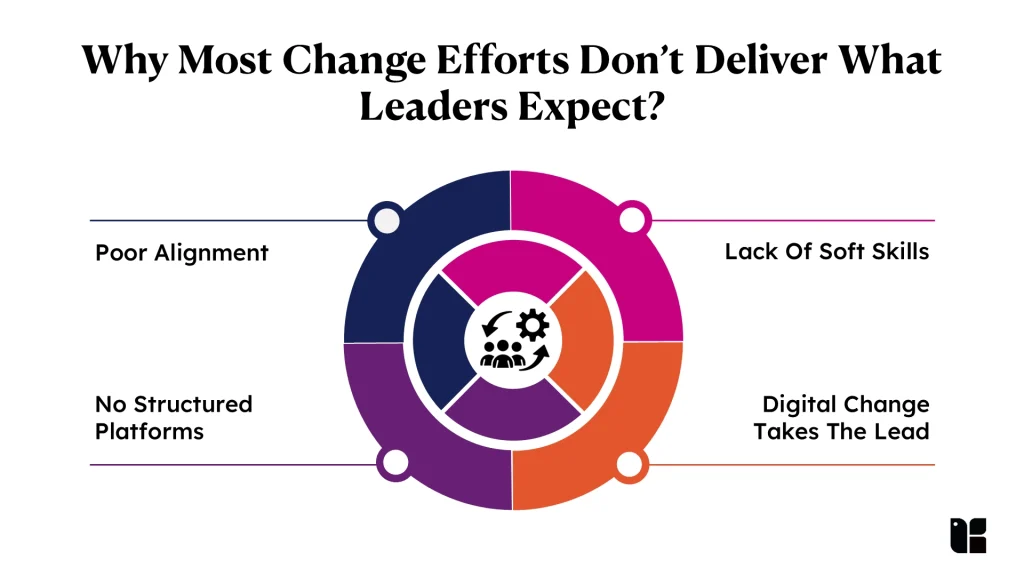
- Poor alignment: A major factor behind the failure of many change initiatives is poor alignment between leadership development and teams on goals and responsibilities. Prosci’s research indicates that organisations lacking alignment are significantly less likely to meet their change objectives. Without a shared vision and clear priorities, efforts become fragmented, causing confusion and resistance that slow down progress.
- No structured platforms: Many change programs struggle without the support of digital tools or structured platforms that facilitate clear communication, track progress, and enable timely feedback. A report that organisations adopting formal change management technology experience up to a 25% higher success rate. Companies using structured change management approaches outperform those without by a wide margin, reducing chaos and enabling faster decision-making.
- Lack of soft skills: Effective change leadership skills go beyond technology and processes. Over 70% of change failures stem from poor communication and low employee engagement. Emphasises that strong articulation and collaboration skills among leaders are critical to building trust, aligning teams, and clearly communicating expectations, factors that greatly increase the likelihood of successful transformation. Such leadership gaps also lead to a surge in the corporate leadership training market focused on emotional intelligence and leading through change.
- Digital change takes the lead: The future of change leadership is shifting toward digitally driven transformation. Bain & Company predicts rapid growth in the digital transformation market, pushing more companies to invest in structured change management platforms. Organisations that adopt digital tools for change management report a 22% increase in initiative success rates, proving the value of tech-enabled change strategies.
While strong systems and strategies matter, the upcoming section highlights how leadership ultimately fails with poor communication skills.
Learn more about Kapable’s approach to helping leaders turn change initiatives into lasting outcomes through stronger communication, team alignment, and practical leadership development.
Why Does the Change Initiative Fail?
Renowned change expert John Kotter emphasises the need for a dual-front communication approach – one that not only details the what and how of change but also continually reinforces the why.
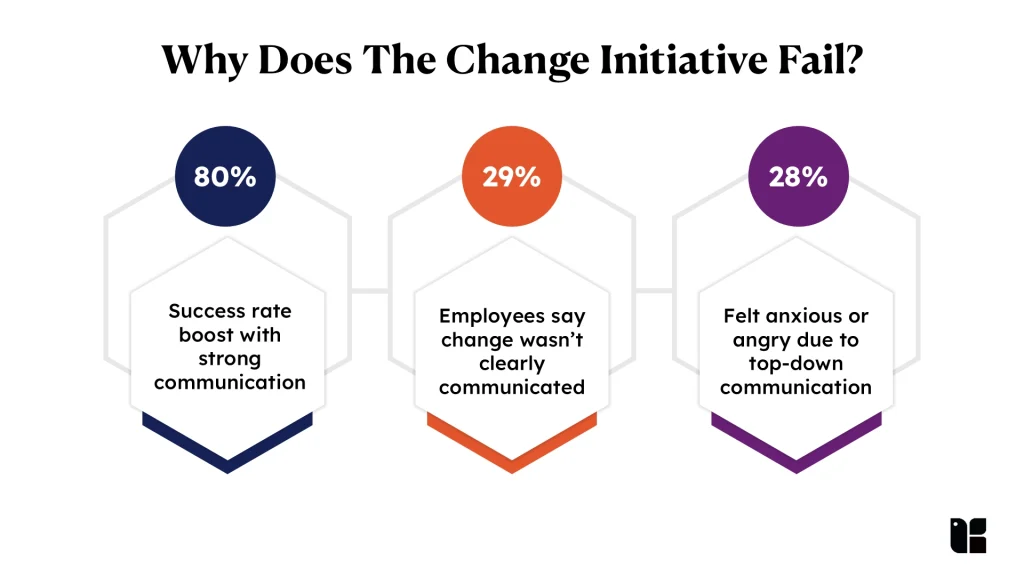
- Clear and consistent communication is one of the strongest predictors of successful change. A Harvard Business Review article found that organisations with well-managed, ongoing communication efforts saw their change success rates improve by up to 80%.
- Unclear or insufficient communication often breeds confusion and resistance. 29% of employees report that change was not communicated clearly in their organisation, and another 28% said they didn’t receive enough information to understand the change.
- Moreover, when communication is strictly top-down, it can trigger emotional resistance – 28% of employees admitted to feeling anxious or angry due to such communication styles (CEB Corporate Leadership Council). These insights underline the importance of making communication a two-way, empathetic, and purpose-driven process.
These repeated failures in major change initiatives often take a toll on those in senior management positions, leading to rising burnout rates. which would be explored in the next section.
“Kapable has helped me transform my communication skills, enabling me to speak with clarity and assertiveness. I can now handle team dynamics effectively and confidently team members which is a significant improvement from where I started.”
– Shyam Sundar AM (Team Lead At TCS)
What Do Statistics Reveal About Change Leadership Burnout?
Leading change in organisations is demanding, and burnout among leaders is a growing concern that impacts the success of transformation efforts. Here are some key statistics highlighting this challenge:
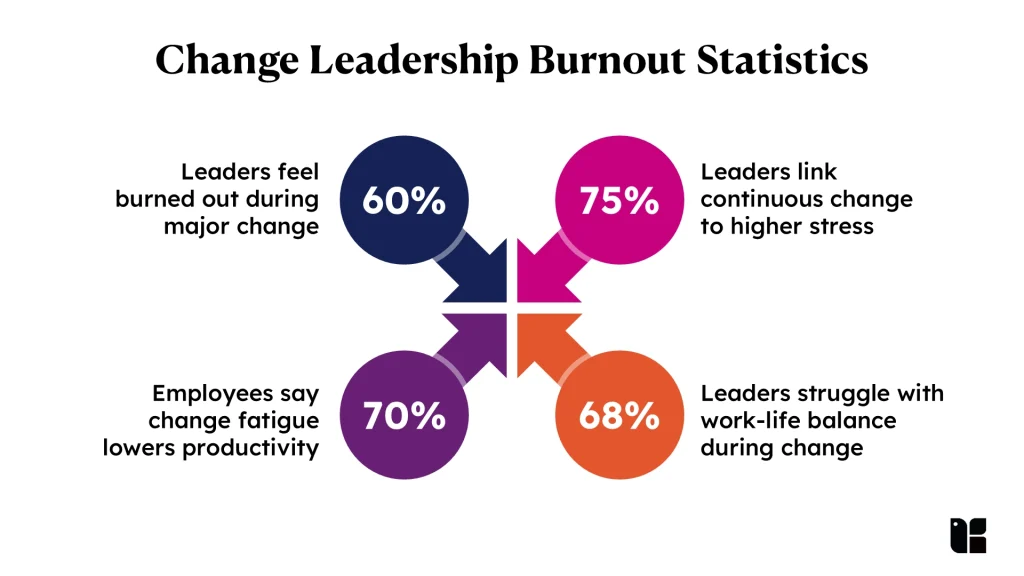
- 60% of leaders report feeling burned out during major organisational change. This burnout reduces their ability to make clear decisions and lead teams effectively.
- 70% of employees say change fatigue reduces productivity and engagement. As a result, overall team performance and morale drop significantly during change.
- 75% of leaders feel that continuous change without proper support increases stress. This stress leads to decreased innovation and higher absenteeism among leaders.
- 68% of leaders admit they struggle to maintain work-life balance during transformational change. This imbalance contributes to long-term health issues and decreased job satisfaction.
While it highlights the pressure senior leaders face during major change initiatives, analysing change management statistics can provide valuable insights to help business leaders design more effective change processes and achieve successful change.
How Can Change Management Statistics Drive Success?
Change fails not from poor planning but from lack of leadership presence. When pressure is high, it’s how leaders respond that makes the difference. Here’s what the most effective ones do to make it work.
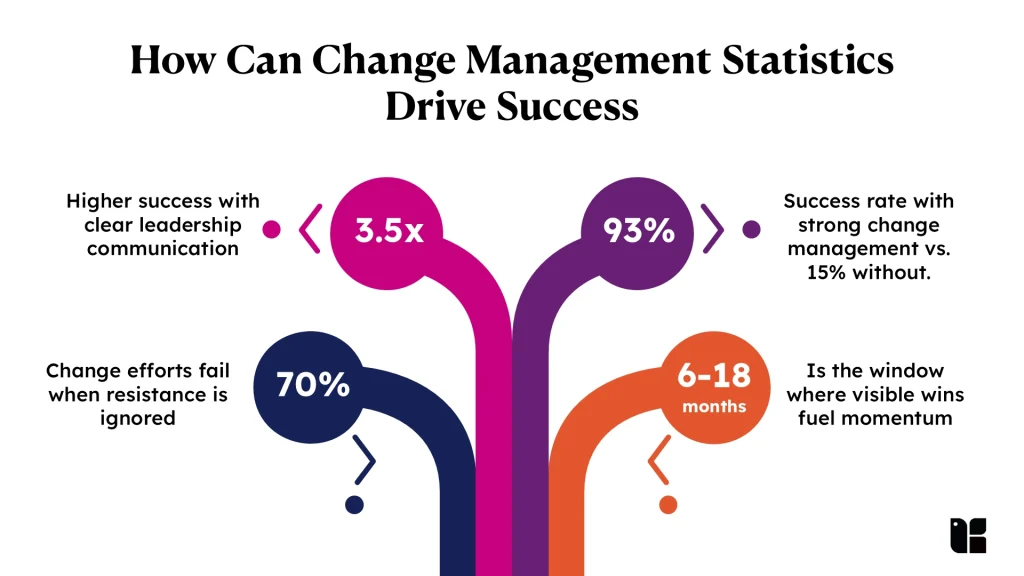
- Acknowledge the tension: Change brings uncertainty, and when leaders stay silent, it creates space for doubt and disengagement. According to McKinsey, 70% of change efforts fail, often because employee resistance is left unaddressed. Strong leaders address the discomfort early. Naming what’s difficult helps reduce emotional friction and builds credibility. Even a simple, honest line like “I know this isn’t easy” helps teams feel seen and supported.
- Communicate with clarity: In high-pressure transitions, people don’t need constant noise; they need focused, honest information. Change efforts are 3.5 times more likely to succeed when leaders clearly articulate the purpose and path of the transformation. This directly contributes to revenue growth through faster alignment and execution. Effective leaders simplify their message: what’s happening, what it means, and what’s still in motion. They resist the urge to sugarcoat or overpromise. This kind of transparent communication earns respect and gives teams something solid to hold onto, even if everything else is shifting.
- Activate trusted voices: People rarely buy into change because a senior management said so. Prosci research shows that projects with effective change management met or exceeded objectives 93% of the time, compared to just 15% of projects with poor change management. They buy in because someone they trust believes in it. That’s why the most effective change leaders involve informal influencers early. When they understand the change and support it, they become powerful multipliers, translating strategy into everyday language and behaviour across the organisation.
- Demonstrate visible progress: Change feels real when people can see it. John Kotter emphasises that short‑term wins, visible within 6-18 months, are essential because they validate the effort, reinforce urgency, and boost commitment. Small visible actions like a new workflow being tested or an early win shared build momentum and trust. Effective leaders focus on movement, not perfection, to show that change is already in motion.
Now that we understand when and how change truly gains momentum, it’s important to recognise the common obstacles that can slow this process.
What Are The Common Challenges Faced During Change Initiatives?
Change is hard, and many organisations run into common pitfalls that make it even harder to manage successfully.
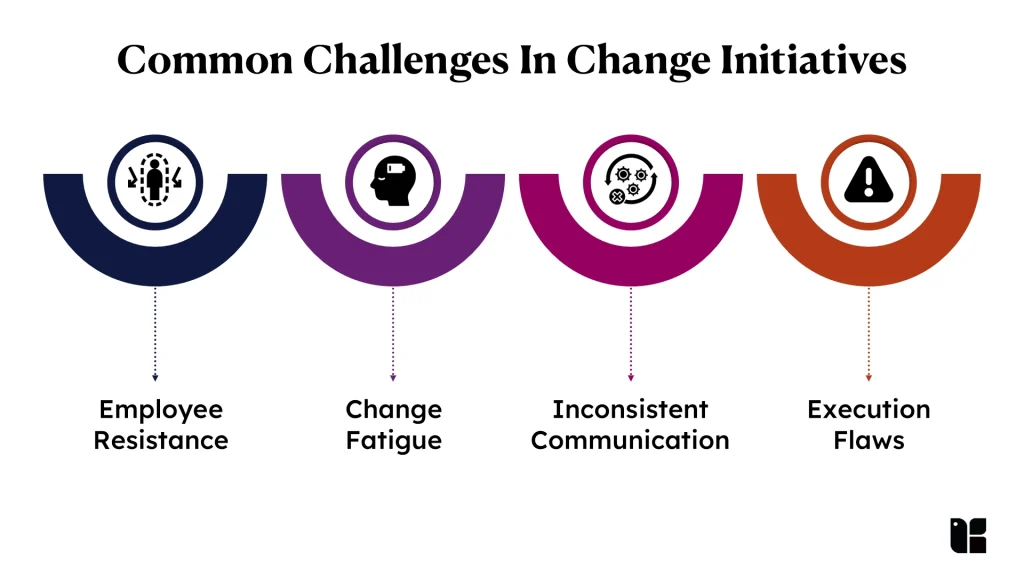
Employee Resistance
Employee resistance remains one of the most significant barriers to successful change management. Resistance often comes from fear, uncertainty, and mistrust, especially when change is poorly explained or implemented without involvement. Thus, change resistance often builds quietly before it’s ever voiced.
- 41% of employees resist change due to mistrust in the organisation, followed by lack of awareness (39%), fear of the unknown (38%), job role changes (27%), and being excluded from decisions (23%). (Oak Engage)
- 70% of transformation initiatives fail, with employee resistance among the top contributing factors. (McKinsey & Company)
- 60% of failed projects cite unmanaged resistance as the root cause. (Prosci)
Change Fatigue
Employees expect constant change, but when it’s frequent or poorly managed, it can lead to disengagement, burnout, and a lack of enthusiasm for future initiatives.
- 71% of employees feel overwhelmed when too many changes happen in quick succession. (Gartner)
- Companies dealing with high levels of change fatigue are 50% less likely to achieve their intended transformation outcomes compared to those that actively manage change capacity and employee adaptability.
- 64% or nearly two-thirds of professionals feel tired and mentally fatigued due to ongoing changes at work. (LinkedIn)
Inconsistent Communication
Lack of clear, timely, and transparent communication leads to uncertainty, fuels rumours, and creates room for resistance and fear.
- Organisations with effective communication are 3.5 times more likely to outperform their peers. (Gallup)
- 29% of employees say that organisational changes are poorly communicated, resulting in confusion and uncertainty around transitions (Oak Engage)
- Change efforts with effective communication are 5 times more likely to succeed compared to poorly communicated initiatives, which makes communication a decisive factor in change success.
Execution Flaws
Change management demands clear direction, leadership diversity, and meticulous planning. Without these, even the best ideas can falter.
- 70% of change initiatives fail due to poor leadership styles and a lack of strategic oversight. (McKinsey & Company)
- Only 34% of change initiatives succeed. This highlights the urgent need for structured planning and consistent leadership to drive real results. (Gartner)
- Initiatives with clear objectives and benchmarks are 30% more likely to succeed. (Bain & Company)
- 50% of digital transformation projects stall due to poorly defined objectives and insufficient stakeholder buy-in. (Gartner).
Understanding the common challenges organisations face during change highlights the need for clear, focused strategies to overcome resistance and drive successful transformation.
How Can Leaders Effectively Drive The Change Management Process?
Leading change successfully requires practical, focused actions that engage employees and maintain steady progress. These ways address real challenges, helping leaders drive transformation in the following ways:
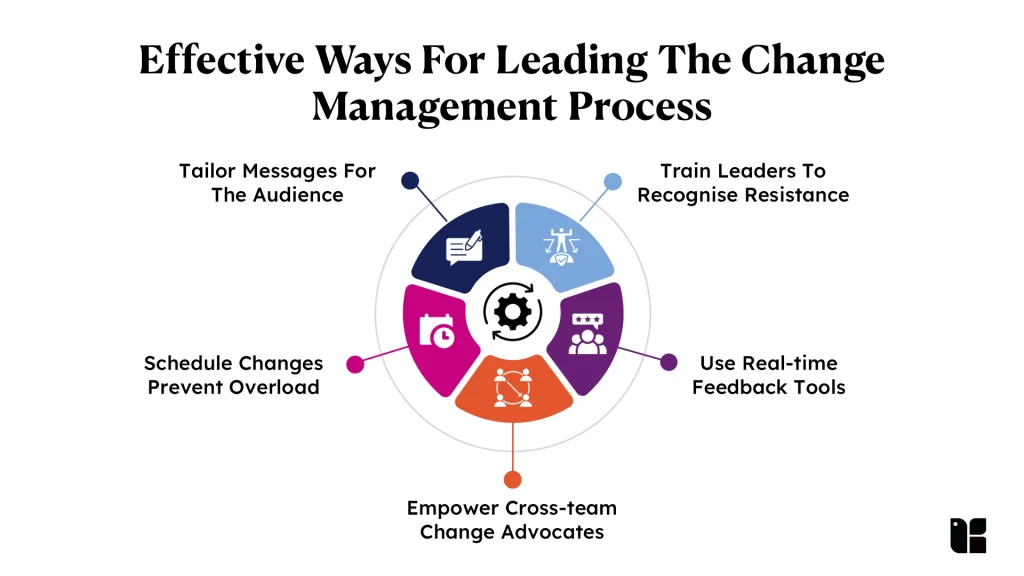
- Tailor messages for the audience: Analyse employee groups to understand their concerns and motivations. Use surveys or focus groups to gather insights and create targeted communications that connect with each group. This personalised approach increases engagement by addressing specific fears and expectations directly.
- Schedule changes prevent overload: Plan change initiatives with proper spacing to avoid rushing or overlapping. Use a quarterly change calendar and coordinate with leaders to balance workloads and reduce burnout. Spacing changes thoughtfully help maintain energy levels and keep momentum steady throughout the transformation.
- Empower cross-team change advocates: Identify respected individuals from different departments to act as change advocates. Provide training on goals and hold regular meetings for feedback and support. These advocates build peer trust and encourage positive attitudes, making adoption smoother and faster.
- Use real-time feedback tools: Gather employee input frequently using quick surveys or chatbots. Review feedback weekly and adjust communications or plans accordingly to address concerns early. This ongoing dialogue fosters transparency and shows employees that their voices matter in shaping the change.
- Train leaders to recognise resistance: Help managers spot subtle signs of resistance, like low engagement or morale dips. Provide training on emotional intelligence and encourage regular one-on-one conversations with team members. Early detection allows leaders to resolve issues proactively before they impact overall progress.
These are not just one-time steps. They help teams understand and adapt to change better. When practised consistently, they build trust and keep momentum going.
Leaders who want to strengthen change communication, manage resistance, and keep teams aligned can explore Kapable’s suitability guide to see whether the program matches their goals.
Conclusion
A leader who creates clarity, earns trust, and keeps people aligned through uncertainty is at the heart of every successful transformation. The data is clear, and what drives real progress is not a strategy or system but visible, grounded, and consistent leadership. When leaders communicate with purpose, involve people in the journey, and stay present through resistance, change becomes more than an initiative; it becomes culture. Sustainable change grows from leadership that listens, adapts, and leads by example. When people see their leaders engaging with honesty, owning the hard parts, and celebrating the small wins, they’re far more likely to commit, even when the path is tough.


