


TL;DR
- Cultivating Positive Interactions: Relationship management in the workplace is the conscious effort to interact effectively with colleagues, creating a positive atmosphere for collaboration and productivity, which is fundamentally supported by high emotional intelligence.
- EI as the Relationship Foundation: Emotional Intelligence is the fundamental skill that allows for the effective practice of relationship management, allowing team members to understand emotions, build trust through empathy, and constructively handle conflict.
- Actionable Skill Development: These skills can be intentionally developed through practical strategies like practising active listening to truly value input, using assertive communication for respectful dialogue, embracing empathy, and giving and receiving constructive feedback.
- Value in Real-World Scenarios: Applying emotionally intelligent relationship management techniques, such as acknowledging frustration with a client or approaching a difficult negotiation with social awareness, leads to improved outcomes, stronger professional bonds, and greater personal satisfaction.
Did you know that having a close friend at work makes you seven times more engaged in your job? This study by Gallup gives us an understanding that building strong relationships at work isn’t just about feeling good; it’s crucial for success! Navigating office dynamics can feel challenging and delicate. But what if there’s a key skill that could help you build trust, collaborate better, and create a positive work environment?
In this blog, we’ll explore how mastering relationship management, supported by emotional intelligence, can transform your interactions at work. Get ready to learn how to build stronger, more fulfilling relationships and enhance your success and satisfaction in your career!
What Is Relationship Management?
In the workplace, relationship management refers to how people interact with each other to get work done smoothly. It involves things like how well team members communicate, listen to each other’s ideas, and handle disagreements respectfully. For instance, picture a team where everyone feels comfortable sharing their thoughts, actively listens to others, and works together to solve problems. This kind of positive interaction creates a supportive atmosphere where ideas flow freely, boosting creativity and productivity.
However, building strong relationships requires effort and intentionality. It involves actively listening to colleagues, providing and receiving constructive feedback, and celebrating successes (both big and small). This is where emotional intelligence comes into play.
Emotional intelligence plays a crucial role in relationship management. It helps people understand their own emotions and those of others better. This understanding allows them to build trust by showing empathy and handling conflicts in a constructive way. When team members have high emotional intelligence, they can foster stronger bonds and work more effectively together, even in challenging situations. Developing emotional intelligence is key to improving relationship management skills, making work interactions more enjoyable and productive for everyone involved.
Let’s understand the concept of emotional intelligence in terms of relationship management, providing practical strategies to develop these skills.

How Does EI Play A Role In Relationship Management?
Have you ever seen a coworker effortlessly handle a tense conversation, calm tempers or prevent arguments? Or perhaps you’ve experienced the opposite, have you experienced a minor disagreement turn into a big fight? The key to these contrasting situations often lies in a powerful skill set we don’t always talk about: Emotional Intelligence.
Emotional Intelligence is the ability to manage and control your own emotions, and to recognise, as well as perceive and respond effectively to the emotions of others. Think of it as the unspoken language that shapes our interactions and relationships at work. It’s the subtle yet powerful factor that supports our interactions, shaping the quality of our relationships and teamwork. Here’s how emotional intelligence works:
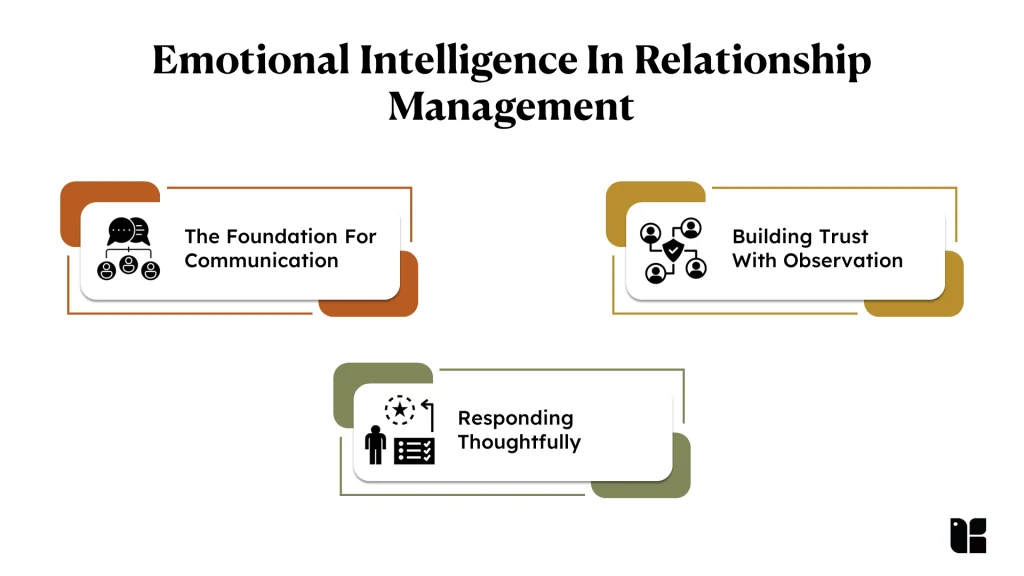
The Foundation For Communication
When you understand and manage your own thoughts effectively, you can communicate with clarity and purpose. For instance, when discussing a sensitive topic, EI helps you recognise and control your emotional triggers, allowing you to articulate your points calmly and effectively. This reduces misunderstandings and fosters a collaborative environment. Practically, using EI in communication means being aware of your tone, body language, and the emotional climate of the conversation. This heightened self-awareness helps you respond in a way that builds rapport rather than creating friction.
Responding Thoughtfully
With EI, you’re better prepared to assess the emotional state around you and adjust your responses accordingly. This means pausing to consider the other person’s feelings before reacting, which can transform a potential conflict into an opportunity for understanding. For example, if a colleague reacts defensively, instead of firing back, an emotionally intelligent response involves acknowledging their perspective and addressing their concerns calmly. This thoughtful approach not only calms down tension but also demonstrates empathy and respect, leading to smoother interactions.
Building Trust With Observation
Social awareness skills allow you to “read the room” at work. Trust is built on the small, often unspoken signals we send and receive. With high EI, you become skilled at picking up on these subtle cues, like noticing when someone’s body language suggests discomfort or when their tone indicates enthusiasm. This keen observation allows you to respond in ways that are both supportive and reassuring. For instance, if you notice a friend seems off during a conversation, using EI to address it sensitively can show that you’re attentive and care about their well-being.
Let’s learn some actionable strategies to enhance your emotional intelligence, fostering stronger workplace relationships in the process.
Effective relationship management is developed through continuous learning rather than experience alone, and Kapable helps leaders build stronger interpersonal skills that improve workplace collaboration.
What Are Some Strategies To Build Workplace Connections?
Emotional intelligence can be developed just like any other skill. Here are some practical strategies to improve your relationship management at work using emotional intelligence:

Practise Active Listening
Active listening means more than just hearing words. In public or group settings, maintain eye contact, nod to show understanding, and use verbal acknowledgements like “I see what you’re saying” or “That makes sense.” During meetings, summarise key points to confirm your understanding and ask clarifying follow-up questions. This approach helps build trust and shows that you genuinely value others’ input.
Use Assertive Communication
Assertive communication involves expressing yourself clearly and respectfully. Use direct but polite language. Instead of saying “Maybe we should,” try “I believe we should.” If you need to provide feedback, focus on specific actions and suggest improvements, like saying “Instead of doing X, I recommend doing Y to improve the outcome.” This helps in maintaining a respectful and productive dialogue.
Embrace Empathy
Show empathy by considering other people’s perspectives and challenges. In public situations, observe nonverbal cues like facial expressions and body language to assess how someone might be feeling. If you notice a colleague looking stressed or overwhelmed, acknowledge their situation and offer assistance. For example, you might say, “I noticed you’ve been handling a lot lately. Can I help with any tasks or support you in any way?” This fosters a sense of connection and allows you to tailor your communication and approach accordingly.
Provide And Receive Feedback
Constructive feedback should be specific and actionable. When giving feedback in a public or group setting, focus on behaviours and offer clear suggestions for improvement. For example, “In the last project, the report was missing some details. For future reports, make sure to include them.” When receiving feedback, listen openly, ask for examples if needed, and express gratitude. This helps you use feedback to enhance your skills and strengthen working relationships.
Celebrate Successes
In public settings, highlight individual or team successes by mentioning specific contributions or accomplishments. Acknowledge and celebrate the achievements of your colleagues, both individually and as a team. This fosters a sense of camaraderie, motivates everyone to do their best work, and builds a more positive and collaborative work environment. Recognising efforts publicly motivates and encourages continued excellence.
Remember that building long-lasting relationships takes time and effort. By consistently applying these strategies and leveraging the power of emotional intelligence, you can develop meaningful connections with colleagues, leading to a more fulfilling and successful work experience.
Which Tips Enhance Relationship Management In The Workplace?
Here are also some more tips you can use in your everyday interactions to build connections at the workplace:
- Mirror their energy: Subtly match the energy level of your colleagues. If someone seems stressed, speak in a calmer tone, and if they’re excited, share their enthusiasm.
- Start with small talk (Strategically): Don’t underestimate the power of casual conversation. Ask about their weekend, a recent project, or a shared interest. This builds rapport and allows you to connect on a more personal level.
- Use positive reinforcement: Catch colleagues doing something right, big or small. A simple “Thanks for stepping up on that project” or “Great idea in the meeting today” can make a big difference.
- Offer help without being asked: Is someone swamped with work? Offer to take on a small task or help them prioritise. This demonstrates empathy and builds trust.
- The power of appreciation: Handwritten thank-you notes for a colleague’s help or a genuine compliment on a job well done are often underutilised but leave a lasting positive impression.
- Use technology for connection: In today’s hybrid work environment, maintaining good connections can be a challenge. Utilise technology to your advantage. Send a quick video message offering encouragement or praise. Set up virtual coffee chats for informal catch-ups. These small gestures can go a long way in building and maintaining strong relationships despite physical distance.
These practices are just a starting point. By consistently practising these strategies, you can create a network of strong relationships at work, leading to a more fulfilling and successful career. Let’s see how these strategies translate into real-life situations.
How Can Relationship Management Be Applied At Work?
Recent studies have revealed compelling statistical evidence that when analysed together, these two factors, relationship management with emotional intelligence, emerge as strong predictors of organisational commitment. Let’s see these concepts in action! Here are some workplace scenarios where applying emotional intelligence in relationship management strategies can make a big difference:
The Client Who Felt Unheard
Let’s take an example from the service industry:
- Scenario: A customer service representative (CSR) is dealing with a frustrated client who feels their concerns haven’t been addressed.
- Emotional intelligence in action: The CSR practises active listening, acknowledging the client’s frustration (“I understand you’re feeling frustrated, and I apologise for the inconvenience”). They show empathy by summarising the situation and using “I” statements (“I hear that you haven’t received a response yet”). The CSR then works collaboratively with the client to find a solution, offering options and keeping them updated on the progress.
- Improved outcome: The client feels heard and valued. They are more receptive to a solution, and their frustration subsides. This builds trust and strengthens the customer relationship.
The Tense Negotiation
Let’s take an example of a business deal in process:
- Scenario: Two business partners are negotiating a contract renewal, and tensions are high due to differing priorities.
- Emotional intelligence in action: Business partners can use their social intelligence to read each other’s nonverbal cues and understand unspoken concerns. By practising effective persuasion and negotiation techniques, such as finding common ground and building rapport, they can bridge gaps and build consensus.
- Improved outcome: The partners reach a mutually beneficial agreement that addresses both sides’ needs. The negotiation strengthens their working relationship and fosters trust for future collaborations.
The Disengaged Employee
Let’s take an example about workplace management:
- Scenario: A manager notices a usually enthusiastic employee become withdrawn and less productive.
- Emotional intelligence in action: The manager schedules a private meeting and uses emotional intelligence to approach the situation. A manager can first approach the employee with empathy and understanding, acknowledging the change in behaviour without judgement. Finally, using assertive communication, the manager can work collaboratively with the employee to develop solutions that address their needs.
- Improved outcome: The manager offers flexible work arrangements or resources to help the employee. The employee regains motivation and their productivity improves. The relationship between the manager and employee strengthens due to the open communication and support.
These are just a few examples of how emotional intelligence can be used to navigate challenging situations in relationship management and achieve positive outcomes. By understanding and managing emotions, you can build stronger connections, foster trust, and create more positive and productive conversations to manage interactions successfully.
Conclusion
It becomes clear that relationship management skills are not just about managing work relationships, they’re about appreciating meaningful connections and personal goals. By nurturing empathy, active listening, and assertive communication, we foster environments where trust and collaboration flourish. These skills empower us to handle challenges with grace and develop positive relationships. Ultimately, investing in emotional intelligence enriches both our professional relationships and our personal satisfaction.
Start incorporating the strategies mentioned throughout this blog into your daily interactions. Watch as your communication improves, misunderstandings decrease, and your network of strong workplace relationships flourishes. After all, strong connections are the foundation for a thriving and enjoyable work life.
If improving relationship management has become essential to your leadership growth, Kapable helps you decide whether its approach aligns with the way you want to develop.
“Kapable has helped me transform my communication skills, enabling me to speak with clarity and assertiveness. I can now handle team dynamics effectively and confidently team members which is a significant improvement from where I started.”
– Shyam Sundar AM (Team Lead At TCS)


