
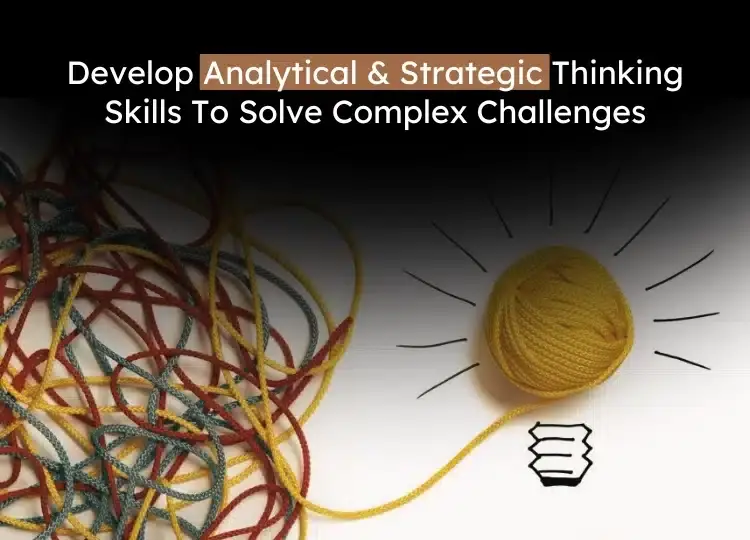

TL;DR
- Analytical vs. Strategic Focus: Analytical thinking systematically breaks down complex issues to find logical, evidence-based solutions in the moment, whereas strategic thinking looks ahead to align resources and actions with long-term goals and anticipate future challenges.
- Interconnected Problem Solving: While both skills use logic to solve problems and evaluate options, analytical thinking is reactive, focused on fixing the immediate issue, while strategic thinking is proactive, designing long-term systems to prevent future problems.
- Leadership’s Core Radar: In leadership, these skills combine to turn chaos into clarity by enabling composed, informed decision-making, spotting critical trends before they become issues, and aligning team efforts with a competitive, forward-looking vision.
- Practical Skill Development: Strengthening these abilities requires overcoming cognitive biases and information overload by employing structured methods like Root Cause Analysis (asking “Why?”) to find a problem’s origin and the continuous improvement of the PDCA Cycle.
How often do you pause to analyse before you act? Taking a moment to assess situations can significantly impact decision-making. Strong decision-making isn’t about luck but about having sharp analytical and strategic thinking skills to evaluate options and plan ahead. These skills are crucial for solving problems, leading teams, and achieving goals. This blog will guide you through understanding these skills, their role in success, and practical ways to strengthen them.
What Are Analytical Thinking Skills?
Analytical thinking is the process of systematically examining information, identifying patterns, and finding logical solutions to challenges. It combines observation, reasoning, and evidence-based decision-making. This skill enables individuals to dissect complex situations, uncover relationships, and make informed, rational decisions.
This ability is invaluable in various settings, from everyday problem-solving to high-stakes strategic planning. By breaking down intricate challenges into smaller, more manageable parts, analytical thinking promotes clarity and precision. It also stimulates innovation by encouraging individuals to consider diverse perspectives and explore creative solutions.
Core Elements Of Analytical Thinking
The core elements can empower individuals and organisations to approach challenges with clarity and precision, which are as follows:

- Observation with critical insight: Analytical thinkers excel at gathering and interpreting details. They pay close attention to trends and information to connect the dots and uncover underlying patterns.
- Effective problem resolution: Tackling challenges involves identifying the problem, brainstorming multiple solutions, and predicting their outcomes. Problem-solving reflects a structured, creative, and rational approach to overcoming obstacles.
- Structured logical reasoning: Logical reasoning is the foundation of analytical thinking. It involves identifying patterns and establishing cause-and-effect relationships by following objective evidence rather than assumption or emotion.
- Interpreting data: Data analysis is about organising and interpreting information to identify trends or patterns. Analytical thinkers sift through raw information, assess its meaning, and draw actionable insights.
- Strategic decision-making: This is the ability to weigh different options by assessing risks, benefits, and probabilities. Strategic decision-making relies on evidence and thorough analysis to determine the best course of action.
- Identifying trends: Analytical thinkers recognise sequences and patterns within data or events, allowing them to make predictions or detect underlying causes driving certain trends.
- Detail orientation: A key trait of analytical thinking is precision. Paying attention to small details ensures that no critical piece of information is overlooked, leading to better problem-solving.

What Are Strategic Thinking Skills?
Strategic thinking involves planning with foresight, envisioning future goals, and anticipating challenges. It is about aligning vision, action, and resources to achieve long-term goals and build competitive advantages while adapting to change.
Strategic thinking empowers individuals to see the bigger picture while managing the finer details. It requires balancing immediate needs with future aspirations, ensuring decisions align with overarching objectives. This skill fosters adaptability, encourages proactive responses to evolving circumstances, and helps in identifying opportunities for growth and innovation amidst uncertainty.
Essential Components Of Strategic Thinking
Strategic thinking is built on key components that enable individuals to craft meaningful plans, anticipate challenges, and seize opportunities effectively. The components are as follows:

- Creating a clear vision: Strategic thinkers define long-term objectives by setting a clear vision for the future. This involves aligning decisions with long-term goals and anticipating trends or opportunities that could shape the future.
- Long-term planning: Strategic thinking incorporates detailed goal-setting and planning for the future. It involves charting paths to achieve objectives while preparing for risks, changes, and shifts in priorities.
- Adaptability: The ability to adjust strategies in response to shifting circumstances or unexpected events is vital for strategic planning. Strategic thinkers remain agile while keeping their goals in sight.
- Systems-based thinking: This perspective focuses on the interconnectedness of systems, looking at how different parts interact and affect one another rather than focusing on isolated events. It provides a broader understanding of organisational and environmental influences.
- Setting goals: Strategic thinking focuses on aligning day-to-day efforts with overarching organisational or personal objectives. Setting priorities allows individuals or teams to focus on the most impactful goals.
- Evaluating risks: Strategic decision-making requires weighing potential threats, opportunities, and uncertainties. Strategic thinkers assess probabilities and their potential impact to make prudent choices.
- Optimising resources: Efficiently distributing time, talent, and financial resources is a hallmark of strategic thinking. It involves ensuring that the available resources are utilised in the most effective way possible to support strategic goals.
While understanding the key components of strategic thinking lays the groundwork, exploring its similarities with analytical thinking highlights the interconnected skills that drive effective decision-making.
Explore how Kapable’s learning framework helps professionals analyse complex problems while building the foresight needed for long-term strategic decisions.
How Are Analytical And Strategic Thinking Skills Similar?
We use both analytical and strategic thinking to make better decisions and solve problems. Though they work differently, these skills have some striking similarities. Let’s understand them in everyday terms:

How They Help You Understand Information
Both skills focus on making sense of information, but they do it in unique ways. Analytical thinking breaks things into smaller pieces to examine details, like figuring out why your monthly expenses are higher than expected. Strategic thinking takes those details and connects them to broader goals, such as planning how to save for a dream vacation while staying on budget.
How They Solve Problems
Both thinking styles are problem-solving tools, but their focus is different. Analytical thinking looks at immediate fixes for example, tightening a leaking faucet. Strategic thinking, however, plans for the long term, like deciding to upgrade your plumbing system to prevent future leaks. Together, they tackle problems with flexibility, depending on what the situation demands.
How They Help You Evaluate Options
Whether you’re deciding on dinner plans or a career move, both styles involve weighing pros, cons, and risks. Analytical thinking compares the options, like choosing a restaurant based on reviews and prices. Strategic thinking considers the bigger picture, like deciding on a dining budget that aligns with your monthly savings plan.
How Logic Plays A Role
Logical reasoning is at the heart of both approaches. Analytical thinking uses facts and figures to spot patterns, such as recognising a trend in your energy bills. Strategic thinking uses logic to plan ahead, like deciding to invest in energy-efficient appliances for long-term savings.
While similarities reveal how these thinking skills align, understanding their differences highlights what makes each unique and valuable.
“Kapable transformed my ability to communicate clearly and confidently, helping me transition from a technical role to a leadership position. I can now present ideas and build rapport effectively, enabling me to take on a role with significantly greater responsibility.”
– Satrajit Sengupta (Principal Business Manager At SAP)
What Are The Differences Between Analytical And Strategic Thinking Skills?
We all think differently when faced with a challenge or decision. Sometimes, we focus on solving a problem right in front of us, and other times, we look ahead to avoid similar problems in the future. These two ways of thinking are called strategic thinking and analytical thinking. Understanding the difference can help you tackle challenges smartly in both your personal life and career. Let’s break it down in a simple, everyday way:

Identifying The Core Issue
Think of analytical thinking as solving a problem by looking at what happened and why it happened. For example, if your fitness plan isn’t working, analytical thinking means digging into the details, maybe you’ve been skipping your workouts, or your diet isn’t aligned with your goals.
Now, strategic thinking is about planning how you’re going to fix it and when you’ll make the changes. It’s like setting a long-term goal to run a marathon and creating a plan that includes training routines, adjusting your schedule, and building healthy habits to prepare you over time.
How You Handle The Problem
With analytical thinking, you’re logical and data-driven. It’s like looking at the numbers and facts to figure out what went wrong. For instance, tracking your spending and realising you spend too much on eating out is an example of this kind of thinking.
Strategic thinking, on the other hand, is more creative and big-picture-focused. It’s about visualising success and setting up long-term strategies to get there. For example, deciding to cook at home more often instead of eating out to save money for a vacation uses strategic thinking.
Addressing Challenges
Analytical thinking is great for short-term problem-solving. Think of it as putting out fires as they come up. For instance, if you forgot to submit an assignment, analytical thinking would help you figure out how to submit it quickly and solve the issue at hand.
Strategic thinking is focused on planning for the future. It’s like deciding to set up a schedule for assignments each week to avoid last-minute stress and keep everything on track long term.
Plan Of Action
With analytical thinking, you’re reactive, you respond to things as they happen. For instance, when your car breaks down, your focus is on fixing it. Strategic thinking, however, is proactive – it’s about thinking ahead so you avoid the problem before it even happens. For example, make sure you keep up with car maintenance regularly so your car doesn’t break down in the first place.
Understanding the differences between analytical and strategic thinking sets the stage to explore their importance and impact on effective leadership.
Why Do Analytical & Strategic Thinking Skills Matter In Leadership?
Being a leader isn’t just about managing people – it’s about possessing problem-solving skills, making smart decisions, and guiding your team toward a shared vision. Analytical and strategic thinking are key to achieving this. Here’s why they matter and how they enhance leadership impact:

Handling Tough Situations
Every leader faces moments where things feel like they’re falling apart, unexpected challenges, tight deadlines, or conflicts within the team. Analytical skills let you break the situation into manageable parts, and your strategic thinking skills help you find the best way forward. Together, they turn chaos into clarity. They empower leaders to stay composed under pressure and make informed choices.
Seeing What’s Coming Next
Think of strategic thinking as your leadership radar. It helps you spot trends before they become issues and seize opportunities before others even notice them. Leadership Development Programs are designed to sharpen this radar, giving leaders the tools to anticipate and adapt effectively in a fast-changing world. This forward-looking approach allows leaders to prepare their teams for upcoming changes.
Boosting Your Team’s Success
When you use analytical thinking to set clear goals and measure progress, your team knows exactly what’s expected of them. Strategic thinking ensures everyone’s efforts align with the bigger picture. It’s like turning a group of individual players into a well-coordinated sports team aiming for the championship. This forward-looking approach allows leaders to prepare their teams for upcoming changes.
Standing Out In A Competitive World
In any industry, staying relevant is a challenge. Analytical thinking helps you understand where your business stands, while strategic thinking shows you where it can go next. This combination gives you a competitive edge, making your organisation a leader in its field. This synergy builds trust and fosters collaboration among team members.
Driving Innovation
Great ideas are born when you dare to think differently. Strategic thinking helps you imagine what’s possible, and analytical thinking ensures your ideas are practical and achievable. Together, they fuel innovation and sustainable growth, turning bold visions into reality. It positions leaders to identify opportunities and stay ahead of industry shifts.
After exploring the importance of analytical and strategic thinking in leadership, it’s essential to examine the challenges leaders may face in applying these skills effectively.
What Are The Common Challenges In Developing Analytical And Strategic Thinking Skills?
Building strong analytical and strategic thinking skills isn’t easy. These skills are essential for problem-solving, decision-making, and planning ahead, but many of us face obstacles that make it harder to strengthen them. Let’s explore the most common challenges people encounter and how they show up in everyday situations.

- Cognitive biases: Our minds can trick us. Cognitive biases like confirmation bias (favouring information that aligns with our beliefs) or anchoring bias (relying too heavily on the first piece of information) often hinder clear thinking. These biases cloud objectivity, making it difficult to analyse situations without preconceived notions.
- Overwhelmed by too much information: In today’s digital world, information is abundant. While access to data can aid decision-making, too much can lead to analysis paralysis a state of overthinking that prevents timely decisions. This can create a barrier where decisions are delayed, even when key insights are present.
- Lack of perspective-taking skills: Strategic thinking requires the ability to step back and see situations from multiple viewpoints. A failure to take alternative perspectives can lead to narrow thinking and blind spots. This limits creativity and prevents the discovery of alternative solutions.
- Fear of failure: Taking strategic risks is essential, but fear of failure can paralyse decision-making and strategic planning. People often stick to the “safe” choice rather than exploring innovative paths. This cautious approach can hinder growth and the pursuit of transformative opportunities.
- Desire for quick results: Strategic thinking is a long-term game, and impatience can derail careful planning. Many people rush decision-making for the sake of immediate outcomes rather than waiting for well-reasoned solutions. This rush can result in overlooking key factors or underestimating challenges.
- Difficulty in balancing goals: Strategic thinking requires balancing immediate needs with long-term goals, but this can be challenging. A focus solely on the present can lead to decisions that ignore future consequences. Failing to balance these priorities often leads to reactive decision-making.
Developing analytical and strategic thinking skills has its challenges, but with practical strategies, you can strengthen them effectively.
How Can Analytical And Strategic Thinking Skills Be Enhanced Effectively?
Enhancing your strategic thinking skills can empower you to solve problems more effectively, make informed decisions, and plan strategically for the future. Below are practical tools and methods to sharpen these essential skills:

Root Cause Analysis
Root Cause Analysis (RCA) focuses on identifying the origin of a problem rather than only addressing its symptoms. By investigating underlying issues, you ensure that the solution addresses the true problem, not just its visible effects. Here is how to apply it:
- Ask the 5 Whys: Start with a problem and repeatedly ask “Why?” until you uncover the root cause. It allows you to understand the hidden causes that may not be immediately visible.
- Look beyond the obvious: Don’t just treat surface-level issues, explore systemic or environmental factors contributing to the issue. This broader perspective ensures that solutions address the problem’s foundation, not just the symptoms.
- Analyse patterns: Review past similar issues to identify recurring triggers. Recognising these patterns helps in implementing proactive strategies to prevent future occurrences.
Root Cause Analysis enhances strategic and analytical thinking by encouraging problem-solvers to dig deeper, recognise patterns, and approach challenges with a structured, evidence-based mindset.
Decision Trees
Decision Trees are visual representations that help you map out choices and their possible outcomes. They allow you to weigh options and predict the consequences of each choice systematically. Here is how you can apply it:
- Visualise every choice and the potential paths it leads to.
- Assign probabilities to outcomes based on data or intuition.
- Assess the risks and rewards of each path to make a logical choice.
Using Decision Trees helps enhance strategic and analytical thinking by encouraging clear visualisation of options, systematic evaluation of potential outcomes, and data-driven decision-making. They foster a structured approach to problem-solving and strategy development by prioritising logic and foresight.
Pareto Analysis (80/20 Rule)
The Pareto Principle, also known as the 80/20 Rule, identifies the “vital few” factors that have the greatest impact on a problem. This method allows you to prioritise which issues to address first by focusing on the most significant contributors. Here is how you can apply it:
- List all the factors contributing to the problem.
- Analyse data to determine which factors are the most impactful.
- Focus efforts on addressing the 20% of factors causing 80% of the issue.
Pareto Analysis supports the development of strategic and analytical thinking by teaching you to prioritise key issues, identify patterns, and approach problem-solving with a focused, data-driven mindset. It sharpens your ability to evaluate information and make logical, strategic decisions.
PDCA Cycle (Plan-Do-Check-Act)
The PDCA Cycle is a continuous improvement model that encourages iterative learning and adaptation. It promotes a cycle of planning, action, reflection, and refinement to ensure constant growth and improvement.
- Plan: Identify the problem, set objectives, and outline a plan to address it.
- Do: Implement the plan on a small scale to test the solution.
- Check: Monitor results and evaluate the success of the solution.
- Act: Refine the solution and implement it on a larger scale or adjust the plan if needed.
It helps in developing analytical and strategic thinking by fostering a structured approach to problem-solving. It encourages evaluating results, learning from outcomes, and making data-driven adjustments, which strengthens logical reasoning and strategic decision-making over time.
Once we’ve identified the challenges of applying analytical and strategic thinking, the next step is to explore strategies to overcome these obstacles and enhance their effectiveness.
Conclusion
Developing analytical and strategic thinking isn’t just about solving problems, it’s about creating opportunities and preparing for what’s next. These skills help you make smarter choices, weigh options clearly, and build confidence in decision-making. Start applying these tips in your daily life and notice the change. Strengthening these skills takes time, so be patient, reflect, and trust the process. Every small step builds a stronger foundation for growth and success
If your role requires balancing immediate problem-solving with long-term planning, Kapable’s program fit can help you evaluate whether it’s the right next step.


