


Executive presence activities are practical exercises that build your gravitas, communication skills, and authority in the rooms where decisions get made. Practised deliberately in real meetings and 1:1s, they change how senior stakeholders experience your clarity, composure, and credibility, which is what a strong executive presence actually is.
This guide gives you 25 concrete exercises to develop executive presence, plus a self-assessment, daily micro-habits, virtual and group formats, and role-specific adaptations for Indian corporate environments, all tied to stronger performance and steady career growth. Executive presence is built incrementally, one deliberate rep at a time.
Before You Start: A 2-Minute Executive Presence Self-Assessment
Self-awareness is crucial for developing executive presence, so diagnose your gap before picking exercises. Rate yourself 1–5 on each dimension, then target your two lowest scores.
- Vocal authority: filler words, strategic pauses, measured pace (Activities 5–8)
- Physical presence: open posture, steady eye contact and body language under pressure (Activities 3, 13–15)
- Composure under pressure: responding rather than reacting when challenged (Activities 13–16)
- Decision credibility: senior leaders see how you weigh trade-offs (Activities 9–12)
- Reading the room: picking up what people are not saying (Activities 17–20)
- Enterprise influence: being seen beyond your functional lane (Activities 21–24)
One honest caveat: self-assessment of presence is unreliable on its own, because the people who most lack it often lack the perception to see it. Pair this scorecard with feedback from two trusted peers before you commit. Peer feedback enhances self-awareness and stops you practising the wrong thing well.
If you’re early in your leadership journey (a new team lead or first-time manager without much formal authority yet), start with Activities 5–8: vocal authority and clear communication are the fastest credibility builders when seniority isn’t on your side. Pair Activity 2 (role-play the room) with a senior peer who can tell you whether your responses land as composed or defensive.

Activities 1–4: Reset How You Show Up Before High-Stakes Moments
How you prepare in the 15 minutes before a meeting often decides how others experience your executive presence in it. For example, a manager prepping a quarterly business review wrote a one-line headline for each agenda item, such as “approve the 8% capex to hold 2027 capacity”, and found the committee engaged with her recommendation first instead of interrogating the backstory. Beyond IT, the same move travels: a supply-chain director at a large Indian pharma company condensed a 15-minute supply-risk briefing into one board-ready line: “accept 12% input-cost volatility or lose the Q3 launch window.” The CFO engaged with the trade-off rather than picking at the data.
1. Write your contribution headline. Write a one-sentence headline per agenda item (“approve an 8% capex increase to secure 2027 capacity”) so you lead with the decision, not the backstory (keep the headline under 15 words).
2. Role-play the room. Run a 5-minute rehearsal with a colleague, anticipating the three hardest questions and practising concise answers aloud. Record it, or have your colleague rate whether you sound composed or defensive.
3. 90-second regulation routine. Box-breathe (4-4-4-4), then lift the ribcage and pull shoulders down and back for 10 seconds, creating an open, confident stance.
4. Set a single intention. Write one intention on a notecard (“Lead with clarity”) and keep it visible; note how often you glance at it, aiming for fewer glances as the intention becomes habit.
“Earlier, I focused on getting all the information out, often over-explaining and revisiting points. Through Kapable, I became more deliberate about pausing, structuring my thoughts and paying attention to how the other person was receiving my message. Using examples, allowing space for questions and giving the right amount of context has helped me communicate technical ideas with greater clarity and create more engagement.”
– Likhith, Firmware Engineer, Apple
Daily Micro-Activities (Under 5 Minutes) to Develop Executive Presence
A common misconception is that these exercises need 30–60 minute sessions. The most effective are under five minutes and fold into work you already do. A deliberate pause in a real meeting builds more presence than an hour of role-play, because it happens under genuine stakes.
Morning presence rituals
- The 60-second intention. Before your first call, name the one impression you want to leave: “considered,” “decisive,” “calm.”
- Vocal warm-up. Read a paragraph aloud slowly, landing the final word of each sentence to train the downward inflection that signals authority instead of uptalk. Measure it: record 30 seconds on your phone and count upward inflections, aiming to cut from a typical 3–4 per paragraph to 0–1.
Between-meeting resets
- The 30-second grounding reset. Take three slow breaths before each call so you arrive present rather than carrying stress from the last meeting.
- The one-line debrief. After any high-stakes exchange, write one line: what supported your presence, what undermined it. This habit of self-reflection compounds faster than any workshop.
Consider, as an illustration, a mid-level manager at a large Indian IT services firm who ran the grounding reset across a fortnight of back-to-back video calls: she tracked a clear drop in how often she interrupted, arrived present rather than reactive, and colleagues began deferring to her read of the room. Deliberate practice under real stakes delivers what no workshop can.
Activities 5–8: Strengthen Executive Communication in Every Meeting
Communication skills are the most visible part of executive presence, and strong public speaking is where they show. For the fundamentals, Kapable’s guide to effective communication skills pairs well with these drills, as does deliberate public speaking practice.
5. The outcome-first rewrite. Reframe your next update to open with the recommendation,
then give 2–3 supports, using bottom-line-up-front (BLUF) messaging.
6. The 30-second boardroom summary. Structure updates as Headline → Why now → Recommendation → three supports, to command attention without overtalking.
7. Speak-last listening drill. Once a week, speak last on one item and summarise prior views before adding yours. Active listening builds rapport and demonstrates gravitas.
8. Hedging-reduction drill. Replace “I think maybe we could…” with “Based on Q2 data, I recommend we…”; eliminating filler words strengthens authority, and a brief narrative beats a bullet dump.
Build the storytelling muscle deliberately. A short narrative arc makes a point land where a bullet list slides past.
Activities 9–12: Make Your Decision-Making Process Visible and Credible
Senior executives judge your decision-making process as much as the decision itself, and emotional intelligence supports better decisions under pressure. Go deeper with Kapable’s blog on decision-making skills for leaders.
9. Decision log. For one decision a week, write 5–7 bullets on inputs, options, trade-offs, and rationale.
10. Step-back question. Ask one enterprise-level question (“How does this affect our 2027 margin target?”) to signal strategic thinking and leadership potential.
11. Red team / blue team drill. Monthly, have a colleague challenge your recommendation so you practise holding calm, evidence-based ground.
12. Decision after-action review. Ten minutes after a high-stakes call, note where your presence helped or hurt, and one fix for next time.
The decision log’s value is the forced articulation: writing “we chose vendor B because switching cost outweighed the 6% price gap” is a two-minute exercise that later lets you narrate the call in one crisp sentence to a CFO, the exact moment executive presence is won or lost.
“For a long time, I relied on my experience and spontaneity when communicating. Through Kapable, I started becoming more deliberate: pausing before I respond, slowing down my pace, preparing the story behind a presentation and recording myself to understand how I actually come across. I’ve realised that communication is something I can consciously improve, and that has helped me bring my experience and knowledge across with greater clarity, composure and connection.”
– Selvin Joseph, Director of International HR, Brentwood Industries India Private Limited
Activities 13–16: Build Gravitas and Composure Under Pressure
Gravitas is the core of executive presence: what people feel when you stay calm while forecasts change or a crisis hits. Confidence under pressure is essential, and emotional regulation is how composed leaders hold the room.
13. Calm-rep exercise. Once a week, slow your pace and lower your volume when delivering unwelcome news. It projects authority, not anxiety.
14. Pause before you answer. On your next three tense questions, wait 2–3 seconds, breathe once, then lead with your considered position.
15. Trigger mapping. List three recurring stress triggers and pre-plan a physical response for each: posture, breathing, opening phrase.
16. Crisis simulation. Quarterly, rehearse a worst-case Q&A with a colleague playing a sceptical board member. Simulation compresses learning: you can practise twenty hard scenarios in a month but face only two or three real crises a year.
Watch: 5 Ways to Establish Executive Presence, a short live-training walkthrough of concrete ways to project steady authority.
Activities 17–20: Use Emotional Intelligence to Read the Room
Emotional intelligence and self-awareness are the engine behind authentic executive presence. Leaders with high emotional intelligence navigate complex dynamics and build stronger teams. Genuine self-confidence underpins all of it. In practice, a product manager at an Indian SaaS firm used the read-the-room scan in cross-functional meetings: naming the unspoken concern early (“it sounds like timelines are the real worry”) changed how peers deferred to her.
17. Read-the-room scan. Spend a meeting’s first 90 seconds noting 3–4 cues (eye contact, posture, expression), then debrief your accuracy.
18. Empathy micro-check. Before a tough message, write one sentence from the other person’s perspective, so your language lands without triggering defensiveness.
19. Listening-ratio drill. In one 30-minute 1:1, listen at least 70% of the time, using clarifying questions rather than advice.
20. Mood naming. Open or close team meetings with one-word check-ins (“stretched,” “optimistic”) to raise emotional awareness and psychological safety.
Activities 21–24: Expand Your Influence Beyond Your Formal Lane
To build executive presence you must be seen as an enterprise leader with broad leadership skills, not just a functional expert. Leaders who only speak to their own domain rarely get tapped for senior roles.
21. Step outside your lane once per meeting. Offer help or a question on one topic outside your remit, framed as support for the wider business.
22. Three new perspectives this week. Hold 15-minute talks with three colleagues from other functions about what most constrains their goals.
23. Stakeholder-map refresh. Quarterly, map your top 10 stakeholders and plan one touchpoint each within 30 days.
24. Private corridor conversation. Address concerning behaviour 1:1 afterwards, not in public. It reinforces trust and senior-level composure.
Here is the trap almost no guide warns you about: an activity that builds presence downward can damage it upward. Decisive interruption makes you look like a strong manager to your team, yet the same move can read as disrespectful to a senior stakeholder, and in many Indian corporate cultures visible disagreement is misread as insubordination rather than leadership potential. Executive presence is directional; before adopting any activity, ask which way it points and who is watching.
Activity 25: Define and Practise Your Authentic Leadership Brand
Executive presence must align with your values to be sustainable. Authentic leaders inspire trust precisely because their behaviour feels real, not rehearsed. Defining your personal brand deliberately turns presence into something consistent rather than performed.
- Define it: list five adjectives you want colleagues to use, with one concrete behaviour justifying each.
- Snapshot your best self: recall one moment you led at your best and note your body language and tone.
- Anchor behaviours: pick three of those behaviours and use them in one high-stakes interaction weekly.
- Monthly mini-360: ask 3–5 peers how consistently they see those behaviours under pressure.
Worked example: an Indian mid-level manager picked “decisive, calm, curious, fair, direct.” She then saw that “direct” landed as blunt with seniors in review meetings. She kept the trait but changed the behaviour, leading with a question before the verdict. The failure mode to avoid is adjectives that fight your context: a brand at war with your culture reads as inauthentic, not impressive.
Virtual and Hybrid Presence Exercises

Hybrid work means much of your presence-building now happens on camera, not in hallways, so activities that ignore the camera train you for a workplace that no longer exists. Virtual presence is not in-person presence on a screen: camera framing, chat timing, and vocal projection carry the load body language carries offline.
- Camera-line conviction: look into the lens for your key sentence, camera at eye level.
- Chat-to-voice elevation: say a strong point aloud rather than typing it: spoken contributions register as presence.
- The deliberate unmute: unmute, pause one beat, then speak, so lag never makes you talk over others.
- Vocal projection drill: on shared or noisy connections, practise a slower, lower, better-projected voice: with variable bandwidth common in India, vocal clarity, not visual staging, is where hybrid presence is won.
Group and Team Executive Presence Activities
Solo practice has limits; peer feedback accelerates development. These executive presence group activities suit offsites, leadership cohorts, and L&D sessions.
- Feedback circle: each person gives a two-minute update; the group offers one specific, behaviour-based observation each.
- Hot-seat Q&A: one person fields rapid challenge questions for three minutes, practising composure; rotate.
- Accountability pairs: partners flag one real presence moment each week.
- Storytelling round: each leader tells a 90-second story about a real decision; the group notes what made it memorable.
Facilitation notes: keep groups to 4–6 so everyone gets airtime; a full rotation runs 45–60 minutes; the common failure mode is feedback drifting into vague praise (“great job”), so enforce a behaviour-based rubric where every comment names a specific observable action.
These formats double as peer coaching. That is one reason professionals often progress faster with structured executive presence training than through self-study alone.
Listen: Pushing Beyond the Obvious hosts Shital Kakkar Mehra, India’s leading executive presence coach, on how expectations shift as you move from managing people to leading functions.
Executive Presence Activities by Career Level

The same activities do not work for everyone. A team lead practising “strategic silence” can look disengaged while a VP looks thoughtful. Activities must match your organisational level or they backfire.
For emerging leaders and individual contributors
Build foundational executive presence and visibility: prioritise the daily micro-habits, the outcome-first rewrite, the speak-last drill, and the read-the-room scan. Aim to be heard without over-talking. Early career growth comes from clarity, not volume. For example, an IC at an Indian IT firm who rewrote status updates from task-lists to outcome-first, “shipped X, which unblocks the Q3 launch”, found skip-level managers began addressing questions to her directly.
For mid-level managers and directors
Scale influence across teams: add the decision log, the step-back question, stakeholder mapping, and stepping outside your lane. This is where executive presence converts into promotion-readiness, so make your decision-making visible upward. The trade-off to watch: stakeholder mapping can read as political manoeuvring if it isn’t paired with visible delivery. Map relationships, but let results, not visibility, be the headline. In Indian IT services, managers often spend a couple of years at a level before promotion, and visible decision-making is what compresses that.
For senior executives and the C-suite
Focus on enterprise-wide executive presence: crisis simulation, the red-team drill, authentic-brand definition, and board-level Q&A rehearsal. At this level leadership presence is judged constantly, and composure under scrutiny matters more than any single tactic. A director at an Indian BFSI firm, for instance, used the red-team drill before a board Q&A (a colleague playing a sceptical board member) and walked in able to field the margin question without notes. The failure mode here is over-preparation that reads as scripted: rehearse the hardest three questions, then trust yourself to respond, not recite.
The trade-off: sequencing by level means you deliberately skip exercises that aren’t yet relevant. An individual contributor drilling board Q&A is optimising for a room they are not in: depth on the right two activities beats breadth across all 25.
Presence Activities for Introverts and Indian Corporate Culture

Western frameworks reward extroverted assertiveness, but many Indian organisational cultures value hierarchy, humility, and indirect communication, so you need activities that build executive presence without violating the norms senior stakeholders expect. The good news: presence is learnable, a meta-analysis across 335 independent samples found substantial, measurable gains in on-the-job leadership behaviour from training that uses feedback and practice, not lectures.
- For introverts: lean on preparation: the contribution headline, the decision log, and speaking last let you land high-impact points without competing on airtime.
- For hierarchical settings: favour “strategic deference”: knowing when to command the room and when to demonstrate respectful listening; the step-back question raises your profile without appearing to challenge authority.
- For multilingual contexts: if you move between English, Hindi, and regional languages, keep a steady, unhurried pace across all of them: authority comes from composure, not vocabulary.
The honest complexity: in some Indian hierarchies, visible failure or overt disagreement is penalised, so “practise strategic disagreement” can be career-limiting if applied without reading your specific culture. Adapt every activity to whether your leadership rewards direct challenge or diplomatic dissent.
Executive Presence in Indian Industries: IT, Banking, Manufacturing, and Startups
What reads as strong executive presence shifts by sector, and Indian industries each set their own bar.
- IT and IT services: matrixed, client-facing, and global. Presence here is clarity across time zones and cultures: concise written updates and calm handling of client escalations carry more weight than in-room theatrics.
- Banking and financial services (BFSI): regulated and hierarchical, with gravitas prized. Composure, precise language, and visible risk-awareness matter most; overstatement is punished.
- Manufacturing: presence spans the shop floor and the boardroom. Credibility comes from operational command: knowing the numbers and the ground reality, delivered without jargon.
- Startups: flat and founder-led, so presence is less about hierarchy signalling and more about decisiveness under ambiguity and aligning a room fast.
Match your activities to your sector’s bar: a BFSI director drills composure and precision, while a startup lead drills fast, confident alignment.
The Role of Executive Presence in Indian Promotion and Appraisal Cycles

In most Indian organisations, promotions are decided in annual appraisal and calibration meetings where your manager argues your case to peers you may never meet. Executive presence is what your manager can point to, and what the room already believes about you.
- Before the cycle: make your decision-making visible upward (the decision log, the step-back question) so there is evidence to cite, not just output.
- In calibration: you are judged on perception as much as delivery, and the stakeholder touchpoints from Activities 21–24 shape how widely you are known.
- Manager advocacy: brief your manager with your headline wins framed as business outcomes, so they can represent you in your absence.
Presence does not replace performance in an appraisal, but between two strong performers, it is often the tie-breaker.
Designing a 30–90 Day Plan to Develop Executive Presence
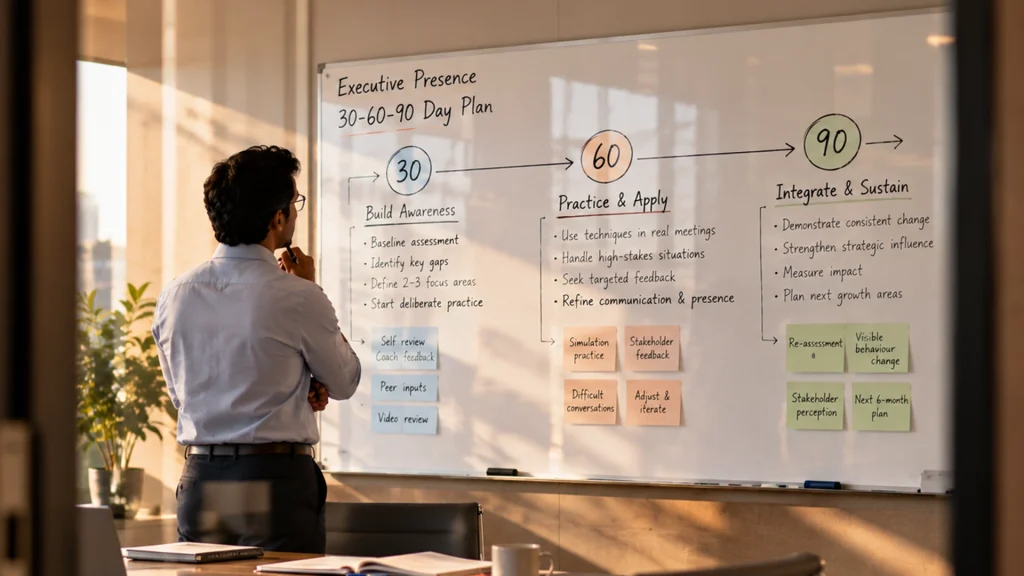
Deliberate practice over 30–90 days is enough to noticeably strengthen executive presence for most leaders, sequenced from foundational to advanced rather than attempted all at once.
- Weeks 1–2: Diagnose and stabilise: run the self-assessment, get two peers’ input, and lock in the daily micro-habits plus one activity from your weakest dimension.
- Weeks 3–4: Communication and composure: add the outcome-first rewrite, the speak-last drill, and pause-before-you-answer.
- Weeks 5–8: Decisions and influence: add the decision log, the step-back question, and one stakeholder touchpoint a week.
- Weeks 9–12: Integrate and pressure-test: add a monthly crisis simulation and a mini-360, and track business moments where your presence felt stronger.
Create a weekly checklist of 5–7 items, block two 20-minute review slots, and seek feedback throughout. Does it pay off? Executive coaching, of which presence work is a core part, shows a median return of about seven times the spend in the ICF/PwC Global Coaching Client Study (2009). Those figures are self-reported and directional, but even read conservatively, few development investments come close.

Measuring Executive Presence Progress: KPIs and Feedback Mechanisms
Presence feels intangible, but you can track it, pair a few simple indicators with a regular feedback rhythm so you know the activities are working.
- Leading indicators: unsolicited stakeholder feedback, being pulled into higher-stakes conversations, and how often your recommendation is adopted without re-litigation.
- Behavioural metrics: filler-word and interruption counts (from your one-line debriefs), listening ratio in 1:1s, and time-to-composure when challenged.
- Lagging indicators: 360-feedback scores on presence dimensions, promotion-readiness ratings, and expanded scope or P&L responsibility.
- Cadence: a one-line self-debrief after every high-stakes meeting, a monthly mini-360 with 3–5 peers, and a quarterly review against your self-assessment baseline.
The point is not a dashboard; it is a feedback loop honest enough to tell you which of the 25 activities to keep and which to change.
Common Pitfalls to Avoid
- Over-performing a persona. Copying another executive rarely works; strong executive presence varies by culture, organisation, and role.
- Surface-only focus. Posture and wardrobe without clarity, judgement, and stakeholder awareness is a polished exterior with nothing behind it.
- Over-talking to prove value. Preparation, brevity, and strategic questions project authority far more than filling airtime.
- Ignoring bias in feedback. Evaluations can be shaped by gender, culture, and role; insist on specific, behaviour-based comments.
- Starting before diagnosing. Skipping the self-assessment means practising the wrong activities well.
- Leaning on pedigree. In Indian corporate settings, an IIT or IIM tag can substitute for demonstrated presence early on: but it wears off fast; seniors judge how you show up in the room, not your alma mater.
- Borrowing someone else’s persona. One manager who modelled his style on a charismatic CEO drew flat 360 feedback within two quarters: the persona wasn’t his, and it showed.
Options and Costs for Executive Presence Training in India
Executive presence support in India spans four tiers; the right one depends on your gap and budget, not price alone.
- Self-study (books, this article’s activities, free resources): ₹0, effective for foundational habits, but no outside feedback on blind spots.
- Group workshops: roughly ₹5,000–₹15,000 per session, good for peer practice and a fast confidence lift, weaker on personalised diagnosis.
- Online courses: ₹10,000–₹50,000, structured and flexible, best for frameworks rather than live pressure practice.
- Personalised 1-on-1 coaching: typically ₹50,000–₹3,00,000 per engagement (Kapable’s programme sits at ₹1,77,000 + taxes). It is the only tier that surfaces individual blind spots and rehearses your real high-stakes moments.
Start at the tier that matches your gap: habit-building can start free, while a plateau or a specific high-stakes moment usually needs 1-on-1 work.
When to Consider Executive Presence Coaching or Training
Self-directed activities take most leaders a long way. Structured executive coaching earns its place when you have blind spots you cannot see, a high-stakes moment to rehearse, or a plateau feedback alone hasn’t shifted. It surfaces patterns self-practice misses, and executive presence training helps professionals align internal confidence with external expression, particularly mid-level managers and aspiring leaders building leadership skills toward the next role.
For Indian professionals, Kapable’s Leadership Acceleration Programme develops presence through personalised 1-on-1 coaching, behavioural diagnostics, and live cohort simulations, with senior-leader tracks in its Executive Leadership Programme. It sits in the 1-on-1 tier (₹1,77,000 + taxes as of 2026); the options and costs above show how that compares with workshops and online courses, so you can match spend to your situation. Kapable learners consistently report a stronger executive presence in high-stakes situations: a Senior Product Manager at Google notes she now walks into high-stakes discussions with confidence rather than rushing through her content, and a General Manager at Tata Motors Design went from hesitating before presenting ideas to speaking more confidently using structured frameworks (Kapable success stories).
Conclusion: Executive Presence Is Built Rep by Rep
Executive presence contributes roughly a quarter of promotion potential, but it is not a fixed trait. It is the accumulated result of specific, repeatable exercises practised in real rooms: leading with your headline, pausing before you answer, making your decisions legible, and showing up the same on camera as in person. These activities connect directly to career growth: readiness for P&L roles, promotion to VP or the C-suite, and visibility with investors.
It starts with a single rep. Run the self-assessment, pick your two weakest dimensions, and try one activity in your next meeting this week; schedule a 30-day check-in to review the impact. Executive presence is built rep by rep, through deliberate, authentic practice. When you’re ready to accelerate it with structured guidance, start with Kapable.
Frequently Asked Questions
Q1. What are the 7 C’s of executive presence?
The 7 C’s are Character, Charisma, Confidence, Credibility, Connection, Composure, and Clarity. Character and credibility build trust, confidence and composure carry it under pressure, and charisma, connection, and clarity make it land with an audience.
Q2. What are the 5 C’s of executive presence?
The 5 C’s are a condensed version, usually Confidence, Composure, Connection, Clarity, and Credibility, the behaviours you can practise directly: staying calm under pressure, communicating clearly, and connecting while remaining believable.
Q3. What are the 3 C’s of executive presence?
The 3 C’s usually refer to Coqual’s original dimensions: gravitas, communication, and appearance, how you act, how you speak, and how you look. Gravitas is the dominant one, rated at roughly 67% of what makes up executive presence.
Q4. What is the 70-20-10 rule for leadership?
The 70-20-10 rule holds that about 70% of leadership growth comes from on-the-job experience, 20% from learning through others (feedback, mentoring, coaching), and 10% from formal training. So most presence gains come from practising these activities in real meetings, reinforced by feedback and executive presence training.
Q5. What are examples of executive presence?
Examples: pausing before answering a hostile question and replying calmly; opening with a recommendation instead of a backstory; staying measured while delivering bad news; asking the one enterprise-level question that reframes a debate. Each is a visible behaviour, not a personality type.
Q6. What are some fun activities for a leadership group?
Group-friendly options include feedback circles, hot-seat Q&A rounds, 90-second storytelling rounds, and one-word mood check-ins. These executive presence group activities work well at offsites because they combine light structure with real peer feedback.
Q7. How do I increase my executive presence?
Diagnose your weakest dimension, then practise two or three targeted activities daily in real meetings. Add peer feedback and review progress every 30 days. Consistent small reps beat occasional big efforts, and they steadily compound into stronger leadership presence.
Q8. How do you train executive presence?
You train it with deliberate practice and feedback: daily micro-habits, weekly drills, monthly pressure simulations, and periodic 360 feedback. Structured executive presence training or executive coaching adds an outside perspective and accelerates the blind-spot work.
Q9. Can introverts develop a strong executive presence?
Yes. Introverts often build executive presence faster through preparation than improvisation, a contribution headline, a decision log, and speaking last land high-impact points without competing on airtime. Presence is about clarity and composure, not volume.
Q10. What is the cost of executive presence training in India?
It varies by format. Group workshops run roughly ₹5,000–₹15,000 per session and online courses ₹10,000–₹50,000; personalised 1-on-1 executive coaching runs higher, typically ₹50,000–₹3,00,000 per engagement, Kapable’s Leadership Acceleration Programme is ₹1,77,000 + taxes (as of 2026). Weigh cost against the multiple-times return structured coaching tends to deliver.
Q11. Do these activities work for women leaders?
Yes, though context matters. Evaluations of presence can be influenced by gender expectations, so women leaders benefit from insisting on specific, behaviour-based feedback and from activities that build authentic authority rather than a perform


