


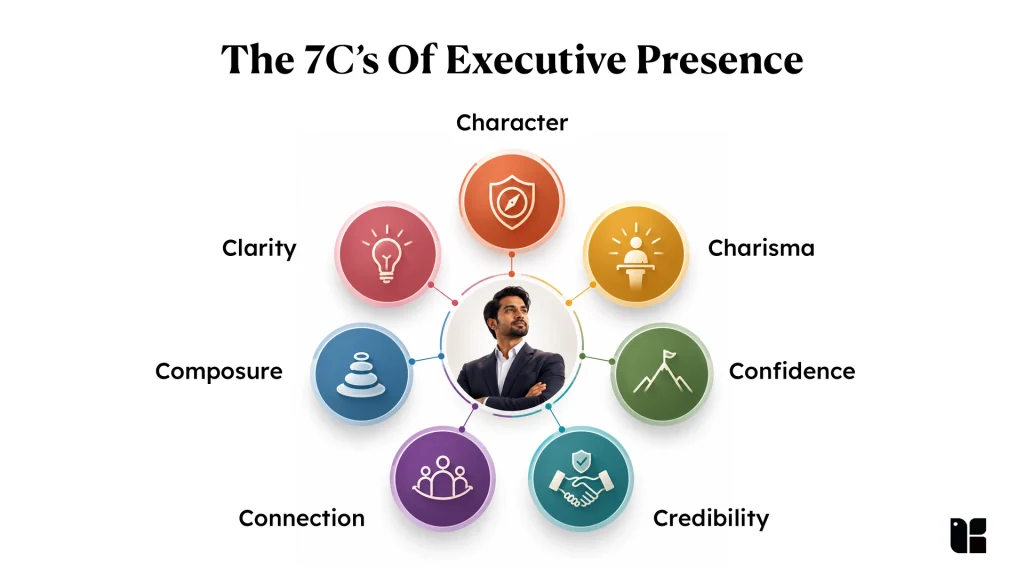
The 7 C’s of executive presence are Character, Charisma, Confidence, Credibility, Connection, Composure, and Clarity; a practical checklist for how a leader projects confidence, authority and emotional maturity at work. A second version swaps Character for Conciseness. This guide uses the list above, maps it against the main variations, and shows you how to measure and develop each one.
Why the framework matters now: for a director or VP being weighed for the next role, executive presence is often the difference between a strong delivery record and an actual promotion. It is how senior stakeholders decide whether they trust you with more, and unlike your technical track record, it is judged in the first few minutes of every high-stakes meeting. The good news: strong executive presence is a set of learnable behaviours, not a personality you are born with, developed through deliberate effort, self awareness and the right guidance.
Before you read on, a five-minute start: rate yourself 1–10 on each of the seven C’s against your last high-stakes meeting, using rough anchors: 3 = the behaviour is largely absent, 5 = inconsistent, present on good days, 8 = reliable under pressure. Note your two lowest. Those are the C’s this guide is worth reading for; everything below is about closing that gap.
The 7 C’s of Executive Presence: An Overview
Here is a one-line snapshot of each C, with a concrete workplace behaviour:
| C | What it is | What it looks like |
| Character | Integrity and authenticity | Admitting a mistake in a retro and explaining what you will do differently |
| Charisma | Warmth that draws people in | Using someone’s name and asking a genuine follow-up in a standup |
| Confidence | Grounded self-assurance | Presenting one clear recommendation to a steering committee, not five options |
| Credibility | Expertise plus follow-through | Arriving at a strategy review with prepared data and realistic timelines |
| Connection | Genuine relationships and psychological safety | Inviting a quiet team member to share before you state your view |
| Composure | Calm under pressure | Staying factual when a senior executive challenges your plan publicly |
| Clarity | Communicating so people know what to do | Ending a 15-minute update with owners, deadlines and next steps |
Great leaders do not need to be perfect at all seven; being consistently strong across them is what sets them apart.
Watch: The 7 Cs of Executive Presence, a focused explainer on how the seven dimensions fit together.
Which “7 C’s” Is Correct? The Framework Confusion, Resolved
If you search the term, you will find several different “7 C’s”, and that is not something you are misremembering. There is no single, standardised, peer-reviewed list; the frameworks are competing models from different executive coaching firms, and each emphasises different behaviours. Here are the main versions side by side:
| Source | The seven C’s it uses |
| IMD / this guide | Character, Charisma, Confidence, Credibility, Connection, Composure, Clarity |
| Business Insider (Jun Medalla) | Composure, Connection, Charisma, Confidence, Credibility, Clarity, Conciseness |
| Marco Polito (2026) | Competence, Control, Confidence, Class, Connection, Communication, Courage |
The overlap is significant: Confidence and Connection appear in all three, and Credibility, Composure and Clarity appear in two (the third list folds them into Competence, Control and Communication). Where they differ is at the edges: some lead with Competence (domain expertise), some with Character (integrity), some add Conciseness or Courage. Pick one framework and use it consistently rather than switching lists mid-development; the labels matter far less than practising the behaviours behind them. This guide uses the seven above because they map cleanly onto observable, coachable actions.
The 7 C’s Explained
Each C below follows the same shape: what it is, the mistake that quietly undoes it, and the fix. Work through them against the two lowest scores from your five-minute self-rating. You do not need all seven at once, you need the one or two that are costing you now. The order here runs foundation-first (Character, Charisma) through to the communication C’s (Composure, Clarity), because the later ones are hard to project convincingly when the earlier ones are shaky.
1. Character: The Foundation of Trust
Character is the alignment between what you say, how you decide and what you actually do over time. It builds the kind of trust that compounds across quarters, not just single meetings. It is what people say about you when you are not in the room.
Common mistake: treating transparency as optional under pressure. Deflecting blame for a missed deadline erodes character faster than the miss itself. Keep commitments visible, explain trade-offs, and acknowledge what you do not yet know. One caveat on how presence is judged: Stanford research by Shelley Correll and Caroline Simard found women’s developmental feedback is vaguer than men’s and less often tied to business outcomes (40% versus 60%), so presence should feel congruent with your identity, not like performing someone else’s version of authority.
2. Charisma: Making Your Leadership Feel Human
Charisma is the magnetic quality that draws people in, not theatrics or being the loudest voice. It combines warmth and approachability, and it is closely tied to emotional intelligence: reading the room, adjusting your tone, and using a short story rather than another slide to influence a decision.
Common mistake: mistaking volume for magnetism. Introverted leaders often develop charisma more effectively by listening deeply and asking better questions. Start meetings with a brief check-in, ask open-ended questions, and hold eye contact instead of multitasking. There is a reason this works: in Connect, Then Lead (Harvard Business Review), Amy Cuddy, Matthew Kohut and John Neffinger argue that leaders should establish warmth before showing competence, because beginning with warmth allows trust to develop. The leader who signals genuine interest first is heard more readily than the one who leads with credentials. In a high power-distance Indian setting, that warmth is also what makes a senior approachable enough to be levelled with.
3. Confidence: Calm Self-Belief Under Scrutiny
Confidence is projecting self-assurance and decisiveness without tipping into arrogance. It means taking a position and owning it even when you do not have perfect information, not pretending to know everything.
Common mistake: the two failure modes sit either side of confidence. Over-hedging (“I just think maybe we should…”) reads as insecurity; over-claiming reads as arrogance, judged especially harshly in hierarchical Indian workplaces. Prepare two or three key points, rehearse aloud, pause before responding, and speak early, because waiting too long signals hesitation.
“I used to get frustrated when people didn’t understand what I was asking them to do. Over time, I’ve become much more conscious of pausing, understanding their perspective and thinking about what the situation needs from me before I respond. That shift has changed the way I communicate with my team and helped me create clearer expectations while giving people more space to learn and take ownership.”
– Chirag Shah, Founder, IronThrone Engineering
4. Credibility: The Currency of Influence
Credibility stems from expertise and consistent follow-through, the “can we trust you with this?” factor that senior leaders weigh, sometimes without realising it. It compounds over every interaction. For context on why organisations reward it, the Fortune 100 Best Companies to Work For delivered a total stock return of 3,174% against the Russell 1000’s 907% from December 1997 to December 2024 (Great Place to Work / FTSE Russell analysis). A high-trust culture built, at every level, on credible leadership.
Common mistake: over-promising to look capable in the moment. Under-promise and over-deliver instead, keep a visible decision log, and send clear follow-up notes with owners and next steps.
5. Connection: Presence That Builds Psychological Safety
Connection is building genuine relationships through empathy and active listening so people share honest information and surface problems early. In practice: inviting dissenting views, summarising what others said before giving your own, and recognising contributions specifically.
Common mistake: running one-on-ones as status updates. Use them to listen, and in hybrid settings check in with remote participants who go quiet on video, because connection is where most presence is won or lost when the team is distributed. This is not soft: Google’s Project Aristotle found psychological safety, the exact thing Connection builds, to be the single strongest predictor of team effectiveness, ahead of who was on the team. A leader safe to disagree with gets the early warnings; one who isn’t gets silence and surprises.
6. Composure: Staying Steady When Stakes Are High
Composure is staying calm and level-headed during high pressure situations: a mid-year budget cut, a production outage, a public challenge from a senior executive. Loss of composure (defensiveness, visible panic, sarcasm) erodes presence faster than almost any other misstep.
Common mistake: reacting before resetting. Pause before responding. Even three seconds signals control. Name issues, not people (“the timeline is at risk”, not “you missed the deadline”), and separate facts from interpretation.

7. Clarity: Communicating So People Know Exactly What to Do
Clarity ensures your vision and expectations land. Conciseness, delivering the message without unnecessary detail, is its natural extension. Leaders who communicate clearly are viewed as more credible.
Common mistake: burying the recommendation. Lead with the headline (“I recommend X because…”), structure updates around three points, cut 30% of the words before sending, and tailor detail to the audience: executives want the decision, teams want the steps.
Listen: Speak Up: Develop Your Executive Presence & Leadership Communication Style, Laura Camacho’s series on executive influence and communication.
How to Measure Your Executive Presence
You cannot develop what you cannot measure, and “get better at presence” is not a plan. The most practical way to measure executive presence is to score each of the seven C’s and track it over time, the same principle formal instruments such as the Bates ExPI apply to their own set of facets: presence treated as ratable dimensions rather than a vague quality.

Use a consistent scale so the number means something across quarters:
| Score | What it means |
| 1–3 | Behaviour is largely absent: you avoid it or it fails you under pressure |
| 4–6 | Inconsistent: present on good days, gone when stakes rise |
| 7–8 | Reliable: you can produce it on demand in most situations |
| 9–10 | Instinctive: it holds even in your hardest rooms |
Score all seven, date it, and re-score once a quarter. Tracking the trend matters more than any single number. A C moving 5 → 7 over two quarters is the evidence you take into a promotion conversation.
Two routes to a score. DIY self-scoring against this table is free, immediate and enough to pick your focus C. A formal instrument, the Bates ExPI (Executive Presence Index), a validated 360 assessment, is administered through a certified coach as a paid engagement, and its value is not the self-rating but the gap it captures between how you score yourself and how bosses, peers and reports score you. Start with the free self-score; move to a formal 360 when you need the perception gap, not just the self-view.
A Simple Self-Scoring Method
Score against a specific recent situation, not in the abstract, and use this guide’s working target: 7/10 or above on every C (the “reliable” band in the table above), not a high average with one or two weak spots, because presence fails at its weakest C. You do not need a 9 or 10 anywhere to get there. Two or three behavioural questions per C keep the score honest. For Connection: When did I last have a non-work conversation with a peer in another function? For Clarity: Could I state my main point in ten words or fewer? Your lowest score is where effort earns the most.

Getting Feedback: Closing the Perception Gap
Self-scores have a blind spot: presence is defined by how others perceive you, so your own rating is half the picture. The gap between your score and how five to seven colleagues rate you on the same seven C’s is where development should focus. A one-page sheet (1–10 on each C with one behavioural example) surfaces the dimension you cannot see yourself, usually not the one you expected. As a working threshold from 360-feedback practice, treat a gap of 2 or more points between your self-score and the average peer score on any single C as a genuine blind spot worth targeting first. Small gaps are noise; a two-point gap is a dimension where your intent and your impact have come apart.
How to Develop the 7 C’s: A Practical Roadmap
Executive presence development is ongoing rather than a one-off training event, but it moves in focused steps: a single dimension is a realistic thing to shift in a quarter, provided you work one C rather than all seven. A workable arc looks like this:
| Weeks | Focus |
| 1–2 | Diagnose: self-score, then a 5–7 person peer read; pick the C with the biggest gap |
| 3–8 | Practise: two or three daily behaviours on that one C; tell a trusted colleague you are working on it and ask them to observe and give weekly input |
| 9–12 | Reassess: re-score self and peers; if the gap has closed, move to the next C |
The sections below unpack each step.

Which C to Develop First
Do not try to improve all seven at once. That dilutes effort and is itself a presence mistake. Start from your self-score and feedback gap: pick the C with the biggest distance between where you are and where your role demands you to be. Foundational dimensions (Composure, Clarity, Credibility) tend to unlock the others, so if two are tied, start there. The mechanism is simple: lose Composure and no one registers your Confidence or Connection, because the room is watching you react; without Clarity, your Character and Credibility never land, because the message that would carry them is muddled; and Credibility is the base rate others apply to everything else you do. It fits Hewlett’s finding that 67% of the senior executives surveyed named gravitas, the composure-and-judgement family, as the core of presence: it is the dimension the others are read through.
A 90-Day Development Plan
Pick one C and define two or three behaviours to practise daily (for Clarity, that might mean leading every email with a one-sentence recommendation for 30 days). Ask a trusted peer to observe you and give candid input on that one dimension. Record a key meeting (with permission) and review it. You will spot habits you did not know you had. Reassess each quarter; what mattered at director level looks different at senior levels.
What this looks like in practice: a director at a large Indian IT services firm was passed over for VP twice despite a strong delivery record. A 360 review surfaced the real block, low Connection and Clarity: she spoke almost entirely in technical jargon and avoided cross-functional networking. Over roughly eight months she ran monthly “translation” presentations that reframed her work for non-technical leaders and held open office hours to build relationships across functions. She was promoted on the third review cycle. The delivery record was never the problem; two specific C’s were, and they were fixable once named.
Watch: 5 Keys for Developing Executive Presence, a complementary, action-oriented set of development keys.
Structured executive coaching accelerates this by providing targeted feedback, role-play of difficult conversations and accountability, which is why most structured leadership development programs pair a diagnostic with sustained practice rather than a one-off workshop. If you are weighing formats, it is worth understanding how leadership coaching approaches differ before committing. Kapable’s Advanced Leadership Program and public speaking and leadership training are built around exactly this diagnostic-then-practise loop for senior professionals.
The 7 C’s in the Indian Workplace
The seven C’s are presented as universal, but Composure, Confidence and Connection are interpreted differently across cultures. Applying a Western framework literally in an Indian corporate setting can backfire. The reason is measurable: on Hofstede’s Power Distance Index, India scores 77 out of 100 against 40 for the United States, meaning hierarchy is expected and accepted rather than flattened. A behaviour that reads as high-Confidence in a US boardroom, such as cutting in to challenge a senior leader directly or holding your ground toe-to-toe, can read at an Indian leadership review as disregard for seniority, and cost you the presence points it would have earned in New York. The C is the same; the way it is received is not.
Balancing Confidence with Hierarchical Respect
This is the counter-case the standard framework ignores: in many Western contexts, Confidence reads as assertive decision-making; in an Indian organisation, the same behaviour can be read as arrogance toward senior leaders. Connection, too, is built here through relationship investment that efficiency-minded frameworks dismiss as wasted time, yet skipping it quietly erodes your presence locally. Project Confidence through the quality of your reasoning and Composure rather than volume, and invest deliberately in Connection. That makes Composure, Clarity and Connection the safest C’s to lead with in a hierarchical setting: staying steady under hostile questioning and reducing a complex argument to a few points signal strength without challenging seniority, where charisma or force can.
Executive Presence on Video Calls and Hybrid Teams
Since many Indian executives now manage remote or hybrid teams across time zones, presence plays out on video as much as in the room. The digital signals are specific: camera at eye level, reliable and structured asynchronous updates, and a communication style that stays warm on a screen. Connection needs deliberate effort here because remote participants disengage silently. Clarity matters more, because written updates carry no tone to soften a muddled message. The thin-slice effect does not switch off on video; it runs on fewer cues, so the same sub-second judgement forms from your framing, your first sentence and whether you look at the camera or your own thumbnail. That makes the controllable signals (eye-level camera, a crisp opening line, a structured written update) disproportionately worth getting right.
“As my scope grew, I realised that having the right answers was only part of the job. Through Kapable, I became more conscious of how I structure my thoughts, respond under pressure and acknowledge another person’s perspective before making my own point. Learning to pause, communicate more concisely and stay composed has helped me approach difficult conversations with greater clarity and confidence.”
– Ajay Saini, Deputy Vice President, NoBroker
Common Mistakes That Undermine Executive Presence
Beyond the per-C pitfalls above, three patterns damage presence across the board: seeking approval instead of projecting conviction (a rising inflection that turns statements into questions); confusing activity with presence (busiest or loudest is not present; the quality of your attention is); and performing a borrowed style that reads as inauthentic and fails the Character test.
When the 7 C’s Work Against Each Other
Here is what no framework admits: the seven C’s can conflict, and leadership is often about choosing which to prioritise. Projecting Confidence can undermine Connection if it stops you admitting a mistake; holding Composure can read as emotional unavailability; demonstrating expertise through technical detail destroys Clarity. Even a leader who scores 7 or above on all seven cannot lead with every C at once. The skill is knowing which two or three matter for the moment. A board presentation rewards Composure and Clarity; a team in crisis needs Connection; a strategy review turns on Credibility and Confidence.
One structural truth worth naming: executive presence works like a credit score for leadership, a proxy organisations use for trustworthiness with power and resources. It is partly subjective and disadvantages those without existing access to high-stakes exposure. That does not make it optional; it makes the seven C’s the vocabulary you need to navigate it, and to advocate for others with concrete criteria instead of “gut feel”.
Conclusion: From Good Manager to Great Leader
The 7 C’s (Character, Charisma, Confidence, Credibility, Connection, Composure and Clarity) are what distinguish great leaders from merely competent managers, forming a practical framework for the kind of presence that inspires trust during challenging times.
Executive presence is not a fixed trait; it is a set of skills you can build, measure and strengthen. Whether you are aiming for senior levels or simply want to exhibit executive presence more consistently now, the path is the same: score yourself on the seven C’s, pick the one with the biggest gap, commit to one visible behaviour change, and practise it in a real upcoming meeting. Start this week. The gap is smaller than you think.
Frequently Asked Questions
Q1. What are the 7 C’s of leadership?
The 7 C’s of leadership overlap heavily with executive presence: Character, Charisma, Confidence, Credibility, Connection, Composure and Clarity. Other versions substitute Conciseness, or Competence, Control, Class, Communication and Courage. They describe the behaviours that make a leader appear credible and worth following, not a single peer-reviewed standard.
Q2. What are the three pillars of executive presence?
From Sylvia Ann Hewlett’s original research, the three pillars are gravitas (calm judgement under pressure), communication (how clearly you speak and listen), and appearance (professionalism, not fashion). Asked which pillar is the core of executive presence, 67% of the senior executives surveyed named gravitas, 28% communication, and 5% appearance.
Q3. How do the 7 C’s map to the three pillars of executive presence?
Most of the seven C’s expand the three pillars into observable behaviours: Composure, Confidence, Credibility and Character sit under gravitas; Clarity, Connection and Charisma under communication. Appearance is largely absent, which is why the frameworks feel behaviour-focused: how you act over how you look.
Q4. How do you develop each of the 7 C’s of executive presence?
Develop one C at a time, not all seven. Score yourself 1–10 on each, pick your lowest, and define two or three daily behaviours for it. For Clarity, leading every email with a one-sentence recommendation; for Composure, a three-second pause before responding. Get peer feedback, record and review a real meeting, and reassess each quarter.
Q5. What are practical exercises to improve executive presence?
Rehearse high-stakes points aloud rather than in your head, record a meeting and review it for filler and hedging, run a 30-day “one-sentence recommendation” habit for Clarity, and send a one-page seven-C feedback sheet to five to seven colleagues. Structured coaching adds role-play and accountability.
Q6. What are common mistakes that undermine executive presence?
The biggest: hedging until confidence reads as insecurity, over-claiming until it reads as arrogance, confusing being busy or loud with presence, losing composure when challenged, and copying another leader’s style instead of one congruent with your identity. In Indian workplaces, over-assertive Confidence can also be misread as disrespect toward senior leaders.
Q7. How do you measure executive presence?
Score each of the seven C’s 1–10 against a specific recent situation, and track the scores over time. This guide’s working target is 7/10 or above on every C, because presence fails at its weakest C, not its average. Pair the self-score with the same rating from five to seven colleagues and the gap between the two is the most useful signal of where to develop.
Q8. What are the 7 P’s of leadership?
The 7 P’s are a separate framework; purpose, passion, people, process, performance, persistence and positivity, not to be confused with the 7 C’s. The 7 C’s describe how a leader is perceived in high-stakes moments; the 7 P’s describe broader leadership priorities.


