

TL;DR
- The Invisible Barrier to Belonging: Diverse leadership is vital for organisational growth, but many professionals feel forced to compromise their identity to fit dominant workplace norms, proving that representation is not the same as belonging.
- The Systemic Advancement Gap: Career advancement is stifled by structural barriers like unconscious bias in hiring, unclear promotion rules, and unequal access to senior advocates who champion the careers of professionals of colour.
- Moving Past Symbolic Inclusion: Future equity requires shifting past simple diversity awareness to demonstrable accountability, cultural intelligence, and shared power that ensures diverse voices influence all strategic decisions.
- Actionable Policy for Lasting Change: Organisations must actively redesign core talent systems by mandating diverse executive candidate pools, enforcing fair pay policies, and establishing transparent audits to measure and sustain progress.
What does belonging mean when your skin colour still decides how you’re seen, and how seriously your talent is taken? For countless professionals of colour, that sense of belonging remains out of reach, as decades of inclusion efforts have yet to remove the invisible barriers blocking advancement and leadership opportunities. A survey found that 98% said they have had to compromise aspects of their identity or self-expression, such as adapting their speech, hairstyles, or cultural behaviours, to fit in professionally. This is a powerful reminder that representation alone does not guarantee equity. The absence of inclusion reflects a missed opportunity for growth. This blog explores the current state of racial diversity in leadership, the lived experiences behind the gap, and the actionable steps organisations can take to build a truly equitable environment.
What Is Racial Diversity In Leadership?
Racial diversity in leadership is all about bringing together leaders from different backgrounds who all have an equal say in shaping the organisation’s vision and culture. Leaders who bring diverse experiences often understand their communities more deeply and inspire teams through shared understanding rather than hierarchy. When people of different racial and ethnic identities lead together, they generate more inclusive ideas, equitable policies, and workplaces that feel more connected and human. Diversity at the top strengthens how an organisation thinks, adapts, and grows.
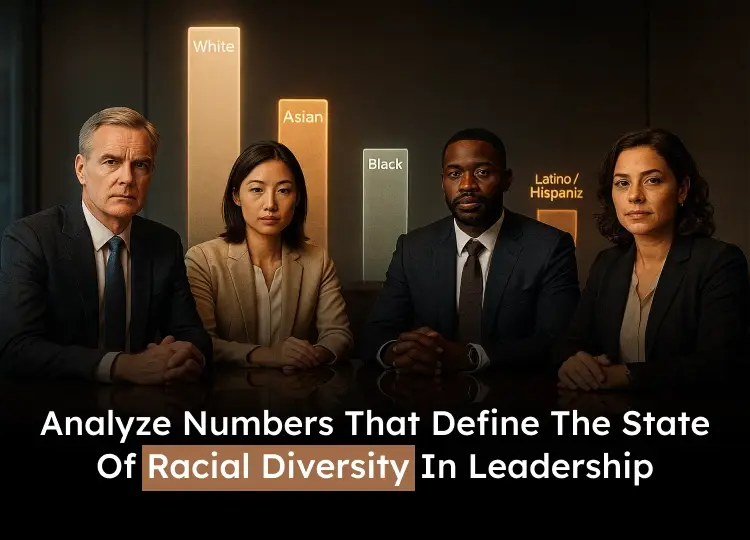
According to a 2023 report from the Bureau of Labour Statistics, 76.5% of the U.S. workforce is White, 12.8% is Black or African American, 18.8% is Latino or Hispanic, and only 6.9% is Asian. Despite growing racial and ethnic diversity across the workforce, leadership representation continues to favour one racial group, exposing the structural inequities that limit inclusive progress. Defining racial diversity in leadership establishes the importance of representation. To understand its real scope, we must now look at what the numbers reveal about who actually holds leadership positions.
What Do The Numbers Reveal About Representation In Leadership?
Racial diversity in leadership continues to evolve, showing signs of progress while exposing ongoing disparities. Here are eight data trends that reflect the current state of representation in leadership roles:

- The imbalance in academia mirrors a broader trend across all leadership roles, from corporate offices to public institutions. In 2022, more than 72% of college presidents were White, while people of colour represented only 28% of top leadership roles. This limited representation shows that leadership in higher education remains unbalanced, with decision-making still concentrated within a narrow group.
- White faculty members made up about 65.3% of teaching staff in higher education, while Latino or Latina faculty accounted for 5.8%, Black faculty for 5.9%, and Asian faculty for 11.4%. This disparity is not limited to education; corporate leadership reflects a similar pattern, with diversity steadily diminishing as positions become more senior.
- In June 2023, only 9 Black CEOs were heading Fortune 500 companies, underscoring how representation at the highest executive level remains an exception rather than the norm. This persistent underrepresentation demonstrates the barriers preventing diverse talent from advancing into the most powerful roles.
- Black professionals hold only 3.2% of all executive and senior leadership roles and less than 1% of all Fortune 500 CEO positions, highlighting how limited access to top decision-making power remains for one of the country’s largest racial groups.
- As of 2024, there were 11 Black CEOs leading companies in the S&P 500 and Fortune 500, a small but telling figure in an economy of hundreds of major corporations. Although this number fluctuates slightly each year, progress has been slow, showing how rarely racial diversity reaches the very top.
- Black professionals make up 13% of the U.S. population but hold fewer than 3% of senior corporate jobs and under 8% of white-collar positions. This gap between workforce participation and leadership presence reveals how opportunity pipelines often fail to promote racial diversity as careers progress.
- Only 8% of C-suite and decision-making employees are women of colour, illustrating how racial and gender inequalities compound at the top. Intersectional theory shows that the overlap of race and gender places women of colour at a unique disadvantage, limiting their visibility and access to sponsorship.
- Although 65% of Black adults and 66% of Asian adults reported holding leadership roles in their youth, more than the general population, this early potential has not translated into equal representation in today’s executive and C-suite positions.
The data on leadership representation shows uneven access to power. Broader disparities across the workforce explain how structural barriers keep those gaps in place.
Which Key Disparities Define Racial Inequality In The Workforce?
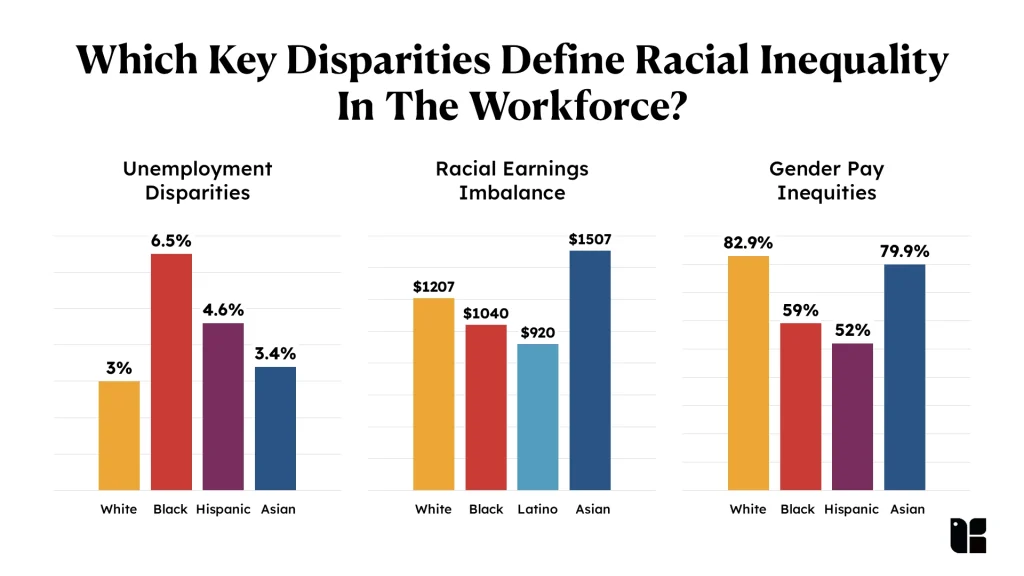
Racial inequalities remain deeply rooted in the modern workplace, shaping who gets promoted and paid fairly. These inequities are reflected across three key dimensions, detailed below:
1. Unemployment Disparities
Unemployment rates reveal how race still determines job stability and opportunity across industries.
- White: White people recorded the lowest unemployment rate at 3%, reflecting their continued access to professional networks, long-term job security, and industries with higher stability. Their stronger foothold in leadership and management positions contributes to sustained employment levels.
- Black: Black workers faced the highest unemployment rate at 6.5%, more than double that of white workers. This difference highlights the ongoing impact of systemic bias in hiring, limited access to career advancement programs, and the underrepresentation of Black people in industries with long-term job growth.
- Hispanic: Hispanic workers experienced a 4.6% unemployment rate, indicating moderate workforce participation but limited access to formal employment channels and professional development. Many remain concentrated in essential or lower-wage sectors with fewer opportunities for promotion.
- Asian: Asian workers had an unemployment rate of 3.4%, close to that of white workers, reflecting strong participation in professional sectors. However, this group remains underrepresented in top executive positions, a phenomenon often referred to as the “bamboo ceiling.”
2. Racial Earnings Imbalance
Median weekly earnings highlight how race continues to influence financial outcomes and access to high-paying industries.
- White: White workers earned an average of $1,207 per week, maintaining steady access to well-paying roles and industries with long-term income security. This economic advantage has also translated into higher representation in leadership and executive roles.
- Black: Black workers earned a median of $1,040 per week, revealing a persistent income gap despite growing educational attainment and workforce participation. Many remain underrepresented in high-paying industries like finance, technology, and corporate leadership, contributing to lower overall earnings.
- Latino: Latino workers had the lowest median weekly earnings at $920, showing the ongoing impact of occupational segregation, lower access to higher education, and limited upward mobility. Many remain concentrated in industries offering fewer promotion pathways and benefits.
- Asian: Asian workers earned the highest median weekly income at $1,507, a reflection of higher representation in high-skill industries such as technology, healthcare, and engineering. However, despite strong economic performance, leadership inclusion for Asian professionals remains limited.
3. Gender Pay Inequities
Gender remains an additional barrier that compounds racial inequality in income and career progression, as men significantly outnumber women across executive and senior management roles.
- White: White women earn 82.9% of what white men earn, demonstrating that even within the most economically advantaged group, gender inequality persists in salary and promotion opportunities.
- Black: Black women earn 59% of what black men earn, depending on the industry, facing both gender and racial bias in advancement. They are more likely to hold roles with lower pay and limited leadership exposure despite strong participation in the workforce.
- Hispanic: Hispanic women experience the widest wage gap, earning 52% of men’s pay. This inequality stems from both industry concentration and systemic barriers to education, promotion, and equal pay enforcement.
- Asian: Asian women earn around 79.9% of men’s pay, showing that even among higher-earning racial groups, gender-based disparities remain entrenched. Cultural bias and underrepresentation in executive roles contribute to slower salary growth and visibility.
Disparities reveal inequality from a distance. Employee experiences bring us closer, showing what diversity and exclusion truly look like inside organisations.
What Do Employee Experiences Reveal About Racial Diversity At Work?
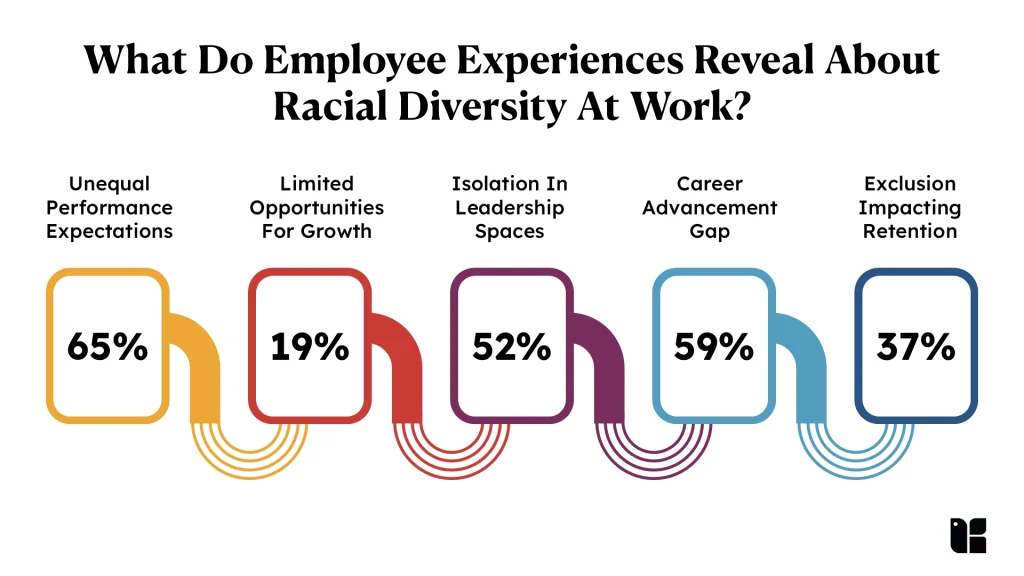
Employee experiences offer one of the most honest reflections of an organisation’s true diversity culture. The reality of racial diversity at work is reflected in five key insights, which are described as follows:
1. Unequal Performance Expectations
Perceptions of unequal effort reveal how bias still defines workplace expectations and performance standards for professionals of colour.
- 65% of Black professionals feel they must work harder to advance, compared to just 16% of white counterparts, showing how bias continues to shape expectations and limit access to more opportunities.
- 58% of Black professionals report racial prejudice at work, versus 15% of white professionals, reflecting ongoing barriers to inclusion and trust in leadership.
2. Limited Opportunities For Growth
Disparities in advancement expose how racial inequity limits access to leadership and weakens confidence in inclusion efforts.
- 19% of Black professionals believe someone of their race will never reach top leadership, compared to 3% of white professionals, highlighting the lack of visible role models in senior roles.
- Research shows that 35% of white women have advocates who actively promote their ideas and skills, compared to just 19% of Black women. This gap highlights how unequal access to sponsorship and support limits advancement for women of colour.
3. Isolation In Leadership Spaces
Underrepresentation in senior roles continues to influence identity and visibility within professional environments.
- 52% of Black and 51% of Asian workers believe being white makes success easier, underscoring persistent racial privilege in career progression.
- 54% of Black women report being “Onlys”, often the only Black person in the room, revealing how underrepresentation continues to impact workplace experience and confidence.
4. Career Advancement Gap
Persistent racial pay gaps and slower promotion rates highlight the structural inequities that prevent equitable advancement.
- The gender pay gap impacts all women, yet it is most severe for women of colour. Black women earn only 59% and Hispanic women 52% of what men earn in similar roles, exposing persistent inequities that restrict racial and gender diversity in higher-paying and leadership positions.
- For every 100 men promoted to manager, only 58 Black women and 64 women overall are promoted, limiting the pipeline of future women leaders and keeping them among the most underrepresented groups in leadership growth.
5. Exclusion Impacting Retention
Feelings of exclusion and lack of belonging continue to drive turnover among employees of colour, affecting long-term diversity progress.
- 35% of Black employees say they intend to leave their companies within two years, compared to 27% of white employees, highlighting how a lack of racial inclusion weakens employee retention and trust.
- While 76% of workers value a diverse and inclusive workplace, only 12% of organisations achieve their DEI goals, a gap that weakens retention among racially diverse employees.
Employee experiences illustrate how diversity efforts are perceived on the ground. They also reveal the root causes of why true racial equity in leadership is still out of reach.
“Kapable helped me overcome my fear of spontaneous speaking and taught me to balance diplomacy with assertiveness, ensuring my voice is heard. I now communicate with confidence and clarity, a transformation that has made a remarkable difference in my journey.”
– Anupam Bajaj (Design Head At SAMSUNG)
Why Do Racial Inequities In Leadership Persist?
Persistent racial inequities in leadership reflect long-standing structural barriers within organisations. There are five key challenges contributing to this imbalance, which are as follows:
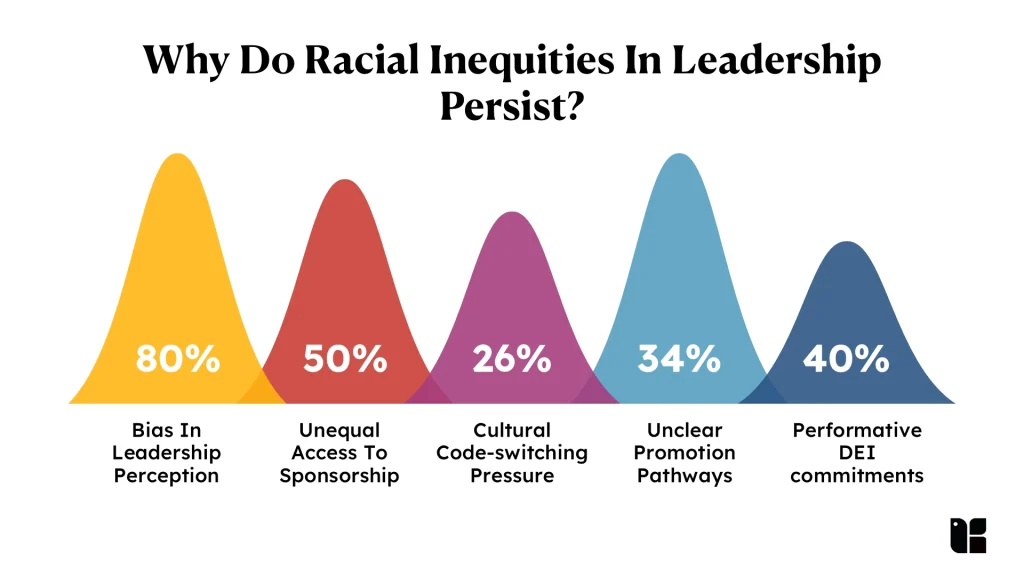
- Bias in leadership perception: Leadership stereotypes continue to equate authority with whiteness, leading racially diverse candidates to have their judgment questioned and to be viewed as ‘not leadership material’ despite equal qualifications. About 80% of C-suite roles are held by white individuals, while only 20% are occupied by leaders from other racial and ethnic minorities combined, a clear reflection of how racial bias still determines who is seen as capable of leading.
- Unequal access to sponsorship: Career advancement often relies as much on advocacy as on ability, yet professionals of colour are far less likely to have senior sponsors who champion their growth. Representation of racial minorities drops sharply between managerial positions and CEO roles, with Black leaders declining by 50%, Latino leaders by 44%, and Asian leaders by 25% between managerial positions and CEO roles, highlighting how unequal access to sponsorship keeps leadership dominated by similar profiles.
- Cultural code-switching pressure: Many professionals of colour feel pressure to adjust their language, behaviour, or appearance to fit dominant workplace norms. This hidden burden undermines belonging and contributes to burnout. Around 25% of employees report facing discrimination, including 26% due to race, revealing how deeply cultural conformity and bias impact daily workplace experiences.
- Unclear promotion pathways: In many organisations, leadership promotions are informal and driven by subjective judgments rather than clear, measurable criteria. This unclear structure allows unconscious bias to define advancement and keeps opportunity confined to the “old network” that favours majority groups. Only 34% of Black employees believe their company’s DEI initiatives are effective, reflecting a deep lack of trust in systems meant to ensure fairness.
- Performative DEI commitments: While Diversity, Equity, and Inclusion (DEI) programs are common, many remain performative rather than structural. Only 40% of employees believe their company’s DEI programs are effective, showing a clear gap between intention and impact. When inclusion becomes a statement instead of a strategy, diversity stays symbolic rather than transformative.
Understanding why racial inequities in leadership persist highlights the depth of systemic barriers. Yet amid these challenges, new shifts are emerging to redefine the future of racial equity in leadership.
Which Shifts Are Defining The Future Of Racial Equity In Leadership?
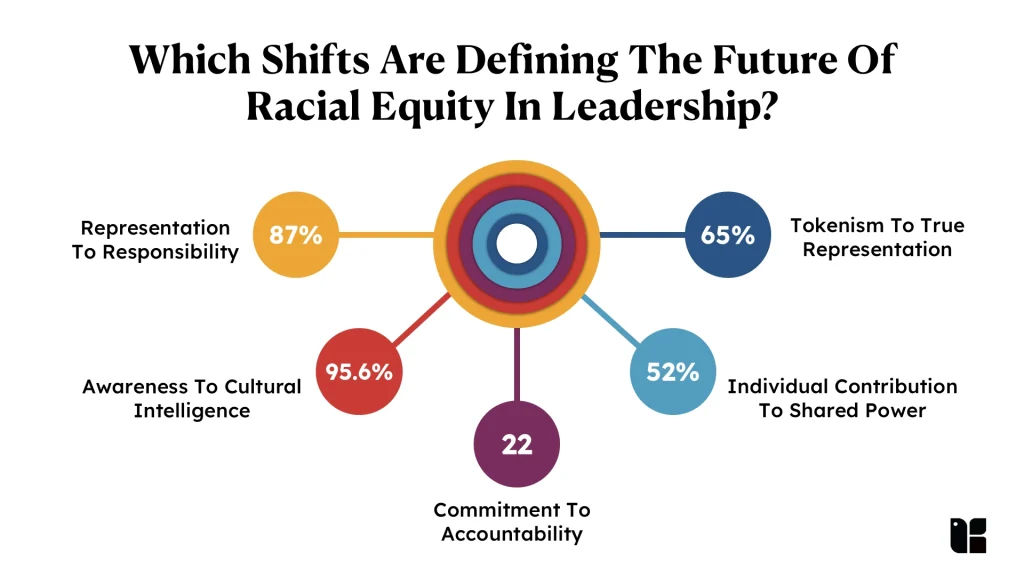
The way organisations view leadership is changing as equity and inclusion become core to progress. There are five major shifts shaping the future of racial equity in leadership, which are as follows:
1. Representation To Responsibility
Representation is no longer enough if it doesn’t come with influence. The future of racial equity will depend on how organisations turn visibility into voice and power. Diverse leadership teams make better decisions 87% of the time, but their impact is often limited when inclusion ends at the meeting room door. Future leaders will be measured not just by the diversity around them, but by the fairness they cultivate within their teams. This means mentoring across racial lines, sponsoring talent that lacks access, and ensuring that decisions reflect a range of lived experiences. Responsibility begins when representation leads to change, not just recognition.
2. Awareness To Cultural Intelligence
Many leaders today understand why diversity matters; fewer know how to lead it. The next generation of leadership will require cultural intelligence: the ability to listen, learn, and adapt across cultures and perspectives. For instance, when leaders understand how different cultural norms influence communication styles or conflict resolution, teams become more trusting and innovative. At Microsoft, 95.6% of employees reported some level of awareness of the concept of allyship in 2024, up from 65% in 2019, reflecting how intentional learning and equity-focused leadership can transform culture across global teams. The future leader will be aware of differences, and they’ll use them as a strength to build connections and collaboration.
3. Commitment To Accountability
The age of diversity statements without accountability is ending. Stakeholders and employees now expect transparency and measurable progress. Only 22 Fortune 500 companies currently publish detailed DEI data, but this trend is growing as credibility becomes the new currency of trust. Future leaders will rely on data to guide progress: tracking who gets promoted, how pay is distributed, and whether opportunity pipelines are truly open to all. This evidence-based approach transforms inclusion from an abstract value into a measurable system. When progress is visible, trust grows, and when leaders are held accountable, equity becomes sustainable.
4. Tokenism To True Representation
In the past, some organisations treated diversity as a checklist item; having one person of colour on a board or panel was seen as proof of inclusion. That is what tokenism looks like, but this mindset is changing fast as companies are moving towards true representation. About 65% of workers aged 18–34 say they would turn down a job if company leadership lacked racial diversity, showing that token gestures no longer build trust. True representation means building leadership that reflects the overall workforce and the world it serves. As 48% of Gen Z identify as racial or ethnic minorities, future workplaces will be forced to confront whether their leadership truly mirrors the communities they serve. Companies that adopt this shift will not only attract better talent but also create more authentic, inclusive cultures.
5. Individual Contribution To Shared Power
Racial equity cannot be achieved in isolation from other forms of inequality. 52% of Black women say they are motivated by the opportunity to influence workplace culture, the highest among all racial and gender groups, and 49% are driven by the chance to serve as role models for others like them. These figures highlight both the strength and determination that underrepresented leaders bring to their organisations, as well as how often their potential to influence culture is overlooked. Shared power means redesigning systems so that leadership reflects multiple perspectives rather than one dominant experience. When leadership includes every identity, decision-making becomes more empathetic, policy becomes more inclusive, and culture becomes more human.
The future of racial equity is being driven by change, but progress requires intention. Organisations must now translate vision into measurable strategies for diverse leadership.
These statistics point to a growing need for leaders who create equitable workplaces. Discover Kapable’s leadership journey to learn how these skills are developed in practice.
How Can Organisations Strengthen Racial Diversity In Leadership?
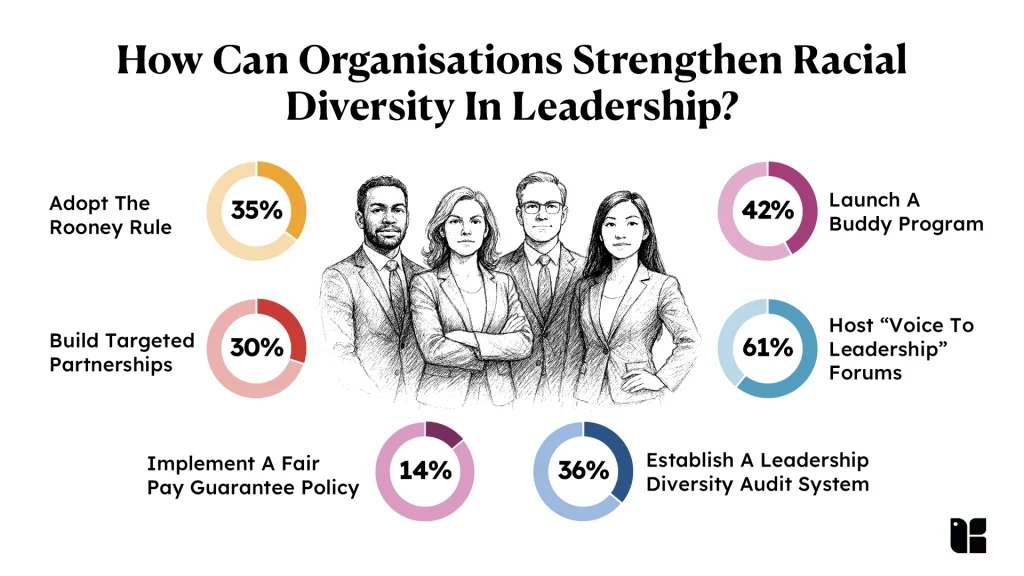
Creating a racially diverse workplace requires more than good intentions. To advance racial diversity throughout the organisation, leaders can implement five key strategies, outlined as follows:
1. Adopt The Rooney Rule
The Rooney Rule ensures that at least one racially diverse candidate is considered for every senior or executive role. Companies with racially diverse teams are 35% more likely to outperform competitors and 19% more likely to see higher revenue. By ensuring racial representation in final interview rounds, organisations move from passive awareness to active accountability. To implement this effectively:
- Find diverse candidates: Use platforms like Jopwell or PowerToFly to reach professionals from underrepresented backgrounds. Partner with local universities or community organisations to build long-term hiring relationships and create talent pipelines that reflect the realities of a diverse workforce.”
- Make interviews fair: Use hiring systems such as Greenhouse or Lever to create structured interview scorecards that evaluate all candidates using the same criteria. Train managers to recognise bias and focus on skills and potential rather than similarity or “fit.”
2. Launch A Buddy Program
A cross-identity buddy program pairs employees from different racial, cultural, or gender backgrounds to promote inclusion. It helps new hires feel welcomed and supported, especially during their first few months. Research shows that employees who feel included are 42% less likely to leave their jobs, and cross-identity interactions strengthen trust across teams. By encouraging employees to build genuine relationships across different teams, organisations create a more inclusive and empathetic workplace culture. To put this into practice:
- Match employees thoughtfully: Use tools like BambooHR or Workday to identify and pair new hires with buddies from different backgrounds. Match people based on shared goals or roles, and schedule introductions during onboarding so relationships start early. Encourage regular check-ins during the first 90 days to build understanding and confidence.
- Track progress: Use feedback tools like SurveyMonkey or Officevibe to ask both buddies how the experience is going. Share quick resources or discussion guides on inclusion and communication, and celebrate strong pairs in internal newsletters or town halls to motivate others to join.
3. Build Targeted Partnerships
Building partnerships with universities, community groups, and professional associations helps organisations connect with diverse talent long before the hiring process begins. These partnerships create ongoing relationships and increase visibility among underrepresented job seekers. Studies show that when firms expanded their hiring channels to include niche platforms and networks serving ethnic minority groups, they reported a 30% increase in candidates from underrepresented backgrounds advancing to interviews. To implement this effectively:
- Work with diverse education networks: Partner with HBCUs or organisations like the National Black MBA Association, to connect with qualified diverse talent. Sponsor job fairs, host guest lectures, or offer paid internships to strengthen relationships and build trust with these communities.
- Track the impact of partnerships: Use simple tools like Airtable or Google Sheets to keep records of hires and engagement from each partnership. Review these results every quarter to see which collaborations bring the best talent and expand those programs over time.
4. Host “Voice To Leadership” Forums
“Voice to Leadership” forums create a safe space where employees of colour can speak directly with senior leaders about their experiences and ideas for improvement. These conversations build trust, accountability, and a sense of belonging across the organisation. 61% of employees have witnessed or experienced workplace discrimination, and many stay silent because they feel their voices won’t lead to change. Regular, structured forums turn feedback into action and guide leaders in practising inclusive behaviour in their day-to-day work. To put this into practice:
- Create safe spaces for dialogue: Use tools like Zoom or Microsoft Teams to host quarterly or biannual open forums. Collect feedback ahead of time through Google Forms so employees can share questions anonymously. Keep discussions guided by clear topics like belonging, growth, and workplace culture.
- Track feedback: Use Notion or Trello to record key takeaways, assign follow-up actions, and share progress updates with the whole company. Recognise leaders or teams that take meaningful steps after these sessions to show that employee input leads to change.
5. Implement A Fair Pay Guarantee Policy
A Fair Pay Guarantee Policy ensures that all employees are paid equally for the same work, regardless of race, gender, or background. It builds trust and shows that fairness is part of how the company operates. According to a study, only 14% of companies worldwide have fully closed racial and gender pay gaps, underscoring how far many organisations still have to go on pay fairness. By reviewing salaries openly and correcting gaps quickly, companies can turn equity into everyday practice. To implement this effectively:
- Compare pay regularly: Use tools like Syndio or PayAnalytics to review pay data by role, race, and gender. Identify gaps and correct them through adjustments or clearer pay ranges. Review results every year to make sure all employees are treated fairly.
- Make pay structures transparent: Use HR platforms like Workday or BambooHR to share salary bands internally so employees understand how pay is decided. Train managers to explain compensation decisions clearly and encourage open conversations about fairness.
6. Establish A Leadership Diversity Audit System
A Leadership Diversity Audit System helps organisations regularly assess how racially diverse their leadership truly is, not just in numbers, but in pay equity and promotion outcomes. Many companies measure diversity only at the entry level, overlooking how racial representation narrows in senior management. According to McKinsey, companies that track leadership diversity transparently are 36% more likely to report above-average profitability, proving that accountability at the top drives both inclusion and performance. To implement this effectively:
- Conduct annual audits: Use analytics tools like Visier or Workday to evaluate leadership representation by race, pay equity, and promotion rates. Break down results by department to identify gaps and hidden bottlenecks.
- Report and act on findings: Share audit outcomes with executive teams and set clear improvement targets. Publish an internal “Leadership Diversity Report” annually to track progress and ensure accountability remains visible across the organisation.
Organisations worldwide are learning how to build more racially diverse leadership structures. The most inspiring examples come from industry leaders already transforming commitments into real outcomes.

How Are Industry Leaders Turning Racial Equity Commitments Into Results?
The following three case studies highlight how leading organisations are implementing strategies to close representation gaps and build more inclusive leadership pipelines:
1. Amazon
In 2021, Amazon’s diversity data exposed a clear gap between workforce inclusion and leadership representation. Across all levels of its U.S. workforce, Asian employees represented 13.2%, while Black and African American employees made up 28.2% and Hispanic and Latinx employees 23.6%. However, these figures dropped significantly at the leadership level. Asian employees accounted for 21.5% of senior roles, but Black employees represented only 5.5%, and Hispanic and Latinx employees just 4.5%. This data reflects a persistent gap in leadership diversity, where representation narrows sharply as positions become more senior. To address this imbalance, Amazon has committed to doubling the number of Black executives and hiring 30% more women for senior technology positions. The company also plans to increase Black representation in corporate roles by 30%. These steps signal a shift from diversity awareness to accountability-driven change, integrating measurable diversity goals into recruitment, leadership development, and promotion strategies.
2. Microsoft
Microsoft’s commitment to racial equity goes further than awareness; it’s anchored in measurable action. In 2020, the company announced a bold plan to double the number of Black and African American people managers, senior individual contributors, and senior leaders in the U.S. by 2025. This goal reflects Microsoft’s recognition that true diversity cannot be achieved without leadership that mirrors the communities it serves. To achieve this, Microsoft has taken a data-driven, accountability-based approach. The company publishes annual Diversity and Inclusion Reports that track progress in leadership representation and pay equity. In addition to internal accountability, Microsoft has invested more than $150 million in diversity and inclusion initiatives. By combining investment and leadership accountability, Microsoft is demonstrating how large corporations can move from symbolic gestures to systemic change.
3. Apple
Apple has long positioned itself as a global leader in diversity and inclusion, but in 2021, the company deepened its commitment by expanding the Racial Equity and Justice Initiative (REJI) with an additional $30 million investment. This initiative focuses on creating pathways for leadership among underrepresented racial groups. Through REJI, Apple funds mentorship programs that strengthen leadership pipelines for Black and Hispanic talent, including the establishment of the Propel Centre. The company also supports the Apple Developer Academy, which equips students from underrepresented communities with technical and leadership skills to prepare them for roles in the tech industry. Internally, Apple integrates racial equity into its executive development programs, emphasising inclusive hiring practices and leadership accountability for diversity outcomes. By investing both inside and outside the company, Apple demonstrates that building racial diversity in leadership requires long-term ecosystem change.
The most transformative organisations treat racial equity as a strategy, not symbolism. By measuring impact and amplifying diverse voices, they redefine what leadership means.
Conclusion
Achieving racial diversity in leadership requires a long-term commitment to redefining how organisations view power, opportunity, and success. Progress is visible across many industries, yet meaningful equity still demands consistent effort and accountability. When companies incorporate fairness into everyday practices and align equity goals with financial targets, they build trust, attract diverse talent, and drive sustainable growth. The future of leadership belongs to organisations that make diversity and inclusion part of how they lead, ensuring every voice is valued and every leader represents the people they serve.
If this approach to building inclusive leadership aligns with your goals, Kapable’s suitability guide can help you decide whether the program is right for you.


