


TL;DR
- Historical Arc of Leadership: The study of leadership evolved from the belief in rare, innate traits (Great Man/Trait Theories) to the understanding that effective leadership is an adaptable, learnable skill defined by context and behaviour.
- Effective Modern Styles: Today’s highest-impact styles like Transformational, Servant, and Democratic leadership emphasise empowerment, collaboration, and collective vision, moving authority from a top-down mandate to a shared partnership.
- Risk of Extremes: Styles at the extremes, such as Autocratic control or Laissez-Faire abandonment, often lead to low morale, burnout, or a lack of clarity, proving that successful leadership demands a balanced approach of guidance and autonomy.
- The Three Pillars of Future Leadership: Navigating complexity requires a blend of human-centred empathy (for well-being), digital fluency (for technological change), and agile adaptability (for constant disruption).
Imagine it’s Monday morning, and a team gathers in a conference room, waiting for the leader’s decision. Instead of giving instructions, the leader asks, “What do you think?” Suddenly, ideas flow, and the room shifts from silence to collaboration. This moment captures a larger transformation that leadership is no longer just about top-down authority but about shared decision-making. Research shows that 98.5% of business leaders now actively seek input from their teams, a practice that strengthens loyalty and develops critical leadership abilities across teams. This blog explores the evolution of leadership thinking, the most common styles shaping workplaces, the direction of leadership’s future, and practical frameworks to guide leaders forward.
What Is Leadership Theory?
Leadership theory is the study of how leadership works, why certain people can influence and guide others, and what conditions make them effective. It offers structured frameworks that explain the behaviours and contexts that define leadership, drawing from psychology, sociology, and organisational science. Early perspectives suggested great leaders were born with innate qualities, while others sought to identify attributes such as confidence, intelligence, or charisma that set leaders apart. Over time, this gave way to ideas that leadership could be learned through actions, and later that educators and organisations could teach leadership theory in ways that adapt to context.
In the modern era, thinking about leadership has expanded to reflect current workplace realities. Approaches today emphasise self-awareness, collaboration, empathy, and inclusion, qualities that employees increasingly value. Recent business leadership statistics reveal that leadership directly influences 70% of employee engagement, and 83% of businesses say efforts to develop leaders are critical to long-term success. By tracing how leadership theories have evolved, organisations gain not just a historical perspective but also practical insights for cultivating leaders who can drive innovation, build trust, and ensure organisational success in a swiftly changing world.
What Does History Reveal About Changing Views Of Leadership?
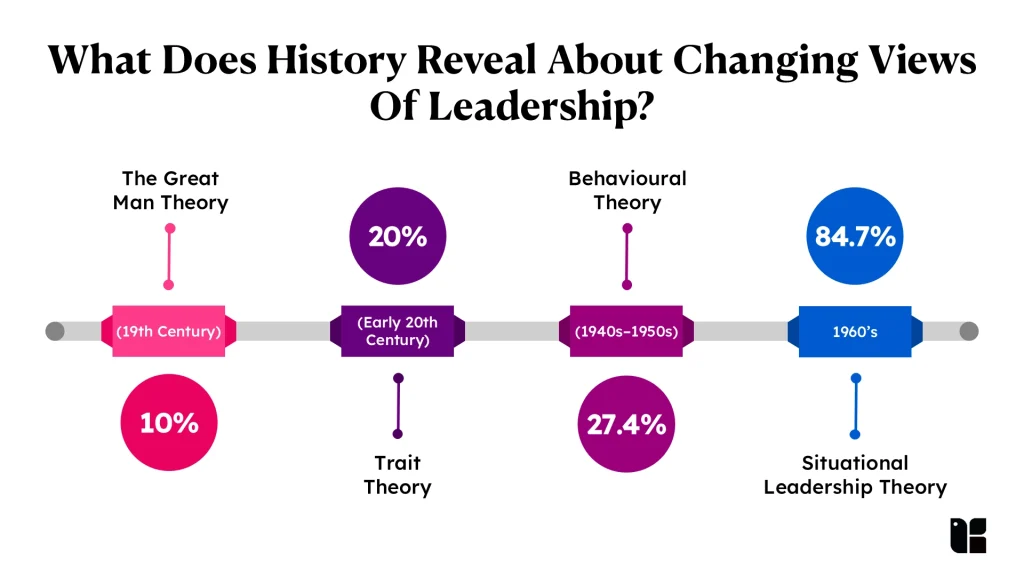
Leadership studies have shifted with each era from seeing leaders as exceptional individuals, to focusing on their actions, and later on how context shapes effectiveness. This evolution shows that leadership is not fixed but redefined by culture and organisational needs.
The Great Man Theory (19th Century)
One of the earliest attempts to explain leadership was the Great Man Theory, which took shape in the 19th century. Rooted in a time of monarchies, military conquests, and revolutionary movements, it reflected society’s belief that history was shaped by a handful of extraordinary figures.
- Central Belief: The theory claims that natural-born leaders are rare individuals with innate qualities like charisma, courage, and vision. This view suggested that leadership positions were reserved for a select few, leaving little room for ordinary people to grow into leadership roles.
- Criticism and evolution: Over time, scholars challenged this rigid view. Research revealed that only about 10% of people possess such natural traits, while many others develop essential leadership skills through experience and context. This criticism shifted attention from destiny to development, setting the stage for later theories that emphasised behaviour and traits.
Trait Theory (Early 20th Century)
With the rise of psychology, researchers began searching for qualities that distinguished leaders from others. Trait theories emerged, suggesting that certain personal traits, like confidence and intelligence, set leaders apart from the rest.
- Central Belief: Leadership traits such as vision, empathy, decisiveness, and influence were seen as the foundation of effective leadership. While some of these appear innate, research indicates that about 20% of individuals can develop them with proper guidance and nurturing.
- Criticism and evolution: Despite shaping decades of research, trait theories faced limitations. Leaders with the same traits often succeeded in one context but failed in another, showing that traits alone could not predict effectiveness. This realisation led scholars to explore behavioural and situational models that emphasised actions and context over static qualities.
Behavioural Theory (1940s–1950s)
In the mid-20th century, leadership studies shifted focus from who leaders are to what leaders do. Behaviours, rather than traits, became the foundation of leadership, reframing it as a skill that could be learned and developed rather than a gift reserved for a few.
- Central Belief: Behavioural theories laid the groundwork for modern leadership development programs, showing that actions such as collaboration and communication can be taught and practised. Surveys show 27.4% of leaders value “leading by example” and 26.2% emphasise collaboration, both behaviours rather than innate traits.
- Criticism and evolution: While this approach highlighted learnable skills, it often ignored the role of context. What proved effective in one situation could fail in another, making it clear that behaviour alone could not fully explain leadership success. This limitation opened the door for situational and contingency theories, which emphasised the importance of adapting leadership style to the environment.
Situational Leadership Theory (1960s)
As research advanced, scholars saw that traits and behaviours alone couldn’t explain leadership. This led to Situational Leadership Theory, which argued that no single style works universally; effectiveness depends on the team’s maturity, the task, and the environment.
- Central Belief: Strong leaders adapt their approach to match the situation, shifting from directing to supporting and empowering as their team grows in capability and commitment. Surveys back this idea that 84.7% of leaders say they grant autonomy, reflecting the modern expectation that leadership flexes toward collaboration and independence.
- Criticism and evolution: Despite its adaptability, situational leadership can be difficult to apply consistently. Leaders may misjudge a team’s readiness or overlook opportunities to coach potential leaders in adapting to the demands of a situation, resulting in mismatched styles and reduced effectiveness. These limitations encouraged the rise of contingency and transformational theories, which further integrated context and vision.
Understanding how leadership styles have evolved explains today’s leadership realities. The next step is to explore practical frameworks that guide leaders in applying theory to everyday choices.

How Have Leadership Styles Evolved In The Modern Era?
Leadership in the modern workplace is no longer defined by rigid hierarchies or command-and-control authority. Instead, leaders adopt styles that reflect how they interact with teams and drive performance. While no style is universally best, research shows clear patterns in their impact on employees and organisations.

Inspiring Growth With Transformational Leadership
Transformational leaders empower their teams by demonstrating leadership behaviours that emphasise vision and personal growth. In the corporate world, where disruption and shifting employee expectations are constant, this style is especially powerful because it equips organisations to thrive in times of change.
- Innovation as a competitive edge: Organisations led by transformational and participative leaders report a 42% higher innovation rate than those with top-down, autocratic models. In a world where innovation often determines survival, this advantage is critical.
- Widespread adoption in business: Around 30% of LLC managers identify as transformational, and 73% of small businesses with such leaders achieve long-term success. This shows the style is not only popular but also proven to sustain growth.
- Revenue growth through vision: Teams under transformational leaders experience up to 35% faster revenue growth than those led by operationally focused managers, demonstrating that vision-driven leadership pays off both culturally and financially.
Empowering Employees With Servant Leadership
Servant leadership flips the traditional power dynamic: instead of employees serving the leader, the leader serves their people. By prioritising the needs of the team, servant leaders build loyalty and psychological safety. In the workplace where employees increasingly value empathy, this approach resonates strongly.
- Commitment through care: Leadership development statistics show that servant leadership increases employee commitment by up to 33%. Organisations are struggling with retaining internal talent, which shows how trust and care translate directly into loyalty.
- Higher engagement levels: Impact on business resilience: Organisations that adopt servant leadership models experience a 34% increase in engaged employees, creating cultures better equipped to withstand disruption and change.
- Proven success in business: About 20% of managers in LLCs adopt this style, and 71% of small businesses with servant leaders achieve long-term success. This demonstrates how servant leadership doesn’t just support individuals, it drives organisational sustainability.
Encouraging Collaboration With Democratic Leadership
Democratic leadership is built on collaboration. Leaders who adopt this style involve their teams in decision-making and encourage shared responsibility. This approach encourages trust and stronger engagement in a workplace where employees want autonomy and a voice.
- Power in participation: Globally, 46.9% of leaders identify as democratic, making it the most common style. This reflects the growing recognition that collective decision-making outperforms top-down approaches in dynamic environments.
- Shared decision-making: Research shows 89.9% of leaders consult employees before making decisions, highlighting how collaboration has become a cornerstone of effective modern management.
- Retention through inclusion: Companies with democratic leaders enjoy a 21% higher employee retention rate, proving that when people feel included and valued, they are more likely to stay committed to the organisation.
Motivating Teams With Charismatic Leadership
Charismatic leaders inspire through personal magnetism. They rally teams during times of uncertainty and create strong emotional bonds that motivate people to exceed expectations. In an unpredictable environment, charisma can be a powerful tool for driving alignment and commitment.
- Emotional connection as an asset: Research shows charismatic leaders excel at creating a strong sense of belonging and psychological safety, a behaviour that 28.4% of employees identify as most valuable in their leaders.
- Motivation during uncertainty: In surveys, 34.7% of employees said the best leaders are those who collaborate as equals, but charismatic leaders often achieve this through inspiration during crises, providing clarity and confidence when it matters most.
- Strengthening trust and satisfaction: A study revealed that employees under charismatic leaders reported a 19.3% increase in job satisfaction, alongside higher trust and commitment to organisational goals, showing charisma’s emotional impact on workplace culture.
Encouraging Autonomy With Laissez-Faire Leadership
Laissez-faire leadership is built on delegation and trust, where leaders step back and allow employees full autonomy in decision-making. While this style can empower highly skilled and self-motivated teams, it often creates confusion and disengagement if employees lack clear guidance.
- Autonomy without support: Surveys show that employees under laissez-faire leaders are twice as likely to experience burnout and workplace stress compared to those under other styles. While autonomy is highly valued today, without guidance or feedback, it can feel like abandonment.
- Disconnect with employee needs: Despite autonomy being valued, 72% of leaders say they let employees resolve conflicts on their own, a practice linked to laissez-faire leadership. Without intervention, this can escalate tensions instead of cultivating healthy independence.
- Productivity risks: Research has found that laissez-faire leadership leads to a 19% decrease in employee productivity. When leaders fail to provide clear goals, teams may lack focus, duplicate efforts, or drift away from strategic priorities.
Driving Authority With Autocratic Leadership
Autocratic leadership is built on control and centralised decision-making, where leaders make choices unilaterally with little to no input from employees. While this style can create clarity and speed in decision-making, it often reduces trust and long-term engagement.
- Clear direction but low engagement: Autocratic leadership can provide quick, decisive action in high-pressure environments, but recent leadership burnout statistics show that 45% of employees under autocratic leaders experience burnout. The lack of voice and involvement often translates to low morale and higher turnover.
- Efficiency at a cost: This leadership style can work when strict rules and procedures are essential, such as in times of political unrest or crisis management. However, 21% of employees globally still view autocratic leadership as viable, suggesting it remains relevant but limited to specific contexts.
- Higher turnover intentions: A study further highlighted that autocratic leadership substantially raises turnover risks. Faculty members under autocratic leaders were approximately 30% more likely to seek alternative employment than those working with more participative leaders.
As leadership styles have adjusted to the modern era, they reveal how adaptability has become central. Looking ahead, leaders must consider which styles will equip them to handle a constantly changing future.
“This journey transformed my confidence and communication skills, enabling me to deliver impactful presentations, including a town hall for 500 people and a compelling business pitch to a senior stakeholder. Kapable has been a game-changer in my professional growth.”
– Ajay Deshmukh (Director At JPMorgan Chase)
Which Leadership Styles Are Needed To Navigate The Future Of Change And Complexity?
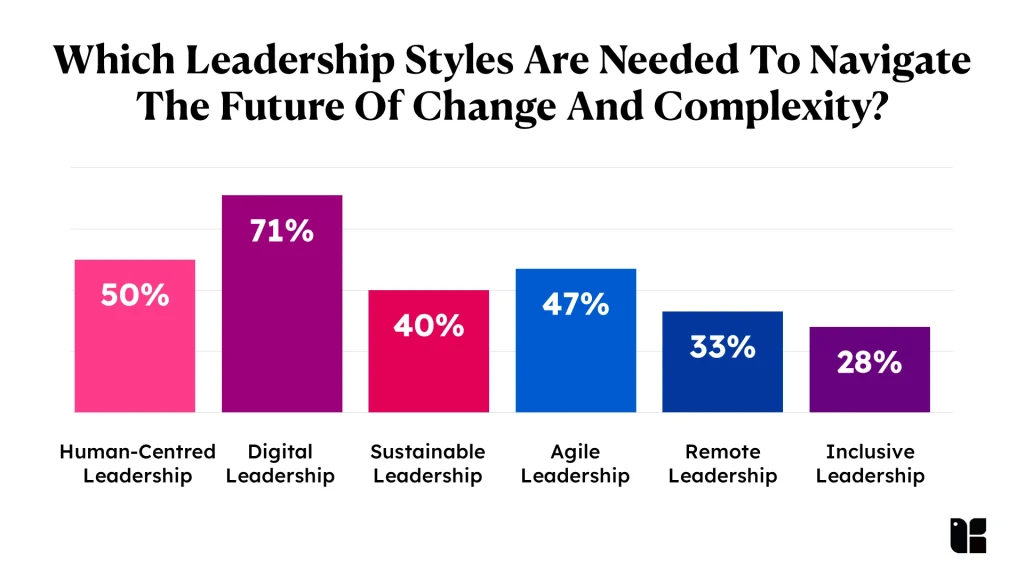
Leadership constantly adapts to the world around it. Digital transformation and rising employee expectations are reshaping what it means to be an effective leader. The future leaders will need to be empathetic, tech-savvy, purpose-driven, agile, and inclusive.
Human-Centred Leadership
Employees now expect their senior leaders to prioritise well-being and demonstrate emotional intelligence. This shift aligns with broader societal changes, where mental health, inclusivity, and work-life balance are becoming central to organisational culture.
- Authentic and ethical leadership reduces workplace anxiety by up to 35%, creating a culture of trust and stability. Lower stress levels improve focus, resilience, and overall well-being, leading to more consistent performance.
- Employees who feel psychological safety and belonging are 747% more likely to be highly engaged. Such environments encourage initiative and creativity, directly fueling productivity and stronger results.
- Teams with high psychological safety are 21 times more likely to share new ideas and spark innovation, showing the power of trust in driving creative performance.
- Organisations that cultivate psychological safety report about a 50% increase in employee engagement, illustrating how emotional safety boosts organisational energy and commitment.
Digital Leadership
From digital-first communication to AI-driven insights, leaders must be digitally fluent and comfortable leveraging tech tools to empower people and streamline processes. AI is also transforming leadership development by providing real-time feedback and personalised coaching.
- Digitally fluent leaders are four times more likely to deliver successful outcomes in technology-driven industries, making digital skills as essential as traditional management abilities.
- AI-powered training platforms are expected to save businesses $20 billion by 2027, and leadership training statistics consistently reveal a positive ROI from technology-driven learning.
- 71% of business executives believe their company is well-positioned in the digital economy, but far fewer believe their senior management has sufficient skills in analytics, advanced tech, or new digital tools.
- 33% of leaders in senior management positions feel well-prepared to lead their businesses in the digital age, highlighting a critical leadership gap in digital fluency. At the same time, 60% of employees across all levels say that staff in their organisation lack the necessary skills to propel the business forward digitally.
Sustainable Leadership
The future of leadership is more than profits; it’s about values and responsibility. Employees, younger generations, want to work for organisations that stand for something meaningful, whether it’s sustainability, ethics, or social impact.
- By 2030, companies with strong sustainability commitments are predicted to attract a talent pool 25% more willing to accept lower salaries for mission-driven work.
- Organisations led by ethical leaders report a 40% improvement in brand perception and public trust, proving that responsibility and transparency pay off.
- Over 40% of Gen Z and Millennial workers say they plan to change jobs due to environmental concerns, and many are specifically attracted to firms with strong ESG credentials.
- Organisations that explicitly weave ESG priorities into business strategy are twice as likely to achieve a 10% boost in revenue compared to peers. This shows that sustainability significantly impacts financial performance.
Agile Leadership
Disruption is the new normal, whether through economic shocks, technological change, or global crises. Leaders of the future will need to pivot quickly, experiment often, and model strong learning capacity within their teams. Agility is no longer optional; it is the difference between resilience and decline.
- Agile leaders are six times more likely to deliver successful organisational transformations, showing that adaptability outperforms rigid planning.
- Research shows companies led by adaptive leaders recover from crises 47% faster than those led by inflexible ones, proving that agility is a competitive advantage.
- According to McKinsey, organisations that have gone through highly successful agile transformations typically see about 30% gains across efficiency, customer satisfaction, employee engagement, and operational performance, while also becoming 5-10x faster in delivering value.
- A study of agile leadership and organisational performance found that agile-led organisations thrive by encouraging innovation, reporting 20-35% higher innovation rates, together with 15-30% improvements in employee engagement across sectors like education, healthcare and tech.
Remote Leadership
The rise of remote and hybrid work has reshaped the definition of leadership, giving rise to a new generation of hybrid leaders. What once relied on in-person visibility and direct oversight now depends on communication and intentional connection across digital spaces.
- 31% of fully remote employees feel “very engaged”, proving that strong engagement is possible when leaders create clarity and purpose-driven connection.
- Employees who are remote by policy are 33% more likely than average to recommend their senior managers, showing that strong leadership doesn’t depend on face time, but on being consistent and supportive even through a screen.
- 27% of hybrid employees often feel isolated, and 14% always feel isolated, underlining the importance of one-on-one check-ins and deliberate team cohesion.
- Employees who are hybrid by choice are 24% more likely to feel their manager supports their growth goals, showing that when leaders champion development without micromanaging location, employees remain loyal and motivated to grow.
Inclusive Leadership
The age of the single “hero leader” is giving way to leadership that is collective and inclusive. Shared leadership distributes responsibility across teams, while inclusive leadership ensures all voices are valued. This shift reflects the modern workforce’s demand for collaboration, equity, and representation.
- Organisations that adopt shared leadership models report 28% higher productivity levels, showing that distributing power strengthens company performance.
- Inclusive leaders achieve innovation rates 2.3 times higher than average, proving that diversity and collaboration directly drive creativity.
- Research shows that inclusive teams are 8.5 times more likely to work effectively together, proving that when diverse voices are welcomed, teamwork and alignment flourish.
- Companies with inclusive and diverse teams report 2.3x higher cash flow per employee, and in smaller businesses, this jumps to 13x higher, showing that inclusivity fuels company culture and profitability.
While theories and styles shape our understanding of leadership, their true value lies in practice. This is where practical frameworks bridge the gap, guiding leaders in daily decisions.
While these findings reveal which leadership styles thrive in complex environments, Kapable’s leadership framework outlines how professionals can develop them in practice.
What Practical Leadership Frameworks Can Help Apply Theory To Daily Decisions?
Leadership theories and styles are valuable, but successful leaders need practical frameworks to apply them in daily decision-making. Below are some proven models and actionable tips:
Hersey–Blanchard Situational Leadership Model
The Hersey–Blanchard Situational Leadership Model suggests that effective leadership depends on adapting your style to the competence and commitment of your team members. As people grow in skills, leaders should shift from giving direct instructions to offering support and eventually granting full autonomy.
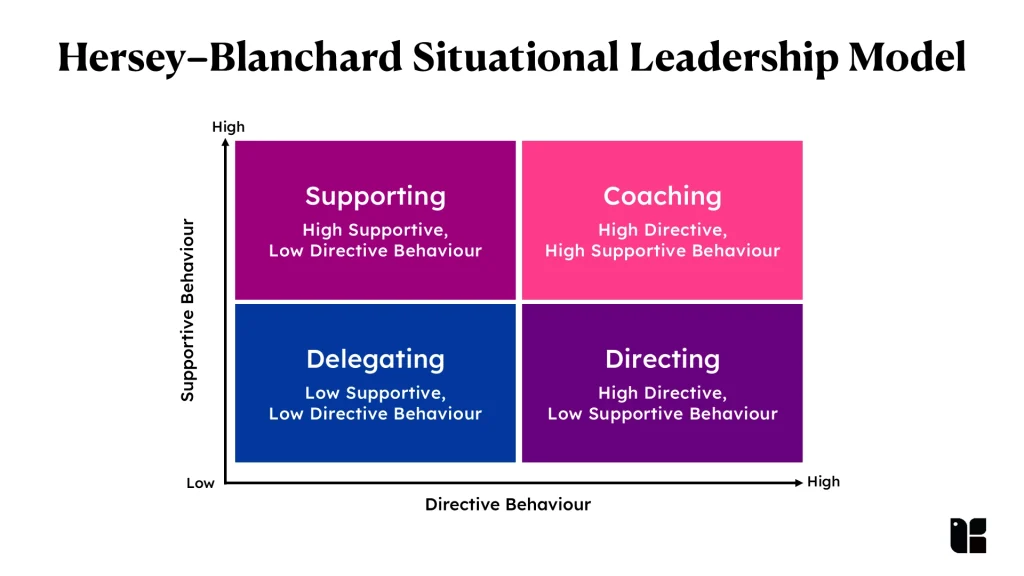
- Directing: This style suits team members with low skills but high enthusiasm. The leader gives clear instructions, defines roles, and closely supervises to ensure tasks are done correctly. It is task-focused and works well for new hires who are eager but inexperienced.
- Coaching: Here, the team has some competence but lacks confidence or motivation. Leaders still provide direction but also explain, encourage, and involve members in dialogue. The focus is on both tasks and relationships, helping employees gain confidence while learning.
- Supporting: When members are fairly skilled but show inconsistent commitment, leaders reduce task direction and instead support, motivate, and share decisions. The emphasis is on collaboration and relationship-building, ensuring capable employees feel engaged and trusted.
- Delegating: This style fits highly skilled and motivated members. Leaders give full responsibility, monitor from a distance, and act as advisors. It empowers capable teams to perform independently and is ideal for experienced employees who can handle projects on their own.
Leader–Member Exchange (LMX) Theory
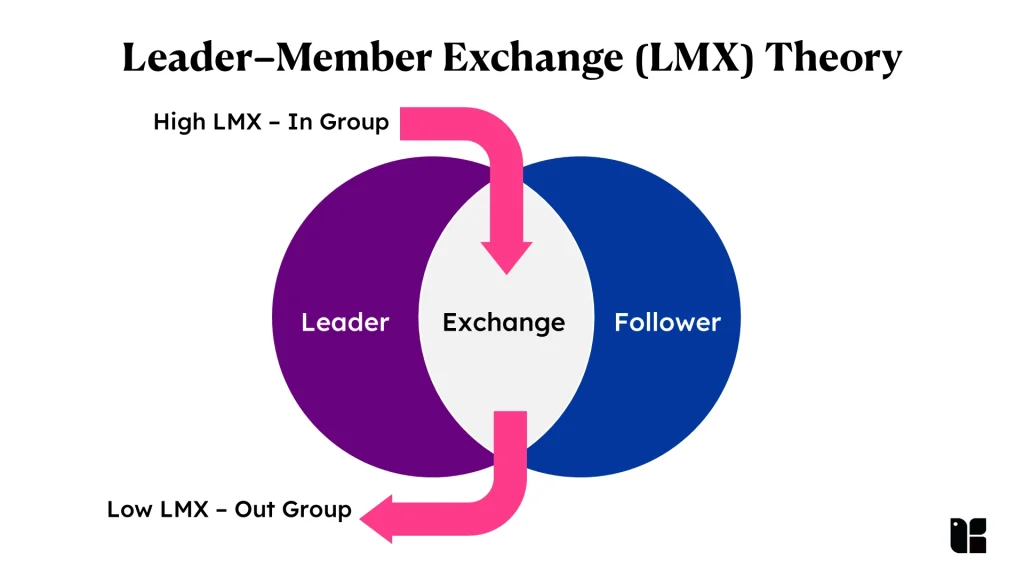
LMX Theory focuses on the relationship between leaders and their team members, arguing that leadership effectiveness depends on the quality of these exchanges. Instead of treating all followers the same, leaders naturally form different types of relationships, which influence support and performance.
- Role Taking: The relationship between a leader and team member begins the moment someone joins the team or starts reporting to a new manager. In this stage, the leader observes skills, experience, and attitude, forming early impressions that guide how opportunities are assigned. These initial interactions set the tone for the relationship, which is why leaders must remain conscious of bias and ensure new members are given fair chances to demonstrate their leadership potential.
- Role Making: As the team member settles into their role and takes on projects, the relationship deepens through collaboration and performance. Leaders, often unconsciously, start to categorise employees into two groups. Those who show loyalty, reliability, and competence are placed in the in-group, receiving more trust, challenging tasks, and development opportunities. Those perceived as less dependable or mismatched become part of the out-group, often left with routine assignments and limited support. This stage is critical because it determines who gains visibility and growth, and who risks being overlooked.
- Routinisation: Over time, these patterns become the norm. In-group members continue to enjoy the benefits of trust, responsibility, and recognition, while out-group members may feel disengaged, undervalued, and stuck. The routinisation stage makes it difficult for individuals to shift groups, reinforcing inequalities within the team. For leaders, this stage serves as a reminder to regularly reassess relationships, intentionally break down barriers, and create opportunities for all team members to stay engaged and thrive.
Four I’s Of Transformational Leadership
Four I’s of Transformational Leadership describe how leaders nurture individual potential and create lasting impact. By applying these principles, leaders rise above transactional exchanges and cultivate an environment where people feel challenged and empowered to achieve more than they thought possible.
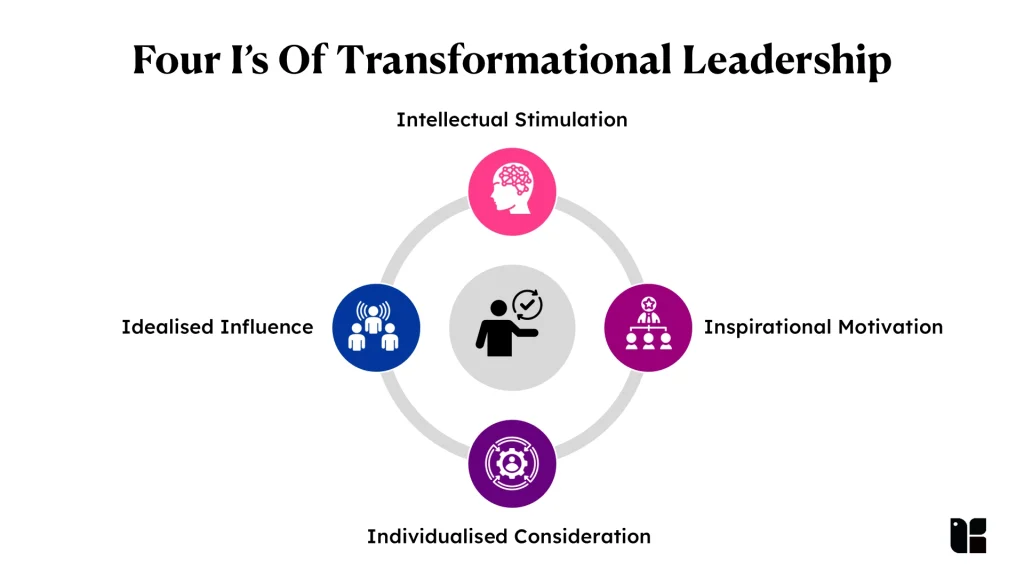
- Intellectual stimulation: Start by encouraging your team to think differently. Instead of always providing solutions, ask open-ended questions that challenge assumptions and push people to explore alternative approaches. Create space for brainstorming and make it clear that no idea is “too out there.” When team members see that their creativity is valued, they feel more confident to innovate.
- Individualised consideration: Apply this approach by tailoring your attention to the personal strengths and requirements of each person. Take time to listen to their concerns, career goals, and personal motivations. Offer mentorship, delegate tasks that align with their skills, and provide constructive feedback tailored to their growth. Small gestures like recognising achievements or checking in personally can build strong trust and loyalty.
- Inspirational motivation: Focus on communicating a vision that excites and unites your team. Frame everyday work in the context of a bigger purpose and highlight how individual contributions move the group closer to that goal. Use positive language, share stories, and show passion for the mission. When your enthusiasm is genuine, it energises others and keeps them motivated during challenges.
- Idealised influence: As a leader, you cultivate it by serving as the role model your team aspires to follow. Demonstrate integrity in your decisions, follow through on promises, and stay accountable even when things get difficult. Lead by example, whether it’s putting in the extra effort, handling conflict with fairness, or admitting mistakes. Your consistent actions set the standard, and over time, your credibility and values will inspire others to emulate you.
Leadership continues to evolve, shaped by theory, practice, and the demands of uncertain times. What remains constant is the responsibility of leaders to adapt and guide their organisations toward stability and growth.
Conclusion
The evolution of leadership theory reflects a broader transformation in how organisations and people understand influence, authority, and collaboration. From the early belief that leaders were born with innate greatness to today’s focus on adaptability, inclusion, and vision, leadership has shifted from being a privilege of a few to a practice that can be learned, nurtured, and shared. Modern workplaces demand senior leadership that drives results and creates environments of empathy and innovation. The statistics are clear: leadership influences everything from employee engagement and retention to innovation and long-term business success. As technology, culture, and global challenges continue to redefine the future of work, leaders who prioritise agility, sustainability, and digital fluency will stand at the forefront of progress.
If these statistics have highlighted the need for future-ready leadership, Kapable’s suitability guide can help you determine whether the program aligns with your goals.


