


TL;DR
- The Foundational Role of Leader Confidence: A leader’s sense of certainty is the key anchor for team morale, fostering a stable culture and enabling clear, purposeful decisions during ambiguity.
- Widespread Organisational Damage: When leadership self-doubt is present, it quietly sabotages organisational health, leading to lower engagement, decision delays, and a chronic spread of stress and misalignment.
- Perception Is Reality for Teams: A notable disconnect exists where leaders overestimate their team’s feeling of support, directly contributing to employee burnout, increased stress, and higher rates of staff turnover.
- System for Building Assurance: Lasting confidence is a structured outcome of clear onboarding, formal skill assessments, consistent coaching, and an environment that prioritises psychological safety for learning.
Have you ever been asked how confident you feel as a leader? Chances are, your answer might be “probably never.” Confidence is one of those things we want leaders to possess but never necessarily discuss. And the numbers reveal a growing gap between how confident leaders feel and how supported their teams are. From rising employee burnout and stress to gaps between how leaders think they’re doing versus how teams feel, there’s a lot hiding beneath the surface. In this blog, we’ll explore why confidence matters more than ever, what happens when it slips, and how high-quality leaders can rebuild it.
Why Does Confidence In Leadership Matter?
Confidence gives leaders the ability to stay calm under pressure, make clear decisions, and guide their teams with purpose. It’s a matter of trusting oneself to act even during times of uncertainty. When a confident leader is on board, his or her team knows it. It creates a feeling of stability that keeps people centred and motivated, particularly in times of change or adversity.
Confident leadership also helps build stronger relationships within a team. People are more likely to speak up and try new ideas when they feel their leader believes in them and in themselves. Without confidence, even the most skilled leader can struggle to earn trust or move things forward. Over time, this can shape how people feel about their work, their value, and their future in the company. This is why leadership confidence matters so much; it influences the entire culture. Let’s now explore how low confidence in leadership shows up across teams and what it means for day-to-day performance.

How Does Low Confidence Affect The Entire Team?
Confident leadership creates a ripple effect that plays a crucial role in how teams show up, connect, and grow. Here’s how it shows up across the board:

- Morale drops quickly: People look to leaders for stability. Teams may start to feel like they’re working without direction or recognition. One study showed that 50% of employees have left a job due to bad management, often tied to poor leadership presence and unclear direction. Over time, this leads to disengagement and that quiet growth mindset that’s tough to reverse.
- Decision-making slows down: Confident leaders help teams move forward. But when there’s hesitation at the top, decisions get delayed or endlessly debated. Only 27% of employees believe their executives value their ideas. Teams can spend more time waiting than doing, leading to lost momentum and missed opportunities.
- Communication becomes unclear: A lack of leadership confidence often leads to vague or mixed messages. Around 86% of employees blame poor communication for workplace failures, and 57% say it directly causes project downfall. This creates a cycle of misalignment that affects everything from strategy to daily work.
- Innovation gets stifled: People are more likely to speak up, take risks, or pitch new ideas when they trust their leaders and their leadership style. 74% of employees want more transparency. This slows down creativity and problem-solving. In workplaces that reward only “safe” thinking, innovation becomes the first thing to disappear.
- Stress spreads wider: When leaders are stressed and unsure, they often pass that energy to their teams. 35% of employees cited their supervisor as their number one stressor at work. This emotional strain builds fast, and soon, entire teams feel burnt out, not because of the workload, but because of the emotional weight behind it.
Low confidence in leadership often reflects deeper disconnects in how leadership is experienced across levels. Let’s now look at how leaders and employees experience confidence differently.
What Is The Confidence Gap Between Leaders And Employees?
When leaders lose confidence or fail to show it, it quietly sets the stage for a leadership crisis that affects everything. Here’s how low confidence in leadership shows up across the workplace:

- Trust begins to fade: When leaders seem unsure or inconsistent, it’s hard for employees to feel secure. People hesitate to speak up or hold back ideas. Research shows 90% of top managers are confident in their leadership team, but only 77% of employees agree. That gap in trust can lead to frustration, tension, and poor communication.
- Burnout becomes common: Leaders who don’t feel confident often carry extra stress. Over time, that pressure is distributed to their teams. Studies show 72% of leaders feel drained at the end of the day, up from 60% just a few years ago. When leaders are burnt out, they’re less available and more reactive, which makes it harder for teams to stay focused and motivated.
- Recognition drops off: Leadership sets the tone. If a leader seems unsure or distant, the team may feel overlooked or unsupported. Nearly 80% of employees have left their jobs because they didn’t feel valued, and that often traces back to poor or unclear leadership positions. When confidence is missing, recognition and encouragement also tend to drop.
- Transitions get harder: New leaders often step into roles without proper support. Between 50% and 70% fail within their first 18 months. Many say they didn’t get enough onboarding or training. When people take on big responsibilities without the right tools or guidance, confidence suffers, and so does performance.
- Turnover rates rise: A third of employees say their manager is the biggest source of stress at work. Others say leadership changes alone raise their stress levels. Over time, these issues push people out. Around 44% of employees have quit because of a bad boss. Without strong, confident leadership, it’s hard to keep good people.
Gaps in perception are closely linked to how leadership opportunities are structured and communicated. Let’s now explore how leadership pathways shape the trust people place in those who lead.
“Kapable has elevated my self-awareness to a degree I couldn’t have imagined. Some of the intrinsic aspects they touched upon impacted me emotionally, physically, and psychologically. It was a holistic approach, not just to how you operate at work, but also in your interactions with family and friends. The benefits of joining Kapable have been immense, and the learnings I’ve gained will stay with me for a long time.”
– Sreemoyee Banerjee (Service Delivery Leader At American Express)
How Does Leadership Development Build Confidence?
People notice who gets leadership roles and who doesn’t. When the process feels unfair or limited, it can lower confidence across the board. Here’s how that shows up at work.
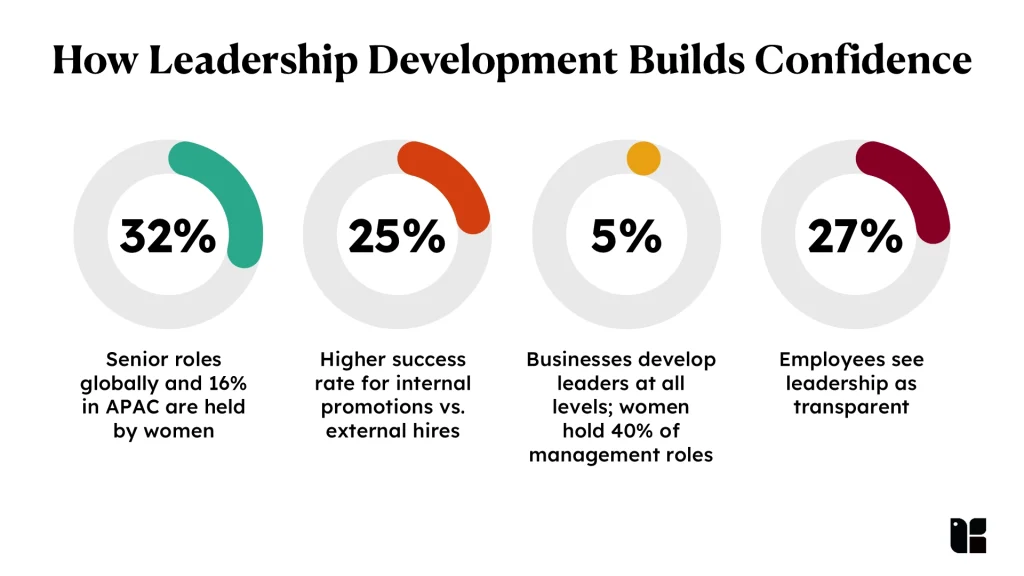
- Development strengthens confidence: Globally, 75% of leaders who participate in leadership training report feeling more confident in making strategic decisions. This rise in confidence directly impacts how leaders handle complexity, make high-stakes choices, and perceive their own ability to lead effectively.
- Promotion practices impact morale: Internal promotions are 25% more likely to succeed than external hires, yet many organisations still favour outside candidates. That sends the wrong signal to employees working hard internally. When people feel overlooked or see favouritism, it reduces their faith in the system and in those chosen to lead.
- Lack of diversity limits innovation: Diverse leadership teams outperform more homogenous ones, yet only 5% of businesses develop effective leadership at all levels, and women still hold just 40% of management roles. Without broader development opportunities, organisations miss out on voices that could strengthen confidence across the board.
- Transparency drives trust: When the path to leadership feels murky, so does faith in the people leading. Only 27% of employees believe their company’s executives genuinely value and support their ideas. Clear, fair, and inclusive leadership pathways help build trust in leadership and belief in upward mobility.
If confidence gaps often start with who gets chosen to lead, the next step is figuring out how to build that confidence once someone is in the role. Let’s look at what actually helps leaders feel sure of themselves and earn the trust of their teams.
Learn more about Kapable’s approach to building lasting leadership confidence through practical coaching, real-world simulations, and personalised feedback.
What Builds Leadership Confidence?
Confidence in leadership grows through habits and self-awareness. Prepared leaders show up with steady confidence that helps teams achieve common goals. Here’s what makes the biggest difference:
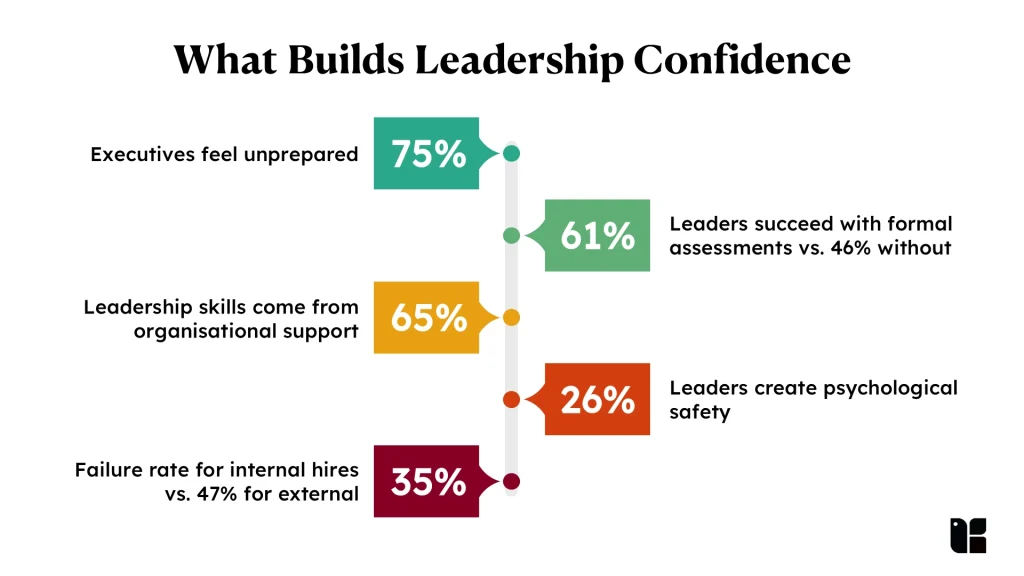
- Strong onboarding: Leaders who go through structured onboarding and know exactly what’s expected of them feel more confident, and emerging leaders feel valued right from the start. Yet three-quarters of executives say they feel unprepared for their roles, often due to unclear expectations and limited training. Clear direction from day one helps leaders hit the ground running.
- Formal training: Confidence grows when leaders understand their strengths and where they need to grow. 61% of leaders who had smooth transitions received formal assessments, compared to nearly half (46%) who struggled. Leadership training builds self-belief through constructive feedback and reflection.
- Organisational support matters: Leaders thrive when they’re backed by their organisation. In one survey, employees said that 65% of the senior leadership and interpersonal skills they gained came directly from organisational support. Coaching and open communication all help leaders feel less alone and more capable.
- Psychological safety: Leaders thrive when they’re in environments that let them admit mistakes, ask questions, and show vulnerability. In fact, just 26% of leaders report creating psychological safety on their teams. That means most leaders struggle to build the kind of environment where confidence can grow, leaving many unsure and unsupported.
- Internal promotion: Leaders promoted from within tend to feel more confident because they know the culture and the team. Internal new hires have a 35% failure rate, while external ones fail 47% of the time. Promoting from within sets leaders up with existing trust and context, boosting both confidence and performance.
Building confidence takes the right support. Let’s look at how some companies are starting to back their leaders with real development.
How Are Organisations Investing In Leadership Development?
Helping leaders lead effectively has become a key priority, supported by leadership development programs and assessments. Here’s how organisations are putting their money and time into building better leaders:
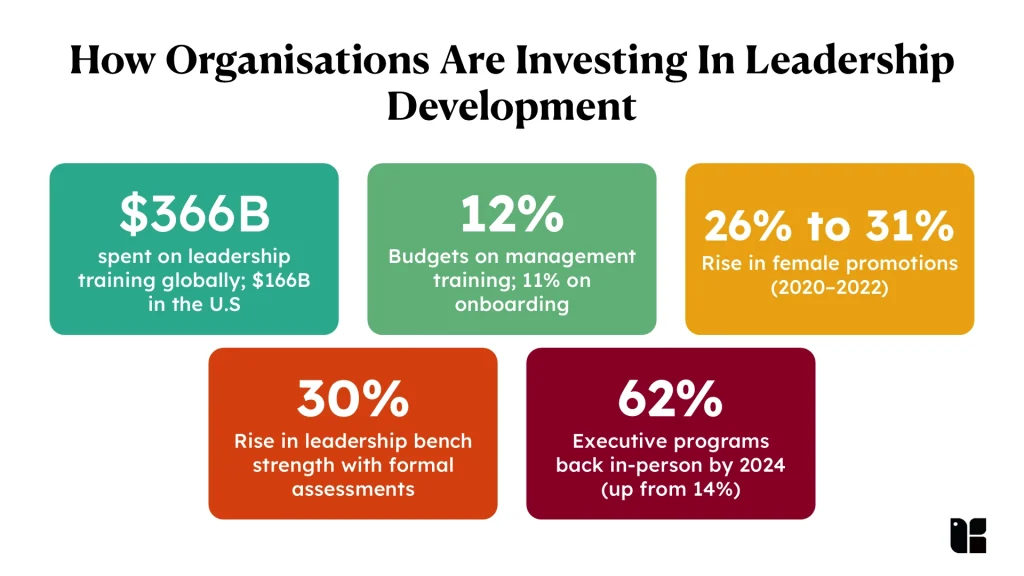
- Massive training budgets: Leadership development is a big investment. Globally, it’s a $366 billion industry, with $166 billion spent in the U.S. alone. Even small businesses spend around $459,000 per year on training, showing a strong commitment to building future leaders. This scale of investment highlights how seriously organisations take leadership readiness, but also raises questions about what works.
- Focus on soft skills: Soft skills like empathy, decision-making, and leadership skills continue to be seen as core to building leadership that lasts. Companies put 12% of their training budgets into management and supervisory training, and 11% into onboarding key priorities that shape a leader’s early confidence and long-term success.
- Tracking growth efforts: More companies are watching how leadership grows within their teams. More companies are now measuring how many women are moving up. In fact, the number of female promotions rose from 26% in 2020 to 31% in 2022. This shift toward tracking internal progress is helping organisations stay more accountable and more aware of slow-moving gaps.
- Using formal assessments: Leaders who go through structured evaluations, like psychometric tests or 360° feedback, tend to make smoother transitions. Companies that use these tools report a 30% increase in bench strength, helping future leaders feel more capable and employees feel confident in their roles. These tools enable leaders and their organisations to have a clearer sense of where growth is happening and where support is needed.
- Adapting to hybrid learning: As workplaces move towards flexibility, continuous learning formats are evolving too. By 2024, 62% of executive education programs had returned to in-person delivery, up from 14% in 2020, while online and hybrid formats continued to serve those needing flexibility. Leaders now benefit from a mix of in-person depth and remote convenience.
Now that we know what builds leadership confidence, the next step is to see how organisations are supporting it in practice.
How To Close The Leadership Confidence Gap?
Bridging the gap between confident leaders and the teams they guide is essential for performance. Here’s how organisations and individuals can work together to close this gap:
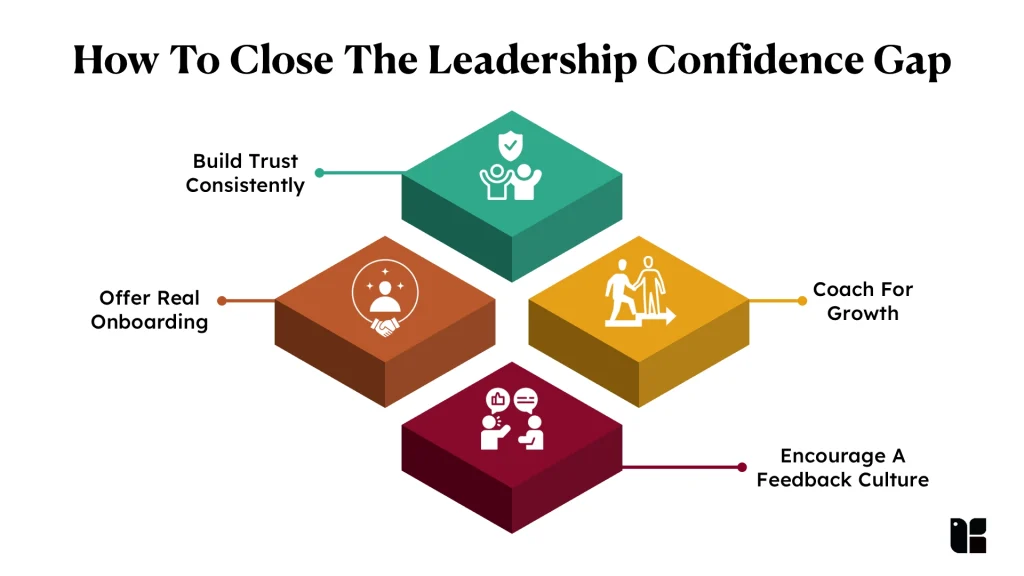
- Build trust consistently: Confidence starts with trust. Leaders who are transparent, listen actively, and admit mistakes earn respect. However, there’s still work to do only 27% of employees feel their executives genuinely value and support their ideas. Closing that perception gap means company leaders need to show up with honesty and humility.
- Offer real onboarding: Many leaders feel unprepared because onboarding is too rushed or vague. A structured process that includes mentoring, role clarity, and expectations can quickly boost a leader’s confidence and alignment.
- Encourage a feedback culture: Leaders need feedback, too. 61% of leaders who received formal assessments had smoother transitions. Regular feedback helps leaders grow, correct course, and understand how they’re perceived key to building self-confidence.
- Coach for growth: Multiple DDI reports reveal that 40% of frontline leaders report insufficient coaching from senior managers, and 31% want more. Investing in one-on-one coaching and peer support gives business leaders the space to reflect, improve, and feel more secure in their roles.
With the challenges clear, closing the leadership confidence gap becomes a critical step. These actions can help move leaders and organisations forward.
Professionals looking to strengthen confidence, executive presence, and communication can explore Kapable’s fit assessment to see whether the program matches their development needs.
Conclusion
Confidence in leadership is how teams function and stay engaged. The numbers paint a clear picture: when leaders are confident, job performance improves, and people stay. However, confidence can’t be assumed; it has to be built deliberately through feedback and coaching. As organisations rethink how they support leaders, the focus should move from quick fixes to building long-term skills. When confident leadership meets team trust, it strengthens the entire workplace. Sustaining that confidence over time is what turns leadership from a role into a shared foundation for culture and performance.


