


TL;DR
- Defining Cognitive Advancement: True problem-solving and innovation require a pause for reflection and engagement with complex thought processes like analysis, evaluation, and creative synthesis, not just gut reactions or memorisation.
- A Cognitive Framework: Bloom’s Taxonomy structures thinking into a hierarchy, illustrating how foundational skills like remembering and understanding build up to the more complex, higher-order skills of analysing, evaluating, and creating.
- Universal Life Skill: These skills are essential across all facets of life, from allowing students to master complex academic subjects to empowering professionals to make strategic decisions and individuals to critically navigate abundant daily information.
- Methods for Development: Cultivating HOTS is achieved through varied practices, including interactive educational technology, collaborative team challenges, curiosity-driven inquiry, and the critical reflection promoted by the Socratic method.
“The eye sees only what the mind is prepared to comprehend.” – Henri Bergson, French Philosopher and Educator
What’s more important to you, trusting your first instinct or taking the time to question it? We often rely on our gut reactions to make quick decisions. It’s easy to fall back on what we already know or rely on quick fixes. But true problem-solving requires more than just memorising facts or following the same patterns. It calls for analysing the situation from different angles, weighing the pros and cons, and thinking creatively to come up with new solutions. In a world where complexity is the norm, whether in education, work, or everyday life, the ability to pause, reflect, and engage in high-order thinking is what sets individuals apart.
What Are Higher-Order Thinking Skills?
Higher-order thinking skills (HOTS) refer to advanced cognitive processes that involve more than just recalling facts. They require individuals to engage deeply with information, analyse it from different perspectives, evaluate its significance, and create new ideas or solutions. Unlike lower-order thinking skills, which focus on basic recall and understanding, HOTS push you to use your knowledge in more complex and innovative ways.
HOTS involve:
- Analysis: Breaking down information into its components to understand its structure and relationships.
- Evaluation: Judging the value or effectiveness of information, arguments, or solutions based on criteria and evidence.
- Creation: Combining different pieces of information to generate new ideas, products, or solutions.
These skills are crucial in various contexts, from academic learning to everyday problem-solving and professional decision-making. They enable us to approach problems critically, make informed decisions, and develop innovative solutions.

Bloom’s Taxonomy
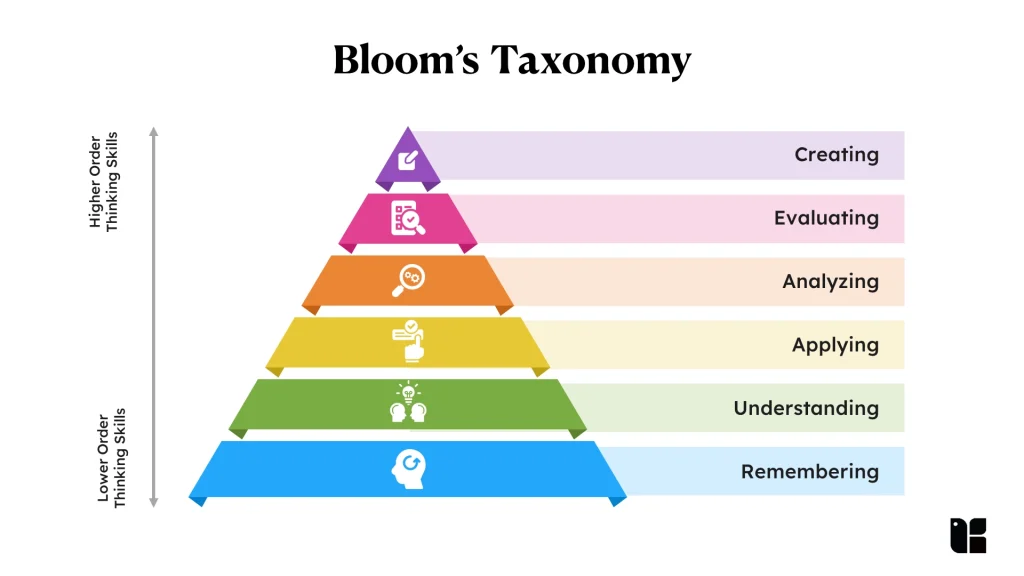
To better understand HOTS, we turn to Bloom’s Taxonomy, a framework developed by educational psychologist Benjamin Bloom. This taxonomy categories cognitive skills into a hierarchy, illustrating how levels of thinking evolves from basic to more complex ones, illustrating how each level builds upon the previous one, transitioning from lower-order thinking skills (LOTS) to higher-order thinking skills (HOTS).
- Remembering
At this foundational level, you focus on recalling basic facts and information. For instance, memorising historical dates or definitions is a start, but it only involves surface-level engagement with the material. - Understanding
This stage involves grasping the meaning of the information you’ve recalled. For example, explaining the causes of historical events in your own words shows a deeper comprehension beyond mere memorisation. - Applying
Applying takes your understanding and uses it in new contexts. For example, using a mathematical formula to solve a problem demonstrates how you can take knowledge and put it to practical use. - Analysing
At this level, you break down complex information into its components and examine their relationships. Analysing a case study involves identifying patterns and assessing evidence, moving beyond simple application to a more detailed examination. - Evaluating
Evaluation requires making judgments about the quality or effectiveness of information based on criteria and evidence. For instance, critiquing the strengths and weaknesses of an argument shows advanced thinking that involves assessing and judging information. - Creating
The highest level involves synthesising information to generate new ideas or solutions. Creating a novel research proposal or designing an innovative product illustrates how HOTS culminate in the ability to develop original and effective solutions.
By progressing through these stages, from recalling basic facts to creating new ideas, Bloom’s Taxonomy helps us understand how higher-order thinking skills are built upon foundational knowledge to enable more complex and insightful thinking.
“Kapable has played a crucial role in my growth. I joined to overcome challenges with public speaking and impromptu situations, especially in larger settings. The sessions helped me structure my ideas better and shift from reacting impulsively to responding thoughtfully, improving my workplace interactions. The tools and techniques I’ve learned have greatly boosted my confidence and clarity.”
– Jainil Vadhan (Programmatic Solutions Consultant At Amazon)
Why Is It Important To Develop Higher-Order Thinking Skills?
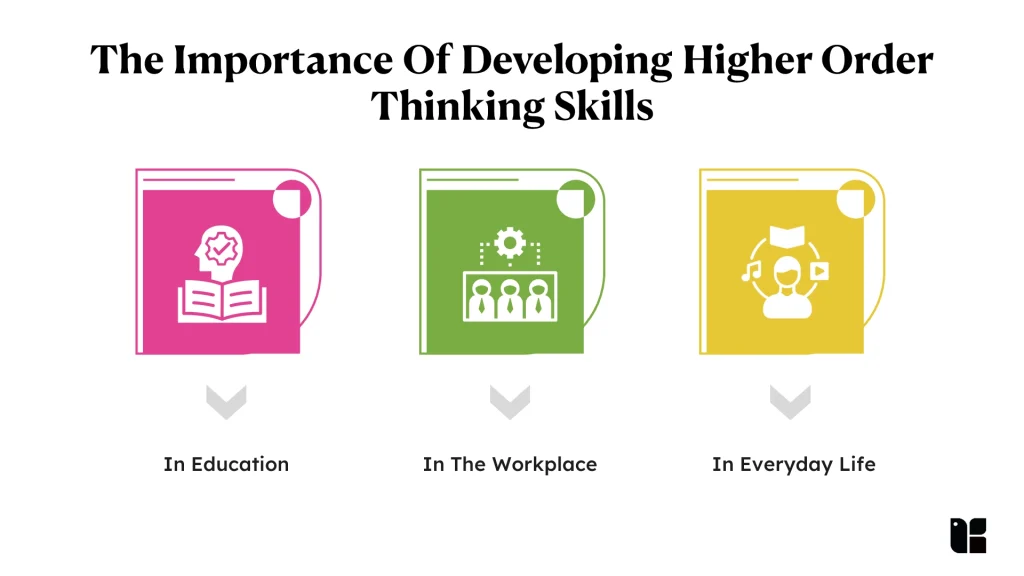
Higher-order thinking is not just like academic tools; they are essential across all areas of life, enabling individuals to navigate complex situations with deeper insight and creativity.
In Education
Developing HOTS is crucial for students as it allows them to master complex concepts across various subjects. In maths, students use HOTS to solve complex problems by applying and analysing mathematical theories rather than just memorising formulas. In science, HOTS enable students to design experiments, analyse results, and make informed conclusions. In literature, HOTS help students critically analyse texts, interpret themes, and create insightful arguments about the material. Mastering these skills enhances their ability to understand and apply knowledge in diverse academic areas.
In The Workplace
In a professional setting, HOTS are essential for effective problem-solving, innovation, and decision-making. Employees who can analyse data, evaluate options, and create strategic solutions often stand out as exceptional performers. Such as in a business environment, HOTS enable professionals to develop innovative marketing strategies, critically assess market trends, and make strategic decisions that drive company success. This ability to think critically and creatively can significantly differentiate between average and exceptional professionals.
In Everyday Life
HOTS are equally valuable in everyday situations, especially in the digital age where information is abundant and often overwhelming. Being able to critically analyse news articles, evaluate the reliability of sources, and create informed opinions helps individuals make better decisions. For instance, when faced with conflicting health advice online, applying HOTS allows individuals to assess the credibility of sources and make well-informed choices about their wellbeing.
Higher-order thinking enables professionals to move beyond memorising information to making better decisions, and Kapable helps build these skills through structured practice and feedback.
What Techniques Help In Developing Higher Order Thinking Skills?
Whether in the classroom, workplace, or everyday life, various methods can foster critical thinking and problem-solving capabilities.

Educational Technology
In classrooms, teachers can use these tools to move students beyond rote learning and into more complex problem-solving activities through interactive learning experiences. Digital tools, apps, and games like Kahoot and Quizlet foster critical thinking by challenging students to apply and evaluate information interactively.
Collaborative Learning
In the workplace, teams can engage in collaborative brainstorming sessions or cross-departmental projects where they challenge each other’s viewpoints to find innovative solutions. Team-based projects and group discussions enable individuals to analyse different perspectives, enhancing critical thinking and problem-solving abilities within a team setting.
Inquiry-Based Learning
In everyday scenarios, people can apply inquiry-based learning by critically researching products before buying, exploring new hobbies, or even analysing news reports to form their own opinions. Encouraging curiosity and research-driven learning, this method pushes individuals to ask questions, explore new ideas, and draw informed conclusions in daily life.
Socratic Method
Leaders can use the Socratic method in meetings by asking their team probing questions, encouraging them to think critically about strategies, decisions, or new ideas, ultimately fostering better decision-making. A questioning technique that promotes critical thinking by encouraging individuals to reflect deeply and evaluate their reasoning.
For instance, rather than asking “What’s our best option?” a leader might ask, “What are the potential risks if we choose this option, and how could we address them?” or “Why do you think this is the best solution, and what evidence supports your reasoning?”
By integrating these techniques into the different areas of life, we can enhance our ability to think critically, innovate, and solve complex problems
Conclusion
To further explore and enhance your Higher-Order Thinking Skills (HOTS), consider diving into resources like Edward de Bono’s Six Thinking Hats for structured thinking strategies. Tools like MindMeister for mind mapping or Lumosity for cognitive training can help you practise these skills in real-time. Development of HOTS is an ongoing journey; these resources will keep you moving forward.
Higher-order thinking becomes stronger when professionals apply it to real workplace challenges, and Kapable gives you an opportunity to explore whether it’s the right fit.


