

TL;DR
- Complementary Forces in Leadership: IQ provides the technical expertise and analytical skills for problem-solving, while EQ offers the emotional and social intelligence to effectively lead teams and resolve conflicts.
- Distinct Measures of Capability: IQ assesses logic, memory, and problem-solving for academic success, whereas EQ measures self-awareness, empathy, and social skills crucial for interpersonal relationships and emotional resilience.
- Success Requires Synergy, Not Choice: The historical debate misses that neither high IQ nor high EQ is sufficient alone; they work together in a positive correlation, where strength in one can enhance the other for overall success.
- Continuous Development is Possible: While formal tests like the WAIS and MSCEIT measure current levels, both cognitive intelligence and emotional intelligence can be intentionally improved through practices like critical thinking exercises and daily emotional check-ins.
Have you ever wondered why some people seem to excel in school and standardised tests, yet struggle with social situations, while others may not be the brightest students but manage to form solid connections and overcome obstacles in life with ease? Our two unique forms of intelligence, Emotional Quotient (EQ) and Intelligence Quotient (IQ), may hold the key to the solution.
For many years, IQ was the only indicator of intellect for human intelligence. However, in recent years, EQ has come to be recognised as being extremely important for both professional and personal success. This blog will explore the ongoing debate about IQ and EQ, examining their complexities. We’ll discuss ways to assess and improve both types of intelligence, helping you recognise your strengths and maximise your potential. Since IQ and EQ can affect each other, it’s valuable to develop and comprehend both for overall success.
How Can EQ And IQ Be Understood Together?
Suppose you’re a project manager leading a team tasked with developing a new software program. Both IQ and EQ will be essential to how well you do, influencing your approach in specific ways. IQ offers the expertise, resources, and methodology for analysis needed to deal with technological difficulties. EQ gives you the emotional skills necessary to oversee team dynamics and guarantee efficient delivery of projects. Let’s see how:
IQ (Intelligence Quotient)
IQ, or Intelligence Quotient, is a numerical measure of a person’s cognitive ability relative to others, typically assessed through standardised tests. Your strong IQ allows you to break down complex technical challenges related to the software’s design. You can analyse user needs and identify potential bugs or limitations in the system. For example, you might recognise a logical flaw in a specific code and propose alternative solutions to improve efficiency. Your IQ makes it easier for you to comprehend technical concepts and programming languages. You can efficiently analyse data and make informed decisions about the project’s direction.
EQ (Emotional Quotient)
This refers to your emotional intelligence skills– how you manage your own emotions as well as those of others. It will allow you to inspire and motivate your team members. You can clearly communicate the project’s goals and vision, fostering a sense of purpose and shared ownership. By understanding individual strengths and challenges, you can delegate tasks effectively and create a collaborative work environment. EQ also aids in resolving interpersonal disputes that may arise within the team. You can empathise with team members’ frustrations, listen actively to their concerns, and find solutions that address everyone’s needs. Open and honest communication, facilitated by your EQ, keeps the team focused on achieving the project goals.
While strong technical skills (IQ) are the foundation for building the software, high EQ allows you to effectively lead the team and translate technical expertise into a successful project.
In simpler terms:
- IQ is the “what” – the knowledge and skills you possess.
- EQ is the “how” – how you apply your knowledge and skills in social situations.
Although IQ and EQ are clearly separated in this example, in reality, they tend to come together. This interdependence fuels the debate. Some argue that strong cognitive abilities are essential for success, providing a solid foundation for learning and tackling challenges. Others believe that emotional intelligence (EQ) is the key differentiator, especially in today’s collaborative and people-centric world.
To understand these distinct, yet complementary, cognitive and emotional aspects of intelligence better, let’s look at a comparison table that highlights their key differences.

What Are The Key differences Between EQ And IQ?
Here’s a table with the key differences between EQ and IQ:
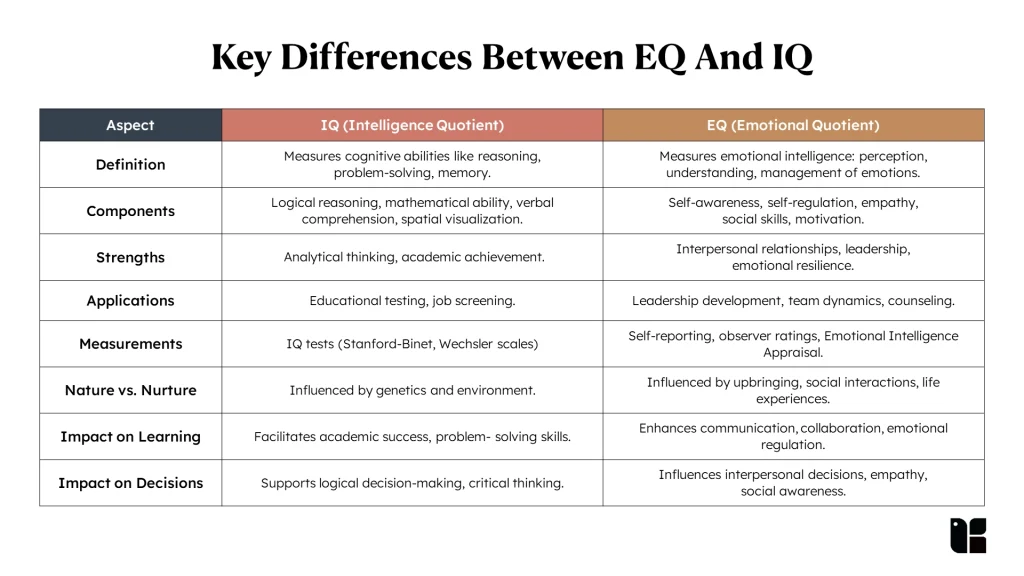
Emotional Quotient (EQ) and Intelligence Quotient (IQ) are two distinct concepts that measure different aspects of human capability and functioning. Let’s learn in detail about the differences with these aspects:
Components
IQ: IQ primarily measures cognitive abilities such as reasoning, problem-solving, memory, and linguistic skills. It typically includes logical reasoning, mathematical ability, verbal comprehension, spatial visualisation, and other similar cognitive domains.
EQ: EQ refers to emotional intelligence, which involves the ability to perceive, understand, manage, and use emotions effectively. EQ includes self-awareness, self-regulation, empathy, social skills, and motivation.
Strengths
IQ: Strength lies in analytical thinking, logical reasoning, and academic achievement. High IQ correlates with success in traditional academic and cognitive tasks.
EQ: Strength lies in interpersonal relationships, leadership, teamwork, and emotional resilience. High EQ is associated with effective communication, conflict resolution, and adaptability.
Applications
IQ: Often used in educational settings (e.g., admissions tests, placement tests). Employers may use IQ tests for job screening, especially for roles requiring strong analytical and problem-solving skills.
EQ: Valuable in leadership development, team dynamics, and organisational culture. Used in coaching, counselling, and therapy to enhance personal and professional development.
Measurements
IQ: Typically measured through standardised tests like IQ tests (e.g., Stanford-Binet, Wechsler Adult Intelligence Scale). Scores are based on comparisons with a normative group.
EQ: Measured through self-reporting, observer ratings, and assessments like the Emotional Intelligence Appraisal. Scores are reflective of emotional competencies and social skills.
Nature Vs. Nurture
IQ: IQ is influenced by both genetics and environmental factors (e.g., education, upbringing). Studies suggest genetics play a significant role in IQ levels, but environmental factors can also impact IQ development.
EQ: EQ is highly influenced by environmental factors such as upbringing, social interactions, and life experiences. It can be developed and improved over time through education, training, and self-awareness.
Impact On Learning
IQ: Higher IQ often correlates with academic success and faster learning in structured academic environments. It facilitates problem-solving and understanding complex concepts.
EQ: EQ enhances learning by promoting effective communication, collaboration, and emotional regulation. It fosters a positive learning environment and supports social and emotional development.
Impact On Decisions
IQ: Helps in making logical and analytical decisions based on data and reasoning. Used in strategic planning, problem-solving, and critical thinking.
EQ: Influences decisions related to interpersonal relationships, leadership, and managing emotions. Supports decision-making in contexts requiring empathy, social awareness, and understanding of others’ perspectives.
We’ve established that IQ and EQ represent distinct aspects of intelligence, each contributing significantly to different areas of our lives. Yet, the debate about IQ versus EQ has captivated psychologists and the general public for decades. Let’s have a closer look at this argument in order to reach a decision.
Comparing EQ and IQ explains what each contributes to leadership success, and Kapable helps leaders develop the emotional capabilities that complement technical expertise.
How Can The EQ Vs IQ Debate Be Understood?
The distinct roles of IQ and EQ have sparked an interesting debate about which one holds the key to success. Let’s explore arguments on both sides to understand this ongoing discussion better.
The Case For IQ
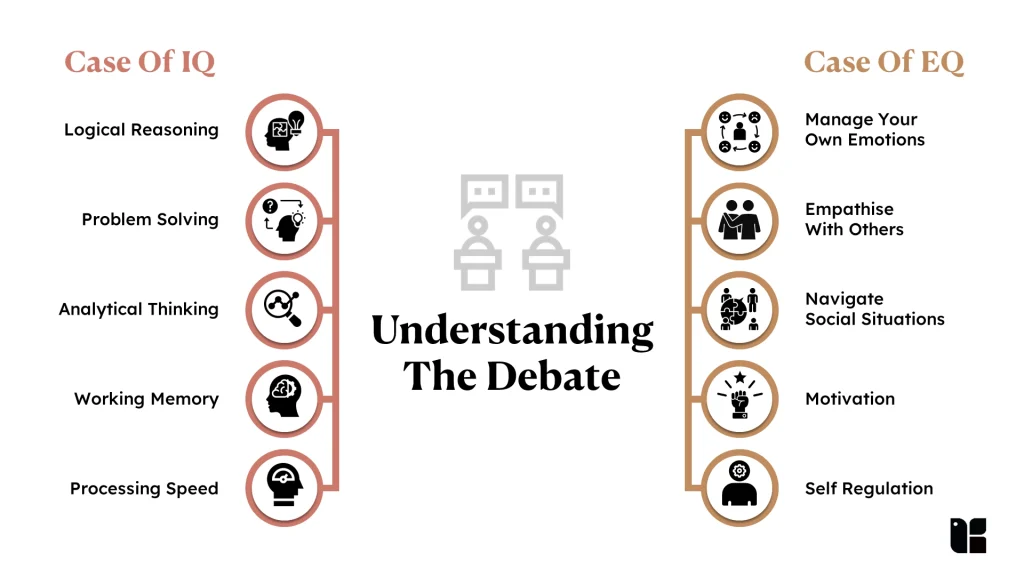
Advocates of IQ highlight its role as the foundation for acquiring knowledge and tackling complex challenges. They argue that strong cognitive abilities are essential for academic performance and success in various fields. Here are some key aspects of IQ:
- Logical reasoning: This skill not only helps you analyse information but also enhances your ability to make informed decisions and solve problems systematically. It strengthens your overall cognitive abilities by training your brain to think critically and make logical connections, which is essential for making sound judgments and understanding complex situations.
- Problem-solving: Developing strong problem-solving skills enables you to tackle challenges effectively by evaluating different solutions and selecting the most appropriate one. It enhances your adaptability and creativity, making it easier to overcome obstacles in both personal and professional settings. By honing this skill, you become more resourceful and capable of handling unexpected situations with confidence.
- Analytical thinking: Breaking down complex ideas into simpler components not only aids in understanding but also enhances your ability to think critically and make well-reasoned decisions. By improving analytical thinking, you become better at identifying key factors and drawing insightful conclusions.
- Working memory: Strong working memory allows you to retain and manipulate information effectively, which is crucial for following instructions, completing tasks efficiently, and learning new concepts. It supports cognitive processes such as reasoning, comprehension, and problem-solving by enabling you to hold multiple pieces of information in your mind simultaneously.
- Processing speed: The ability to think and react quickly enhances your efficiency in tasks that require rapid decision-making or responding to time-sensitive situations. It enables you to process information swiftly and accurately, which is advantageous in fast-paced environments or situations where quick thinking is essential.
By focusing on developing these cognitive skills, individuals can enhance their overall intelligence and capabilities in various aspects of life, from academics to professional endeavours and everyday problem-solving. Studies have shown a correlation between high IQ scores and success in certain professions that require strong cognitive abilities, such as engineering, law, medicine, and scientific research.
The Case For EQ
On the other hand, advocates for EQ emphasise its significance in navigating the complexities of human interaction and personal well-being. High EQ allows individuals to:
- Manage your own emotions: This involves being aware of your own feelings, understanding what triggers them, and effectively managing your emotional reactions. By developing these skills, individuals can maintain emotional stability, make better decisions, and foster healthy relationships with themselves and others.
- Empathise with others: Empathy is the ability to recognise and understand the emotions and perspectives of others. It enables individuals to connect more deeply with people around them, build trust, and respond to others’ needs with sensitivity and compassion. Cultivating empathy enhances interpersonal relationships and promotes a supportive and collaborative environment.
- Navigate social situations: Strong EQ helps individuals communicate clearly and effectively, both verbally and non-verbally. It involves understanding social cues, adapting to different personalities, and resolving conflicts constructively. These skills are essential for building positive relationships, fostering teamwork, and achieving common goals in various social and professional settings.
- Motivation: Having high emotional intelligence includes the ability to set meaningful goals, maintain enthusiasm, and persist in the face of challenges. This inner drive propels individuals towards personal and professional achievements, as it encourages resilience and a positive outlook even in difficult circumstances.
- Self-regulation: This skill involves managing impulses, controlling emotions, and handling stress in productive ways. It allows individuals to maintain composure under pressure, make thoughtful decisions, and avoid reactive behaviours that may hinder personal growth or relationships. Developing self-regulation enhances emotional stability and promotes overall well-being.
These skills are increasingly valued in today’s job market, where collaboration, teamwork, interpersonal communication, and emotional intelligence are essential for effective leadership and overall success. Studies suggest that high EQ can contribute to leadership abilities, career satisfaction, career advancement, positive mental health, and strong relationships.
“Kapable transformed my ability to communicate clearly and confidently, helping me transition from a technical role to a leadership position. I can now present ideas and build rapport effectively, enabling me to take on a role with significantly greater responsibility.”
– Satrajit Sengupta (Principal Business Manager At SAP)
How Can The Importance Of EQ And IQ Be Compared?
Is having a high IQ enough for a successful career and a happy life, or is emotional intelligence the real factor in reaching our full potential? Perhaps the answer lies not in choosing one over the other, but in embracing the power of both. The debate about IQ Vs EQ often misses the bigger picture. Leaders with exceptional technical skills but lacking emotional intelligence might struggle to motivate their teams or foster a positive work environment.
A historical example often cited is Robert McNamara, a brilliant strategist who served as US Secretary of Defence during the Vietnam War. While his analytical mind excelled in business and logistics, some argue that his struggles with empathy and emotional intelligence contributed to the war’s human cost. Conversely, someone with high EQ but limited technical skills might face challenges in fields demanding strong analytical thinking. Traditionally, IQ reigned supreme as the sole measure of intelligence. But the real world is complex.
Exceptional problem-solving abilities are essential in academics, but without effective communication and collaboration skills, you might face challenges working with peers or professors. Likewise, high EQ allows you to navigate social situations with ease, but if you lack critical thinking skills, you might struggle to make well-informed decisions.
Consider a salesperson with a deep understanding of the market and customer needs (IQ). They can tailor their pitches effectively. But without strong emotional intelligence (EQ), they might struggle to build rapport with clients or manage objections constructively. However, a salesperson with high EQ can connect with customers on a personal level, understand their concerns, and build trust, leading to successful sales outcomes.
Studies suggest a positive correlation between IQ and EQ. Strong cognitive abilities (IQ) can help you understand your emotions better, while high EQ can improve your focus and motivation, leading to better learning and knowledge acquisition (IQ). They work together in a synergistic way.
Having explored the importance of both IQ and EQ, you might be curious to know where do your strengths lie? What areas hold room for development? While there’s no single definitive answer, various assessments can offer valuable insights.
What Methods Are Used To Measure EQ And IQ?
Assessing intelligence is a complex process. Considering a variety of tools for measuring EQ and IQ is always better for a clear assessment.
Both IQ and EQ encompass a range of abilities. An IQ test might focus on logic and problem-solving, while an EQ assessment might delve into self-awareness or social skills. By considering multiple tools, you get a more comprehensive picture. But both kinds of assessments have limitations. Relying solely on one test might not provide a complete picture.
Examining different assessments can help validate or refine the initial results. For IQ, look for quizzes that assess various cognitive skills like logic, reasoning, and spatial perception. For EQ, explore quizzes that cover different aspects like self-awareness, social skills, and emotional regulation.
Let’s look at some resources to consider for intelligence assessments:
While some online options exist, the most reliable IQ assessments are administered by qualified professionals. These tests can provide valuable insights into your cognitive strengths and weaknesses. Here are some options:
- The Stanford-Binet Intelligence Scale: This widely used test measures cognitive abilities in children and adults.
- The Wechsler Adult Intelligence Scale (WAIS): Designed for adults and older adolescents, the WAIS assesses various cognitive domains. A newer version, the Wechsler Intelligence Scale for Children (WISC), is available for younger individuals.
- The Woodcock-Johnson Tests of Cognitive Abilities: This comprehensive test assesses a broad range of cognitive skills across different or same age groups.
Similarly, established EQ tests like the Mayer-Salovey-Caruso Emotional Intelligence Test (MSCEIT) or the Bar-On EQ Inventory (EQ-i 2.0) offer a comprehensive evaluation by trained professionals.
- Mayer-Salovey-Caruso Emotional Intelligence Test (MSCEIT): Considered one of the more reliable ways to measure emotional intelligence, the MSCEIT assesses four key areas: perceiving emotions, using emotions, understanding emotions, and managing emotions. It uses a variety of tasks, like identifying emotions in faces or completing stories, to gauge your emotional intelligence. The MSCEIT is typically administered by trained psychologists.
- Emotional and Social Competence Inventory (ESCI): This situational test focuses on how you demonstrate emotional intelligence in real-world situations. It involves both self-assessment and feedback from others (often colleagues or supervisors) to provide a well-rounded picture of your strengths and weaknesses in areas like self-awareness, relationship management, and social awareness. The ESCI is commonly used in leadership development programs.
These standardised tests can be a starting point for self-reflection, which empowers you to develop a personalised plan for growth. Scores don’t define your potential for growth. Our intelligence is not fixed; it can be developed through social and emotional learning, experience, and conscious effort.
What Are The Best Ways To Strengthen EQ And IQ?
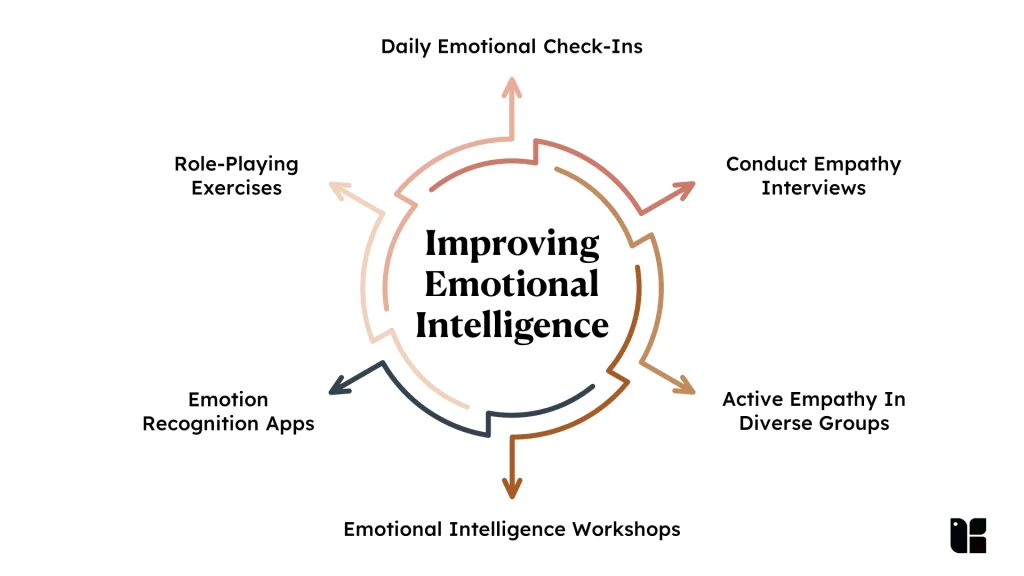
Let’s discuss a range of practical methods that can help us boost both our cognitive and emotional intelligence. Consider the following tips can help enhance your emotional intelligence:
Daily Emotional Check-Ins
Set aside a few minutes each day to assess your current emotional state. Use a journal or an app to record how you’re feeling and why. Reflect on how your emotions influence your behaviour and interactions. Use a simple scale (e.g., 1-10) to rate your emotions and track patterns over time. This helps identify triggers and progress.
Role-Playing Exercises
Join a role-playing group or use online simulations to practise responding to various emotional scenarios. This can help you practise empathy and effective communication in a controlled environment. Create a list of common workplace or social scenarios and practise them with a friend or coach. Record these sessions and review them to refine your responses.
Emotion-Recognition Apps
Use apps designed to help recognise and understand emotions by analysing facial expressions or voice tones. Apps like “Moodfit” can offer insights into your emotional patterns and those of others. Track your emotional responses in different situations using these apps to better understand your emotional triggers and how to manage them.
Emotional Intelligence Workshops
Participate in workshops or webinars focused on advanced emotional intelligence techniques. Look for interactive sessions that offer practical exercises and real-world applications. Apply what you learn immediately in real-life situations. Create a follow-up plan to review and refine the techniques you’ve learned.
Active Empathy In Diverse Groups
Engage with people from different backgrounds, cultures, and professions. Observe and learn from their emotional responses and communication styles. Attend events, join clubs, or volunteer with groups outside your usual circle. Use these interactions to broaden your understanding and practice empathy.
Conduct Empathy Interviews
Schedule one-on-one conversations with colleagues or friends specifically to understand their perspectives on various issues. Ask open-ended questions about their experiences and feelings. Prepare a list of questions focused on their emotional experiences and responses. Use their feedback to adjust how you interact and communicate.
Similarly, you can boost your IQ, which is your cognitive intelligence, with the following approaches:
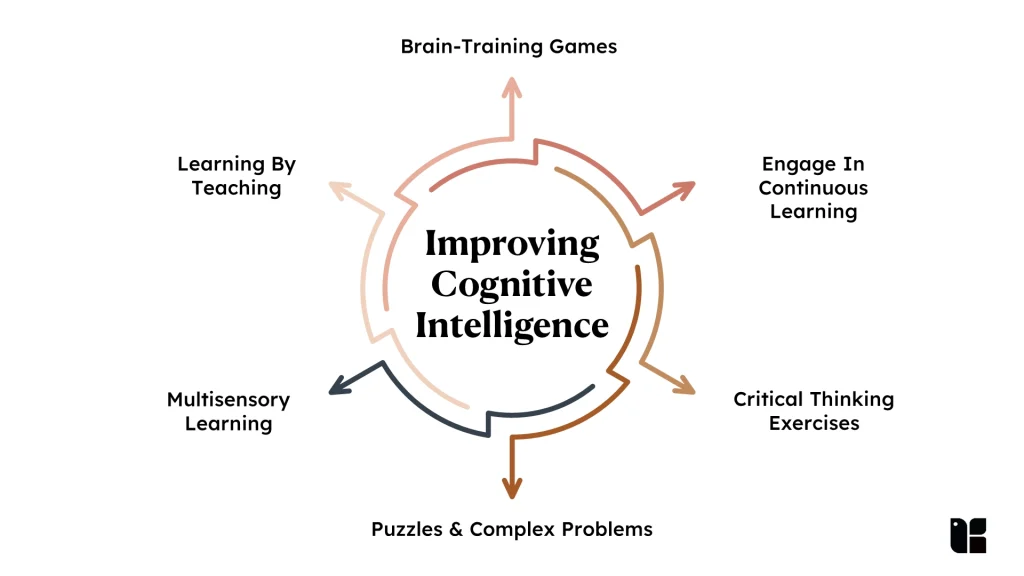
Brain-Training Games
Use apps and websites that offer brain-training games and exercises to enhance specific cognitive skills like memory, problem-solving, and attention. Set a daily or weekly schedule for brain-training sessions, focusing on different types of exercises to cover various cognitive areas. Track your progress and adjust the difficulty as you improve.
Learning By Teaching
Teach a concept or skill to someone else. This could be a friend, a colleague, or even an online audience. Explaining complex ideas in simple terms can reinforce your understanding and reveal gaps in your knowledge. Choose a topic you recently learned about and create a short presentation or write an article explaining it. This helps you grasp on the material and improves your ability to communicate complex ideas.
Multisensory Learning
Use multiple senses to learn new information. For example, combine reading with listening to related podcasts, watching videos, and practising hands-on activities. This helps reinforce learning and improves retention. Create a “learning playlist” that includes videos, audiobooks, and articles on a topic of interest. Rotate through these resources to get a well-rounded understanding of the subject.
Puzzles And Complex Problems
Regularly challenge yourself with puzzles and complex problems, such as Sudoku, crosswords, or logic puzzles. These activities stimulate your brain and enhance problem-solving skills. Set aside a few minutes each day to work on a different type of puzzle or problem. Consider joining online puzzle communities or challenges to add variety and stay motivated.
Critical Thinking Exercises
Regularly engage in activities that require critical thinking, such as debating, analysing case studies, or evaluating arguments. These exercises improve reasoning and analytical skills. Join a debate club, participate in online discussion forums, or use critical thinking apps. Challenge yourself to view issues from multiple perspectives and construct well-reasoned arguments.
Engage In Continuous Learning
Commit to lifelong learning by taking online courses, attending workshops, or reading books on various subjects. Diversifying your knowledge base can enhance cognitive flexibility. Set learning goals and track your progress. Create a learning plan that includes a mix of new topics and advanced study in areas of interest. Use platforms like “Coursera,” “Udemy,” or “Khan Academy” to find relevant courses.
Consistency is key! Make these practices a regular part of your routine to see long-term improvements in both your EQ and IQ.

Conclusion
Life isn’t a competition between IQ and EQ. They’re both teammates on your path to success. By working on improving your skills in both areas, you’ll be better equipped to handle what life throws your way. Remember, success is more about the journey than the destination. Focus on learning, taking care of yourself, and developing all the skills that make you a well-rounded and happy individual.
If you’re looking to strengthen the human skills that complement technical expertise, Kapable helps you decide whether its learning experience aligns with your professional aspirations.


