


TL;DR
- Cognitive Agility: Building these skills trains your mind to process information faster, make crucial connections, and approach problems from multiple insightful angles to find optimal solutions.
- Essential for Life Success: Developing these abilities enhances problem-solving, improves decision-making, and strengthens communication, leading to better academic achievement, professional clarity, and personal growth.
- Core Development Techniques: Sharpen your analytical and creative capacity by consistently practising logical organisation through classifying, sequencing, comparing, and analysing relationships between concepts.
- Activity-Based Mastery: Engage in focused methods like the Socratic Method, Problem-Based Learning, and Metacognition to build a deeper, applied understanding and promote critical reflection on your own thought process.
What if there was a way to make your brain work smarter and faster? That’s exactly what building thinking skills does, it trains your mind to look at problems from different angles, make connections, and find the best solutions. Whether you’re trying to crack a tricky question in class, organise your thoughts, or simply evaluate the best course of action in a given situation, this makes critical thinking skills necessary for daily life activities. In this blog, we’re going to explore some tips and activities that’ll help you flex those thinking muscles and get better at solving problems, big or small.
What Are Thinking Skills?
Thinking skills are the foundation of how we process information, make decisions, and solve problems in everyday life, work, and learning. These skills aren’t just about having thoughts; they’re about having structured, clear, and insightful thoughts that help us navigate complex situations, whether in the classroom, the workplace, or in personal decision-making.
Building thinking skills means enhancing how we approach new information, analyse challenges, and come to conclusions that make sense. These skills are versatile, they apply to every area of life and can be developed throughout our lives, from childhood through adulthood, in both personal and professional contexts. Building thinking skills is essential for everyone, regardless of age or occupation. By developing these skills, you can:
- Understand connections: See how different pieces of information are related. This helps in forming a clearer picture and understanding how things fit together, whether you’re analysing data, evaluating a situation, or organising ideas.
- Determine relevance: Focus on what truly matters. This involves filtering out unnecessary details and honing in on the most important aspects of a problem or decision.
- Identify gaps: Recognise when something is missing or flawed. It’s about spotting areas that need further exploration, whether it’s an overlooked detail or a critical piece of information that hasn’t been considered.
- Ask insightful questions: Probe deeper to uncover new perspectives and insights. Asking the right questions can help you explore underlying causes, challenge assumptions, and generate new ideas.
- Adapt and reflect: Reflect on your own thinking and adjust your approach based on new insights. This allows you to refine your thought process, correct mistakes, and improve future decision-making.
By improving your thinking skills, you can navigate a wide range of situations, thinking more clearly, logically, and flexibly.

Why Is It Important To Build Thinking Skills?
By focusing on building thinking skills, individuals gain the ability to approach challenges with clarity, solve problems with confidence, and contribute meaningfully in various aspects of life.

Improved Academic Achievement
The ability to analyse and solve problems makes critical thinking skills necessary for success in reading, writing, math, science, social studies and standardised tests. They help learners understand abstract concepts, analyse patterns, and draw meaningful conclusions, making it easier to excel in studies and tests.
Effective Decision-Making
Critical thinking skills enable individuals to weigh pros and cons, assess risks, and make informed choices. Whether it’s selecting the best method to tackle a problem or determining priorities, these skills ensure decisions are logical and impactful.
Enhanced Problem-Solving
These skills provide a structured approach to understanding and addressing challenges. From recognising relationships between concepts to identifying gaps in solutions, thinking skills are crucial for tackling obstacles efficiently.
Better Communication And Collaboration
Clear thinking leads to effective communication. These skills allow individuals to organise their thoughts, present ideas logically, and engage in meaningful discussions, whether in group projects or professional meetings.
Foundation For Advanced Skills
Building thinking skills lays the groundwork for mastering higher-order abilities such as critical thinking, creative problem-solving, and strategic planning. These are essential for success in diverse areas, from academics to leadership.
Versatility Across Contexts
Whether you’re analysing data in the workplace, solving puzzles at home, or brainstorming solutions in a community project, thinking skills apply universally. They form a bridge between learning and real-life application.
Understanding these key benefits shows that it is more than just a skill; it’s a tool that improves various aspects of life, from career advancement to personal growth. And now that we’ve seen how it helps, we can appreciate why it’s worth developing.
Learn more about Kapable’s approach to building thinking skills through structured practice, real-world simulations, and personalised coaching that improve problem-solving speed and accuracy.
How To Develop Effective Thinking Skills?
Developing strong thinking skills is essential for the academic success you want with your personal growth. These techniques can help you sharpen your ability to analyse, reason, and think creatively:

Classifying Information
Start by organising objects, concepts, or data into categories. For instance, sort items into groups based on shared traits (like colors, sises, or functions). This technique sharpens your ability to recognise patterns and relationships, essential for solving complex problems.
Comparing And Contrasting
Practice identifying similarities and differences between two or more items or ideas. This skill strengthens critical thinking by encouraging you to evaluate perspectives or elements critically, whether comparing theories in science or assessing decisions in daily life.
Sequencing Activities
Engage in exercises that involve arranging events or ideas logically. For example, create timelines for projects or narratives. Sequencing strengthens your ability to organise thoughts systematically and draw accurate conclusions.
Figural And Spatial Reasoning
Solve puzzles or tasks that develop figural spatial skills. Activities like tangrams, 3D model building, or graph interpretation help you understand spatial relationships and think creatively to analyse relationships between objects and words, and words and objects when solving visual problems.
Concrete To Abstract Thinking
This includes progressive development with each skill. For example, classifying is presented first in the semi-concrete figural spatial form and then in the abstract verbal form, building from visual to verbal reasoning. Use physical models or visual aids to grasp a new topic before diving into theoretical discussions.
Analysing Relationships
Work on identifying how ideas or objects relate to each other. Exercises like creating mind maps or drawing diagrams can clarify the connections between concepts, improving your ability to link ideas and apply them to different contexts. This helps develop superior thinking and communication skills that lead to deeper content learning in all subjects.
Engaging With Analogies
Solve analogy-based exercises that encourage drawing parallels between seemingly unrelated ideas. For instance, identifying how “a key is to a lock” relates to “a password is to a computer” strengthens abstract reasoning and creative thought.
Critical Reflection Tasks
After completing a task or solving a problem, take time to reflect on your approach. Ask yourself questions like, “What worked well?” or “What could I do differently?” This helps refine your thinking strategies over time.
Now let’s explore specific activities designed to further develop these skills, making learning both fun and effective.
What Are Some Engaging Activities For Developing Thinking Skills?
Developing critical thinking skills requires consistent practice and effective methods that engage individuals in deeper thought processes.
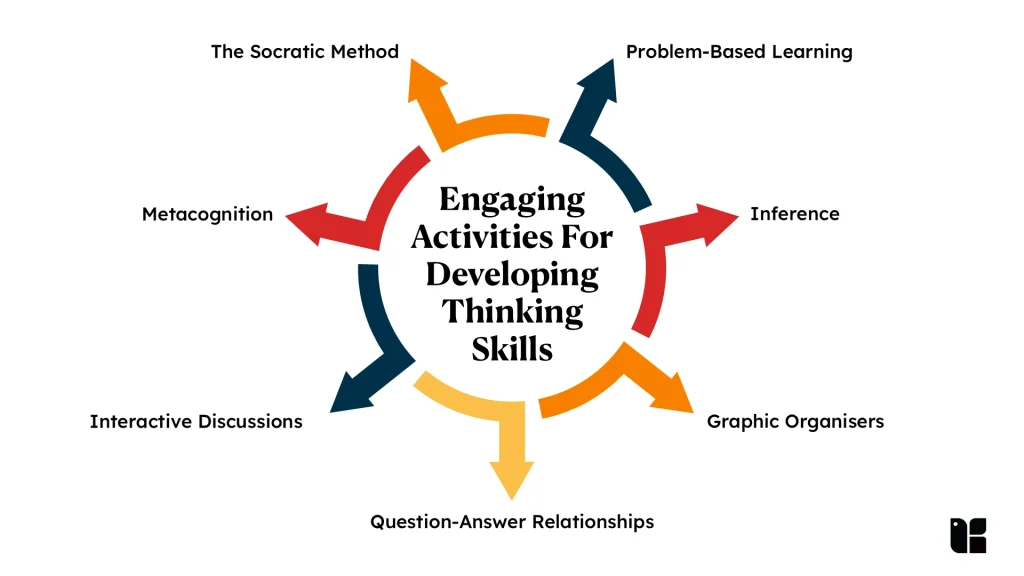
The Socratic Method
The Socratic Method is a teaching strategy that involves guiding individuals to think deeply by asking open-ended questions. Named after the Greek philosopher Socrates, this method is designed to stimulate critical thinking and illuminate ideas through dialogue. Rather than giving direct answers, the Socratic Method encourages learners to explore their own understanding by reflecting on the questions posed to them. It helps participants uncover assumptions, challenge their perspectives, and refine their thoughts.
In Socratic Circles, people gather in a group and engage in a structured discussion, focusing on a specific topic or text. The goal isn’t to reach a consensus, but to dig into the topic by questioning assumptions, analysing concepts, and uncovering new insights. The facilitator poses Socratic questions, which are open-ended to encourage exploration. For instance, in a discussion about a novel, instead of asking “What is the main theme?” the facilitator might ask, “Why do you think the author chose this setting to portray the conflict?” This encourages students to think beyond surface-level details and explore deeper meaning.
The result of Socratic questioning is a more profound understanding of the subject. Your students learn to think critically, evaluate different perspectives, and articulate their reasoning. In the process, they become more independent thinkers. For example, during a history lesson on the civil rights movement, a teacher might ask, “What would have been the consequences if nonviolent protests were not used?” This type of question requires students to analyse historical decisions and consider alternative outcomes, developing their thinking skills in the process.
Problem-Based Learning
Problem-Based Learning (PBL) is an educational approach where students are presented with complex, real-world problems that do not have clear or predefined solutions. Instead of focusing on memorised facts and procedures, students must engage in critical thinking and creative problem-solving to find solutions. PBL helps learners develop thinking skills by requiring them to investigate, analyse, and synthesise information from multiple sources, all while navigating unfamiliar challenges.
In a PBL setting, the problem serves as the starting point of the learning process. For instance, students could be given a scenario such as, “Your city is facing an increase in air pollution. How can we develop a sustainable transportation system to reduce it?” This type of problem does not have a single correct answer, so students must research possible solutions, explore environmental impacts, and consider budget constraints. They need to draw on knowledge for developing critical thinking through science, economics, and urban planning, making the learning multidisciplinary and applicable to real-world situations.
By focusing on finding solutions to unfamiliar problems, PBL encourages students to go beyond simple recall of information. It promotes the development of critical thinking, adaptability, and creativity, as students explore multiple avenues and weigh the pros and cons of each potential solution. In doing so, they build the confidence to tackle complex issues and develop lifelong learning skills essential for academic, professional, and personal growth.
Metacognition
Metacognition is the practice of thinking about your own thinking. It involves analysing your thought process, recognising patterns, and adjusting strategies to improve learning and decision-making. By becoming more aware of how you think, you can find better ways to solve problems and learn more efficiently.
For example, when you notice a pattern of repeated mistakes, whether at work, while learning a new skill, or even in daily routines, you can pause and ask yourself, “Why do I keep getting stuck at this point?” By identifying the specific thought or action that leads to the problem, you can focus on improving that particular area. If you frequently struggle with project deadlines, instead of blaming time management as a whole, you might realise it’s the tendency to procrastinate on certain tasks that throws you off schedule. Recognising this, you can then set more manageable goals and adjust your approach.
Encourage reflection after completing a task. Ask questions like, “How did I come to that conclusion?” or “What strategies worked, and which didn’t?” Writing down these reflections can further cement understanding and promote self-awareness in future tasks. This reflective practice boosts strategic thinking and helps individuals adjust their thinking to achieve better outcomes.
Inference
Inference is the ability to draw conclusions or make educated guesses from information that isn’t explicitly stated. It’s about interpreting hints, subtle details, or indirect clues and piecing them together to understand the bigger picture. This skill sharpens one’s ability to analyse and interpret information, which is essential for critical thinking.
To practise inference, present scenarios where key details are left out, and ask participants to deduce what might be happening. For example, imagine a short passage where a character checks the clock frequently, sighs, and taps their foot. Without being told directly, you can infer that the character is likely anxious or impatient. A question like, “Why do you think the character is feeling this way?” encourages participants to use their reasoning skills, drawing from the details provided to reach a conclusion.
By practising inference, individuals develop the ability to think beyond the obvious, reading between the lines and building a deeper understanding from incomplete information. This enhances their capacity to analyse complex situations in both academic and everyday contexts.
Interactive Discussions
Collaborative discussions, especially through debates and argumentation, are powerful tools for enhancing thinking skills. In these settings, participants must not only defend their viewpoints but also analyse opposing perspectives, evaluate evidence, and refine their arguments. This requires critical thinking, brainstorming without judgement, active listening, and the ability to adapt to new information, all of which build essential cognitive skills.
Schools can integrate these strategies into their curriculum by designing activities that encourage students to work together to solve problems or engage in structured debates. For example, assigning students to debate a controversial issue forces them to research, think critically about their stance, and engage in thoughtful argumentation. They learn to support their points with evidence, consider counterarguments, and adjust their thinking as they encounter new ideas.
Beyond debates, brainstorming sessions, role-playing scenarios, and gamification using digital tools can also foster collaborative problem-solving. For instance, in your classroom setting, students could role-play historical figures or decision-makers, requiring them to adopt a different perspective and think deeply about complex issues. Meanwhile, tools like online simulations and educational games can bring abstract concepts to life, allowing students to work together in a virtual environment to tackle real-world challenges. These activities not only boost engagement but also cultivate the analytical, evaluative, and creative thinking that are demanded.
Graphic Organisers
Graphic organisers are visual tools that can help in structuring and organising information, which can enhance understanding and analysis. They provide a clear, visual representation of concepts and their relationships, making complex information more accessible and manageable.
The “I Wonder” Wall is a dynamic graphic organiser idea to stimulate curiosity and critical thinking. In this setup, students or participants post questions they are curious about on a designated wall or board, using sticky notes or cards. These questions often start with phrases like “I wonder…” or “How might…?” and focus on aspects of the topic that aren’t directly addressed in the lesson.
Similarly, in a business setting, a mind map could be used to plan a new marketing campaign. Start with the central idea (e.g., “Marketing Campaign”) and branch out to various components such as target audience, key messages, channels, and budget. Each branch can further split into specific tasks and responsibilities, helping teams visualise all elements of the campaign and how they interconnect.
Question-Answer Relationships
Question-Answer Relationships (QARs) are a strategy used to help students understand different types of questions and how to approach them effectively. This technique categorises questions into different types, each requiring a distinct approach to find the answer.
Here’s a breakdown of the QARs framework:

- Right there: These questions have answers that are directly stated in the text. For instance, if a text says, “The cat sat on the mat,” a right-there question would be, “Where did the cat sit?” The answer is explicitly found in the text.
- Think and search: These questions require students to gather information from various parts of the text to form an answer. For example, if a passage describes a character’s actions in different sections, a think-and-search question might be, “How does the character’s behaviour change throughout the story?” Students need to piece together information from different parts of the text.
- On my own: These questions require students to use their own experiences and knowledge to infer or deduce an answer. For example, if a text describes a character who is feeling sad but doesn’t explicitly say why, an “In My Head” question might be, “Why might the character be feeling this way based on what we know about them?”
- Author and me: These questions ask students to connect the text to their own knowledge or experiences. For example, if a text discusses a historical event, an “Author and You” question might be, “How does this event relate to current issues we face today?”
By categorising questions in this way, students learn to approach texts with a strategic mindset, knowing which method to use for different types of questions. This helps in developing the critical thinking skills and comprehension skills by making students aware of how to extract and interpret information from texts.
“I needed to enhance my personal brand and overcome my discomfort with public speaking and networking events. Kapable’s personalised sessions gave me the tools and confidence to handle these situations. Recently, I confidently participated in a panel discussion and a networking event, applying the skills I learned. My presentations are now more engaging, and public speaking feels natural, empowering my professional journey.”
– Shreyas Tonse (Founder At Zwayam)
Conclusion
To further enhance and practice your thinking skills, a variety of resources are available. Platforms like Quizlet and BrainPOP offer interactive quizzes and exercises that challenge your ability to analyse, classify, and evaluate information. Additionally, Khan Academy provides tutorials and activities that build these skills through practical examples. Exploring these tools can make sharpening your thinking skills both effective and enjoyable, helping you apply them in everyday situations.
If you want to solve problems faster and make more confident decisions, Kapable’s suitability check can help you determine whether the program aligns with your goals.


