


TL;DR
- Common Mistakes Reveal Core Gaps: The most damaging leadership failures fall into patterns like unclear communication, a lack of empathy, poor decision-making, and an inability to delegate or guide teams through change effectively.
- Mistakes Stem from Deeper Roots: These failures often originate from internal challenges, such as overconfident blind spots, a lack of proper management training, leaders experiencing burnout, or a fundamental misalignment between the leader’s style and the organisation’s current needs.
- The True Cost is Systemic: Repeated errors systematically weaken trust and engagement, leading to performance declines, higher employee turnover, the formation of a toxic culture, and significant financial strain on the entire business.
- Growth is found in Accountability: Transforming mistakes into progress requires building self-awareness, adopting clear decision frameworks, investing in continuous development, and developing psychological safety through honest feedback loops, as demonstrated by famous leader turnarounds.
Have you ever watched a capable leader lose their team, not in one dramatic moment, but through a series of small, repeated mistakes? The unclear instructions, the decisions that drag on, the constant need to control. On their own, they look harmless. Together, they drain trust and results. Leadership mistakes don’t always come from incompetence. Often, they come from blind spots leaders don’t see until it’s too late. And when that happens, the impact spreads across the whole organisation. In this blog, we’ll break down the most common mistakes leaders make, why they happen, and how they can be turned into growth instead of decline.
How Do We Identify Leadership Mistakes?
Leadership mistakes are the repeated actions or decisions by a leader that create negative consequences for their team or organisation. They are not the small errors that come with day-to-day decision-making, but patterns of behaviour that disrupt clarity, lower motivation, or block progress. A leadership mistake can be as visible as poor decision-making in a crisis or as subtle as overlooking team and employee development until people begin leaving. The weight of these mistakes becomes clearer when seen through data.
A global survey by Gallup found that 82% of managers are seen as lacking in leadership skills by their employees, and these gaps show up most often as recurring mistakes. Other studies show that these missteps account for a large share of disengagement and voluntary exits in organisations. This is why defining leadership mistakes matters: only when leaders recognise them for what they are can they begin to reduce their impact. In the next section, we’ll look at which mistakes surface most often across organisations.

What Are The Most Common Leadership Mistakes?
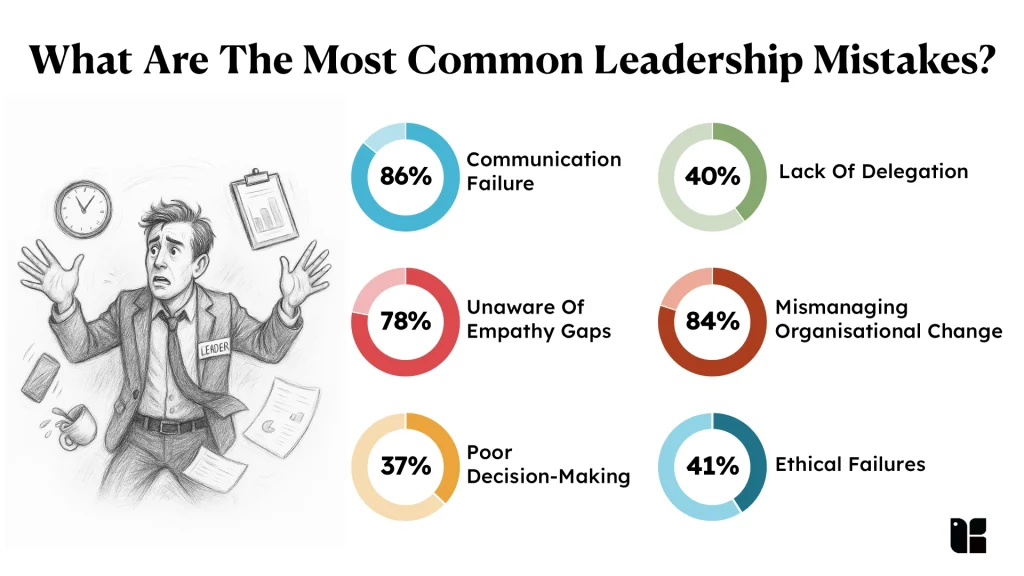
Leadership mistakes show up in different forms, but research consistently highlights a few that do the most damage. Below are six of the most common ones, each backed by data and real-world consequences.
Communication Failure
When leaders don’t share information clearly, people get confused about what to do and why it matters. This slows projects, creates mistakes, and leaves teams feeling disconnected.
- 86% of employees and executives say poor communication is the main reason for workplace failures. This shows that unclear messaging doesn’t just create confusion; it directly undermines collaboration and results. Over time, these gaps make it harder for teams to stay aligned on goals and priorities.
- Companies with effective communication are 3.5x more likely to outperform their peers. Strong communication isn’t a soft skill; it directly links to financial and operational success. It creates clarity across all levels of the business, which improves speed and quality of execution.
- Poor communication costs companies an estimated $12,506 per employee every year. That’s a measurable financial hit for every worker, not just an abstract senior leadership issue. These costs build silently over time, eating into margins and reducing overall competitiveness.
Unaware Of Empathy Gaps
Employees want to feel understood, not just managed. When leaders don’t show care or empathy, motivation drops, and people start feeling like they’re just filling a role, not contributing to something meaningful.
- 86% of employees believe empathetic leadership boosts team morale, while 87% say it drives inclusion. This means empathy isn’t optional; it’s tied directly to how safe and valued people feel at work. Leaders who practice it consistently build stronger loyalty and commitment across their teams.
- Workplace empathy perceptions have dropped from 78% in 2018 to 66% in 2023. This decline reflects growing employee frustration with leaders who appear disconnected from their realities. If the trend continues, trust in leadership will erode further, making retention even harder.
- The empathy leadership gap is costing organisations $180 billion annually in attrition. Employees leave when they feel unseen or unheard. The financial hit is matched by a loss of talent, expertise, and team stability.
Poor Decision-Making
Leaders are expected to make choices that give direction and confidence. When decisions are delayed, unclear, or simply wrong, teams lose focus and opportunities slip away.
- On average, employees spend 37% of their time making decisions, and they feel that more than half of this time is spent ineffectively. This wasted time slows down progress, delays projects, and creates frustration across teams
- Businesses that make high-quality decisions achieve 6% higher returns than peers. Even a few percentage points in returns can mean millions for large organisations, showing the high stakes of leadership judgment.
- Companies with agile decision-making processes are 2.5x more likely to outperform financially. Speed and clarity in decisions create a measurable competitive advantage.
Additionally, a McKinsey report reveals that women’s leadership statistics have few voices reaching senior management in corporate leadership, even though diverse leaders consistently communicate effectively and improve the quality of decisions.
Lack Of Delegation
No leader can do everything alone. When leaders hold on to too much work instead of trusting their teams, it creates bottlenecks and frustrates people who want to take ownership.
- 40% of employees feel their managers don’t trust their abilities to handle tasks. This lack of trust reduces confidence and prevents employees from growing.
- A 2024 Workhuman report stated that 24% of people who quit their jobs in 2024 cited micromanagement as a major reason for leaving.
- 70% of employees think about quitting due to micromanagement, and 30% actually do. Leaders who can’t let go risk losing their best people.
Mismanaging Organisational Change
Change can develop a growth mindset, but it also brings uncertainty. When leaders don’t guide people through change properly, it creates fear, resistance, and sometimes pushes the best employees out.
- 40% of employees feel their managers don’t trust their abilities to handle tasks. This lack of trust reduces confidence and prevents employees from growing. Over time, it creates dependency and slows down team development.
- Employees who feel their manager is overbearing or micromanaging are 2.8 times more likely to say that their workplace discourages them from taking risks that could lead to innovation. When people feel controlled, they avoid experimentation and stick to safe choices.
- Employees who work for a controlling manager are 84% more likely to experience burnout compared to those who have more autonomy. Constant oversight drains motivation and leaves people feeling powerless in their leadership roles.
Ethical Failures
Trust in leadership is built on integrity. When leaders cut corners or ignore ethics, it damages credibility fast and leaves lasting scars on both people and the organisation.
- 41% of employees have left a job due to poor leadership ethics. This shows ethics aren’t abstract; they’re directly tied to retention. When trust in leadership breaks down, people no longer see a future with the organisation.
- Companies with strong ethical cultures outperform their peers by 40% in employee loyalty. Integrity builds commitment, which translates into long-term business stability. A clear ethical framework also strengthens the organisation’s reputation with customers and stakeholders.
- Over a five-year period, companies recognised for their strong ethical cultures and leadership outperformed a comparable index of large-cap companies by 13.6%. Ethical leadership builds long-term credibility with investors, customers, and regulators.
Seeing the mistakes is only the first step. To truly understand why they happen, we need to look deeper at the root causes behind them.
Learn how Kapable’s coaching methodology helps professionals identify leadership blind spots and build the skills needed to lead teams more effectively.
What Are The Root Causes Behind Leadership Mistakes?
Leadership mistakes don’t happen by chance. They usually come from deeper issues in the way leaders think, prepare, and respond to pressure.

Leadership Blind Spots
Leaders often believe their judgment is stronger than it is. Overconfidence can make them ignore feedback, misjudge risks, or assume clarity where none exists. Blind spots form when they stop questioning their own perspective.
- Around 65% of executives admit they rely too much on intuition instead of data. This creates decisions shaped more by gut feeling than evidence, which can backfire when dealing with complex or high-stakes issues. Over time, it normalises risky judgment calls as a leadership style.
- 79% of employees say their leaders are out of touch with daily realities. When leaders don’t seek ground-level input, they miss early signals of problems until those problems become crises. This disconnect can make leaders appear detached and unapproachable.
Insufficient Leadership Training
The corporate leadership training market exists to fill this gap, yet most new managers in leadership positions still never receive proper managerial training. Without training, they enter leadership with no tools for handling conflict, building trust, or motivating people.
- 60% of new managers never receive formal leadership training. They are expected to learn on the job, which often means repeating the same mistakes until they become habits. This lack of structure leaves them underprepared for complex people challenges.
- Employees working under untrained managers are 56% more likely to be disengaged. This shows how a manager’s lack of preparation doesn’t just affect them; it spreads disengagement across the team members. In time, this results in high employee turnover and weaker team culture.
Risk Of Burnout
Leadership is demanding, and constant pressure takes a toll. When leaders operate under workplace stress for too long, they make slower, more emotional decisions and struggle to think strategically.
- 70% of leaders report feeling burned out regularly, and many admit it affects the quality of their decision-making. Burnout doesn’t just drain energy; it reshapes the way leaders think and react. It creates a cycle of short-term fixes instead of long-term thinking.
- Companies with high-stress leadership cultures see 50% higher turnover rates. Work-related stress doesn’t stay at the top; it flows downward, creating disengagement and pushing employees to leave. Over time, entire departments begin to lose their best talent.
Misalignment With Organisational Needs
Sometimes leaders fail not because they lack ability, but because their style doesn’t fit what the organisation needs. A visionary leader may struggle in a period of crisis, while a detail-focused leader may slow innovation.
- 82% of companies say poor leadership alignment is the biggest barrier to meeting goals. When leaders and organisational needs are mismatched, execution suffers regardless of strategy. This misfit often shows up as missed deadlines and unclear priorities.
- Teams with leaders misaligned to business strategy are 3x more likely to miss performance targets. Leadership fit isn’t about personality; it’s about whether the leader’s approach supports the organisation’s goals. Without alignment, even strong performers fall short.
These root causes show that leadership mistakes grow from deeper issues. Next, we’ll see how these mistakes affect organisations at every level, from culture to financial performance.
“I needed to enhance my personal brand and overcome my discomfort with public speaking and networking events. Kapable’s personalised sessions gave me the tools and confidence to handle these situations. Recently, I confidently participated in a panel discussion and a networking event, applying the skills I learned. My presentations are now more engaging, and public speaking feels natural, empowering my professional journey.”
– Shreyas Tonse (Founder At Zwayam)
How Do Leadership Mistakes Affect Organisations?
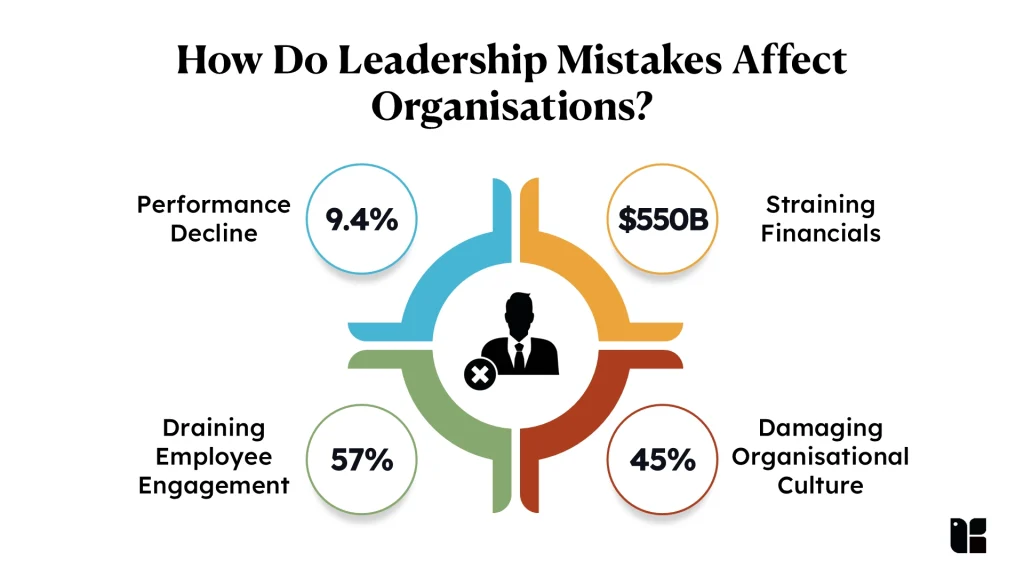
When leadership mistakes keep repeating, they spread across teams and shape how the whole organisation functions. Here are the key areas where their impact is most visible:
Performance Decline
When high-quality leaders make repeated mistakes, execution suffers. Projects slow down, decisions stall, and overall productivity drops.
- Research from PMI shows that ineffective communication and leadership support are among the top causes of project failure. As a result, organisations waste an average of 9.4% of their investment in projects and strategic initiatives.
- A study found that teams led by the best managers achieved 25% higher customer satisfaction and 21% greater sales revenue than teams under poor managers. This highlights how leadership quality directly influences both customer outcomes and business growth.
Draining Employee Engagement
Research consistently shows that effective leadership is the single biggest driver of employee engagement, productivity, and retention. Thus, poor leadership drains motivation and makes employees question their future with the company.
- 57% of employees say poor communication by leadership is their biggest frustration at work. Without clarity, people feel directionless, waste energy on the wrong priorities, and gradually disconnect from their roles.
- 50% of employees have left a job to escape a poor manager. Replacing employees is costly, and when turnover becomes a pattern, it drains time, money, and employee morale across the organisation. This constant churn also weakens the company’s ability to build a strong, experienced workforce.
Damaging Organisational Culture
When leadership mistakes go unchecked, they shape the company’s culture in negative ways. Trust weakens, collaboration drops, and employees become more cautious than creative.
- 45% of employees cite toxic work environments as the number one reason they quit. A toxic environment drains energy, creates constant tension, and makes it difficult for people to do their best work. This kind of culture pushes talent out and weakens overall team stability.
- Companies with strong leadership are 12x more likely to have high employee satisfaction scores. Leaders influence the tone of culture, and positive leadership creates energy that drives collaboration and commitment.
Straining Financials
Leadership mistakes carry a clear financial cost. Mismanagement, turnover, and poor decisions directly show up in numbers.
- Disengaged employees cost US companies up to $550 billion every year in lost productivity, much of it tied to weak leadership. This cost grows year after year when disengagement becomes normal across departments.
- Firms with strong leadership capabilities are 2.3x more likely to financially outperform peers. Good leadership improves decision-making and helps companies grow faster. It also builds resilience, allowing organisations to adapt more effectively during periods of change or crisis.
The cost of leadership mistakes is high, but mistakes don’t always have to leave lasting damage. Let’s explore how strong leaders can turn these difficult moments into opportunities for growth.
How Can Leaders Turn Mistakes Into Growth Opportunities?
Leaders who reflect on their mistakes often come out stronger than before. Instead of ignoring errors or repeating them, they can use mistakes as lessons that strengthen relationships and build resilience.
Building Self-Awareness
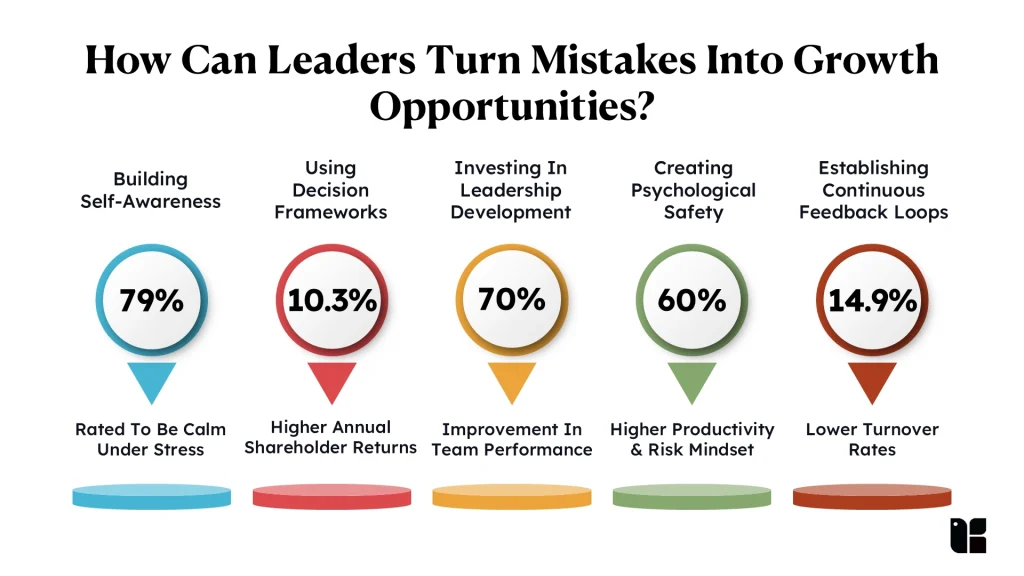
Leaders who have a high degree of self-awareness are 79% more likely to be rated as composed (calm and in control) during stressful situations. Self-awareness allows great leaders to recognise blind spots, notice behaviour patterns, and adjust before small mistakes grow bigger.
- Leadership journaling: Keeping a weekly journal of key decisions, conversations, and outcomes allows effective leaders to step back and see patterns in how they lead. Over time, this practice shows which behaviours help the team move forward and which ones create friction. Journaling is widely used in leadership development as a tool for reflection and growth.
- External reflection partner: Talking regularly with a trusted colleague, mentor, or advisor helps leaders test their assumptions. These conversations bring in diverse perspectives they might not see on their own and encourage more thoughtful decisions. Many leadership coaches also recommend this as a way to create accountability.
Leaders who build self-awareness are better at regulating their responses, building stronger relationships, and preventing repeated mistakes caused by unchecked habits.
Using Decision Frameworks
Executives who consistently made decisions with both high speed and high quality saw their organisations achieve 10.3% higher annual shareholder returns over a five-year period. Frameworks help leaders reduce bias, test assumptions, and make decisions with more confidence.
- Pre-mortem analysis: Before finalising a decision, leaders ask: “If this fails, what will have caused it?” This simple tool forces teams to anticipate risks and prepare solutions in advance. It shifts thinking from reacting to problems to preventing them. Over time, it builds a culture of foresight and shared responsibility.
- Eisenhower matrix: This framework categorises tasks into four groups: urgent and important, important but not urgent, urgent but not important, and neither urgent nor important. Leaders can then decide what to act on immediately, what to schedule for later, what to delegate, and what to drop entirely. Over time, this habit creates discipline around priorities and ensures that long-term strategic goals don’t get buried under day-to-day urgencies.
Leaders who use decision frameworks make clear and concise communication, reducing the number of repeated mistakes in high-stakes situations.
Investing In Leadership Development
Organisations that provide leadership development programs report a 70% improvement in team performance. Coaching and training programs bring in outside perspectives that help the best leaders learn faster and avoid repeating the same errors.
- Professional coaching: One-on-one coaching gives personalised feedback and helps identify blind spots that leaders may struggle to see on their own. It also provides a structured path for developing new behaviours. Regular coaching sessions create accountability, making it easier to turn new habits into consistent leadership practices.
- Mentoring relationships: Partnering with a more experienced leader creates space to share challenges and learn from someone who has faced similar situations. Mentors often help shorten the continuous learning curve after failures. Strong mentoring relationships also give leaders long-term guidance that goes beyond immediate problem-solving.
With consistent coaching and mentoring, mistakes turn into lessons that accelerate professional growth for both the individual and their team.
Creating Psychological Safety
Teams with high psychological safety are 60% more productive and more willing to take risks that drive innovation. When people feel safe to speak up, leaders gain early warnings about problems and new insights for solutions.
- Open questioning: Asking questions like “What concerns do you see?” or “What am I overlooking?” shows teams their input matters and creates a space for honest conversations. This habit builds trust and makes it easier for employees to raise issues early.
- After-action reviews: Holding structured team reflections after projects helps discover what went well and what could be improved, without placing blame. These sessions normalise learning from mistakes. They also create shared ownership, so improvement becomes a collective team’s effort rather than an individual burden.
When psychological safety is present, mistakes become shared learning moments instead of hidden problems, and teams respond with more creativity and accountability.
Establishing Continuous Feedback Loops
Companies with strong feedback cultures have 14.9% lower turnover rates, proving that regular feedback prevents small issues from growing into larger problems. Feedback makes learning from mistakes an ongoing process rather than a one-time reflection.
- Pulse surveys: Short, anonymous check-ins allow employees to share honest views about senior management and team direction. They help leaders catch blind spots quickly before they escalate. Consistently running these surveys also shows employees that their opinions matter, which strengthens trust.
- Regular one-on-ones: Weekly or bi-weekly meetings that focus on feedback, not just tasks, create continuous dialogue between leaders and employees. These conversations surface small missteps and correct them early. They also deepen relationships, making feedback a natural part of team culture.
When feedback is built into daily routines, organisations grow faster because mistakes are addressed immediately rather than repeated over time. This rhythm of regular feedback also strengthens trust, making employees more open to learning and adapting.
The principles are clear, but examples often make the lesson stronger. Let’s see how some of the world’s most influential leaders turned their biggest mistakes into turning points.
How Have Leadership Mistakes Shaped Famous Leaders’ Turning Points?
Not every senior management positions mistake ends in failure. In many cases, missteps become the lessons that shape a leader’s credibility. The difference lies in how leaders respond, whether they deny the problem or confront it directly.

Satya Nadella At Microsoft
Microsoft was late to cloud computing, focusing too long on its traditional Windows and Office businesses. This mistake gave Amazon and Google a significant head start in one of the most important technology shifts of the century.
- Earlier leadership underestimated the importance of cloud adoption, leaving Microsoft lagging in one of tech’s most important shifts.
- When Satya Nadella became CEO in 2014, he acknowledged the failure and pivoted the company toward Azure. He also reset Microsoft’s culture, breaking down silos and pushing collaboration across teams.
By confronting the mistake directly, Nadella transformed Microsoft into one of the world’s top cloud providers and restored its reputation as a leader in innovation.
Howard Schultz At Starbucks
In the mid-2000s, Starbucks focused on aggressive global expansion, opening stores at record speed. The quality of coffee and the customer experience suffered, and the brand lost its unique identity. By 2008, sales were down, and loyal customers were drifting away.
- Expansion outpaced the company’s ability to maintain standards, leading to declining sales and brand fatigue.
- When Schultz returned as CEO in 2008, he closed over 600 stores, retrained staff, and re-focused on coffee quality and customer connection.
The decision to cut back in order to refocus saved Starbucks from long-term decline and showed that sometimes the boldest move is scaling down.
Reed Hastings At Netflix
In 2011, Netflix tried to split into two businesses: Qwikster for DVDs and Netflix for streaming. Customers were confused and angry, especially with a price hike tied to the move. Within one quarter, Netflix lost nearly 800,000 subscribers, and its stock price collapsed by more than 70%.
- The split confused users, added extra costs, and triggered mass cancellations, with Netflix losing 800,000 subscribers in one quarter.
- Hastings admitted the error, scrapped Qwikster, and refocused the company fully on streaming. This failure accelerated Netflix’s move into original content and global expansion.
The failed Qwikster experiment became the push Netflix needed to fully commit to streaming, proving that even damaging missteps can sharpen strategy.
The case studies show that mistakes can define or destroy a leader depending on how they respond. The final step is to bring these lessons together and ask what they mean for today’s business leaders.
Conclusion
Leadership mistakes carry weight because they ripple through people, performance, and culture. They are reminders that leadership effectiveness is about responding with clarity when things go wrong. A mistake acknowledged becomes a moment to develop self-awareness; a decision corrected becomes a signal of accountability. These responses shape how teams experience leadership and how organisations sustain progress. When leaders show emotional intelligence through active listening, set clear expectations, and seek feedback, they protect against high employee turnover and decreased productivity. By recognising the team’s efforts, offering valuable insights, and applying strategic thinking grounded in industry trends and financial reports, they create a productive work environment. Over time, these everyday actions help engage employees, strengthen work-life balance, and give people the confidence to make more informed choices.
Whether you’re stepping into a leadership role or refining your management style, Kapable’s fit guide helps you decide if the program is the right choice.


