


TL;DR
- Core Principle of Flexibility: Effective leadership mandates a shift between Directing, Coaching, Supporting, and Delegating, which is dynamically determined by assessing an employee’s current competence and commitment to a task.
- Readiness-Based Pairing: Effective application is achieved by aligning the four leadership styles directly with a team member’s specific developmental readiness level for maximum performance and growth.
- Enhanced Team Growth: The methodology cultivates a flexible mindset and delivers personalised guidance, which directly enhances individual skill development, boosts morale, and improves overall team effectiveness.
- Complexity and Intentionality: While complex to implement, risking inconsistent management, successful situational leadership is mastered through intentional adaptation, deep team knowledge, and transparent communication.
“The function of leadership is to produce more leaders, not more followers.” Ralph Nader.
Have you ever found yourself in a leadership role where the same approach that once worked wonders seemed to fall flat? It’s like having a map that suddenly leads you the wrong way.
Imagine if there were a better way to lead that change based on what’s needed. That’s where situational leadership comes in. Situational leadership is exactly that an approach where leaders adjust their strategies based on their team members’ skills and commitment levels. It’s about recognising that different situations demand different leadership styles, creating a flexible and effective way to guide teams toward success.
In this blog on situational leadership, we’ll explore what it’s all about, look at different ways to use it, see why matching how you lead with how ready your team is matters, talk about the good parts and the complex parts, and even learn from leaders who are really good at it.
Get ready to be a leader who can change with the wind, like a compass that always points in the right direction.
“I knew I had to overcome my fear of being judged on how I speak. Kapable’s sessions helped me organise my thoughts and articulate them clearly. I now confidently present ideas and communicate effectively with my team and external partners, creating a remarkable change in my workplace.”
– Anandi Kapoor (Private Label Head At KW)
What Are The Different Styles Of Situational Leadership?
Have you ever wondered how leaders can help each team member grow in their own way, like guiding them through stages of learning and commitment? Situational leadership offers diverse styles that address team member competence and commitment levels. These four situational leadership styles provide a roadmap for guiding teams effectively as employees progress through developmental stages. By ensuring timely support and direction, leaders enhance team performance and growth, fostering adaptability and collaboration within their groups using the four leadership styles.
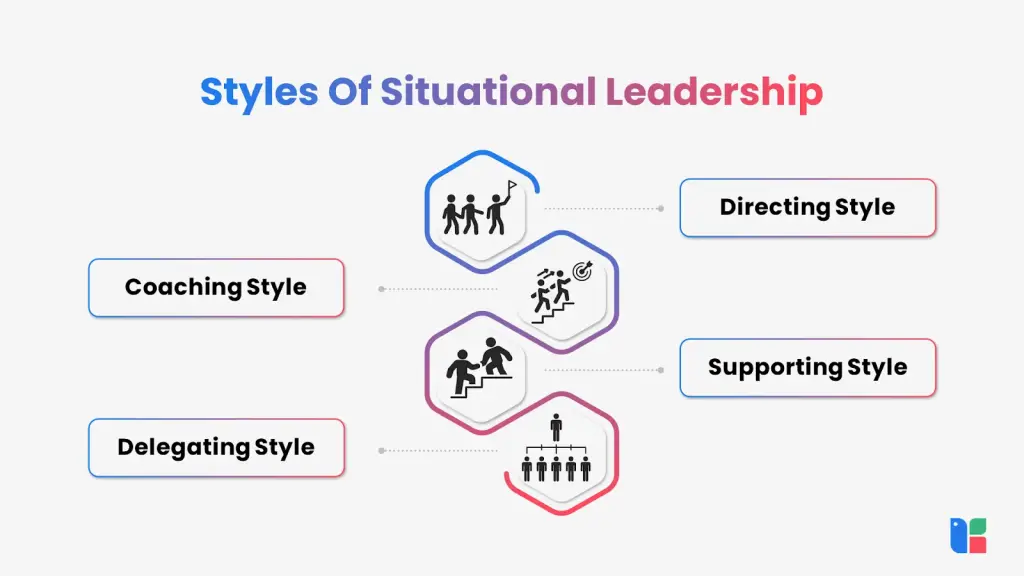
1. Directing Style
The directing style is like being a tour guide for your team. When using the situational leadership i model, leaders provide clear and specific instructions to their team members. This is particularly effective when dealing with situations where team members are new employees to task orientation or need step-by-step guidance. Leaders who adopt the Directing Style closely monitor progress, offering advice and support. This hands-on approach helps team members understand what is expected of them and how to achieve their goals.
2. Coaching Style
The coaching style involves a more interactive and mentoring approach. Leaders who use the situational leadership ii model act as coaches, guiding and supporting their team members in their professional growth and skill development. This style is beneficial when team members have some basic skills but still require guidance to reach their full potential. Leaders using the Coaching Style encourage open communication, provide constructive feedback, and work closely with their team to enhance their strengths and address any areas of improvement.
3. Supporting Style
The supporting style is all about empowerment. Leaders adopting the situational leadership iii model provide support, encouragement, and a sense of autonomy to their team members. This approach is most effective when team members possess the necessary skills but may need more confidence to tackle challenges and work independently. By offering a supportive environment, leaders help team members build their self-esteem and take ownership of their tasks. The Supporting Style fosters collaboration and trust, enabling team members to excel.
4. Delegating Style
The delegating style is a testament to trust and empowerment. Leaders who embrace the situational leadership iv model have confidence in their team members’ capabilities and decision making skills. In this approach, leaders delegate tasks and responsibilities to team members who are experienced and proficient in their roles. This style allows team members to take charge of their work environment and make the decision making process automatic. The Delegating Style is particularly effective when dealing with skilled and self-reliant team members who thrive on independence and responsibility.
Now, let’s focus on another important aspect of situational leadership: understanding maturity levels. Simply put, they help leaders understand how well-equipped and self motivated individuals are to take on specific responsibilities.
To learn how you can adapt your leadership style based on team needs, performance, and context, explore how Kapable helps you build this flexibility through guided practice, feedback, and real-world application.
What Do Maturity Levels Mean In Situational Leadership?
Have you ever thought about how knowing where your team members stand regarding skills and motivation could help you lead them to success? Maturity levels are like the building blocks of situational leadership. Maturity levels in situational leadership refer to the varying degrees of readiness that team members exhibit when performing tasks. They help us understand how ready team members are for a task, considering both their skills needed and how much they care about the task.
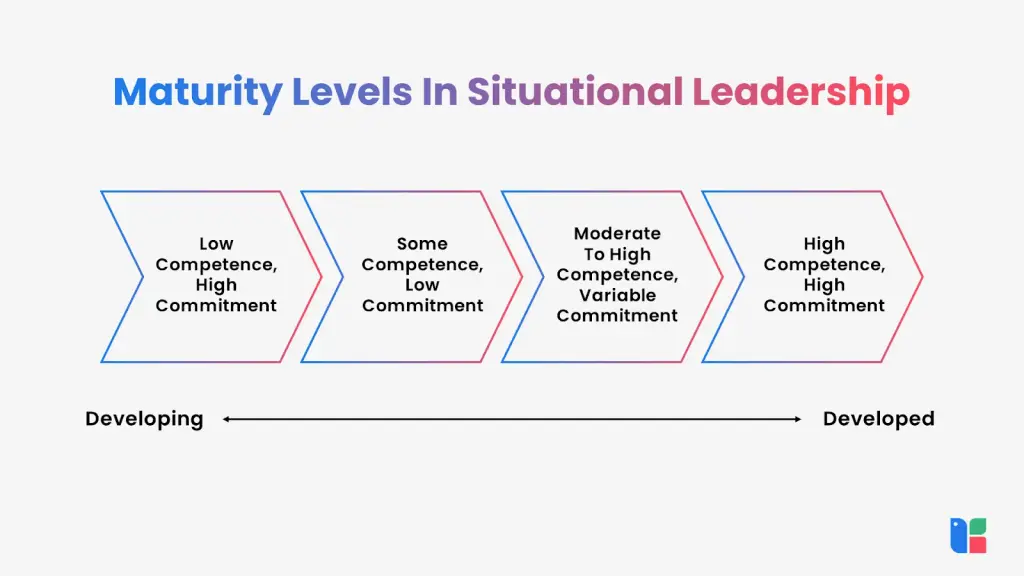
1. Low Competence, High Commitment
Imagine someone who really wants to help but doesn’t know how. They’re like an eager explorer who hasn’t been on this journey before. They’re excited, but they need a lot of guidance. In these cases, leaders should give clear directions and keep a close supervision on progress.
2. Some Competence, Low Commitment
Think of someone who knows the basics but could be more confident and highly motivated. It’s like a young bird that’s not sure if it can fly yet. They need encouragement and support to build their confidence and commitment. This is where leaders provide the right environment for them to feel more involved.
3. Moderate To High Competence, Variable Commitment
This is when someone knows what they’re doing but might only sometimes be fully into it. It’s like a sailor who’s skilled but deals with changing winds. They might need some help getting motivated or staying focused. Leaders can guide and encourage them to maximise their skills and commitment.
4. High Competence, High Commitment
Imagine a team member who’s both really good at what they do and really motivated to do it. They’re like a star athlete who gives their all in every game. These team members are ready to take charge and make decisions independently. Leaders should trust and empower them to shine.
As we explore the dynamics of situational leadership, we come to the important connection between matching effective leadership styles and maturity levels and which style suits which level.

How Can Leaders Match Their Leadership Styles With Maturity Levels?
Navigating the waters of leadership involves more than just knowing the right leadership styles and the team’s maturity levels; it’s about pairing them up to create a seamless journey. Let’s explore how different leadership styles align with the various maturity levels of team members:
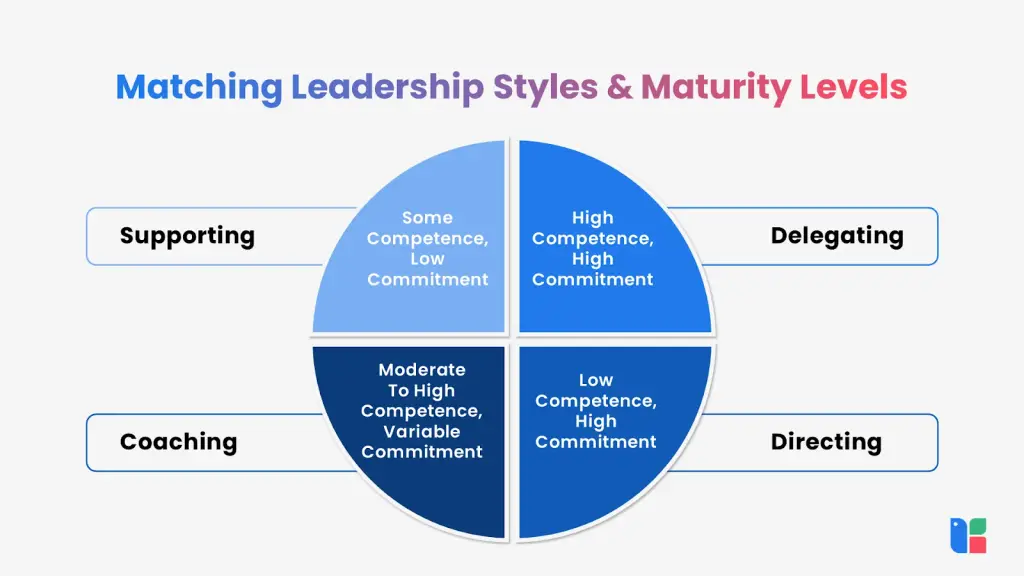
Directing
When you encounter enthusiastic beginners who are eager but lack the skills, the directing style is your anchor. These team members have high commitment but low competence, so you provide clear instructions and closely monitor their progress. Your guidance gives them the confidence to navigate uncharted territories.
Supporting
The supporting style works best for developing performers who have some competence but low commitment. Be their safety net, offering encouragement and a supportive environment. Your role is to empower them to take on challenges with renewed enthusiasm while building their confidence and motivation.
Coaching
For skilled but inconsistent members with moderate to high competence but variable commitment, the coaching style comes into play. Just as a coach guides athletes to peak performance, guide these team members to stay committed while enhancing their competence. Your mentorship helps them overcome obstacles and stay on course.
Delegating
With confident experts who are both highly skilled and motivated, the delegating style reigns supreme. Trust their expertise and let them take the lead. These team members are ready to take ownership and make decisions independently, so your role shifts to oversight and support as needed.
With a clearer understanding of how leadership styles align with team readiness, let’s now uncover the advantages of situational leadership.
What Are The Advantages Of Situational Leadership?
Situational leadership is like having a versatile toolkit for leaders, with each tool designed to fit a specific situation. This approach brings forth several advantages that can significantly impact teams and organisations.
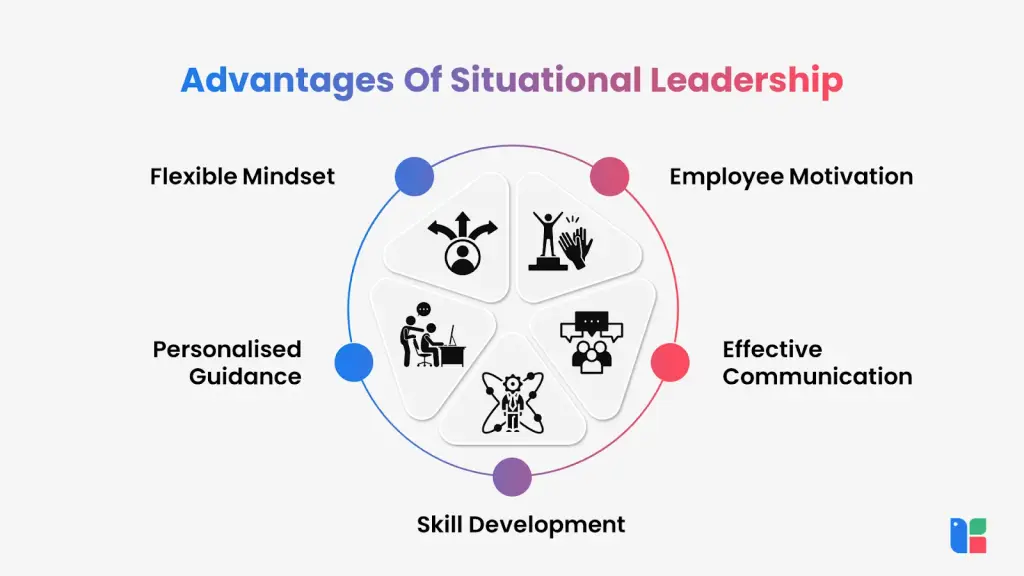
Flexible Mindset
Imagine being an effective leader who can seamlessly adjust their approach based on the moment’s needs. That’s what situational leadership offers – a leader’s own ability to adapt like a chameleon in a changing environment. Effective leaders tailor their style to match the situation, creating an atmosphere of flexibility essential in today’s dynamic workplaces. Situational leaders are ready to switch gears, whether it’s a crisis that demands quick decisions or a collaborative project that needs careful nurturing.
Personalised Guidance
Team members come with diverse skills, personalities, and motivations. Situational leaders recognise this and provide personalised guidance that speaks to each individual. It’s like a tailor crafting a suit – each stitch is made precisely to ensure a perfect fit. By addressing the unique needs of team members, leaders build strong connections, boost morale, and create an environment where everyone feels valued.
Skill Development
Situational leadership isn’t about handing out orders but nurturing growth. Leaders become coaches, mentors, and guides on a journey of skill enhancement. Leaders step in with support and guidance when team members are challenged just outside their comfort zone. This fosters a culture of continuous learning, where even the most seasoned professionals find opportunities to sharpen their skills.
Effective Communication
Clear communication is the bridge that connects leaders and their teams. Situational leaders recognise that communication isn’t just about talking – it’s about listening, understanding, and responding appropriately. The leader and employees’ ability to engage in open and honest dialogue creates a foundation of trust. Team members feel comfortable expressing their thoughts, concerns, and ideas, fostering an environment where collaboration flourishes and innovation thrives.
Employee Motivation
Leaders ignite a sense of motivation and ownership by involving team members in decision making and encouraging them to contribute ideas. It’s like igniting a spark that fuels their dedication to achieving shared goals. When individuals know their voice matters and their efforts are recognised, they become more engaged and enthusiastic contributors.
While the advantages of situational leadership are compelling, it’s essential to also consider the potential challenges. Let’s now turn our attention to the disadvantages of situational leadership.
What Are The Disadvantages Of Situational Leadership?
While situational leadership undoubtedly offers valuable insights for effective guidance, it’s important to acknowledge that, like any leadership approach, it comes with challenges. Recognising these disadvantages enables leaders to make informed decisions about when and how to apply situational leadership principles.
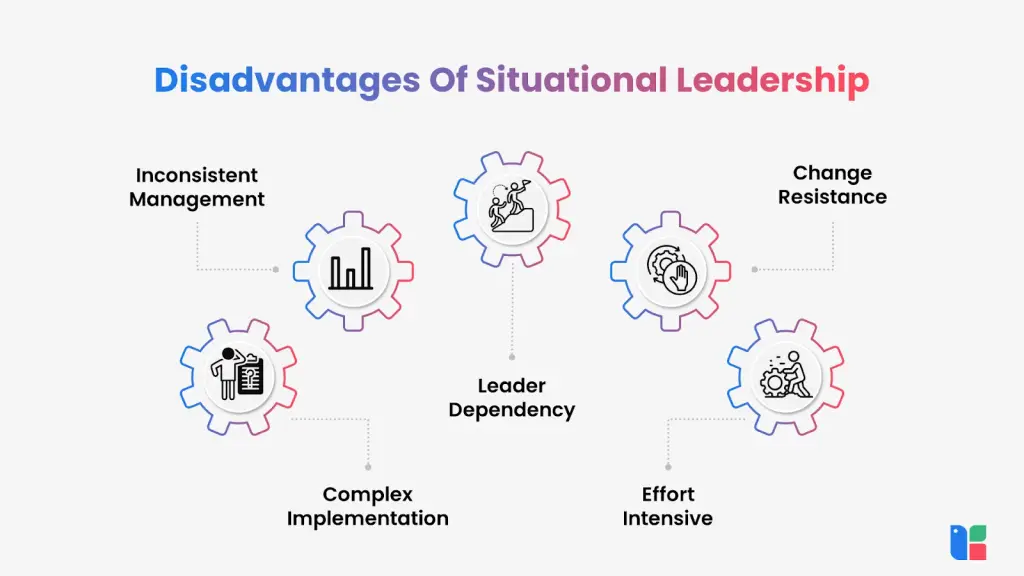
Complex Implementation
While the concept of situational leadership is straightforward, putting it into practice can be complex. Leaders must be adept at assessing the readiness of their team members and determining the most suitable style for each situation. This process demands careful analysis, which might be time-consuming and challenging in fast-paced environments.
Inconsistent Management
With different situations demanding different leadership styles, there’s a risk of inconsistent management. Team members might need help to predict how their leader will respond, which can lead to confusion and uncertainty. Maintaining a balance between flexibility and consistency becomes a delicate art that leaders must master.
Leader Dependency
The effectiveness of situational leadership hinges on the leader’s ability to accurately assess the situation and select the appropriate leadership style. Suppose leaders misjudge the performance readiness of their team members or choose an unsuitable style. In that case, it can lead to confusion and suboptimal outcomes.
Effort Intensive
Adapting leadership styles to match different situations requires an investment of time and effort from leaders. This can be particularly demanding in busy and high-pressure environments, where finding the time to assess and adjust might be challenging.
Change Resistance
Change, even when beneficial, can be met with resistance. Some team members prefer a consistent leadership style, finding it difficult to adapt to the varying leadership approaches. Overcoming this resistance requires effective communication and a deep understanding of team dynamics.
While acknowledging potential drawbacks, exploring real-world instances where situational leadership has thrived is enlightening. Let’s see the examples of successful situational leade
Who Are The Leaders Known For Successfully Applying Situational Leadership?
Learning from real-life leaders who’ve mastered the art of situational leadership can be truly inspiring. Let’s delve into the stories of a few exceptional individuals who have navigated various challenges with adaptability and insight:
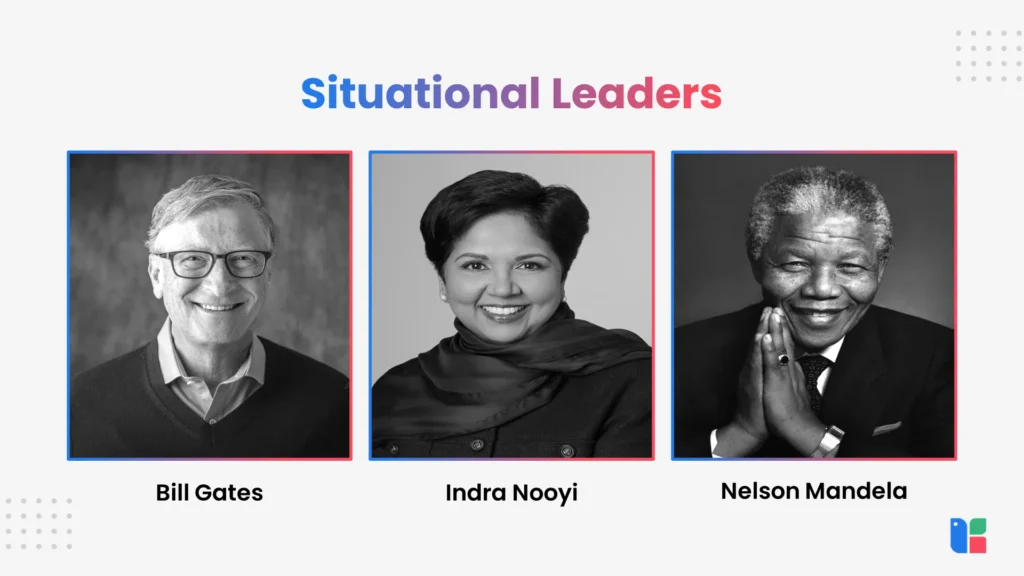
Bill Gates
Bill Gates, the co-founder of Microsoft, is a prime example of the best leader who seamlessly transitioned through different stages of his company’s growth. He was a visionary entrepreneur in the early days, leading a small team to develop innovative software. Gates evolved his leadership style as Microsoft expanded into a global tech giant. He became a strategic thinker, steering the company’s direction while empowering managers to take the lead in their respective areas. Gates demonstrated that situational leadership isn’t about sticking to a single playbook but adjusting strategies based on the organisation’s needs and the team’s maturity.
Nelson Mandela
Nelson Mandela, the iconic leader of South Africa’s anti-apartheid movement and its first black president, showcased unparalleled adaptability during a critical period of transformation. Facing a deeply divided nation, Mandela understood the need for reconciliation. He seamlessly shifted from a fierce activist to a unifying figure, bringing people together and fostering a spirit of forgiveness. His situational leadership approach was instrumental in South Africa’s transition to democracy and its journey toward healing and unity.
Indra Nooyi
Indra Nooyi, the former CEO of PepsiCo, is a shining example of a leader who championed innovation and diversity through situational leadership. Under her guidance, PepsiCo embraced a culture of innovation, adapting its product offerings to changing consumer preferences. Nooyi also recognised the importance of understanding diverse markets and teams. She encouraged inclusivity and promoted diversity, understanding that situational leadership means tailoring strategies to resonate with different cultures and backgrounds.

How To Become An Effective Situational Leader?
Becoming an effective situational leader can be a simple endeavour. In fact, there are straightforward strategies you can employ to master this dynamic approach. Here are three simple ways to enhance your situational leadership skills:
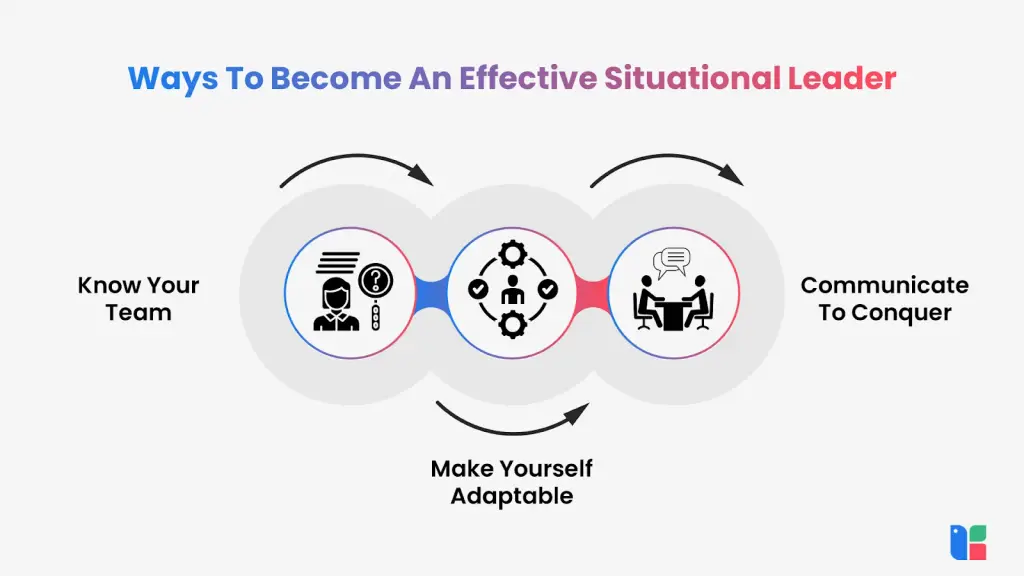
Know Your Team
Understanding your team members deeper is the foundation of situational leadership. Take the time to learn about their strengths, weaknesses, and aspirations. Regular one-on-one conversations can reveal their readiness levels and give insights into each individual’s most suitable leadership style. By knowing your team members as individuals, you can tailor your approach to effectively support their growth.
Make Yourself Adaptable
Situational leadership thrives on adaptability. Flexibility is key as you navigate various tasks and situations. Recognise that one size doesn’t fit all when it comes to leadership. Be prepared to switch between directing, coaching, supporting, and delegating tasks based on the context and the team member’s readiness. Embrace change and embrace the role of a versatile leader who can seamlessly shift gears.
Communicate To Conquer
Open and effective communication is the glue that holds situational leadership together. Regularly engage with your team to understand their progress, challenges, and aspirations. Be transparent about your expectations and the rationale behind your chosen leadership style for a particular situation. This builds trust and allows your team to align with your vision and direction.
Conclusion
As we begin our leadership journeys, let’s embrace the essence of situational leadership; its core lies in adjusting, personalising, and inspiring. Understanding that different situations and team members demand tailored approaches allows us to lead with versatility and empathy. Drawing wisdom from successful practitioners of this method equips us to navigate challenges, build thriving teams, and drive positive transformation. Through adaptable guidance and a personalised touch, we can forge impactful leadership that fosters growth and change.
If you’re considering whether your current leadership approach, adaptability, and readiness to grow align with this kind of development, this quick check from Kapable will help you assess your fit.


