


TL;DR
- Vision-Driven Influence: Organisational leadership is the ability to inspire and guide employees toward the organisation’s strategic goals, distinct from general leadership’s application across varied contexts.
- Adaptive vs. Task-Focused Approach: Unlike traditional management’s emphasis on control and process efficiency, organisational leadership centres on motivating people, building adaptability, and driving innovation toward a shared vision.
- Essential Competencies for Impact: Distinguished organisational leaders master key skills including strategic thinking, effective communication, adaptability, timely decision-making, and modern empathy-driven emotional intelligence.
- Path to Efficacy: Leaders develop by conducting honest self-assessments, defining SMART goals, and fostering professional networks, while critically avoiding detrimental behaviours like micromanagement and favouritism that weaken trust.
“A leader is one who knows the way, goes the way, and shows the way.” – John C. Maxwell.
Are you a leader who likes to frame a strategy and stick to it until the goal is reached? Or do you like to be dynamic and adjust your strategies to the needs of your team members?
In this goal-oriented world, organisational leadership is more people-oriented. An organisational leader needs to reach the goals and objectives of an organisation by sharing their vision with the employees and motivating everyone to work efficiently.
In this blog, we will explore this leadership style associated with organisational behaviour, how it differs from traditional management style and those baby steps you can take to become a good organisational leader.
What Is Organisational Leadership?
According to the National Center for Education Statistics (NCES), organisational leadership involves those leadership skills that are applied mainly in a business setting, governmental and non-governmental organisations, and education settings.
In simple words, organisational leadership is the ability of a leader to influence, inspire, and guide an organisation to work collaboratively towards a common vision and achieving the set goals. Let’s dive a little deeper into this.
Organisational leadership involves your capability to make strategic decisions, provide direction, and inspire individuals within an organisation to work collaboratively towards a shared vision. It comprises various leadership styles and approaches, emphasising the importance of effective communication and decision-making and fostering a positive culture in the organisation.
Now, we see a leader even in our parents, siblings and friends. So, can these be considered as organisational leadership? The answer is no because this is not an example of leadership in organisational behaviour.
Leadership and organisational leadership are related concepts, but they have distinct focuses and implications within the context of an organisation. Leadership is a broader term and can apply to various contexts rather than being confined to an organisational setting. Leadership can manifest in personal relationships, community initiatives, or any situation where a person guides, influences, or inspires others. Contrary to this, organisational leadership specifically pertains to leadership in the context of the organisation. It includes the skills, behaviours, and strategies a leader employs to guide the group of employees to achieve the organisation’s goals.
Still trying to understand what organisational leadership is? Read the example below and see if it’s clearer.
Let’s take an example from the real world of a great leader and visionary, Elon Musk, who envisioned a future where space travel would be more viable and less costly. With this idea in his sight, he created SpaceX and developed the concept of reusable rockets. He built an entire team around this vision in SpaceX and set up audacious and long-term goals for his team. Musk then personally engineered the team to achieve the objectives of the company. This is precisely who is an organisational leader and what organisational leadership style means.

How Is Organisational Leadership Different From Traditional Management?

Organisational leadership and traditional management are two distinct approaches to how you lead a team of employees within an organisation. Both management and organisational leadership are essential for the smooth functioning of the organisation. With respect to differentiation, they differ in their focus, style, and overall impact on organisational culture and success.
Focus
Traditional management tends to be more task-oriented. The focus of the managers is on planning, organising, and controlling processes to ensure that tasks are completed efficiently. On the other hand, the organisational style of leadership forms a vision. It focuses on motivating and engaging the employees to contribute creatively to the achievement of the vision.
Style
In traditional management, the leadership style followed is mostly conventional. It is more autocratic leadership, with a top-down approach to decision-making. Decisions may be made centrally, with limited input from subordinates. Leaders in organisational behaviour encourage collaboration, seek input from team members, and are willing to adapt to changing circumstances. They foster a culture of continuous learning and improvement.
Impact
With respect to impact on the entire organisation, traditional management brings stability and efficiency. It aims to establish and maintain control over processes, ensuring that tasks are completed according to established standards. Organisational leadership tends to foster a culture of adaptability and innovation. By empowering the employees and promoting a shared vision, leaders can inspire creativity and a willingness to take calculated risks.
This is a minute distinction between the two leadership styles. Now, let’s understand the essential skills that form the foundation of the importance of leadership.
What Are The Key Skills For Organisational Leadership?
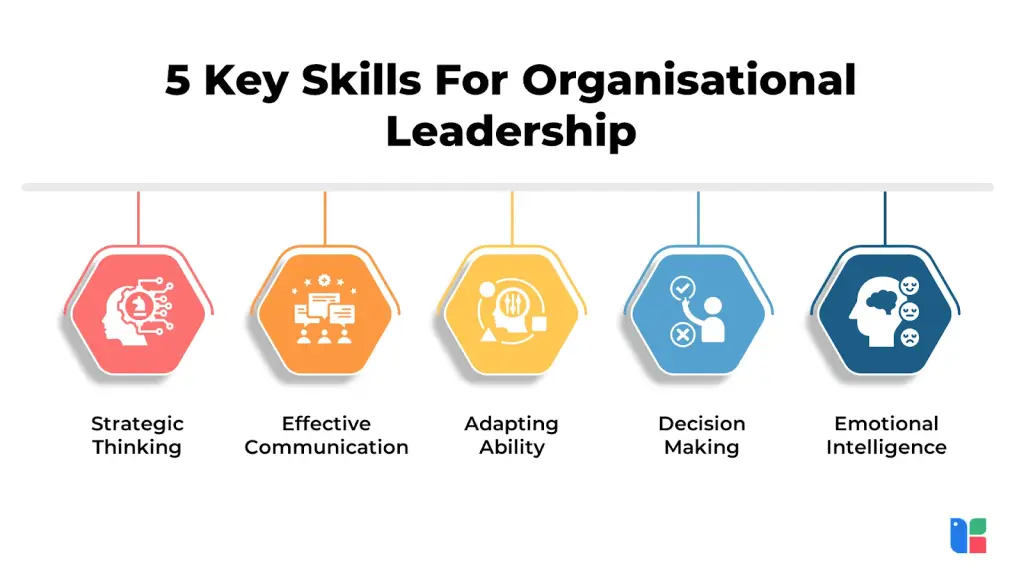
In the present world, effective organisational leadership is not about holding a position or title but about honing specific skills to drive your team towards achieving a common objective. In this part, we will explore these skills leaders need to master to become a distinguished organisational leader.
1. Strategic Thinking
It includes the ability to comprehend complex situations, envision solutions to these complexities, and form plans to implement these solutions. A good leader always tries to align their thought process with the vision of the organisation.
A significant benefit of strategic thinking is that you are always prepared for contingencies, stay ahead of your competitors, and enable your organisation to come out of difficult situations with ease.
2. Effective Communication
Effective communication would occupy the top spot if we had to organise these skills in a hierarchical order. All prominent leaders, such as Steve Jobs, Mark Zuckerberg, have reached the pinnacle mainly through their effective communication skills.
Communication is ineffective when you speak your heart out, and the audience dozes off. Effective communication means the listeners hear and understand the message that you convey. A lot of experienced professionals get stuck on the edge of becoming a good leader just because they need more effective communication skills.
3. Adapting Ability
A big strength of an organisational leader is adapting to changes within and outside the organisation. A change within the organisation can be a change of team members, a change of department or an assignment of a new vertical, whereas change outside the organisation involves advancement in technology, for instance, adapting to virtual working during Covid.
Change is inevitable in an organisation, and the entire team collapses if a leader fails to adapt. To adapt quickly to such changes, you have to be updated on recent trends, aware of your customer feedback, and also the emotional quotient of your team.
4. Decision-Making
Imagine yourself as an organisational leader of a company, and you have to decide whether to invest in new technology to streamline operations or focus on better marketing strategies to gain market share. This is what a good leader has to do – make difficult and quick decisions.
To make good decisions, it is important to gather correct and enough information about the situation, analyse the possible decisions, assess the potential risks arising out of different decisions and make a decision that is consistent with the goals and vision of the organisation.
5. Emotional Intelligence
The traditional management approach requires leaders to impose assertiveness on their team, but the modern world needs you to be empathetic.
To depict emotional intelligence:
- Encourage honest feedback from peers, subordinates, and mentors to gain insights into how others may perceive your emotions.
- Develop habits such as meditation or deep breathing exercises to stay calm under pressure.
- Before making decisions, consider how they might affect different individuals or teams.
These are the five most significant skills related to organisational leadership style. But can you do something in your day-to-day life to inculcate these skills? Let’s find out.
“My journey with Kapable has been truly valuable. The sessions helped me gain confidence and handle impromptu speaking and assertiveness. I successfully led high-level meetings, which I used to avoid, and received positive feedback from my director. I now feel confident and empowered.”
– Ruchika Bagga (Senior Manager At Mankind Pharma)
What Are The Actionable Steps You Can Take?

There are some very simple and easy steps that you can take to inculcate essential skills of leadership right when you join an organisation. Let’s explore these steps here:
1. Self-Assessment And Reflection
Becoming an organisational leader begins with an honest and comprehensive self-assessment. It means analysing your strengths, weaknesses, values, shortcomings, and motivation and working on them individually.
Seek feedback from the employees, mentors, or supervisors to gain insights into your performance and leadership potential. Use personality assessment tools like the Myers-Briggs personality test, where you self-evaluate yourself on more than 90 questions.

2. Setting Clear Goals

Set your goals according to Specific, Measurable, Achievable, Relevant and Time-bound (SMART). Clearly defined goals provide direction and motivation.
For instance, instead of a broad goal like “Increase Sales”, specify your goal like “Increase sales by 10% in 12 months”. Make achieving goals easy by dividing them into smaller pieces like “Sell two additional units every week”. This method is more impactful and easy to implement.
3. Strong Professional Network
Remember that in any industry, your net-work is your net-worth. A strong professional network means increased collaboration opportunities, diversity in ideas and continuous learning opportunities.
Let’s look at some pro tips to build your professional network. Be approachable and friendly – a smile goes a long way. Attend organisational events, regional and national meetups and social gatherings. Be active on LinkedIn, post informational content and engage with content of people you would like to network with.
Do you know that despite these actionable steps, sometimes people still fail to acquire leadership in the organisation? Ever wondered why this happens?
This happens because we forget to avoid certain conducts and practices that hamper growth. Let’s understand some of them in the next section.
Organisational behaviour improves when leaders communicate, influence, and adapt effectively, and Kapable develops these capabilities through structured leadership learning.
What Practices Should You Avoid As A Good Organisational Leader?

As positive traits can help you become an effective and good leader, certain practices or conducts can deteriorate your efficacy as a leader. These are very common iniquities that a leader needs to avoid if you want to climb the stairs of leadership.
1. Micromanagement
Micromanagement is often confused with providing help and support. Thus, at times, leaders do not realise when their helpful gesture turns into micromanagement.
Micromanagement means excessive control and hand-holding of the employees. Constantly checking in, suggesting minute changes, and requiring approval at every step are some common traits of micromanagement.
Micromanaging not only hampers productivity but also erodes trust and hinders creativity. To avoid micromanagement, adopt a Laissez-faire leadership style. Laissez-faire is an economic concept to let things happen without controlling them. As a good leader, delegate responsibilities, communicate goals, deadlines, and expectations to your team and let them fend for themselves.
2. Narrow-mindedness
Narrow-mindedness is a trait of Autocratic Leadership. Exactly like micromanagement, it is difficult to identify whether I am narrow-minded or open-minded.
Narrow-minded leaders would resist new ideas, perspectives, and innovations. They show little interest in learning about new topics, industries, or perspectives outside their immediate scope of knowledge. They avoid engaging in discussions with people who hold different opinions or beliefs.
To avoid narrow-mindedness, encourage a diverse workforce, be open to new approaches and be willing to adapt your strategies based on feedback.
3. Favouritism
A common and most unhealthy trait of leadership is bias in favour of a person or playing favourites. It can create resentment and division within a team, resulting in reduced performance and slow progress.
Base decisions on merit, performance, and objective criteria rather than personal biases or preferences.
4. Transparency
Open and honest communication is vital. Keeping information from your team can lead to mistrust. So, a leader needs to be transparent about organisational goals, challenges the company may be facing, and decisions to foster a culture of openness.
Conclusion
Being an organisational leader might not be your official role in the organisation, but it’s more than just a name. It’s about having the right attitude skills, caring about people, and having the courage to make positive changes.
There will always be a need for skilled organisational leaders. The ability to bring a vision, especially one focused on growth and sustainability, is always in demand. So, being an organisational leader is a crucial and lasting part of the professional world, both now and in the future.
Being a leader of the organisation is about doing things that matter and working on our actionable steps you can build, inspire, and create a lasting impact as well. For further growth, there are articles, TED talks, and Training Programs that can help you become an effective organisational leader. Remember to work on these actionable steps listed above, and check your progress daily.
Whether you’re leading teams, managing change, or shaping organisational culture, Kapable can help you understand if its program supports your leadership journey.


