


TL;DR
- Scope vs. Strategy: Delegation is an operational tool for entrusting specific tasks with retained accountability, whereas decentralisation is a strategic choice for permanently distributing authority across entire units.
- Dual-Edged Empowerment: Both strategies boost efficiency and employee growth but introduce risks, such as managerial fear of losing control with delegation and the potential for inconsistent outcomes with decentralisation.
- Structuring Success: Effective delegation requires setting SMART, manageable goals, while successful decentralisation depends on structural clarity using tools like the RACI matrix and central KPI monitoring.
“Leaders become great not because of their power, but because of their ability to empower others.”– John Maxwell.
This statement by John Maxwell rightly states a crucial way leaders empower others is by effectively distributing power and responsibilities through concepts like delegation and decentralisation. While these terms are sometimes used interchangeably, each plays a unique role in shaping how a company operates and flourishes over time.
In this blog, we will explore the differences between delegation and decentralisation in a way that’s easy to understand. We’ll explore the benefits and challenges of each approach, as well as share some best practices. By getting a clearer idea of these concepts, leaders can make smarter decisions that can improve efficiency, spark innovation, and enhance employee satisfaction.
What Is Delegation?
Delegation is an essential management skill where a leader hands over responsibility and authority to team members for specific tasks. Delegation involves the distribution of authority from higher levels to subordinates, allowing them to make decisions at lower levels and improve organisational efficiency.
It’s not just about assigning a job; it’s about empowering people to make decisions and take ownership of their work. Here’s how effective delegation usually works:
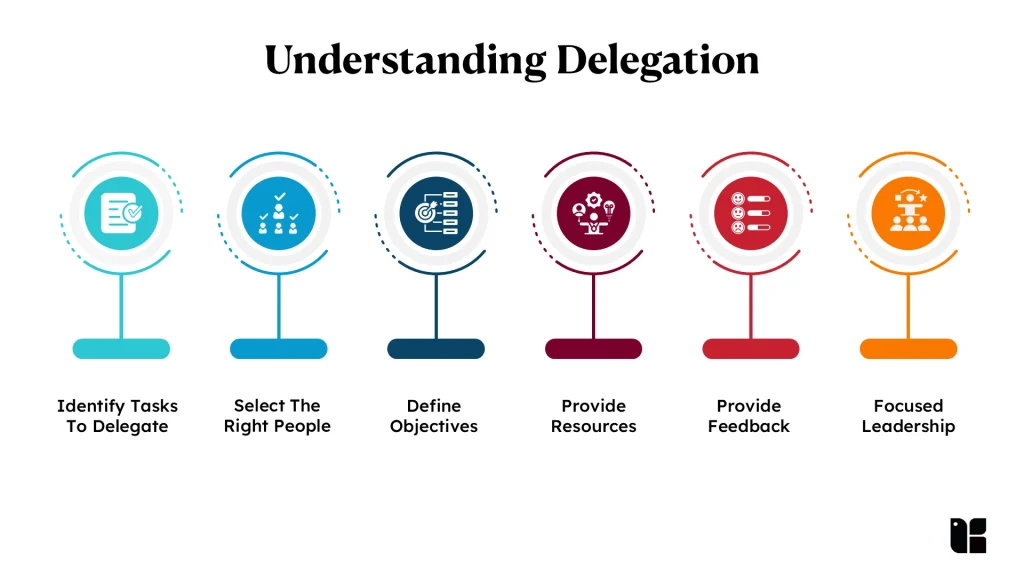
- Identify tasks to delegate: Leaders take a look at their to-do list and figure out which tasks can be passed on without affecting the quality of work.
- Select the right people: It’s all about choosing team members who have the right skills and strengths for the job. Finding the right fit makes all the difference!
- Define objectives: Clear communication is key. Leaders need to set clear goals and expectations so everyone knows what’s needed and can stay on the same page.
- Provide resources: It’s important to make sure team members have the tools and information they need to succeed. This support goes a long way!
- Provide feedback: Regular check-ins and constructive feedback help keep things on track and show team members they’re supported in their efforts.
- Focused Leadership: Effective delegation allows top management and the organisation to focus on strategic planning and higher-level responsibilities, as routine tasks and decisions are handled by those at lower levels of the organisation.

How Can Delegation Benefit Leaders?
Delegation involves entrusting tasks and responsibilities to others, which can lead to significant advantages for both individuals and organisations. It can bring about some great benefits, which are as follows:

- Increased productivity: When leaders delegate tasks, they can concentrate on higher-level responsibilities while their team takes care of the daily operations. This teamwork helps everyone stay productive!
- Skill development: Delegating tasks encourages employees to learn new skills and build confidence, which prepares them for future leadership roles.
- Motivated employees: When team members are empowered through delegation, they feel a real sense of ownership over their work. This leads to higher job satisfaction and a more motivated team overall.
Despite these benefits, delegation also comes with its own set of challenges that need to be managed effectively. Let’s explore the challenges of delegation in the next section.
What Are The Common Challenges Of Delegation?
Delegation is an important tool for leaders to share tasks among team members, making work more efficient and helping team members grow. However, it has its own difficulties that need careful handling:

- Fear of losing control: Managers often worry about losing control over outcomes when they delegate tasks. They want to keep quality high and make sure tasks are done right. Overcoming this fear means clearly explaining expectations, checking in regularly, and building trust with the team.
- Skills gap: Delegation can be tricky if team members don’t have the right skills or experience for the tasks they’re given. This can cause delays, mistakes, or incomplete work, hurting overall team performance. Managers should assess each team member’s abilities before delegating and provide training or support as needed.
- Communication issues: Successful delegation relies on clear communication. Problems happen when expectations, deadlines, or responsibilities aren’t laid out, which can lead to frustration, lower morale, and projects not turning out as planned. To tackle this, managers should encourage open conversation, listen actively, and ensure everyone understands their roles and tasks.
Managing these challenges requires leaders to be proactive, plan well, and support their teams. By overcoming these hurdles, managers can use delegation effectively to boost productivity and create a supportive work environment.
How Do Real-World Cases Demonstrate Successful Delegation?
Starbucks is known for its strong emphasis on employee empowerment and effective delegation. Howard Schultz, the former CEO, believed in creating a culture where team members felt valued and trusted to make decisions.

Delegation in action: Schultz encouraged store managers to take ownership of their locations, allowing them to tailor their approach based on local customer preferences. This delegation not only enhanced operational efficiency but also fostered a sense of pride among employees, leading to higher job satisfaction and engagement.
Outcomes: By empowering store managers and baristas, Starbucks was able to maintain high-quality customer service across thousands of locations, even as it expanded globally.
What Is Decentralisation?
Decentralisation means sharing decision-making power across an organisation instead of keeping it all at the top. This way, different teams can take charge and find solutions that work best for their specific situations.
How Is Decentralisation Implemented in Different Forms?
Decentralisation can take various forms, each with its own structure and scope, tailored to different organisational needs and goals. It can come in several forms:
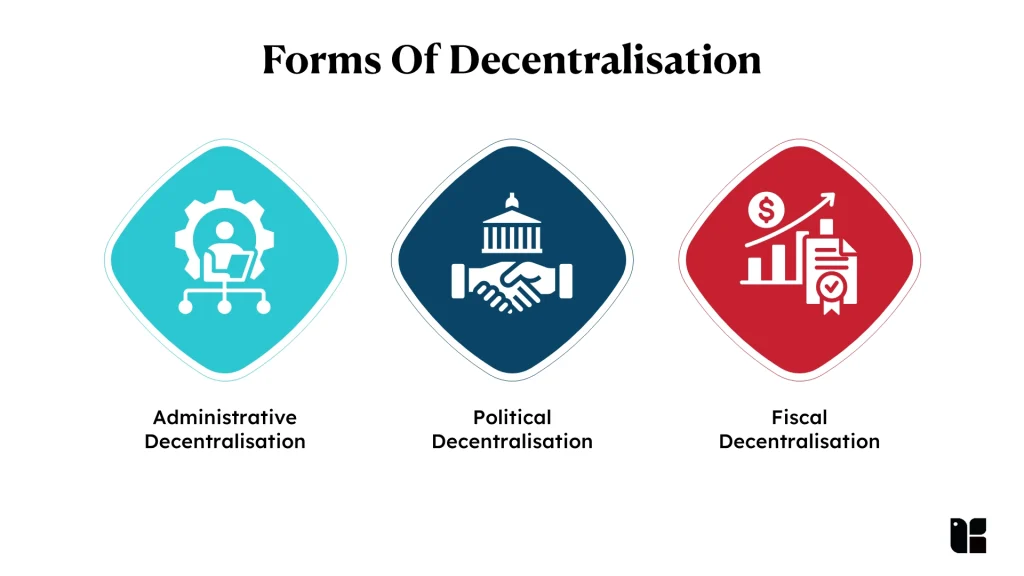
- Administrative decentralisation: This means sharing authority among different levels of management and departments so decisions can be made closer to the action.
- Political decentralisation: This gives local governments and community members a say in decisions that impact their areas, making sure their voices are heard.
- Fiscal decentralisation: This allows lower levels of government or teams within an organisation to manage their own budgets, giving them more control over their finances.
Understanding the different forms of decentralisation helps in appreciating its specific benefits and how they can be used effectively. Let us explore the benefits of decentralisation in the next section.

What Are The Key Benefits Of Decentralisation?
Decentralisation distributes decision-making authority, leading to increased efficiency, better responsiveness to local needs, and a more empowered workforce. Decentralisation offers several benefits:

- Faster decision-making: New leaders can make decisions quickly without having to wait for approval from higher-ups, which helps them respond to changes right away.
- Empowerment of new leaders: It encourages local leaders to take charge and come up with new ideas, which helps the organisation grow.
- Better responsiveness: This decision-making allows organisations to adapt quickly to customer needs and shifts in the market.
However, while decentralisation offers several advantages, it also comes with its own set of challenges. Let’s take a look at the challenges in the next section.
Which Challenges Are Common When Decentralisation Is Practiced?
Decentralisation can also bring challenges, such as inconsistent decision-making, difficulties in maintaining unity, and the need for effective coordination. However, decentralisation can also bring some challenges:
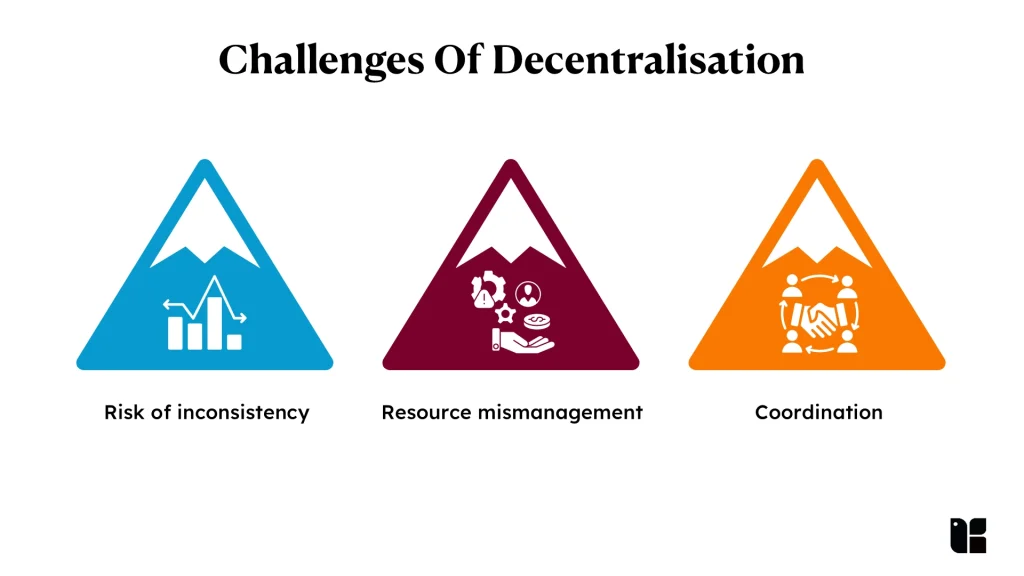
- Risk of inconsistency: Different teams might create their own ways of doing things, which can result in differences in how the organisation runs.
- Resource mismanagement: Local leaders might make choices that don’t always match the overall goals of the organisation, leading to wasted resources.
- Coordination: With teams working independently, it can be harder to coordinate activities between them, which may cause conflicts or misunderstandings.
After understanding these challenges, it is important to explore a real-world example of decentralisation to see how these issues play out in practice.
What Insights Do Real-World Decentralisation Examples Provide?
Procter & Gamble (P&G) is a leading global consumer goods company known for a wide range of household and personal care products. The primary reasons for the decentralisation of this company is as follows:
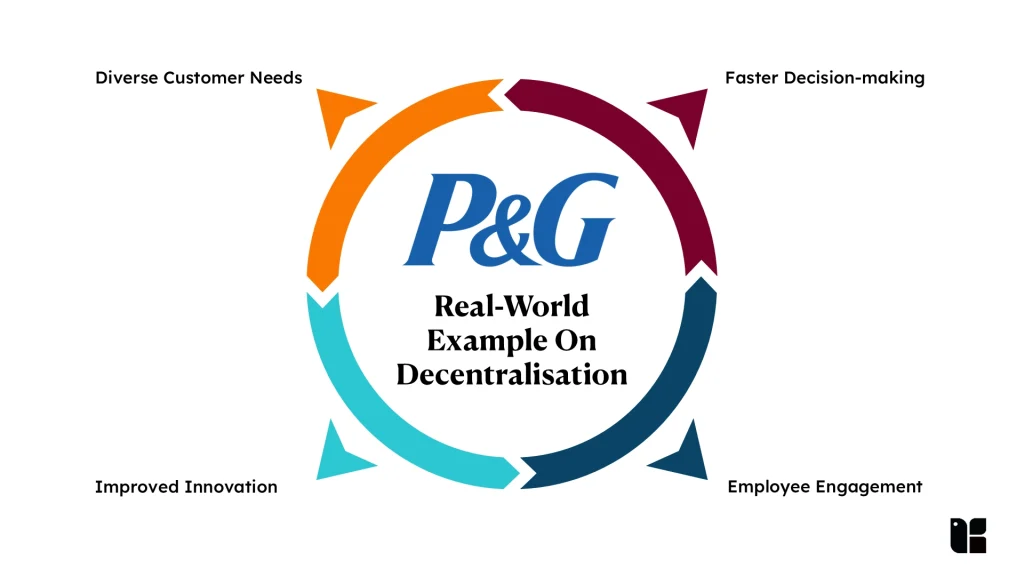
- Diverse customer needs: P&G operates in various markets with unique consumer preferences. Decentralisation enables regional managers to customise marketing strategies and product offerings to better connect with local customers.
- Faster decision-making: Centralised decision-making can be slow. Empowering regional managers allows for quicker responses to market trends and competitor actions, providing a competitive edge.
- Improved innovation: Local managers understand their markets deeply and can identify opportunities for new products. Decentralisation encourages innovation tailored to local needs.
- Employee engagement: Giving regional managers more authority boosts their sense of ownership and motivation, leading to a more engaged workforce.
Positive Outcomes
Decentralisation has provided several benefits for P&G, including enhanced market responsiveness, allowing the company to quickly adapt to changing customer preferences. This approach has also resulted in a stronger local brand presence, as tailored strategies increase brand relevance in diverse regions. Furthermore, decentralisation has spurred increased innovation by empowering local managers, who can develop products that meet specific local needs.
By decentralising decision-making, Procter & Gamble effectively leverages local insights and agility to maintain its competitive advantage in the consumer goods industry.
“This 3-month journey has been enlightening, as I transitioned from an ambitious manager to an inspiring leader. Applying Kapable’s techniques, I confidently delivered a 30-minute speech at our Annual Planning Session, receiving positive feedback from my team. Kapable has been instrumental in helping me reach my full potential.”
– Sailesh Gadalay (Sr Account Director – Enterprise Sales At Linkedin)
How Are Delegation And Decentralisation Similar?
Here are the four most important similarities between delegation and decentralisation, explained in a simple and relatable way:

- Empowerment: Both delegation and decentralisation give people in the organisation the power to make decisions. This helps them feel more involved and valued in their roles.
- Sharing authority: Instead of one person making all the decisions, both approaches spread out the decision-making power. This creates a more collaborative environment where everyone can contribute.
- Better efficiency: When decisions are made closer to the action, like on the ground level, it can lead to quicker and more effective responses. This makes the whole organisation run more smoothly.
- Accountability: Both methods encourage individuals or teams to take responsibility for their actions. When people have authority, they also know they need to own the outcomes of their decisions.
After exploring similarities, it’s time to understand the key difference between delegation and decentralisation for proper division of duties and responsibilities, which will be explored in detail in the next section.
What Distinguishes Delegation From Decentralisation in Organisations?
In management and organisational structure, delegation and decentralisation are crucial yet distinct concepts. Understanding the difference between delegation and decentralisation is vital for optimising decision-making and responsiveness. Delegation streamlines task-specific decisions, while decentralisation accelerates decision-making across broader areas. This clarity ensures effective resource allocation and a balanced approach to control and autonomy, promoting a more agile and strategically aligned organisation.
Let’s explore the key differences between delegation and decentralisation in detail, as outlined below:
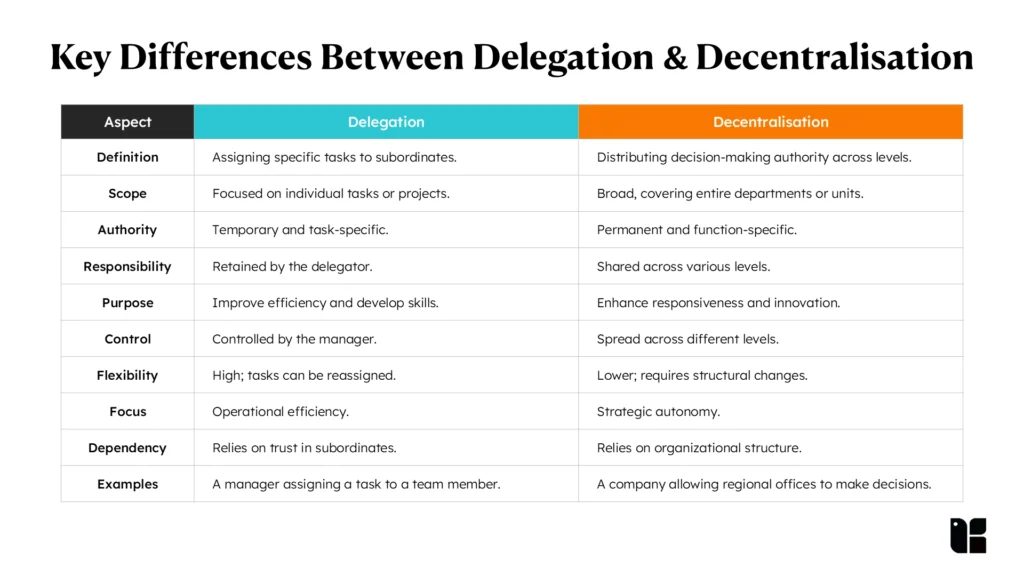
Definition: It provides a fundamental explanation of the concept and sets the groundwork for understanding its application and scope.
- Delegation: This process involves a manager assigning particular tasks to subordinates, giving them the responsibility to execute these tasks while the manager retains ultimate accountability.
- Decentralisation: This is the distribution of decision-making authority across various levels of the organisation, allowing different units or departments to make decisions independently.
Scope: It determines the breadth and reach of the responsibilities assigned.
- Delegation: The focus is on specific tasks or projects assigned to individuals. The delegation is typically limited to a particular task or short-term project.
- Decentralisation: This encompasses a wider scope, impacting entire departments or business units. It involves a more permanent transfer of decision-making authority.
Authority: It helps to understand the power granted to individuals or units to make decisions.
- Delegation: Authority granted is temporary and limited to the task at hand. Once the task is completed, the authority typically returns to the manager.
- Decentralisation: Authority is more permanent and relates to specific functions. Departments or units maintain ongoing decision-making power.
Responsibility: It addresses who is accountable for the completion and outcome of tasks.
- Delegation: The delegator retains ultimate responsibility and accountability for the task, even though the subordinate performs the task.
- Decentralisation: Responsibility is distributed across various levels, with each department or unit accountable for its own decisions and outcomes.
Purpose: It outlines the primary goals and intentions behind the action.
- Delegation: Aims to improve efficiency and develop subordinates’ skills. By delegating tasks, managers can focus on more strategic activities while subordinates gain experience.
- Decentralisation: Seeks to enhance organisational responsiveness and innovation. Empowering various units to make decisions enables the organisation to respond more swiftly to changes and opportunities.
Control: Supervision and rules are managed under authority.
- Delegation: Control remains with the manager who oversees the delegated tasks to ensure they align with organisational goals.
- Decentralisation: Control is distributed across different levels, with each unit managing its own operations within the broader organisational framework.
Flexibility: It describes the ease with which tasks or decisions can be modified or reallocated.
- Delegation: High flexibility as tasks can be reassigned or modified as needed. Managers can quickly adapt to changes by reallocating tasks.
- Decentralisation: Lower flexibility because changes often require adjustments to the organisational structure and decision-making processes, which can be complex.
Focus: It reveals the primary area of attention and effort within the organisation.
- Delegation: Primarily focused on achieving operational efficiency. Delegating tasks helps ensure that routine operations are handled effectively.
- Decentralisation: Focused on achieving strategic autonomy. Departments or units have the freedom to pursue their strategic goals and make decisions that drive innovation and growth.
Dependency: It explores the reliance on various factors or structures within the organisation.
- Delegation: Relies on trust in subordinates’ abilities and judgement. Managers must trust that their team members can handle the tasks effectively.
- Decentralisation: Depends on a clear and well-defined organisational structure. Each unit must understand its role and have the necessary resources and authority to make decisions independently.
Examples: It provides practical illustrations of how each concept is applied in real-world scenarios.
- Delegation: A manager assigns a specific report to a team member, allowing the manager to focus on other priorities while the team member handles the report.
- Decentralisation: A company allows regional offices to create and implement their own marketing strategies, enabling them to tailor their approaches to local market conditions without needing approval from the central office.
With these distinctions clear, the next step is to explore how to effectively implement these strategies to improve organisational structure and decision-making.
If you want to confidently choose when to delegate versus when to decentralise and apply that choice to real team structures and workflows, Kapable explains a program journey that develops practical leadership judgement through guided practice and reflection.
How Can Organisations Put Delegation And Decentralisation Into Practice Effectively?
Implementing delegation and decentralisation is crucial for creating a more flexible and empowered organisation, allowing teams to make decisions quickly while encouraging individual growth and responsibility. Moreover, by spreading decision-making power and tasks across various levels, organisations can tap into a broader array of talents and insights. This approach not only boosts innovation and responsiveness but also nurtures a collaborative environment where trust and mutual respect thrive, driving overall organisational success. Implementing delegation and decentralisation is crucial for creating a more flexible and empowered organisation, allowing teams to make decisions quickly while encouraging individual growth and responsibility.
What Are The Best Practices For Effective Delegation?
Effective delegation is the foundation of successful leadership, allowing teams to leverage individual strengths while achieving collective goals. To successfully implement delegation, consider these tips:
Setting SMART goals
Effective delegation begins with setting SMART goals, providing clarity and structure that enhance accountability and streamlining progress monitoring within your team. This is how it can be implemented:
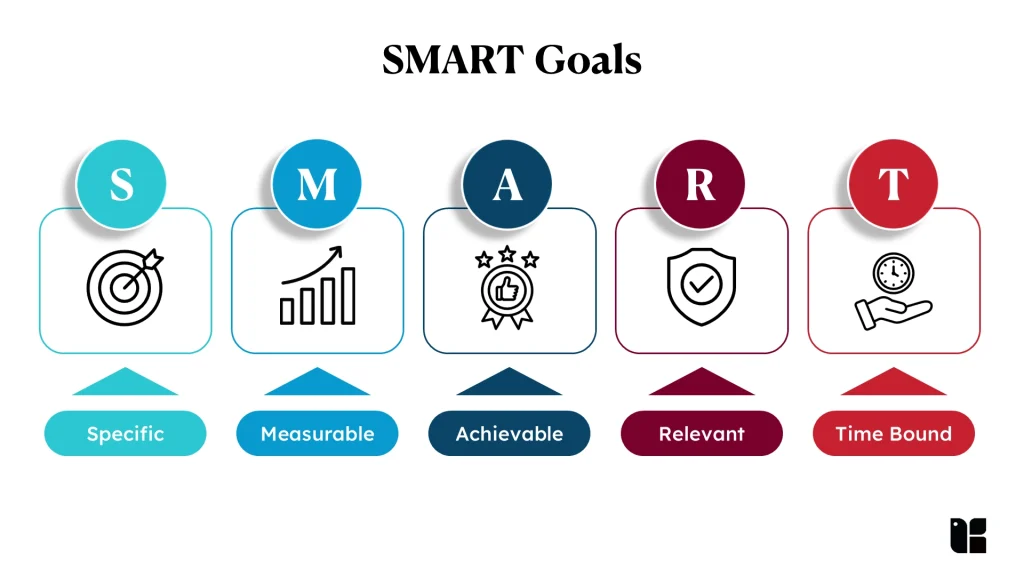
- Specific: Clearly define what needs to be accomplished. Avoid vague language and ensure the goal answers the questions: What do I want to achieve? Why is this goal important? Who is involved? Where is it located?
- Measurable: Establish concrete criteria for measuring progress toward the attainment of each goal you set. When progress is measurable, it can be tracked, and it helps in remaining motivated.
- Achievable: Make sure that it’s possible to achieve the goals you set. If you set a goal that you have no hope of achieving, you will only demoralise yourself and your team members.
- Relevant: Goals should align with broader objectives and contribute meaningfully to overall success.
- Time-bound: Assign deadlines to create a sense of urgency and accountability, ensuring goals are completed in a timely manner.
When delegating, create Specific, Measurable, Achievable, Relevant, and Time-bound (SMART) goals. This clarifies expectations for both you and the team member and allows for easier progress tracking.
Bite-sized delegation
To optimise team productivity and ensure seamless task execution, implementing bite-sized delegation breaks down complex projects into manageable segments tailored to individual strengths.

- Break it down: Instead of handing over a massive project all at once, split it into smaller, manageable pieces. This makes the workload feel lighter and easier to tackle.
- Match skills: Take a moment to identify each team member’s strengths and assign them sub-tasks that play to those strengths. This not only boosts confidence but also leads to better results.
- Assign clear roles: Make sure everyone knows who is responsible for what. Set realistic deadlines for each sub-task to keep things moving smoothly.
- Track progress together: Use a simple system to monitor progress on all the sub-tasks. This helps everyone stay on the same page and quickly spot any roadblocks.
Bite-sized delegation reduces overwhelm, boosts efficiency by leveraging individual strengths, increases motivation through clear ownership, and enhances project visibility for timely adjustments.
How Can Organisations Apply Best Practices For Successful Decentralisation?
Effective decentralisation fosters organisational agility and efficiency by empowering regional teams while maintaining alignment with overarching company goals and standards. It can be done in the following ways:
RACI matrix
The RACI matrix (Responsible, Accountable, Consulted, Informed) is a helpful tool for establishing clear roles and communication channels in a decentralised structure. It outlines who is involved in each decision at each level. Let’s see how it how it works:

Rows: List the different tasks or decisions that need to be made within the organisation.
Columns: These represent the different roles involved:
- Responsible (R): The person who actually completes the task.
- Accountable (A): The person ultimately responsible for the outcome of the decision.
- Consulted (C): Those whose input and expertise are valuable before a decision is made.
- Informed (I): Those who need to be kept in the loop about decisions that may impact them.
RACI Matrix clarifies roles, speeds decisions, improves communication, and aligns goals in decentralised structures. It is a valuable tool for ensuring clarity, efficiency, and effective communication in decentralised organisations by defining roles and responsibilities for each task or decision.
Metrics and performance reporting
Empowering regional teams still requires them to report on key performance indicators (KPIs) aligned with company goals. This allows for central monitoring and course correction if needed.
Empowering regional teams requires effective tracking and reporting of key performance indicators (KPIs) aligned with company goals. To achieve this:
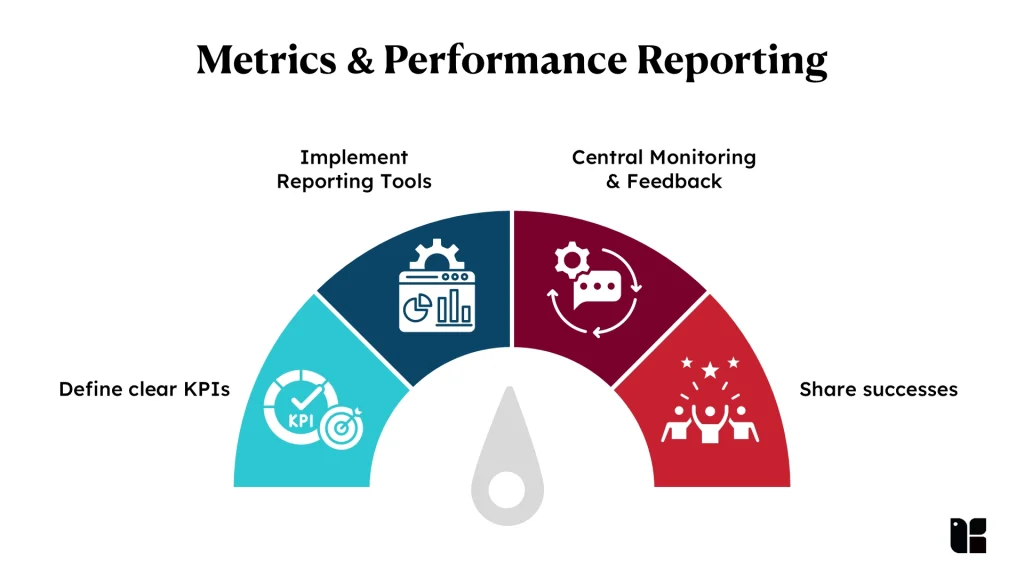
- Define clear KPIs: Set specific KPIs that align with company objectives and communicate them to regional teams.
- Implement reporting tools: Use performance management software to collect and track data, ensuring regular updates.
- Central monitoring and feedback: Regularly review performance data to monitor progress and provide feedback for any necessary adjustments.
- Share successes: Create a system for sharing regional successes across the organisation to encourage collaboration and innovation.
By integrating these practices, you can ensure that regional teams are aligned with company goals while promoting a culture of continuous improvement and shared success. Additionally, sharing regional successes across the organisation can foster a culture of collaboration and innovation.
Moreover, effective performance reporting allows organisations to identify trends and patterns across different regions. This data-driven approach helps in making informed strategic decisions, allocating resources more efficiently, and predicting future challenges or opportunities. By leveraging these insights, companies can better align their regional strategies with overarching goals, optimise their operations, and maintain a competitive edge in the market.
Conclusion
Understanding how to use delegation and decentralisation is key to any organisation’s success. Both strategies empower employees and improve efficiency, but they serve different purposes. Delegation helps leaders share the workload and allows team members to grow and feel more engaged. In contrast, decentralisation enables teams to make quick decisions that fit their specific needs. When organisations focus on their needs and align strategies with long-term goals, they can thrive in a changing world, fostering a culture where everyone feels valued and responsible.
Before committing to any leadership development pathway, Kapable offers a detailed fit check to help you evaluate whether the program’s structure, pace, and outcomes align with how you want to lead and grow.


