


TL;DR
- Conflict Management’s Purpose: It’s not about eliminating workplace disputes but constructively addressing them to ensure a productive outcome, with the TKI Model providing a framework to understand styles.
- Five Core Conflict Styles: The Thomas-Kilmann Model identifies five approaches, Competing, Collaborating, Avoiding, Accommodating, and Compromising, each combining different degrees of assertiveness and cooperativeness.
- Self-Awareness Through Assessment: The questionnaire moves beyond theory by assessing how you actually behave in conflict, generating personalised insights vital for developing practical conflict resolution skills.
- Navigating Resolution Strategically: Effective conflict resolution requires adapting your approach based on the audience, weighing the long-term impact on relationships, and using flexible techniques like ‘Yes, And…’ to facilitate common ground.
Conflict management is the art of effectively dealing with disagreements and disputes in the workplace. While differences in opinion can spark healthy debate, the ability to manage conflict constructively ensures a productive outcome. It’s not about eliminating conflict altogether, which is unrealistic with diverse personalities and goals in a society. Instead, it’s about addressing these clashes with constructive and positive behaviour, considering the perspectives of the other party and balancing one’s own needs with the broader aspect of organisational goals and harmony.
Certain tools identify areas where individuals or groups might have underdeveloped conflict skills. The Thomas-Kilmann Conflict Mode Instrument (TKI Model) is a valuable tool for conflict management as it identifies five different conflict-handling styles. The five modes of the TKI Model represent different approaches people take when facing workplace conflict. The TKI model establishes a common language for understanding conflict styles. The Conflict Management questionnaire uses this framework to categorise responses, allowing for easy individual comparison. Let’s first look at the five styles of the Thomas Kilmann Model.

The Five Conflict Management Styles
The Thomas-Kilmann Conflict Mode Instrument (TKI) identifies five main conflict management styles that individuals utilise when faced with disagreements. The five conflict management styles – competing, collaborating, avoiding, accommodating, and compromising, offer a framework for understanding how we access disagreements.
The key to positive and effective conflict resolution is recognising your style and choosing the most appropriate one for the situation. Let’s look into these styles, exploring their strengths and weaknesses through the lens of two fundamental modes: assertiveness and cooperativeness.
These styles involve understanding how each impacts conflict dynamics, describe the degree of control one seeks in resolving disputes, and consider how they allocate resources and reconcile beliefs. This provides valuable insight into navigating conflicts constructively.
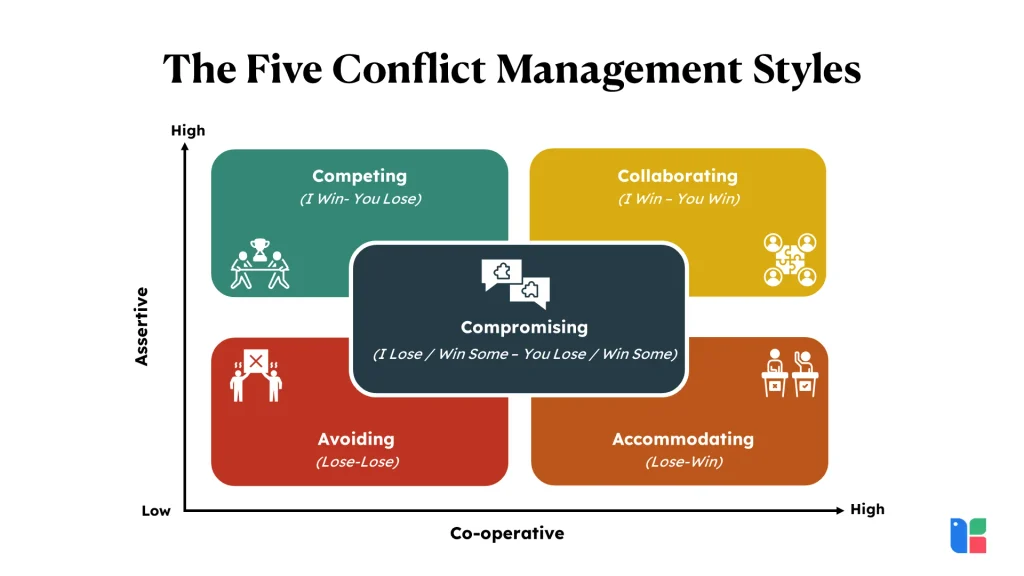
Competing
The competing style prioritises winning and getting your way. People who lead this style are typically direct and assertive and may use solid arguments or force their solutions. This style can be effective in urgent situations where you need to decide quickly, when dealing with someone unresponsive to more collaborative approaches, or when you are more creative in handling situations in your own way. Competition can also be helpful in negotiation, where a firm stance is necessary in mediation.
When to Use: This style is appropriate when you need to be assertive, like in negotiation when you are called for mediation or when a quick solution is vital to decide or when unpopular actions need to be implemented. For instance, a manager might use this style in a business setting to enforce a critical industry policy or decision, even if it’s not popular among employees.
Collaborating
The collaborating style seeks a win-win solution that can lead to everyone’s concerns in groups. People who lead this style value open communication, brainstorming, and working together to find a mutually beneficial outcome over personal interest. The collaborating style seeks a win-win solution that addresses everyone’s concerns. Effective conflict management can enhance productivity by fostering a collaborative culture and problem-solving environment.
People who use this style value open communication, brainstorming, and working together in a positive way to find a mutually beneficial outcome. A strong commitment to a collaborative culture can turn conflicts into positive growth with productivity. This approach is characterized by its ability to foster cooperation among family, friends, students, and other groups, emphasizing shared goals and truth rather than forced demand.
When to use: Collaborating is useful when long-term relationships are meaningful, complex issues must be addressed in cooperation, or creative solutions are required. For example, collaborators might brainstorm and negotiate in a group project to integrate diverse perspectives into a comprehensive solution that satisfies everyone’s needs.
Avoiding
The avoiding style involves withdrawing from the conflict altogether. People who use this style might downplay the disagreement or dispute, struggle dealing with the stress, or simply leave the confrontation with clouding strong emotions. Avoiding can be a good strategy for cooling down stress, tensions or de-escalating a heated situation because of goal differences. It can also be helpful when the subject is minor or when more information is needed before engaging in a conflict.
When to Use: Use avoiding when tempers are high, when the subject is trivial, or when more information is needed. It can also be a temporary strategy before re-engaging with a calmer approach. For example, suppose coworkers have a minor disagreement about office seating arrangements. In that case, one might decide to avoid the conflict by temporarily switching desks or working remotely rather than demanding their concern until the issue naturally resolves.
Accommodating
The accommodating style involves prioritising maintaining harmony and peace over personal needs. People who use this style might struggle to be assertive about their concerns and readily give in to the other person’s demands to avoid conflicts. Accommodating can help preserve relationships in the society or industry culture when the subject is more critical to the other person. It can also de-escalate situations and promote a sense of teamwork for positive movement towards constructive conflict resolution.
When to Use: Use accommodating when maintaining relationships with the other person is crucial, when the issue is less important to you, or when building goodwill is essential. For instance, if a person from your team realises they made a mistake that caused a project delay, they might accommodate their colleagues’ concerns by taking responsibility and offering to compensate for the lost time without expecting anything in return.
Compromising
The compromising style seeks a middle-ground solution where both parties give up something to reach an agreement. People who relate to this style are willing to negotiate and focus on a common ground that partially satisfies everyone.
When to use: Use compromising when you want a quick and efficient way to solve a conflict, especially when time is limited or complete agreement isn’t possible. For instance, in a negotiation over a contract, both parties might compromise on specific terms to reach an agreement that benefits both sides.
The TKI Model is a framework, but a questionnaire personalises it. By answering questions that reflect real-world scenarios, individuals gain a deeper understanding of how they actually behave to manage conflict situations, not just how they think they might behave. We can develop a more constructive resolution process by gaining insights into the underlying strong emotions of the conflicts. This self-awareness is crucial for the development of practical conflict resolution skills. Let’s get going with the conflict management questionnaire.
“Kapable helped me overcome my fear of spontaneous speaking and taught me to balance diplomacy with assertiveness, ensuring my voice is heard. I now communicate with confidence and clarity, a transformation that has made a remarkable difference in my journey.”
– Anupam Bajaj (Design Head At SAMSUNG)
What Is The Conflict Management Questionnaire?
A Conflict Management Questionnaire is a tool used to assess your preferred way of dealing with conflict. It’s a series of questions designed to reveal your natural tendencies when faced with disagreements. By using a Conflict Management Questionnaire and reflecting on the results, you gain valuable insights into how you handle conflicts. This knowledge empowers you to develop effective communication and conflict-resolution skills for a more harmonious work environment.
Components Of Conflict Management Questionnaire
Here’s how a questionnaire helps you know your conflict style:
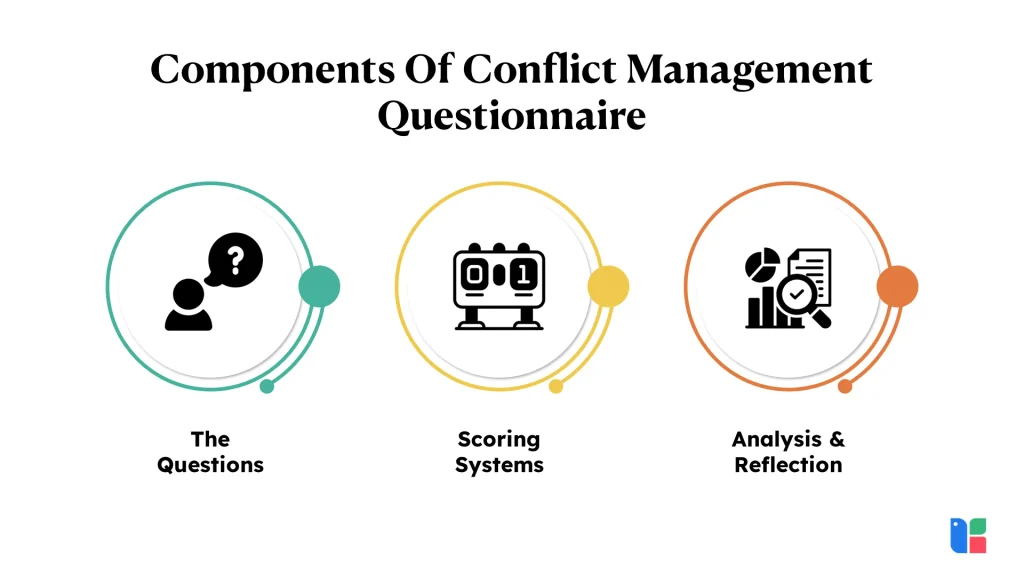
The Questions
They typically address various conflict scenarios and ask about your preferred way of handling them. Your answers point towards styles you naturally gravitate towards (e.g., competition, collaboration, avoidance). The questionnaire can identify patterns that point towards your dominant conflict styles by analysing your chosen responses across various scenarios. They typically address various conflict scenarios and ask about your behaviour in handling them. Your answers point towards styles you prefer in any given situation.
Scoring Systems
Scoring systems in conflict management questionnaires play a crucial role in identifying your dominant conflict styles by analysing your answers. Many questionnaires use scoring mechanisms to highlight your dominant conflict styles based on your answers. Transparent access to your styles of dealing with conflict circumstances leads to accurate results. Scoring helps remove bias from the assessment. Your results are based on your answers, not the interpretation of someone else.
Analysis And Reflection
After completing the questionnaire, take time to reflect on the results. Consider real-life situations where you used these styles and how effective they were. A story about a similar conflict will lead to a positive movement in creating conflict resolution strategies. The scores analyse the strengths and weaknesses associated with your dominant style and your interest. For example, competing might be effective in urgent situations but can damage relationships. Collaborating fosters teamwork but can be time-consuming.
A conflict management questionnaire can reveal how you typically respond to disagreements, but lasting improvement comes from strengthening those behaviours over time. Kapable supports that development.
Conflict Management Styles Quiz
Directions: Here is a series of ranking questions that reveal your dominant conflict styles at the workplace. In every question, choose the option that best describes you. Be truthful in your answers to get the most accurate results. There are no right or wrong answers. The goal is to understand your tendencies.
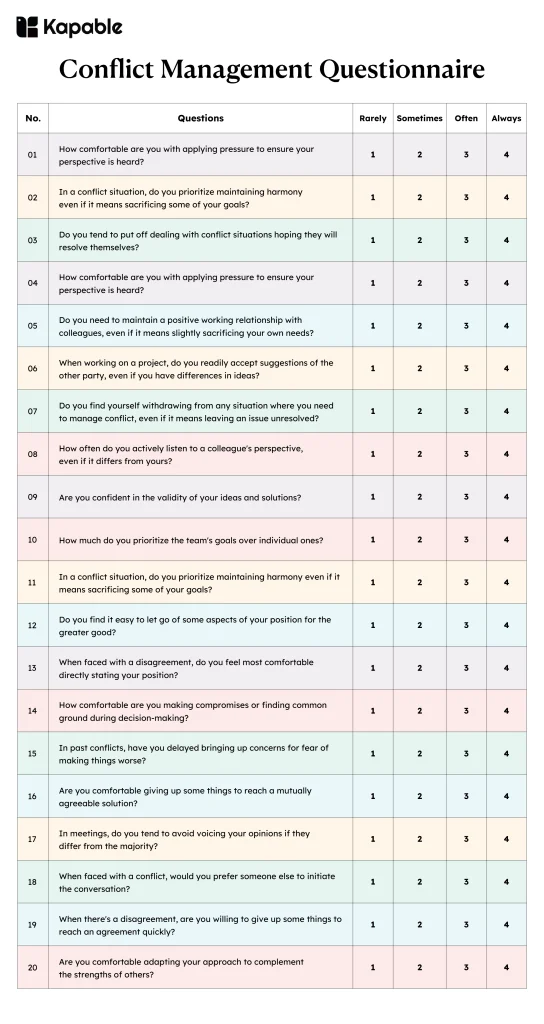
Score Interpretation
The statements in the questionnaire correspond to the five conflict resolution styles. After assessing specific conflict situations, you will evaluate your score to find your preferred conflict style, considering your choice of answers. Click here to evaluate your score.
The category with the highest score indicates your preferred way of dealing with conflicts. It could be competing (assertive, direct), collaborating (problem-solving, open communication), avoiding (withdrawing, side-stepping), accommodating (harmonious, yielding), or compromising (finding a middle ground).
Let’s answer these questions based on the results of the questionnaire.
- What is your preferred conflict style according to the assessment?______
- Based on your preferred style, can you think of a recent conflict situation where it played out? How effective was that approach?_______
- What is the conflict style with the lowest score? Do you think you need to work on that style to handle workplace conflicts better?______
Tips For Choosing A Conflict Management Style
Here are some tips for choosing a conflict management style:
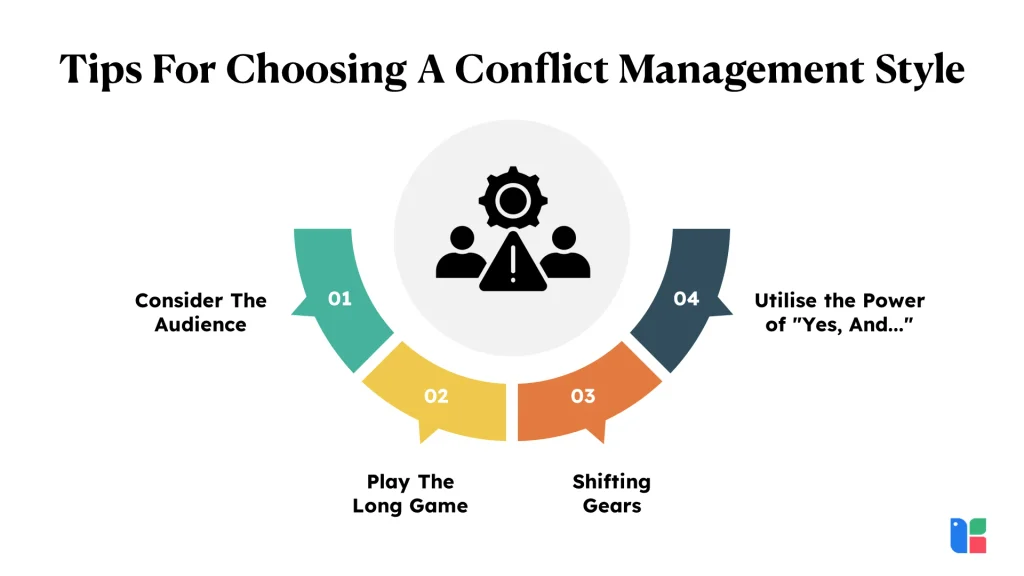
Consider The Audience
- Pay attention to the other person’s behaviour, communication style, and emotional state. Are they seeking a quick resolution (competing) or a more profound understanding (collaborating)? A strong leader’s ability to manage conflicts lies in recognising the difference in communication styles between team members.
- Think about past interactions with this person. Does a specific conflict style work well for them, or do they respond better to a different approach that can lead to better circumstances in the future?
Play The Long Game
- Consider the long-term implications of the conflicts. Is it a one-time disagreement (competing might be okay), or is an ongoing relationship crucial (collaboration is better)? In that case, speak openly with the other parties to lead to a positive outcome.
Shifting Gears
- Begin to speak with a less assertive style (accommodating or compromising) to gauge the situation with the other person. If needed, you can shift towards a more assertive approach (competing) if progress stalls.
- Even in competitive situations, acknowledge the other person’s behaviour. It can soften the blow and help create space for finding common ground.
Utilise The Power Of “Yes, And…”
Instead of outright disagreement, use “yes, and…” to acknowledge their point and add your own perspective. It can help bridge the gap and move towards a solution. Focus on the “We” when working in groups. Frame the conflict as a challenge you must overcome together (we) rather than against each other (you vs. me).
These tips help you in creating more adaptable situations in choosing a conflict management style that considers the situation, the people involved, and the desired outcome. It will allow you to navigate disagreements more effectively and build stronger relationships in the long run.
Conclusion
The TKI model, also known as the Thomas-Kilmann Conflict Mode Instrument, helps us understand how we normally react to conflict. The model explained basic styles, but the questionnaire helped you choose your preferred style. We all have a combination of these styles, and the questionnaire can help you figure out which one you prefer.
Answering questions about their previous conflict-related conduct can help individuals determine their strengths and limitations in conflict resolution. This knowledge can be utilised to improve communication and conflict management abilities. Keep in mind that the “best” method is determined by the clash, so be flexible and adaptable! Go ahead and resolve those disagreements with confidence.
A questionnaire can tell you where you are today, but choosing the right development path shapes where you go next. Consider whether Kapable aligns with your leadership aspirations.


